Featured paper: Towards two-dimensional diamond.

Two-dimensional materials, those whose thickness goes from an atom to a few nanometers, have unique properties related to their dimensionality and are protagonists in the development of nanotechnology and nanoengineering.

A team of scientists from five Brazilian institutions and one American institution took an important step in the development of the two-dimensional diamond version. This work on 2D diamond was reported in a paper published in Nature Communications (impact factor 12,124) with open access.

“Our work presented spectroscopic evidence of the formation of a two-dimensional diamond, which we named diamondene”, says Luiz Gustavo de Oliveira Lopes Cançado, professor at the Brazilian Federal University of Minas Gerais (UFMG) and corresponding author of the paper. In choosing the name of the new material, the scientists followed the tradition of using the suffix “ene” for two-dimensional materials, as with graphene, 2D version of the graphite.
box_enIn fact, it was from the compression of graphene sheets that the diamondene was obtained by the team led by Professor Cançado. Initially, the team deposited two layers of graphene one on top of the other and transferred the graphene bilayer to a Teflon substrate, chosen for being chemically inert, preventing the formation of bonds with the graphene.

The sample of bi-layered graphene on Teflon was then subjected to high pressures and simultaneously analyzed by Raman spectroscopy at the Laboratory of Vibrational Spectroscopy and High Pressure of the Department of Physics of the Brazilian Federal University of Ceará (UFC). The experimental system used was a diamond anvil cell with a coupled Raman spectrometer. This equipment allows high pressure to be applied to small samples that are immersed in a pressure transmitting medium (in this case, water). The pressure is applied through two pieces of diamond (material chosen for being one of the hardest and resistant to compression), which compress the transmitting medium, which passes the pressure to the sample. At the same time, the spectrometer allows to monitor the changes that occur in the structure of the sample material against the different pressures applied. “In Raman spectroscopy, light behaves like a probe that measures vibrational states of the material,” explains Cançado. As a result of the probing, the spectrometer generates graphs (spectra), through which it is possible to identify the structure of the material being studied.

By analyzing the spectra, the team of scientists observed changes in the two-dimensional material that indicated the transition from a graphene structure to a diamond structure. The researchers were able to conclude that the diamondene was obtained at a pressure of 7 gigapascals (GPa), tens of thousands of times higher than the atmospheric pressure. “The evidence we present in this work is a signature in the vibrational spectrum obtained from a two-dimensional carbon material that indicates the presence of sp3 bonds, typical of the structure of the diamond,” says Professor Cançado.

To explain the formation of diamondene, the team used first principles calculations following the Density Functional Theory and Molecular Dynamics simulations. “These theoretical results guided the experiments and allowed us understanding the experimental results,” says Cançado.
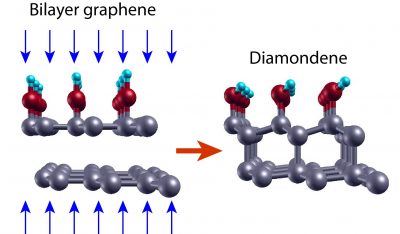
Scheme of the diamondene formation mechanism from two layers of graphene submitted to high pressures (blue arrows) in water as pressure transmitting medium. The gray colored balls represent the carbon atoms; the red ones, the oxygen atoms, and the blue ones, the hydrogen atoms.

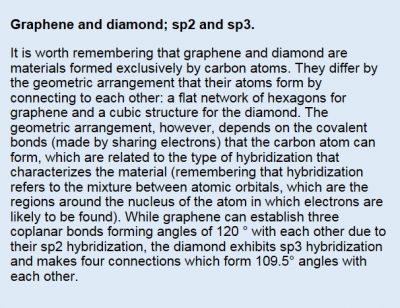
According to the theoretical results, when the bilayer graphene system on inert substrate with water as pressure transmitting medium is subjected to high pressures, the distances between the elements of the system decrease and new connections occur among them. “When applying this level of pressure on graphene, connections can change, going from the sp2 configuration to the sp3 configuration,” explains Professor Cançado. The carbon atoms in the upper graphene layer then establish covalent bonds with four neighboring atoms: the atoms of the lower layer and the chemical groups offered by water (OH- and H). The latter are fundamental to stabilize the structure. In the lower layer, in contact with the inert substrate, half of the carbon atoms are bound to only three neighboring atoms. “The pending connections give rise to a gap opening in the electronic structure, as well as polarized spin bands,” adds Cançado.

This feature makes diamondene a promising material for the development of spintronics (the emerging strain of electronics at the nanoscale in spin-bases electronics). According to Cançado, diamondene could also be used in quantum computing, microelectromechanical systems (MEMS), superconductivity, electrodes for electrochemistry-related technologies, DNA engineering substrates and biosensors – applications in which thin diamond films have already proven to have good performance.

However, there is still a long way to go before demonstrating the diamondene applications. Firstly, because the diamondene shown in the article dismantles under normal pressure conditions. To overcome this limitation, the group of Professor Cançado at UFMG is setting up an experimental system that will allow the application of much higher pressures to the samples in the order of 50 GPa and analyze them using Raman spectroscopy. “With this we intend to produce stable diamondene samples, which remain in this form even after having the pressure reduced to the level of ambient pressure,” says Cançado.

In addition, since Raman spectroscopy provides indirect evidence of the structure of the material, it will be necessary to perform direct measurements of the diamondene to know its structure in detail. “The most promising techniques in this case would be X-ray diffraction in synchrotron light sources or electron diffraction,” suggests Cançado. “The complicating factor in this experiment is the need to have the sample subjected to high pressures,” he adds.

The Brazilian history of diamondene

The idea of the 2D diamond formation originated in the doctoral research of Ana Paula Barboza, conducted under the guidance of Professor Bernardo Ruegger Almeida Neves and defended in 2012 in the Department of Physics of UFMG. In this work, Cançado says, atomic force microscopy (AFM) tips were used to apply high pressures on one, two and several layers of graphene. Indirect evidence of the formation of a two-dimensional diamond was obtained by means of electric force microscopy (EFM). The work showed the importance of the presence of two layers of graphene and water for the formation of the sp3 two-dimensional structure. The main results of the research were reported in the article Room-temperature compression induced diamondization of a few-layer graphene [Advanced Materials 23, 3014-3017 (2011)].

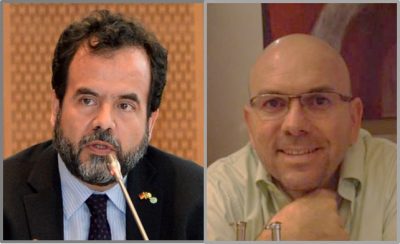
Main article authors. On the left, Luiz Gustavo Pimenta Martins (MSc from UFMG and doctoral student at MIT). On the right, Professor Luiz Gustavo Cançado (UFMG).

“The idea of measuring the Raman spectrum of graphene under high pressure conditions (using anvil diamond cells) came after Luiz Gustavo Pimenta Martins, an undergraduate student at the time, developed a very efficient method of transferring graphene to different substrates,” says Professor Cançado. This development was carried out during a visit to the laboratory of Professor Jing Kong at the Massachusetts Institute of Technology (MIT), after having won a grant for international mobility of the Formula Santander Award. During his master’s degree at the Physics Department of UFMG, carried out under the guidance of Professor Cançado and defended in 2015, Pimenta Martins carried out an extensive and systematic work to obtain Raman spectra of graphene samples subjected to high pressures. “There were many visits to UFC and much study until understanding the diamondene formation mechanisms,” explains Cançado.

The research reported in the Nature Communications paper was made possible by the collaborative work of several Brazilian research groups with recognized expertise in various subjects, as well as the participation of the MIT researcher in the sample preparations. Scientists from the physics departments of UFMG and UFC have contributed their recognized expertise in Raman spectroscopy applied to carbon nanomaterials and, in the case of UFC, in experiments under high pressure. Also participating in these experiments were researchers from the Brazilian Federal Institute of Education, Science and Technology of Ceará and the Brazilian Federal University of Piauí (UFPI). In addition, theoretical physicists from the Brazilian Federal University of Ouro Preto (UFOP) and UFMG performed calculations and computational simulations.

The research was funded by Brazilian federal agency CNPq, state agencies FAPEMIG and FUNCAP, Formula Santander Program and UFOP.

[Paper: Raman evidence for pressure-induced formation of diamondene. Luiz Gustavo Pimenta Martins, Matheus J. S. Matos, Alexandre R. Paschoal, Paulo T. C. Freire, Nadia F. Andrade, Acrísio L. Aguiar, Jing Kong, Bernardo R. A. Neves, Alan B. de Oliveira, Mário S.C. Mazzoni, Antonio G. Souza Filho, Luiz Gustavo Cançado. Nature Communications 8, Article number: 96 (2017). DOI:10.1038/s41467-017-00149-8. Disponível em: https://www.nature.com/articles/s41467-017-00149-8]

Call for symposium proposals for the XVII Brazilian MRS Meeting (Natal – RN, Brazil).

logo-natal.jpgSymposium proposals for the XVII Brazilian MRS Meeting can be submitted from October 31st, 2017 to January 31st, 2018.

The meeting will take place at the Praiamar Natal Hotel & Convention Center, located at the Ponta Negra Beach, Natal, RN, from September 16th to 20th, 2018. The meeting chair is Prof. Antonio Eduardo Martinelli (Federal University of Rio Grande do Norte).

Proposals may be submitted by any PhD professor or researcher affiliated to a Higher Education and/or a Research Institution in Brazil or abroad, in any current field of Materials Science and Engineering. A submission form is available at http://sbpmat.org.br/proposed_symposium/.

The following data is required:

– Description of the symposium scope
– List of topics of interest
– Tentative list of invited speakers
– Names and contacts of symposium organizers

The organizing committee looks forward to having your contribution and participation at the 2018 B-MRS Meeting in Natal.

Founding member of B-MRS is elected “Scientist of the Year” by the Nanocell Institute.

Edgar Dutra Zanotto.

Professor Edgar Dutra Zanotto (UFSCar), a member of B-MRS and one of its founders, was elected “Scientist of the Year” in the area of fine materials chemistry: sustainable routes and new (nano) materials in the “Scientist and Entrepreneur of the Year Award”. In total, eight professors, six students and one company were awarded in the various categories. The award was presented on October 20 in a ceremony held at the Institute of Chemistry of the University of São Paulo (USP).

The winners were chosen through a process that involved nominating candidates by the Nanocell Institute site users, that community`s online voting, and voting by a pool of researchers (members of scientific committees, foundations, associations and societies).

The “Scientist and Entrepreneur of the Year Award” is sponsored by the Nanocell Institute, a non-governmental organization whose mission is “to promote science and education, developing technology and innovation for social welfare” and the Brazilian Society of Cellular Signaling (SBSC). The award aims to recognize and disseminate innovative works in the areas of science, education and public health.

For more information about the award visit: http://www.institutonanocell.org.br/premio/

Young B-MRS member receives 4 awards from international scientific societies in 2017.

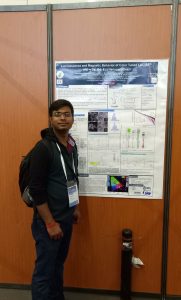
Navadeep Shrivastava at the E-MRS Spring Meeting 2017 presenting the awarded poster.

So far this year, B-MRS member Navadeep Shrivastava has won four awards for his work on materials with magnetic and luminescent properties developed in the context of his doctoral research being conducted at the Federal University of Maranhão (UFMA) under the guidance of Professor Surender Kumar Sharma.

In February, Shrivastava was selected to receive a registration exemption at the E-MRS 2017 Spring Meeting, within an existing agreement between B-MRS and the European Materials Research Society (E-MRS). The award allowed the participation of the doctoratal student in the event, which was held in Strasbourg (France) from 22 to 26 May 2017.

At the E-MRS event, Shrivastava won an award for the poster he presented at the symposium entitled “Luminescence and Magnetic Behavior of Color Tuned LaF3:RE3+  (RE= Ce, Gd, Eu) Nanoparticles”. In addition, he presented another contribution at symposium V (“Green emitting magneto-luminescent iron-oxide/ZnS coated by codoped lanthanum fluoride nanomaterials”), which drew the attention of the audience, initiated a collaborative relationship with a group from the Université de Strasbourg (France) and expanded his network of professional contacts. “I want to express my gratitude for the opportunity to participate in the E-MRS 2017 Spring Meeting,” says Shrivastava.

In third place, the doctoral student was one of the winners of the 2017 Bernhard Gross Award, awarded by SBPMat to the best works presented by students at the annual events of the society. Shrivastava was awarded for the work “Facile synthesis and magneto-luminescence study of aliance of iron oxide and NaGdF4:RE3+ into nanoentity”, presented in an oral session at symposium B. The award was delivered on September 14 this year in the city of Gramado, during the closing ceremony of the XVI B-MRS Meeting.

Finally, the UFMA PhD student has just been selected to receive a travel assistance from the IEEE Magnetics Society to present two papers at the 62nd edition of the International Conference on Magnetism and Magnetic Materials, called MMM 2017, to be held in Pittsburgh in November of this year.

B-MRS members named editors of international scientific journals.

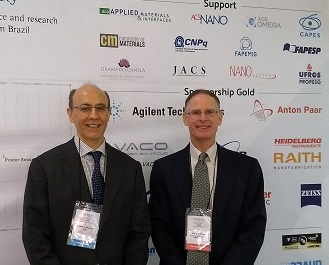
Prof. Novais de Oliveira Jr (left), associate editor of ACS Appl. Mater. Interfaces with editor-in -chief Prof. Schanze at XVI B-MRS Meeting.

B-MRS President Osvaldo Novais de Oliveira Junior is the newest associate editor of ACS Applied Materials and Interfaces, an ACS Publications journal with an impact factor of 7,504. The full professor of IFSC – USP (Institute of Physics of São Carlos of the University of São Paulo) assumed this post in early September. At B-MRS, Oliveira Junior has been administrative director and counselor, and has been chairing the society since early 2016.

The Solar Energy journal (impact factor 4,018) also recently incorporated a member of B-MRS among its editors, Carlos Frederico de Oliveira Graeff, full professor and pro-rector of research at Unesp (Universidade Estadual Paulista Júlio de Mesquita Filho). Graeff was named associate editor in the area of Photovoltaics in this periodical of the publisher Elsevier. A member of B-MRS since its beginning, Graeff was scientific director of the society and served on the scientific committee of the B-MRS Newsletter.

Finally, Carlos José Leopoldo Constantino, also a professor at Unesp and a member of the B-MRS community, took over as Associate Editor in the Nanomaterials area of the Journal of Nanoscience and Nanotechnology (Impact Factor 1,483) from American Scientific Publishers.

Prof. Graeff (left) and Constantino, associate editors of international journals.

B-MRS at IUMRS General Assembly in Japan.

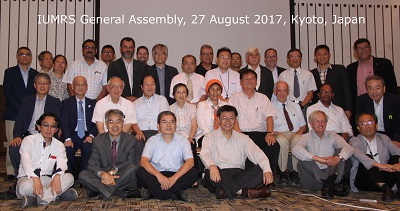
Participants of IUMRS General Assembly. Prof. Bianchi (B-MRS) is the sixth standing from the left.

Professor Rodrigo Fernando Bianchi (Brazilian Federal University of Ouro Preto, UFOP), scientific director of B-MRS, represented the society at the General Assembly of IUMRS (International Union of Materials Research Societies), held on August 27, 2017 in Kyoto, Japan, during the IUMRS-ICAM 2017 (fifteenth edition of the International Conference on Advanced Materials).

B-MRS is one of fourteen materials research societies in the world that currently make up IUMRS. The other societies are from Africa, Australia, China, Singapore, Korea, Europe, India, Indonesia, Japan, Mexico, Russia, Thailand and Taiwan.

According to Bianchi, the meeting made clear the interest of several associations to collaborate with Brazil.

In addition to representing SBPMat at the meeting, Professor Bianchi presented, at the IUMRS-ICAM 2017, his research group’s work focused on developing printed radiation sensors. The event attracted about 1,900 participants from dozens of countries.What most attracted the attention of B-MRS scientific director were presentations on the application of materials science and characterization techniques in the conservation of cultural resources (paintings , monuments and etc.). “That is, the cultural valuation within the area of materials – very important for the conservation of artistic, historical and cultural heritage of a country, and which is present in Kyoto, cultural capital of Japan. Brazil could follow the same trend!” said Bianchi.

At the event, Professor Ado Jorio (UFMG), also a member of the Brazilian materials community, delivered a plenary lecture on inelastic light scattering in carbon nanostructures.

Professor Victor Pandolfelli (DEMa – UFSCar) elected as honorary member of the European Ceramics Society.

Award ceremony of the Honorary Fellow of the European Ceramic Society (ECerS), at the closing dinner of the “15th Conference and Exhibition of the ECerS” in Budapest. Pandolfelli is third from left.

Professor Victor Carlos Pandolfelli, of the Materials Engineering Department of the Federal University of São Carlos (DEMa-UFSCar) was elected Honorary Fellow of the European Ceramic Society (ECerS).

The statute of that society determines that only scientists from the European Community can be elected as members. The title of Honorary Fellow was created in 2017 for researchers from other regions to be recognized for their scientific contribution in the area of ceramic materials.  In this first selective process that occurred through internal voting by the Council of ECerS, without the candidates’ knowledge, Professor Victor Carlos Pandolfelli of the Department of Materials Engineering at UFSCar was the first Latin American chosen for this honor. Also on the list of honorary members are Professor Gary Messing (Penn State, EUA), Dr. M. Singh (NASA, USA) and Professor M. Yoshimura (Tokyo Institute of Technology, Japan, and University of Taiwan).

Processo Seletivo para pós-graduação em Ciência e Engenharia de Materiais, USP/São Carlos.

Inscrições abertas na pós-graduação em Ciência e Engenharia de Materiais, USP/São Carlos.

O Programa recebeu nota 6 na última avaliação da CAPES e oferece vagas de mestrado e doutorado.

Inscrições até 12/11/2017.

http://www.smm.eesc.usp.br/pgrcem/index.php/75-processo-seletivo-1-semestre-de-2018

See folder in English, here.