Papers from Brazilian or foreign researchers and students will be accepted in any field of the 19 symposia of the event, which cover various themes regarding materials research and its applications. The symposia were selected by the event’s organizing committee, based on the proposals received for a call for symposia released in last October, directed to the whole scientific community.
The best papers in each symposium (at most, a poster and an oral presentation) presented by undergraduate or graduate students will receive the Bernhard Gross Award by the end of the event. The winning papers may be published in a special issue of the open access journal “IOP Conference Series: Materials Science and Engineering”, dedicated to the best papers of the XIII SBPMat Meeting.
About the SBPMat Meetings
The annual SBPMat meeting is a traditional international forum devoted to the recent advances and perspectives in Materials science and technology. In its last editions, the event has gathered about 1,500 participants, coming from the five regions in Brazil, and dozens of others countries, to present and discuss scientific and technological research results in the Materials field. The event also counts with plenary lectures given by internationally renowned researchers, as well as exhibitors concerned by the Materials community.
The UC program from SBPMat was launched. Students may form organized groups linked to the society to organize lectures and other activities related to Science and Technology, attend events, enter in exchange programs etc, counting with an annual budget and financial support. The application form is already available. See it.
Featured paper with Brazilian participation
This month, we highlight a communication published by Nanoscale and prepared by research groups in Brazil with partners from Spain and France. The scientists assembled sensors based on nanorods of silver tungstate and assessed their performance to detect ozone – a gas that, above certain amounts, is harmful to health. Silver tungstate has proved to be a great material to be used in ozone sensors. Read the story.
(To suggest papers with Materials focus with Brazilian participation published in high impact journals for this section of our newsletter contact comunicacao@sbpmat.org.br)
SBPMat’s community people
We spoked with scientist Sergio Mascarenhas, known in our community for creating, in 1970, the first course of Materials Engineering of Latin America. Mascarenhas has provided important contributions to the field of Materials, as his studies with ionic crystals, used in optical memories. He also went further, though, and guided by the idea of fulfilling the social role of the scientist, accomplished achievements permeating fields as Biology, Medicine and Farming. The 85 year old scientist is currently concerned with encouraging the youth to develop some frontier subjects he considers very important for human kind, complex systems and biomimetics.
We started a series of interviews with former SBPMat presidents on the work of the successive directory boards of our Society. In the interview with Guillermo Solórzano, read which were the main actions, challenges and pending issues of the founding board (2001-2003), the highlights of the first SBPMat meetings and more. Here.
Reading recommendations
Science journalism stories based on papers published in journals with high impact factor.
Nanoparticles of platinum and nickel, eroded on the inside, form a nanoframe with optimized design for electrocatalysis (based on paper from Science). Here.
Graphene membranes desalinize water in subnanometric scale (based on paper from Science). Here.
In addition to produce electricity from the sun, perovskite-based material emit light of various colors (based on paper from Nature Materials). Here.
New technique to produce graphene membranes for monolayer and multilayer filters (based on paper from Nano Letters). Here.
New biomaterial: gel contracts when subject to the temperature of the human body and lead steam cells to start the formation of teeth (based on paper from Advanced Materials). Here.
Drug delivery system for patients with glaucoma: nanodiamonds in contact lenses (based on paper from ACS Nano). Here.
Bacteria in liquid crystal interact and form new material applicable in Biomedicine. View text and video (based on article from Proceedings of the National Academy of Sciences). Here.
Books, presentations, multimedia material, etc.
Review of book on nanomaterials and Tissue Engineering. Here.
Materials news from the Brazilian National Institutes of Science and Technology (INCTs).
Metallic compounds developed in INCT Redoxoma display potential anti-tumor and anti-parasitic action. Here.
Opportunities.
Postdoc in the United States on perovskite or organic semiconductors via Science Without Borders program. Here.
Postdoc in multiferroic materials and functional devices in Universidade Estadual de Maringá (Brazil). Here.
Postdoc in materials for Photonics in Universidade Estadual de Maringá (Brazil). Here.
Upcoming events in the area.
VI Curso do Método Rietveld de Refinamento de Estrutura. Here.
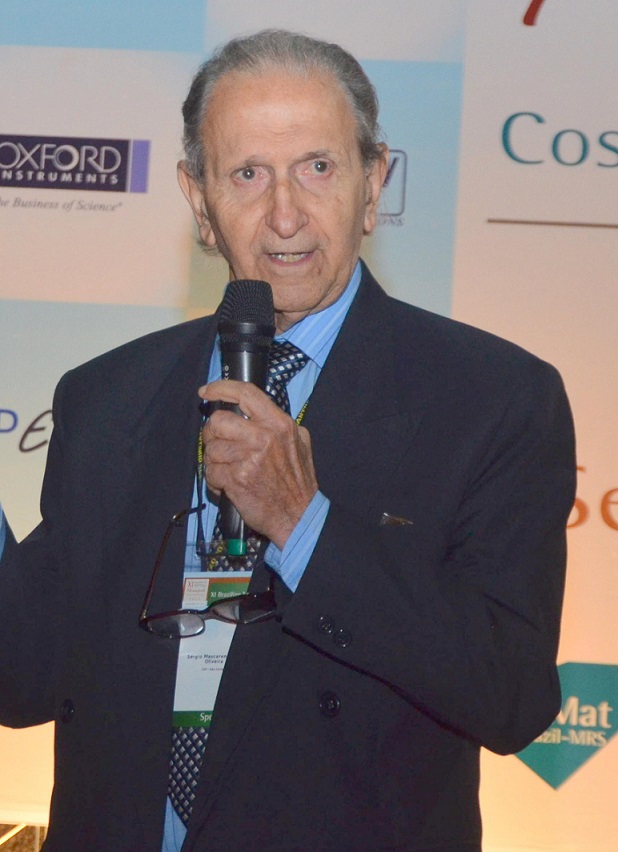
Sergio Mascarenhas on September 23, 2012, lecturing at the XI SBPMat meeting, in Florianópolis city (Brazil).
Along his path as a scientist, Sergio Mascarenhas Oliveira, currently 85, has provided some important contributions to the improvement of the scientific research, mainly in Brazil, and for the Materials field in particular. Starting from Solid-state physics, pillar of the Materials Science, he covered several domains of knowledge, such as Molecular Biophysics and Medical Physics, to name a few. Impelled by the idea of fulfilling the social role of the scientist, which is related to social development, Mascarenhas promoted advances in science and technology with a significant impact on areas as farming, health and education.
An example that illustrates the work of Professor Mascarenhas is the recent development of a system to measure the intracranial pressure that is minimally invasive. The motivation for this came when the Professor was diagnosed with hydrocephaly in 2005 and, during treatment, had to be subject to skull drilling operations in order to measure his pressure. From this moment on, jointly with students and companies, as well as supported by several entities, he conducted a series of studies, which lead to a cheaper and minimally invasive system, applicable to a large range of patients.
Mascarenhas was born in Rio de Janeiro. From 1947 to 1951, he studied Physics at the Federal University of Rio de Janeiro State (UNIRIO) and Chemistry at the Federal University of Rio de Janeiro (UFRJ). After some time as a researcher for universities in the US, he decided to return to Brazil. In the country, he played a major role in the establishment and coordination of some institutions as, among others, the Physics and Chemistry Institute of São Carlos from São Paulo University (USP), the Federal University of São Carlos (UFSCar) and its Materials Engineering course (the first one to be offered in Latin America), as well as the instrumentation unit of the Brazilian Agricultural Research Corporation (Embrapa) and USP’s Institute of Advanced Studies of São Carlos and its International Studies and Projects Program for Latin America, which he still coordinates until this day.
Sérgio Mascarenhas is a Full Professor, now retired, at USP. He was also a visiting professor in the US at the Universities of Princeton and Harvard, and at MIT; at the National Autonomous University of Mexico, the Institute of Physical and Chemical Research in Japan, the London University (UK), and, in Italy, at the Abdus Salam International Centre for Theoretical Physics and at the University of Rome.
He has advised about 50 theses for master’s degrees and doctorates, and published approximately 200 articles and books. Among many awards and honors, it is worth mentioning the Grand Cross of the National Order of Scientific Merit (given in Brazil, by the President of the Republic); the Guggenheim Award and Fulbright Award (United States); the Yamada Foundation Award (Japan); the Brazilian award from Conrado Wessel Foundation in 2006 in the General Science category, and titles of Emeritus Professor and Honorary Doctorate degrees from several universities in Brazil and abroad. In 2012, it was time for the SBPMat to grant Professor Mascaranhas an award, the memorial lecture Joaquim Costa Ribeiro. Mascarenhas is a member of the Brazilian Academy of Sciences and the American Physical Society, and a founding member of the Latin American Academy of Science, and of the Academy of Science of the São Paulo State.
Below, there is a transcription of the interview Professor Mascarenhas gave us at 08:30 PM on March 26, once a work meeting was closed. The scientist told us a little about his background, the social role of the scientist, and his message to our younger readers.
Main contributions to science, technology and innovation, particularly in the Materials field in Brazil.
As I started doing sciences in Brazil in a moment when there was virtually no Materials, I was lucky enough to introduce this kind of research, both in applied and basic forms. So, I would say that, from the institutional perspective, an important contribution was the creation of the Condensed Matter Physics Group in the Physics Institute at USP São Carlos, in the 1960s. Thanks to a very intense exchange between USP São Carlos and the universities of Princeton and Carnegie Mellon in the United States, as well as groups from England and Germany, mainly from Stuttgart, we managed to establish a very strong researchers training program, which still exists today.
After that, I had the chance to be the first president of the Federal University of São Carlos (UFSCar), and then, I proposed the creation of the Materials Engineering Course. It was the first course of studies in Materials Engineering in Latin America, and was a great success, both on the academic and the business sides. So, these were two institutional contributions that led to the establishment of an actual School of Materials Science and Engineering in Brazil.
From the point of view of the research, there are contributions that I managed to do with the collaboration of many young and senior professors. First, the researches related to the defects in crystals, such as ionic crystals with color centers, through radiation or crystal growth with impurities. These ionic crystals displaying color centers were used later for optical memories. This was the result from a very strong collaboration between our group from São Carlos with the RCA laboratories in Princeton and Bell Labs, in the United States.
Another field we were pleased to see how it developed was the electrets, dielectric materials that can retain an electrical polarization for a very long time, up to 100 years, as we see in teflon. These electrets, then, were studied mainly by the group advised by professor Bernard Gross, who I was happy to bring to São Carlos. He worked with groups from MIT and Bell Labs and they developed the famous electrets microphone, which was used in all cell phones, telephones and many other applications. This was an application that gained a global status, coming from a product that was practically born in São Carlos.
Later, my extension of this concept of electrets to biological materials led to the concept of bioelectrets, which are biological materials also capable to retain an electrical polarization for a very long time. The concept of bioelectrets, I think, was one of the contributions that I was fortunate to do, and today is globally used. There is a book on electrets published by Springer publishing house [MASCARENHAS, S. 1979. Bioelectrets: electrets in biomaterials and biopolymers. Electrets – Topics in Applied Physics., Springer-Verlag, vol. 33 , p. 341 – 346] in which, in one of the chapters, I discuss this notion of biolectrets. The concept applies to proteins, DNA, polysaccharides. I think this concept is very important for being significant in Biology and Medicine.
Finally, we started working with concepts of Materials also in the field of Molecular Biophysics and Medical Physics. It happed due to the fact that I was invited by Nobel laureate Abdus Salam to conduct, in Trieste (Italy), a series of courses, for twelve years, in these two areas. These contributions were capable to spread the idea and the career in Medical Physics in many developing countries in Africa, Asia and Latin America. So, this was one of the contributions that please me the most.
But it all depends on people, especially young people. I always say that professors are only good when they have students that are even better than them. I had the joy of counting with students that were better than me, who went further and continued with the school of Condensed Matter Physics, such as in the case of professor Roberto Faria, who, nowadays, it the president of SBPMat and works in the frontier of conductive polymers – a revolution in the field of electronics, energy, pharmacology etc.
Current occupations and new frontiers of knowledge.
Lately, I have been concerned with examining phenomena under the point of view of complex phenomena, in which there is a great amount of variables and non-linear phenomena. For example, there is the brain, the Internet, the origins of life. So, the engineering of complex systems for Materials results in a number of very important effects, which are going to be gradually explored. This issue of complex systems permeates Engineering, Biology, Education, Agribusiness, which is one of the most important areas for humanity in the production of food, the issue of biomass, which is a very important problem for the production of energy, and the comprehension of the brain.
So, I think my function now it to draw the attention of the youth and of the research centers in developing countries to the importance of studying complex systems, which requires a lot of computer modeling, the understanding of what is artificial intelligence, Game Theory, chaotic systems, fractals… And the research on complex materials holds a crucial importance.
Another area that I think is going to progress more, and is an announced revolution, is the biomimetics field. You look to biological nature, which has worked for millions of years to produce materials as shells, bone, hair, organs, and learn how the evolution of the properties of these materials occurred. It is as we could open the large biological treasure of knowledge.
The social role of the scientist.
I think the social role of the scientist is essential for two reasons. First, if you look at the human history, all great evolutionary leaps in human thought came from basic science, which turned into technology. It is important for the scientist to provide, not only a voice to society, but some kind of self-awareness of the society, which is consolidated in science, technology and education policies. I think one of the best examples for that is looking at the convergence between science and technology. When Faraday’s electric motor was invented, it took about 40 years for it to be fully used. Nowadays, you cannot even think what would happen to society if there were no electric motors. When nuclear energy was discovered, in 10 to 15 years it already had some applications. And in the same year laser was invented, it was applied. Then, the convergence between science and technology is huge. It means that scientists and research are important to produce economic development, which leads to social development, which leads to cultural development, which leads to what Charles Percy Snow said was the third culture. In his book, “The two cultures”, he showed that, by the time of World War II, there was a very long distance from humanism to science and technology, even a lack of respect between these two players of the human development. But said distance has to converge into a third culture, in which it is possible to find a much more holistic view, not only of men, but also of the universe, as in the example of the Gaia theory of James Lovelock.
So, for the social development, research is the only weapon that men can hold to bring humanity to a stage of respect for nature, humanity itself and its role in the cosmos. I think, if we didn’t have universities producing researches and extension, and then taking their researches out, we wouldn’t see the formation of the virtuous cycle, which transforms knowledge into quality of life and new possibilities for men, for this homo sapiens sapiens that came out of caves and went to space.
A message to our younger readers, starting their careers.
I think this career, in Materials Science, Materials Engineering, Biomaterials, Complex Materials, is a huge world that is at dispose for the future of mankind, but this future depends on today’s youth, who can face its challenges and experience the great pleasure of building a more virtuous humanity through the research with Materials. If you start to think what Materials mean to human life, even in a more straightforward perspective, focused on happiness and wellbeing, our lives depend on materials. Our nutrition depends on materials, as well as communication, health, the manufacturing of equipment, machines, robots, ships and satellites. Thereby, materials really are a great source for innovation and wealth. The young people choosing this career are actually choosing to work for the future of science and technology.
Ivan Guillermo Solorzano-Naranjo chaired the first board of the Brazilian Materials Research Society (SBPMat), also composed by directors Fernando Lázaro Freire Júnior, José Arana Varela, Roberto Cerrini Villas Bôas, Elisa Maria Baggio Saitovich and Moni Behar.
This founding board was established during the General Assembly for the Constitution of SBPMat, on June 26, 2001, at the auditorium of RioDatacentro at the Pontifical Catholic University of Rio de Janeiro (PUC-Rio). They held office until 2003.
Born in Ecuador, Solórzano studied and developed his scientific career in many places all over the world. He studied Mechanical Engineering at Escuela Politecnica Nacional in Quito, Ecuador, Metallurgical Engineering at Université Catholique de Louvain, Belgium, and got a degree from PUC-Rio in Brazil. He held his MSc in Metallurgical and Materials Engineering, also at PUC-Rio, and his PhD in Materials Science at McMaster University, in Canada. Developed postdoctoral research at Max-Planck Institute – Sttutgart campus, in Germany, and was a visiting professor at Institut National Polytechnique of Grenoble -France, Massachusetts Institute of Technology (MIT) and Stanford University (USA). He is a professor in the Department of Materials Engineering at PUC-Rio.
Along with Edgar Zanotto, he led the foundation of SBPMat. He also acted as president of the Inter American Committee of Societies for Electron Microscopy (CIASEM) and of the Brazilian Society of Microscopy and Microanalysis (SBMM), as well as chairman of the International Committee of the Materials Research Society (MRS). Member of several international executive committees, such as the International Federation of Societies for Microscopy (IFSM), as well as editorial boards of international journals, such as Materials Characterization (Elsevier), Journal of Materials Science (Springer), and Microscopy and Microanalysis (Cambridge University Press).
You can read below an interview with the former president of SBPMat, on the performance of the first board of our society.
1.List the main actions carried out over your time as president of SBPMat.
– Carried out successfully the inaugural congress (First SBPMat Meeting), as well as the II SBPMat meeting, the following year.
– Established a standard format for the annual event – based on symposia and unprecedented in the country –, which remains until now.
– Officially registered SBPMat.
– Arranged that SBPMat joined the International Union of Materials Research Societies (IUMRS).
– From the first meeting on, we gave start to collaboration with Materials Research Society (MRS), from the United States, and with E-MRS, from Europe, which has been growing steadier and stronger over time.
– Established the title of “founding members”, with more than 350 members who have received their certificates. We also started a membership campaign for SBPMat, for both professional and student members, reaching over 600 regular members in the second year. In the third meeting, under the chairmanship of Professor Elson Longo, in Foz do Iguaçu, there was a boom in the number of participants of the SBPMat Meeting, with over a thousand researchers and students.
– At the IUMRS meeting, we postulated SBPMat to host the forecoming International Congress on Advanced Materials (ICAM) in Rio de Janeiro. ICAM 2009 was successfully held in Rio de Janeiro, under my coordination.
– We left the society with funds summing up to about BRL 80,000.
2. List the main challenges you faced while directing SBPMat.
– Consolidating SBPMat was a challenge due to the lack of resources and infrastructure; I could rely only on my “part-time” secretary to help me with communication and administrative tasks as they arose, counting also with the help of my students (one of them made the first SBPMat website). However, it was also a time of great enthusiasm, in which I received full support from the Brazilian research community; we were all very driven to secure this endeavor. The funding agencies, CNPq, CAPES, FAPERJ, FAPESP, acknowledged the importance of the initiative and lent their support since the first meeting. I have nothing to complain about, and consider it a privilege to have had this experience of founding a national and interdisciplinary scientific society in Brazil…
3. What do you wish you have done, but could not get to it?
One of my proposals that never went beyond the project phase was the formation of executive committees for specific important activities for the consolidation and growth of the society, such as academic affairs committee; relationship with the industry committee; publications committee; international affairs committee; distinctions and awards committee… Each committee should have a director or coordinator (chairman), who would manage it for a certain time, reporting regularly (usually on the occasion of the meeting of SBPMat), and so on. Moreover, with Brazil being such a huge country, it would be necessary to have regional SBPMat sections with boards duly established and regulated by the statutes of SBPMat. The role of such branch offices would be basically to promote the general goals of SBPMat, but in a regional manner, always aligned with the guidelines of the society (through the Board and Council), thus contributing to strengthening its impact over the scientific community and Brazilian society.
All these ideas would grant more flexibility to the society, and also increase the participation of members of our community. It is important to increase the effective participation of members, particularly young people. We have a great generation of young talented people willing to take part, and they should be invited to do so.
4. What would you highlight about the two SBPMat meetings organized and held over your administration?
– The first SBPMat Meeting had the participation of the American and European MRS, and also of the International Union of Materials Societies (IUMRS). All the presidents of these bodies came to the meeting, which had about 400 participants and five symposia, counting with the presence of national authorities. From an international perspective, it had great representation and visibility.
– We established English as the official language in SBPMat Meetings. This has been increasing the participation of researchers from abroad.
– We reinforced the interdisciplinary nature of the society, reflected in the symposia, where each symposium would have co-chairs from different knowledge areas (i.e., Physics, Engineering, Chemistry, etc.), encouraging the presence of colleagues from abroad. We also established an organizing committee involving scientists from the academic sector, research centers and industry. This structure has been working successfully ever since.
– Both the first and second SBPMat meetings had distinguished international scientists as co-chairs of symposia, such as the President of MRS (Alex King, by that time) and the President of E-MRS (Giovanni Marletta, back then).
5. Would you like to leave a message for the readers about the election process in SBPMat? (importance of participating in elections, be it as voters or candidates, and so on)
I find it of importance, to establish and spread a clear process or program for president election at SBPMat, with two excellent candidates with a history of participation in SBPMat, identified by a search committee, to ensure that the community really takes part in the choice, in the election. The same goes for directors. We should not have only a single candidate for president, nor a single candidate group for the directory board, let alone the possibility of reelection, for these elements undermine the participation of the community. Regard the example given by MRS, where the term of office is of one year, with no reelection.
It should be established an election schedule that makes it possible to know the results of the voting for President, Board and Counselors by the occasion of the SBPMat meeting. This way, the participation of the already elected president at the meeting should facilitate the transition to the new board.
The scientific paper by members of the Brazilian community on Materials research featured this month is:
Luís F. da Silva, Ariadne C. Catto, Waldir Avansi, Laécio S. Cavalcante, Juan Andrés, Khalifa Aguir, Valmor R. Mastelaro and Elson Longo. A novel ozone gas sensor based on one-dimensional (1D) α-Ag2WO4 nanostructures. Nanoscale (Print), 2014, v. 1, p. 1-2. DOI: 10.1039/C3NR05837A
New ozone sensor based on nanorods of silver tungstate
A study carried out by a research group from Brazil, with collaboration from French and Spanish scientists, has reported, for the first time, gas detection properties in nanorods of silver tungstate in its alpha phase (α-Ag2WO4).The study showed that this material can be applied as a resistive sensor, displaying great performance when detecting ozone (O3). The work was and coordinated by Elson Longo, Professor at the São Paulo State University “Júlio de Mesquita Filho” (UNESP).
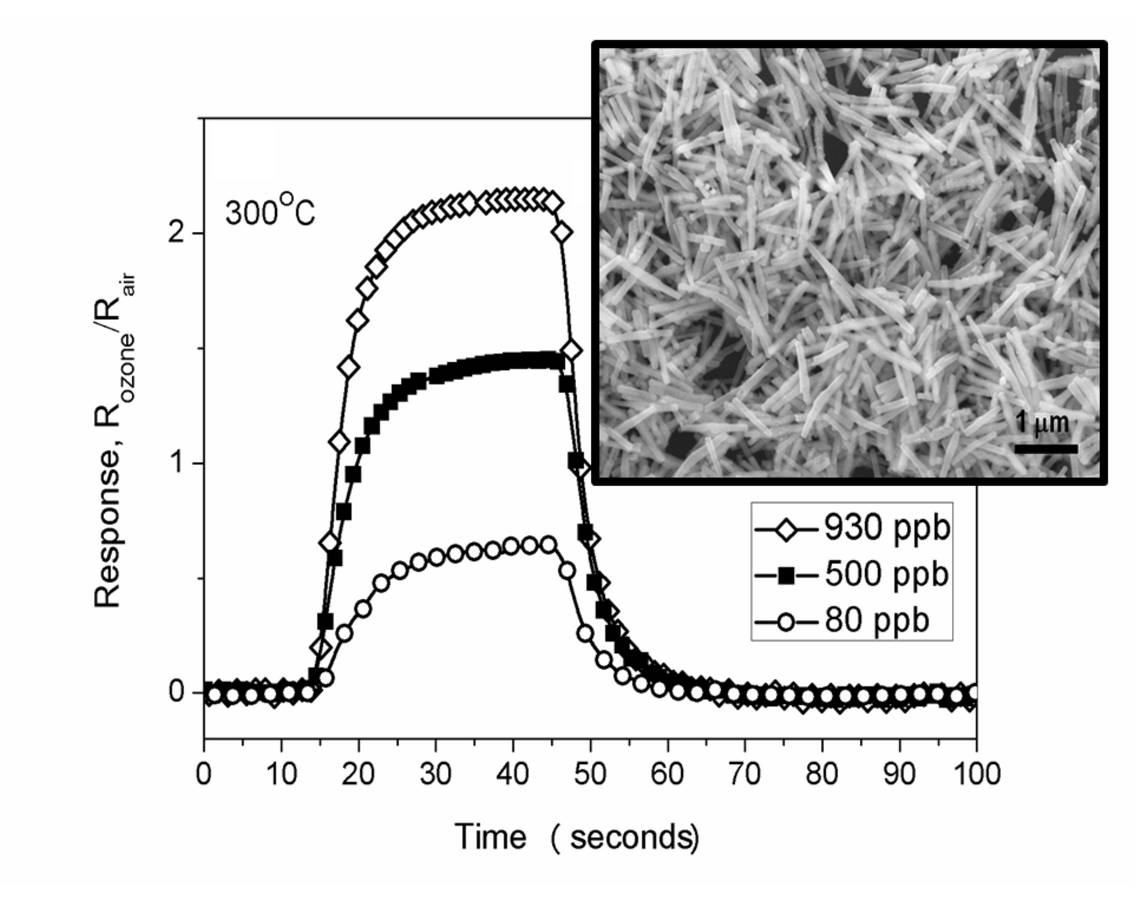
Resistive gas sensors are basically built from a material capable of changing its electrical properties when molecules of a certain gas are adsorbed in its surface. In the specific case of the silver tungstate, when it is submitted to an oxidant gas such as ozone, there is an increase in its electrical resistance that is proportional to the presence and concentration of the gas.
SEM image of the nanorods inside a diagram showing the sensor performance.
In this work, the Brazilian scientists synthesized nanorods of silver tungstate and assembled a sensor based on such nanoparticles. They had put the sensor in a temperature controlled test chamber, exposed it to different concentrations of ozone gas, from 80 to 930 parts per billion (ppb), and evaluated its capacity to detect the ozone.
Present in high atmospheric layers, the ozone plays an important role protecting living beings by absorbing the solar ultraviolet radiation. The ozone is also used by people in several applications, such as, for example, cleaning water. However, the exposition to the gas in certain concentrations may lead to health issues as headache, burning and irritation in the eyes, and respiratory system problems. The World Health Organization (WHO) recommends avoiding the exposure to ozone gas above 120 ppb.
“Subjecting the compound to low amounts of ozone, we observed a fast response, as well as a very short recovering time, making its properties comparable or even better than traditional sensors as tin dioxide (SnO2), tungsten trioxide (WO3), and indium oxide (In2O3),” says Luís Fernando da Silva, first author of the article and postdoctoral fellow of the São Paulo Research Foundation (Fapesp) at UNESP’s Chemistry Institute of Araraquara.
The results were published online in the peer reviewed journal Nanoscale in the end of January this year.
Background of the paper
The studies with silver tungstate started in the postdoctoral research of Laécio Cavalcante, currently a Professor at Piauí State University (UESPI). Cavalcante synthesized nanorods of silver tungstate using microwave-assisted hydrothermal technique (process that was also used in the synthesis of nanorods from the paper published by Nanoscale). Performing electronic microscopic analysis with the microscope of the Chemistry Institute of Araraquara, the group of scientists coordinated by Professor Longo noticed that the interaction of the electron beam with the material was stimulating the growth of metallic silver particles on the surface of the nanorods. The result of this paper led to an article published in April last year by Scientific Reports (DOI: 10.1038/srep01676).
“Since then, Professor Elson Longo has researched and encouraged the investigation of the potentiality of the α-Ag2WO4 compound”, comments Luís Fernando da Silva. Longo, his team and partners have already observed that the material holds bactericidal (J. Phys. Chem. A, 2014; Doi:10.1021/jp410564p), photoluminescent (J. Phys. Chem. C, 2014, DOI: 10.1021/jp408167v), and photocatalytic properties, with a series of possible applications.
“Based on these potential applications”, Luís Fernando da Silva adds, “I, Professor Waltir Avansi Junior from the Physics Department of the Federal University of São Carlos (UFSCar), jointly with Professor Valmor Mastelaro from the São Carlos Physics Institute of São Paulo University (USP) and his PhD student, Ariadne Catto, started investigating about the detection properties of the non-irradiated α-Ag2WO4 compound (without nanoparticles of metallic silver)”. During the experiments, Silva says, the team noticed that the material was sensitive to detect ethanol and acetone steam and, ultimately, ozone gas, even in low amounts. Assisted by Professors Khalifa Aguir from Université Aix-Marseille (Marseille, France), and Juan Andrés, from Universitat Jaume I (Castelló, Spain), they prepared the communication published by Nanoscale, a renowned journal in the nanotechnology field.
The studies concerning silver tungstate performed by the team of Professor Longo might not end there. According to Luís Fernando da Silva, the team will assess the capacities of the material to detect other gases. In addition to that, returning to the silver tungstate nanorods with nanoparticles of metallic silver, the scientists are going to study the effects of electron irradiation on the gas detection capacity of the material.
“This paper contributes to the discovering of new materials applied as gas sensors”, states the postdoctoral fellow. “However, complementary examinations are necessary in order to achieve a deeper comprehension of the mechanisms involved in the detection, adsorption and desorption processes of the gas(es)”, he concludes.
There was ceremony to empower the new board of directors and counselors, as well as the first meeting of the team. Learn more.
Get to know the new members and their roles. Here.
Featured paper with Brazilian participation
A team of three scientists managed to identify defects of atomic dimensions which exist in thin films of zinc oxide, through an interesting experiment, using the luminescence capability of this material. Initially, they prepared films with various quantities and types of defects and, systematically, they excited the samples, measured luminescence and related these data with the defects that had been introduced. The experiment was conceived and performed by a Brazilian researcher, using photon-scanning tunneling microscopy in Germany. The results have been published in The Journal of Physical Chemistry Letters. More.
(To suggest papers with Materials focus with Brazilian participation published in high impact journals for this section of our newsletter contact comunicacao@sbpmat.org.br)
History of Materials research in Brazil
We present the second part of the history of CAPES Materials Area, followed by an interview with Professor Carlos Graeff (coordinator of the area from 2009 to 2014) about the evolution of postgraduate courses in Materials in Brazil, the evaluation criteria of their scientific production and challenges for the next years, among other subjects. Here.
SBPMat’s community people
Interviewed due to Bridge Building Award of American Ceramic Society, Professor José Arana Varela has told us how he got to science of Materials and which are his most important contributions to the area of ceramic materials and his main collaborators. Arana Varela also left a message for our readers who are initiating their career. Here.
Reading recommendations
Science journalism stories based on papers published in journals with high impact factor.
Scientists use nanoparticle solutions as adhesive to glue gels and biological tissues (based on paper from Nature) Here.
Graphene bread sandwich: new technique to prepare biomolecules for electronic microscopy (based on paper from Advanced Materials) Here.
Organic Electronics: fastest polymeric transistor is developed. It is transparent and benzothiophene-based (based on paper from Nature Communications) Here.
For the first time, nanomotors travel inside living cells (see texts, images and videos) (based on paper from Angewandte Chemie International) Here.
Books, presentations, multimedia material, etc.
Review of the book “Fundamental Principles of Polymeric Materials” – for beginners in polymers science and technology. Here.
Materials news from the Brazilian National Institutes of Science and Technology (INCTs).
Thermal nanoimprint lithography developed at Namitec with potential application to photovoltaic panels. Here.
From the INCT for Nanotechnology Materials: silver tungstate as ozone gas sensor. Here.
Very sensitive hydrogen sensor developed in Namitec is ready to be used. Here.
Upcoming events in the area.
VI Curso do Método Rietveld de Refinamento de Estrutura. Here.
A little more than four months after the creation of CAPES Materials Area, with Professor Lívio Amaral as pro tempore coordinator, in 12 and 13 of June 2008, the first meeting of postgraduate programs of the new field took place in the headquarters of CAPES, Brasilia. Discussions basically involved the presentation of ten programs already linked to CAPES Materials Area (from UCS, UFC, UFPE, UFRGS, UFRN, UFSC, UNESP – Bauru, UNESP – Ilha Solteira, USP-Lorena and USP São Carlos), meetings with some of the directors from CAPES and the presentation of new programs (from FATEC, FEEVALE, UFMT and UFSCar- Sorocaba). Some programs linked to other areas in CAPES (from UFVSF, UFPR and UFS) have also been invited, to assess a possible change of area. At the end of the event, there was a discussion about creating what they called “the document of the Materials Area”.
This document was finalized in the second meeting of postgraduate programs, which took place in the 5th and 6th of March 2009 at Puc-Rio. At this time, the meeting was summoned by Professor Lívio Amaral, together with SBPMat, presided then by Professor Fernando Lázaro Freire Junior. Discussions included presentation of SBPMat and work teams about the creation of the document.
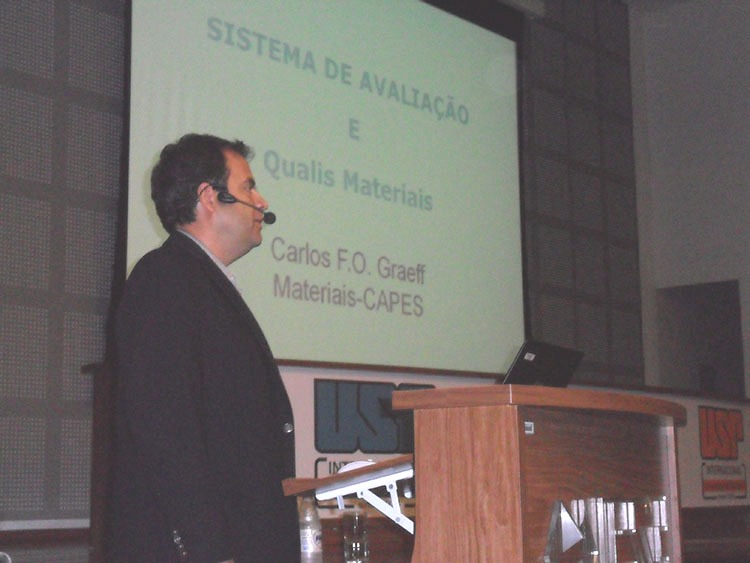
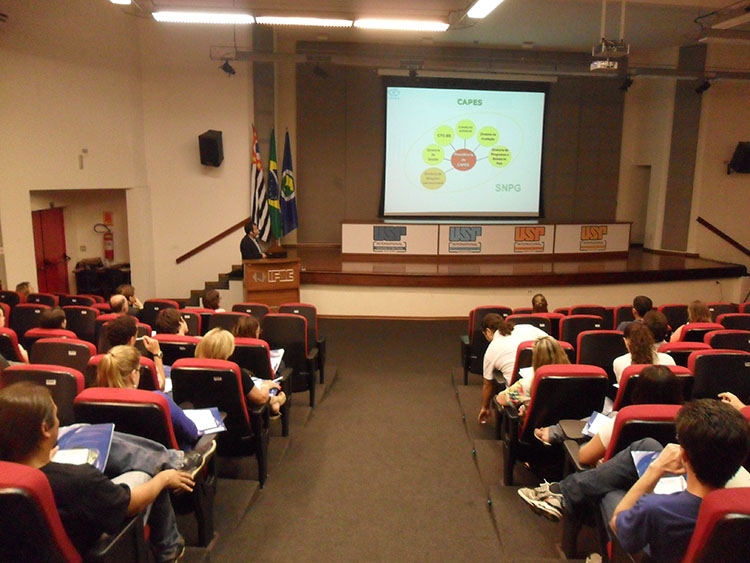
Professor Carlos Graeff, coordinator of the Materials Area at CAPES, lecturing at USP in November, 2013. Photo supplied by Carlos Graeff.
In April 2009, Professor Lívio Amaral left the coordination of the Materials Area to take over as Evaluation Director at CAPES. Regarding the actions performed during his coordination, which lasted a year and two months, Professor Amaral states that theytake this time to essentially identify the postgraduate programs in the field of Materials; from this, they try to consolidate the Materials Area and include it among the other CAPES areas, in a way that could be understood by the community”. On the other hand, Amaral regrets not being able to stimulate, neither in existing programs nor in new initiatives, “the imperious need to have much more research and human resources formation in Biomaterials”, subarea which, according to the Professor, is still very critical in the country. “All you have to do is go to a MRS meeting, either American or European, and it is easy to observe the increasing research in Biomaterials”, demonstrates Amaral.
On August 12th, 2009, CAPES president, Professor Jorge Guimarães, announced through Normative Regulation 097 that Professor Carlos Frederico de Oliveira Graeff had been assigned to fulfill the role of Materials Area coordinator until 2010, concluding the period of three years started by Lívio Amaral. Graeff still remains the coordinator until June 2014, being assigned for the role for three more years.
——————————
APPENDIX 1: About CAPES Materials Area.
The main tasks of CAPES are: evaluate and promote creating of new postgraduate programs; evaluate existing programs applying grades; evaluate scholarships and other financial support requests for students and teaching staff and for scientific events organization. Besides, CAPES coordinators are the most important interface between academic community and CAPES.
The Materials Area at CAPES is composed by a coordinator and two deputy coordinators. The job of the second deputy coordinator has been recently created, around 2013, to follow up in more detail programs of professional masters. Besides, the Evaluation Direction at CAPES has one or more technicians that help in the coordinators with internal procedures and the interface of CAPES with the community.
Coordinators in the area are chosen by the president at CAPES, after consulting post-graduate programs and technical and scientific societies connected to the area.
——————————
Professor Carlos Graeff, coordinator of the Materials Area at CAPES, lecturing at USP in November, 2013. Photo supplied by Carlos Graeff.
APPENDIX 2: Interview with Professor Carlos Graeff, CAPES Materials Area coordinator from 2009 to 2014.
SBPMat Bulletin:– Could you summarize the quantitative and qualitative evolution of postgraduate courses in Materals in Brazil, since the creation of CAPES Materials Area?
Carlos Graeff: – The area was created in 2008 with the adhesion of 10 programs. We are 29 today, that is, we have increased 290% in 6 years. This is quantitative date, but, most importantly, the area has diversified. It is a multidisciplinary area and with new programs, new frontiers of knowledge have been embraced with interfaces related to biological and medical fields, as well as agriculture, to name a few. Besides, another important feature of this evolution was the expansion of covered areas with postgraduate programs, especially in places with no high level education programs in the field, as the Central-west and Northeast Brazilian regions.
SBPMat Bulletin:– What were the main actions and facts during your coordination?
Carlos Graeff: – The main mark of our administration was transparency. We had a series of meetings with coordinators and, as the area is still relatively small, we could make a serious of decisions collectively, mostly relating to the evaluation of postgraduate programs. Regarding new courses, we always tried to invite new members, specialists, to the evaluation committees, for a fair examination of requests. This measure also brought improvement of the existing knowledge concerning CAPES role. A recurring issue is related to unawareness of CAPES work; when bringing a representative number of professors to the assessment processes, there is a tendency to strengthen the relationship between the scientific community and CAPES. I hope that this interview can contribute in that sense.
Besides working in this interface with post-graduate programs, I am a full member of Conselho Técnico-Científico da Educação Superior, where I led the work team with the topic “technical products”. There is an increasing demand for stronger interaction between academic society and society in general, that is, for applied research or technological development. In fact, creating the Materials and Biotechnology Areas at CAPES was basically inspired by this approximation. However, to evaluate programs that work with this interface there is a need for tools that might measure and qualify products such as patents, prototypes, etc. Therefore, it is essential that CAPES successful in assessing intellectual production well (in the case of Materials, basically articles in scientific journals) can be extended to technical production. The discussions have been very productive and we hope that soon they will reflect both on the CAPES evaluation process.
SBPMat Bulletin:– Can you comment on the “Qualis” (CAPES system for evaluation of scientific journals) of Materials Area?
Carlos Graeff: – One of the debates in the area was how to generate a Qualis that would attend multidisciplinary. Qualis is a broadly discussed tool in academic community in general, but especially in more dynamic areas of knowledge, considering its role is one of the most important: to qualify main intellectual products generated by postgraduate programs, scientific papers. The most used method uses impact factor. However, impact factor reflects the size and dynamics of different academic communities. For instance, when we compare average impact factors in Engineering with those of Natural Sciences (Physics, Chemistry, and Biology), they are inferior. We do not want to discuss the reasons for this difference which is even more remarkable if, for instance, we enter the realm of humanities. But this difference exists and, therefore, we should take this into consideration in order to avoid distortions in the evaluation process of, for instance, postgraduate research with strong inclination to research in Materials Engineering against Materials Chemistry. Our proposal, therefore, separates journals in big groups: Materials Science, Materials Engineering and correlate areas. By doing this, we try to achieve fairness while comparing papers generated by groups of engineers or physicists that work with Materials. Obviously, our proposal needs some adjustment, but I believe we have taken a step further in this direction.
SBPMat Bulletin:– In your opinion, which are the challenges faced by the area in the next few years?
Carlos Graeff: – Brazil is going through an important time in industry where it suffers with increasingly stronger competition, due to a great opening of our market and the integration with global economy. An important path is the sophistication of our products and processes, and Materials area has a lot to contribute to a stronger and more competitive industry. Nanotechnology is increasingly more emphasized and there are expectations that it might generate a series of new products, which is a fundamental subject of Materials field. Therefore CAPES and SBPMat play an important part in this matter. Actions in this direction are being discussed both at CAPES and SBPMat. Besides great national issues, there is still a lot of room to grow in the area. There are, for instance, the great and urgent challenges of creating a postgraduate program in the North Brazilian region, the only region with still no offer for Materials courses.
SBPMat Bulletin:– Feel free to add anything else.
Carlos Graeff: – I am honored with the generous invitation from Professor Livio Amaral to conduct the implementation of Materials Area at CAPES. I have learned a lot and I could follow changes that CAPES have been through in the last years, focusing in system improvement. We will soon have significant changes in the assessment process, among them, a new tool to collect and support evaluation called Sucupira Platform. This initiative has been taken with enthusiasm and skillfulness of Professors Amaral and Guimarães. So I would like to end thanking both of them.
The scientific paper by members of the Brazilian community in Materials research featured this month is:
Fernando Stavale, Niklas Nilius, and Hans-Joachim Freund. STM Luminescence Spectroscopy of Intrinsic Defects in ZnO(0001̅) Thin Films. J. Phys. Chem. Lett., 2013, 4 (22), pp 3972–3976. DOI: 10.1021/jz401823c.
Luminescence measurements to identify defects in zinc oxide thin films.
Zinc oxide (ZnO) is a very common material in everyday life. It can be found in screws, sunscreen, catalyzer for methanol synthesis and sophisticated optoelectronic devices, such as computer flexible screens, to name just a few. However, in order to enable some promising applications, such as transistors and new devices, it is important to control electrical properties of this semiconductor material, which are related to specific defects in its atomic structure.
Within this context, three scientists from institutions in Germany and Brazil identified specific defects in zinc oxide films through an original approach, taking advantage of luminescence capability (emission of light not resulting from heat) of zinc oxide. Researchers prepared zinc oxide thin films with different types and amounts of specific defects. Systematically, scientists measured luminescence of each film and, thus, they managed to relate peaks on the measurements with various types of defects in crystal nets. The results of this study were published in periodical The Journal of Physical Chemistry Letters (JPCL).
“In this study, we developed extremely high quality thin films of zinc oxide and we altered the amount of specific defects using thermal desorption, photo-desorption induced by laser and reduction by treatment in hydrogen controlled environment” – says Fernando Stavale, researcher for Centro Brasileiro de Pesquisas Físicas (CBPF), who signs the article as main author.
Characterization technique
In order to make the experiments, scientists used a scanning tunneling microscope (STM) in ultra high vacuum with a few peculiarities designed to generate luminescence, collect the emitted photons and obtain the measurements (spectrum) of luminescence. With this configuration, the STM is known as photon-scanning tunneling microscope. According to Stavale, one of the main scientists in the field of development and application of this technique is Professor Niklas Nilius, correspondent author of the JPCL paper, with whom Stavale has directly worked for three years during his post-doctoral research at Fritz-Haber Max-Planck Society, in Berlin, specifically at Physico-chemical Department led by Professor Hans-Joachim Freund, last author of the JPCL article. “The photon-scanning tunneling microscope has been employed in unprecedented manner to characterize metallic acids at the department directed by Professor Freund” – says Stavale. “The technique is still underused in Brazil and it is an essential part of the projects I develop with my research team at CBPF, situated in Rio de Janeiro” – he adds.
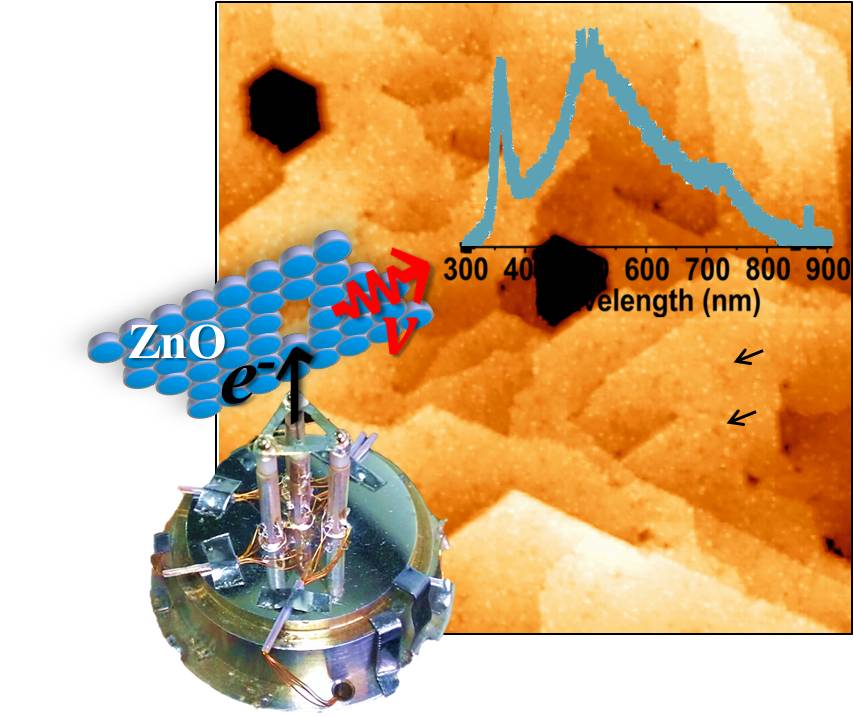
One of the most important features in photon-scanning tunneling microscopy is the use of electrons which are emitted by the tip of the STM to excite samples and, in the case of zinc oxide, to generate the desired luminescence. This phenomenon of emitting light generated by the impact of electrons over the material is called cathodoluminescence.
Experiment scheme in which the tip of the tunneling microscope can be observed, in the photo, exciting the zinc oxide film. The graph shows a spectrum of the oxide cathodoluminescence. At the back , the tunneling microscopy image of a zinc oxide film, with density of 20 layers (~5 nm) shows monoatomic steps and specific defects in the film’s surface. Vacancies of oxygen and zinc, specific defects, correspond to the areas indicated by arrows. The dark areas with hexagonal shape correspond to the areas where the film is noncontinuous, with depth of up to eight atomic layers.
This systematic work allowed scientists to infer that some peaks of luminescence of zinc oxide are due to defects such as vacancies of oxygen and zinc (dots in the lattice containing “vacancies”, instead of the expected oxygen and zinc atoms). “These specific defects are related to electrical properties often observed in zinc oxide, known as n-type doping” – Stavale adds.
The context of the work
The experiments of the JPCL article were conceived and conducted by Brazilian national Fernando Stavale in 2012, during his last year of post-doctoratal research with the group led by Professor Nilius, at Fritz-Haber of Max-Planck Society. Stavale joined the group in 2010 with financial support from Humboldt Institute in Germany. “For three years we have investigated for the first time the role of several dopants, such as chromium, europium and lithium in zinc and magnesium oxides, combined with ultra-thin films, raised in ultra-high vacuum with tunneling microscopy and local cathodoluminescence” – says Stavale about his post-doctoral studies.
The interpretation of results and the JPCL article redaction were performed in 2013 when Fernando Stavale became a CBPF researcher and Niklas Nilius became a Professor at University of Oldenburg, Germany.
Professor Arana Varela (to the left) receiving the award. Photo by American Ceramic Society.
On the last January 27th, in Daytona Beach (Florida, United States), during the 38th edition of International Conference and Exposition on Advanced Ceramics and Composites, the Bridge Building Award of the American Ceramic Society was given to a Brazilian for the first time, Professor José AranaVarela, president of our SBPMat from 2010 to 2011. The honor annually distinguishes people from outside the United States who have notably contributed to the field of engineering ceramics.
Graduated in Physics from University of São Paulo in 1968, Arana Varela also has a Master’s Degree in Physics for the Instituto Tecnológico de Aeronáutica (ITA), becoming a Master in 1975. He took his PhD from 1977 to 1981 at University of Washington (United States), conducting research in the field of ceramic materials.
His scientific papers gather over 6,500 citations. In the last 13 years, he has been the author of more than 500 articles, published in international journals. Up to this moment, he has advised and co-advised assignments for over 30 masters and over 40 doctoral theses.
Throughout his career, he has received more than 20 awards from organizations such as American Ceramic Society, Sociedad Española de Cerámica y Vidrio, CNPq, Associação Brasileira de Metalurgia e Materiais and Associação Brasileira de Cerâmica.
A brief interview with the researcher can be seen below:
SBPMat Bulletin:– Tell us a little bit about your story: which were the opportunities and choices that led you to become a researcher in the field of ceramic materials?
José Arana Varela: – Our choice of being a scientist in mateirals started during the Master’s at ITA, in 1972. During this period (in 1975), I met Professor O. J. Whittemore from the University of Washington, Seattle, during his visit to Universidade Federal de São Carlos for a year. As my master’s research was related to a physico-chemical view of thermal decomposition of talcum, which is a ceramic material, Professor Whittemore became interested in it and made some remarks regarding ceramic processing (his specialty). Thence the invitation for a doctorate in Seattle (from 1977 to 1981).
SBPMat Bulletin:– In your own analysis, which were your main contributions to the science and technology of materials? Specifically, can you comment on your main contributions to the field of engineering ceramics, the focus of Bridge Building Award?
José Arana Varela: — As the main theme of our doctoral theses was related to sintering models, we performed a simple study about variable effects, such as water vapor and heating rate in densification and microstructure of magnesium oxide ceramic. We created a model to take into account the structural rearrangement in sintering process.
Considering the evolution on application of ceramic materials in Microelectronics, due to functionality of these materials, we started the Electroceramic line in the 90’s. The functionality initially chosen was resistivity variation with electrical field (ceramic varistors) due to its application, mostly with lightning rods and electric circuits protectors. After understanding and contributing with varistor’s system based on zinc oxide (ZnO), we proposed to change the system considering another semi-conductor (stannous oxide). In this case, we developed throughout the years a stannous oxide varistor with properties that were much superior to traditional ZnO varistors.
Other contributions are related to development of thin ceramic films with Perovskite structure, with the purpose of optimizing their dielectric, piezoelectric and ferroelectric properties by using chemical deposition. We have advanced in the knowledge of chemical deposition, which we call polymeric precursors methods. One of the applications of these films are related to the manufacture of ferroelectric memories. With this, our students have worked in characterizing thin films with ferroelectric properties in some systems such as barium titanate, lead zirconate titanate, as well as strontium niobate and tantalate. A patent in ferroelectric memories, licensed to Panasonic, was proposed by a group led by Professor Carlos Paz de Araujo, at University of Colorado.
The latest contribution is related to sensors with nanometric structure, in collaboration with a group led by Professor Harry Tuller at MIT. Recent results were very promising and they showed great sensitivity in nanosensors based on stannous monoxide. It is important to point out that we have recently applied for patent regarding this study.
SBPMat Bulletin:– “Bridge building”, building bridges. Can you share with us a retrospective on the main bridges built throughout your career and the ones you would like to build?
José Arana Varela: — Our bridges have been built from the moment we finished our PhD at University of Washington. I continued to collaborate with Professor Whittemore for decade and I started other partnerships with Professor Gary Messing at Penn State University e then Professor Richard Bradt at University of Alabama.
Concurrently, we had joint projects in Europe with Professor João Baptista at Universidade de Aveiro, Portugal and with Doctor José Fernandez from Institute of Ceramics and Glass in Madrid, related to the subject of Electroceramics. We began to collaborate with groups in Bordeaux, France (Professor Marc Onillon), as well as André Perrin at University of Rennes. The collaborations proceeded with groups led by Professor Paolo Nanni at University of Genoa, concurrently with group led by Professor Danilo Suvorov at Josef Stephan Institute, in Slovenia and Professor Harry Tuller at MIT, in Boston.
SBPMat Bulletin:— Would you like to leave a message for our readers who are developing their academic or industry career as materials researchers?
José Arana Varela: — Science of Materials is fundamental to developing new useful technologies that will resolve society’s greatest problems. Great advancement in knowledge of ceramic materials, mostly their application in production of energy, communication, environmental control, etc., has been increasing in the past 20 years, mainly because of increased collaboration among researchers in different parts of the world. Science of Materials stopped being polarized between the United States and Europe (Germany, England and France) and it relies on contributions from other players in Asia and certainly Brazil. Fundamental knowledge of mass and charge transportation mechanisms, as well as structure of materials in nanometric scale, is essential to new developments and advances in technology.
On February 14th of this year, at 10 o’clock, the Brazilian Society of Materials Research (SPBMat) had an investiture ceremony for the Seventh Board of directors, for a two-year term beginning in January, 2014. Together with the Board of directors, four new full counselors and a deputy counselor were in role, whose term goes until 2018. The ceremony took place at Golden Park Hotel Viracopos, in the city of Campinas, in Sao Paulo. The new Board of directors and the new counselors were elected by vote at the end of 2013.
New Board of directors on the day of the investiture. From left to right, Rodrigo Bianchi, Marco Cremona, André Pasa, Ieda Garcia dos Santos, Julio Sambrano, Maria Aparecida Zaghete and Roberto Faria (president).
First meeting
The first meeting with the new Board of directors, together with the council occurred on the same day, at 2 p.m.
At the meeting, members of the board and council were appointed to take part in SBPMat’s commitee. For the Events Commitee, Professor Marco Cremona, Professor Iêda Maria Garcia dos Santos and Professor José Alberto Giacometti were assigned; for the SBPMat Bulletin Commitee, Professors Fernando Lázaro Freire Junior, André Avelino Pasa and José Antonio Eiras; and for University Chapters Commitee, Professors Rodrigo Fernando Bianchi, Antonio José Felix de Carvalho, Iêda Maria Garcia dos Santos, Maria Aparecida Zaghete and Waldemar Augusto de Almeida Macedo. As responsible for creating the document “Materials Science Impact” together with Institute of Physics, Professors Roberto Mendonça Faria, Marco Cremona and Julio Ricardo Sambrano were chosen. It is important to highlight that other SBPMat associates besides the initial members can be included.
During the meeting, scientific directors were assigned their duties.

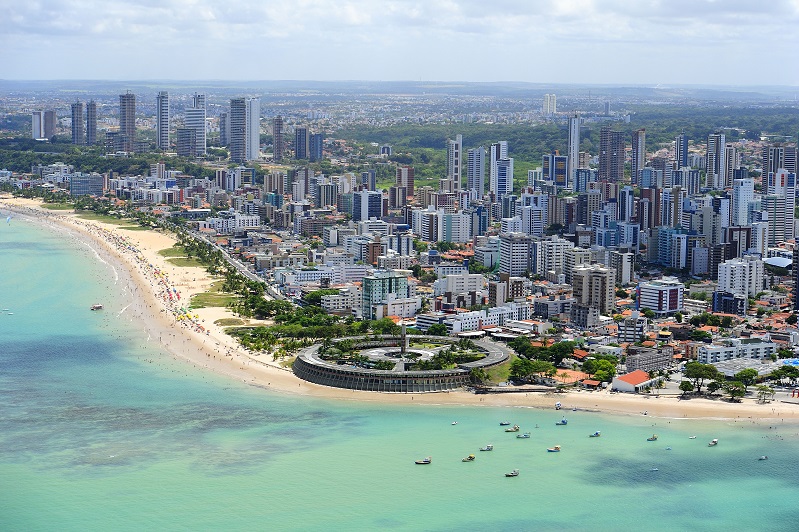 Abstract submission for the XIII Meeting of the Brazilian Materials Research Society (SBPMat) is open until May 23rd. The event will be held from September 28th to October 02nd, in João Pessoa, at the city’s brand new Convention Center.