
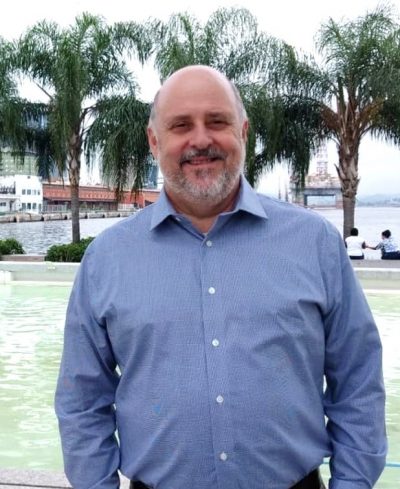
Edson Roberto Leite memories related to science are all very pleasant: the book about rockets in his childhood in the interior of São Paulo, the opportunity to use an exceptional microscope during the sabbatical period in the United States, the discovery of a mechanism for the growth of nanocrystals at the Brazilian National Synchrotron Light Laboratory…
Some of these wonderful memories include the many occasions experienced alongside his tutor and scientific father, Professor José Arana Varela, a prominent Brazilian materials scientist who died in 2016. Arana Varela was honored by B-MRS with the creation, in 2019, of an award that bears his name, and which annually distinguishes a prominent researcher from Brazil, who gives a plenary lecture at the Society’s annual event. In its first edition, the award was befittingly granted to Edson Roberto Leite, professor at the Federal University of São Carlos (UFSCar) and scientific director of the Brazilian National Nanotechnology Laboratory (LNNano-CNPEM). Leite is also editor for Latin America of the Journal of Nanoparticle Research (Springer).
Edson Roberto Leite received his first degree in Materials Engineering from UFSCar in 1988. In doubt between pursuing a career in industry or academia, he initially tried to reconcile both. After graduating, he worked in the research and development area at 3M, while doing his master’s degree and starting his doctorate, both in Materials Science and Engineering at UFSCar. In 1992, he left the company in order to dedicate his time to the doctorate, a decision that he recalls did not please his father-in-law, who was concerned with the livelihood of the family that by now included two children. However, over the years, the results of this decision have been very positive. In 1994, shortly after defending his doctorate, Leite became a professor in the Chemistry Department at UFSCar and started a career as a researcher in materials, which would not only be fruitful, but also enjoyable.
Co-author of more than 400 scientific articles published with more than 19 thousand citations, today Leite has an h index of 72 (Google Scholar). The scientist is also the editor of three books related to materials for energy and co-author of a book on the process of nucleation and growth of nanocrystals. Leite received several awards, including the Scopus Prize from Elsevier/CAPES (2006), for the excellence of his scientific production as a whole, and the John Simon Guggenheim Memorial Foundation Fellowship (2009), awarded to scientists with exceptional research skills. In 2012, Edson Leite was elected member of the World Academy of Ceramics and the Academy of Sciences of the State of São Paulo. In 2014, he was cochair of the Spring Meeting of Materials Research Society, held in San Frascisco (USA). In 2019 he was elected full member of the Brazilian Academy of Sciences (ABC).
Read our interview and learn more about this scientist, his main contributions and his memories of Professor Arana Varela.
B-MRS newsletter: At school, you had more affinity with science subjects, right? Do you remember how this taste for science originated?
Edson Roberto Leite: A person’s story always has the personal version and the version of the people who interacted with him. I will recount my perspective of how it happened.
At school I always had a strong affinity for Science and History. A striking memory was when I was in the third grade of elementary school and my father took me to the Municipal Library of Araras to take out a membership card so I could access books. The first book I chose was about rockets. I have always loved the conquest of space and the science behind fundamental historical moments. It is noteworthy that man had reached the moon only a few years earlier, nuclear power was seen as the global energy solution and semiconductors were just beginning.
In addition to this fond memory, there were other motivations, including Jonny Quest, a really cool cartoon. This animation, in addition to the adventures, had a lot of science fiction, and Jonny’s father (Dr. Benton Quest) was a renowned scientist with an excellent research laboratory in his own home.
My childhood, then, was always marked by a strong influence of science classes. I think it easily guided me to choose Engineering. At first the idea was to become a mechanical engineer, but during my prep course for the entrance exam I was introduced to Materials Engineering, at UFSCar. I took the exam in the middle of 1983 and passed. From then on I knew what I wanted and what I liked.
However, there was still a doubt, whether to go to the academic area or go to industry (my father was a Nestlé employee in Araras and the industrial sector always caught my attention). During my undergraduate studies, I went to live at the student housing headed by Celso V. Santilli (today an important researcher in the field of Materials, Professor at IQ-UNESP-Araraquara) and he helped me to participate in an undergraduate research program with professors Elson Longo and José Arana Varela. That was when I learned what science was and that increased my taste for the academic area. In 1984, I had the first undergraduate scholarship from FAPESP under the guidance of Professor Varela (who was a visiting professor in the Materials Engineering department (DEMa) at UFSCar). In 1988 I graduated, joined the DEMa-UFSCar master’s degree program and went to work as a development engineer at 3M do Brasil, in Sumaré, SP. My director at 3M was the engineer Aloysio Pizarro and he released me for the master’s degree (which I defended in 1990 under the guidance of Professor Elson) and for the doctorate (in 1990). In 1992, I realized it would be impossible to reconcile the research area and my activities at 3M, so I left 3M to focus entirely on my academic research, returning to São Carlos. I finished my doctorate in 1993 under the supervision of Professor José A. Varela. In January 1994, I became an adjunct professor in the Chemistry department at UFSCar and joined LIEC (Interdisciplinary Laboratory of Electrochemistry and Ceramics), founded by Elson, Varela and Bulhões (Professor Luís Otávio S. Bulhões). I went back to the place that had introduced me to science.
Those moments influenced me…
B-MRS newsletter: In your assessment, what are your main contributions to the Materials area?
Edson Roberto Leite: Ever since undergraduate research, I have been working mainly with inorganic materials, more specifically with ceramic materials. So, I will report the contributions I believe are most important, according to my point of view (in fact these may be the contributions I most enjoyed working with).
Since 1994 I have been working with chemical and physical-chemical materials and have been involved in several areas, among them: chemical synthesis of ceramic oxides, synthesis of nanoparticles with controlled size and morphology, growth of nanocrystals, electrical properties of ceramic oxides, materials for application in alternative energy devices and transmission electron microscopy (TEM). During this period, always developing works in collaboration with professors Elson Longo and José A. Varela, at LIEC of DQ-UFSCar. Among these different areas I will highlight my contributions to the growth of nanocrystals and the work on alternative energy.
In 1998, that is, 4 years after I was hired, I went on a sabbatical in the USA, in the group of Professor Martin P. Harmer, at Lehigh University (Betlehem, PA). In my sabbatical, I worked on converting polycrystalline ceramics into monocrystalline ceramics, using controlled grain growth. It was a wonderful year and my recollection of that period is vivid in my memory. I still remember the smell of the laboratory and the friendships I cultivated. From a professional point of view, the work drew my attention to the process of solid-state crystal growth. My contribution to the project was to characterize the growth process using advanced transmission electron microscopy techniques. At that time I had the opportunity to operate the VG-603 analytical transmission electron microscope. There were few microscopes like this being produced, and I still remember the words of the coordinator of the Lehigh microscopy laboratory, Dr. Dave Ackland saying that “few researchers in the world have had the honor of operating this equipment.” Returning to Brazil in 1999, I dedicated a lot of my time to microscopy and, with the help of the newly created Electronic Microscopy Laboratory of LNLS (created in 1997 by Dr. Daniel Ugarte), I began studying the process of growing nanocrystals in colloidal solution. I quickly identified, for SnO2 nanocrystals, a growth mechanism recently described in the literature known as “Oriented Attachment” (OA). The first article we published about this nanocrystal growth mechanism was in 2003. During this period I created a group of high-level master and doctoral students (today these students are researchers and professors), which truly allowed exploring this growth mechanism. In fact, we published, almost simultaneously with American groups, the first kinetic model to describe this growth process, and shortly afterwards we published two important articles, one related to the growth of anisotropic nanocrystals and the other correlating the OA process with a polymerization process. Both articles are considered pioneers in the area. International recognition in the area came with the invitation to publish two review articles (one at Nanoscale and the other at CrysEngComm), one of them in collaboration with leading international experts in the field of nanocrystal growth kinetics by OA.
I started working in alternative energy in 2004, when I helped organize a symposium on the theme at the MRS Spring Meeting in San Francisco. After that, we invested in this area and, with a new group of brilliant students, we achieved fantastic results, between 2007 and 2016, regarding the development of hematite photo anodes to promote water photo-electrolysis aimed at hydrogen production. We developed an electrode manufacturing process based on colloidal nanocrystal deposition. This enabled the highest impact publications of my career, in journals such as JACS and Energy Environ. Sci. In the same period we developed a method for synthesizing MoS2 (2D material), combining non-hydrolytic sol-gel method and microwave reaction. This again resulted in excellent materials for electrocatalysis and for supercapacitors. This research also enabled publications in high-impact journals, such as Chem. Comm and Advanced Energy Materials. Without a doubt, this team of students placed us in the state-of-the-art to develop materials for alternative energy.
I would like to highlight just one more important contribution, which was in the study of the combustion process in glass-melting furnaces, carried out with funding from White Martins/Praxair. In this work, carried out with Professor Carlos Paskocimas (currently at UFRN) and Professors Elson and Varela, we characterized the corrosion rate of the furnaces and proposed technological solutions to inhibit this corrosion. This work was a success at the time and we were invited to present the results at Corning Glass and Praxair in the United States.
B-MRS newsletter: You were celebrated in the first edition of the B-MRS José Arana Varela award, which honors this prominent Brazilian scientist (who died in 2016), former president of B-MRS. Professor Varela was your doctoral advisor and co-author of many published articles. Could you share with us some memories about Professor Varela and comment on the scientific partnership both of you developed over time? Feel free to leave any more personal comments.
Edson Roberto Leite: As I mentioned above, I was introduced to Professors Varela and Elson during my undergraduate years, and Professor Varela was my undergraduate and PhD advisor. In fact, I was Varela’s first doctoral student, in 1993. Being the first to win this award is an honor, which made me very happy. Besides being my advisor, Professor Varela was a tutor and almost a father, teaching me and introducing me to the national and international scientific community. It was with him that I made my first trip abroad, in 1993, where he introduced me to the great names of international Ceramics at the American Congress of The American Ceramic Society. It was at this opportunity that I met Professor Gary Messing and Professor Harmer. I remember him introducing me to the famous Professor W.D. Kingery, the father of modern Ceramics. It was Varela who encouraged me to be a member of World Academy of Ceramics. There were several trips, opening new work fronts and new research areas. As a tutor and advisor he knew how to get my attention and point out my mistakes. I remember, more recently, at an MRS Fall meeting in Boston (USA), a long discussion that we had where he, without hesitation, “pulled my ear” and helped me handle future problems I would face as a group leader in the Materials Chemistry area. I know he saw me as a rebellious student, but I’m sure he was proud of the training he gave me. His premature death took me by surprise and I miss him very much. I miss our discussions, our conversations and especially his advice and guidance.
B-MRS newsletter: Please leave a message for our younger readers who are starting a scientific career or are evaluating this possibility.
Edson Roberto Leite: I am not good with words, my students and former students know that I am very direct. I never worried about planning my career, everything was happening as I followed my instincts. What I am today is largely due to my students and the support of two scientific parents, professors Elson and Varela. My job is not a job, it is a hobby. So my message is: To achieve success in a scientific career you must really like what you do.
 Owing to the uncertainties related to the COVID-19, and in order to reduce the risk of hampering the health of our community, the Organizing Committee, the Executive Board of the B-MRS and the IUMRS decided to postpone the 2020 B-MRS and the IUMRS/ICEM meetings.