
The Brazilian Materials Research Society (SBPMat) is pleased to announce that the XVI Brazil-MRS Meeting will be held in the city of Gramado (State of Rio Grande do Sul, Brazil) from 24 to 28 10 to 14 of September, 2017.
Save the date!
The Brazilian Materials Research Society (SBPMat) is pleased to announce that the XVI Brazil-MRS Meeting will be held in the city of Gramado (State of Rio Grande do Sul, Brazil) from 24 to 28 10 to 14 of September, 2017.
Save the date!
|
||||||||||||||||||||||||
Cannot see this message? Click here.
[Paper: Hybrid tantalum oxide nanoparticles from the hydrolysis of imidazolium tantalate ionic liquids: efficient catalysts for hydrogen generation from ethanol/water solutions. Virgínia S. Souza, Jackson D. Scholten, Daniel E. Weibel, Dario Eberhardt, Daniel L. Baptista, Sérgio R. Teixeira and Jairton Dupont. J. Mater. Chem. A, 2016, 4, 7469-7475. DOI: 10.1039/C6TA02114J.]
Super efficient nanoparticles to catalyze production of hydrogen, an alternative fuel.
While some automobiles which use hydrogen fuel are entering the market, scientists from around the world are still trying to find cleaner, more sustainable, safer and cost-effective ways to generate and store hydrogen. In fact, even though it is the most abundant element in the universe and found in the water and in numerous other compounds, hydrogen cannot actually be found in its pure form on our planet. It must therefore be obtained from other chemical compounds.
One of the best methods to produce hydrogen, from ecological and economical points of view, is water splitting. This technique consists of separating water molecules into its two primary elements, generating hydrogen (H2) and oxygen (O2) gases. This separation can be achieved through the use of the abundant solar energy, at room temperature. However, in practice, for sunlight to split one water molecule, it requires nanoparticles made of semiconducting materials to act as catalysts, or more specifically, as photocatalysts.
In a study fully carried out in Brazil, a team of scientists developed a new simple and efficient method to produce tantalum oxide nanoparticles (Ta2O5) with outstanding performance catalysts for hydrogen generation. The research was reported in a paper recently published in the Journal of Materials Chemistry A (impact factor: 8.262).
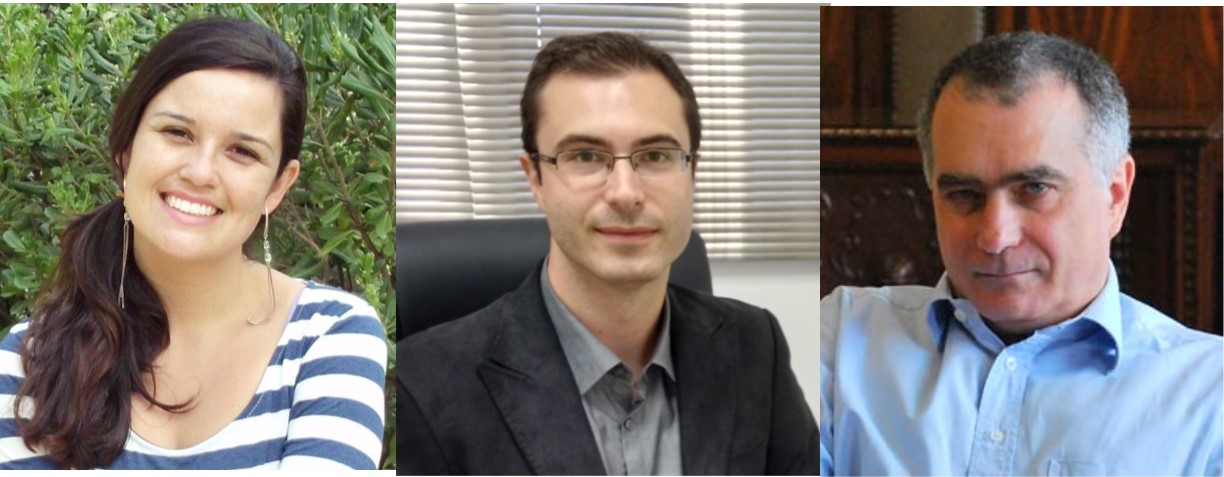
This study was funded by the Brazilian research agencies CAPES and CNPq, as the doctoral research of Virgínia Serra Souza at the Chemistry Institute of the Federal University of Rio Grande do Sul (IQ-UFRGS), under the guidance of Professor Jairton Dupont.
“The idea for this research came when we were looking for an alternative and efficient route for the synthesis of Ta2O5 nanoparticles, and after some experiments we decided to test the possibility of using ionic liquids as stabilizing sources and agents of the nanomaterials”, says Professor Jackson Damiani Scholten, who is one of the corresponding authors of the paper and member of the research group of IQ-UFRGS. This group has extensive experience in the study and development of ionic liquids (salts which are in liquid state at room temperature). Due to their physicochemical properties, ionic liquids can be used in the preparation of nanoparticles as stabilizers to keep the particles in the nanometric range.
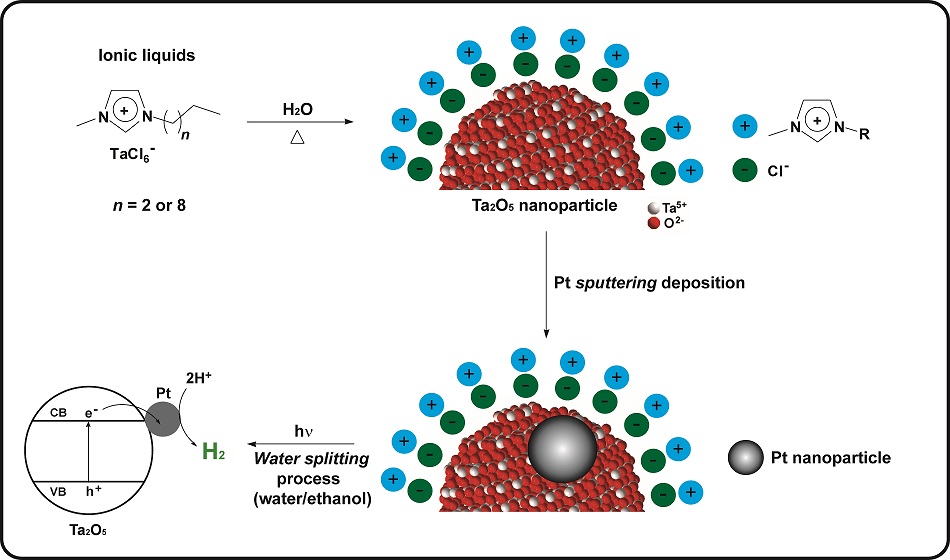
Souza, Scholten and Dupont prepared two types of ionic liquids containing tantalum and create the conditions for the hydrolysis reaction (breaking the chemical bonds of a compound by the addition of water). The elements resulting from the hydrolysis, from the water and the ionic liquid, recombine to form tantalum oxide nanoparticles.
The team realized it had produced tantalum oxide nanoparticles ranging between 1.5 and 22 nm, the smaller ones had been generated from one of the ionic liquids and the larger ones from the other. With the assistance of Professor Daniel E. Weibel, also from IQ-UFRGS, they studied the surface composition of the nanoparticles. These scientists proposed that the nanoparticles obtained were hybrid: remains of ionic liquid were observed around the tantalum oxide.
To see how the nanoparticles behaved as catalysts in the separation of water molecules to generate hydrogen, the team conducted photocatalytic tests at the facilities of the Institute of Physics – UFRGS, provided by Professor Sérgio R. Teixeira. The tests were carried out in a solution that besides water contained ethanol – a compound that helps to increase the hydrogen production rate.
“We were delighted that the Ta2O5 nanoparticles showed one of the best results ever published for the production of H2 from a water/ethanol solution”, recalls Professor Scholten. In the article, this exceptional result was attributed to the presence of ionic liquid in the nanoparticles. “We believe that the residual ionic liquid enhances the formation of a hydrophilic regions on the surface of Ta2O5, favoring the approximation of polar molecules (water and ethanol)”, explains Scholten. To be certain about this, the scientists removed the ionic liquid from the nanoparticles by heat treatment and confirmed their very low photocatalytic activity.
In another stage of the research, Dario Eberhardt, then professor at the University of Caxias do Sul (UCS), collaborated with the team in the deposition of roughly 1 nm platinum nanoparticles on the surface of the hybrid tantalum oxide nanoparticles by the sputtering technique, carried out at IF-UFRGS. Professor Daniel L. Baptista, of IF-UFRGS, helped to characterize the material. In the tests, the performance of the tantalum oxide nanoparticles with photocatalytic ionic liquid was even better with the addition of platinum.
This work, carried out in southern Brazil, presented a new method to produce super-efficient catalysts for hydrogen production, a promising alternative fuel from water and ethanol, two renewable and abundant resources.
 The “Research in Germany” campaign invites all XV Brazil-MRS Meeting attendees to the “Science Lunch” that will take place on September 26 (Monday) from 12:00 to 14:00 hs in Araucária room at the convention center Expo D. Pedro.
According to the organizers of this activity, an informal lunch will be offered, in which Germany will be presented as a research location and scientific networking will be promoted. Participants will be able to speak directly to invited scientists who will talk about their research, as well as to representatives of German funding agencies providing individual consultation on exchange programmes and research stays in Germany. This event is also an opportunity for those who are looking for information regarding scientific collaboration with colleagues in Germany and research funding.
The activity is free of charge for the XV Brazil-MRS Meeting attendees and requires registration, available here: https://ssl.daad.de/limesurvey/538867/lang-en. Limited spaces available.
 Organic semiconductors are materials that combine useful properties of plastics (easy shaping, flexibility, low weight, low-cost processing) with the possibility of conducting electricity and emitting light. At the University of St Andrews, which lies since 1413 in a beautiful seaside location in Scotland (UK), Prof. Ifor Samuel converts his fascination for organic semiconductors into new materials, devices and applications.
Ifor Samuel received his MA and PhD diplomas from the University of Cambridge (England, UK), after working on optical spectroscopy of organic semiconductors. After his PhD, Samuel moved to Paris for two years to perform postdoctoral work at CNET-France Telecom, investigating the non-linear optical properties of organic materials. Back to England, he carried out research at Cambridge for a year, as research fellow at Christ’s College. After that, he set his own research group on light-emitting polymers at the University of Durham where he also held a Royal Society University Research Fellowship. In 2000 he joined the University of St Andrews, where he founded, in 2001, the Organic Semiconductor Centre, dedicated to interdisciplinary research on understanding and improving organic semiconductors and exploring their applications in the semiconductor, electronics and optoelectronics industries. In 2004 he founded the company Ambicare Health Ltd that produces wearable light sources for healthcare applications.
Ifor Samuel holds an H-index of 58. He has published more than 400 journal papers. His publications have more than 12,000 citations. He is a Fellow of the Royal Society of Edinburgh, the Institute of Physics, the International Society for Optics and Photonics (SPIE) and the Royal Society of Chemistry. Among other prizes, he won the Chemical Dynamics Award for 2016 of the Royal Society of Chemistry for his contributions to understanding light emission and fundamental photophysical processes in organic semiconductors.
At the University of St Andrews, Ifor Samuel is Professor of Physics, Director of the Organic Semiconductor Centre and head of the Organic Semiconductor Optoelectronics group. He is a member of the editorial board of the Journal of Photonics for Energy, and Editor-in-Chief of Synthetic Metals, a journal of electronic polymers and electronic molecular metals.
Here follows a short interview with Professor Ifor Samuel, who will be in Campinas (Brazil) at the end of September to talk about Organic Semiconductor Optoelectronics in a plenary lecture of the XV Brazil-MRS Meeting.
SBPMat newsletter: – In your opinion, what are your most significant scientific contributions to the organic semiconductors field? Explain them very briefly and, if possible, share references of resulting publications.
Ifor Samuel: – There have been two main themes to my research. One is understanding organic semiconductors with the aim of using that understanding to improve them. In this direction, I have studied the light emission process in conjugated polymers which is very important for organic light-emitting diodes (OLEDs) [1,2], developed as a new class of OLED material (with P.L. Burn) [3], and measured exciton diffusion which is very important in polymer solar cells [4].
The other major theme has been pushing the boundaries of devices and applications. Here, instead of developing new materials, I have been exploring what new things can be done with existing materials. For example, whilst nearly everybody was working on OLEDs for displays, I had a very interesting discussion with James Ferguson, head of dermatology at Ninewells Hospital in Dundee, leading to the development of wearable light sources for treatment of non-melanoma skin cancer [5]. More recently my team developed a wearable organic optoelectronic sensor for muscle contraction [6]. We have also been working with the Belgian Royal Military Academy on using conjugated polymer fluorescence and lasing for explosive detection for humanitarian demining. Recently we demonstrated (as part of a large project with collaborators in Edinburgh, Strathclyde and Oxford) the use of organic semiconductors for visible light communication, achieving record data rates for white visible light communication [7].
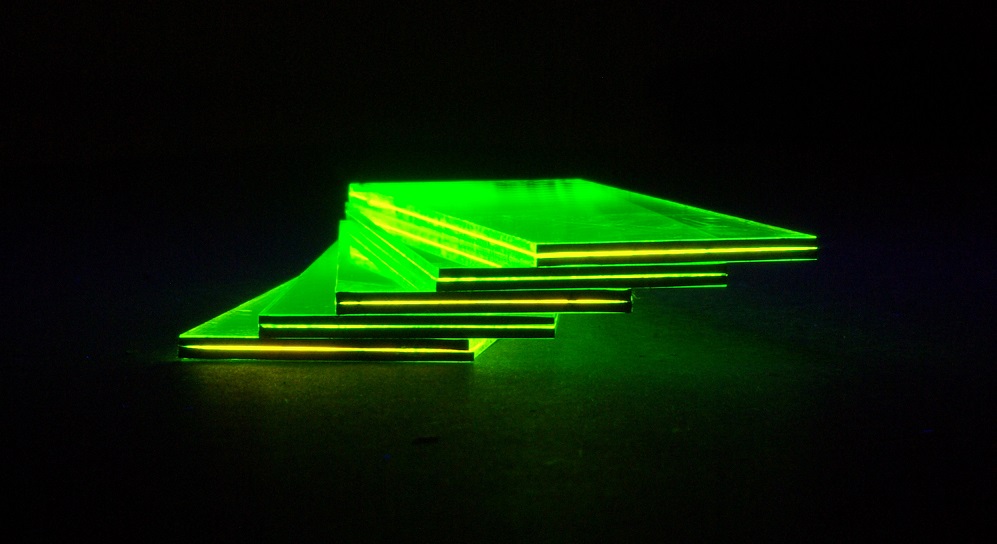
Efficient interchain photoluminescence in a high-electron-affinity conjugated polymer. I.D.W. Samuel, G. Rumbles and C.J. Collison. Physical Review B. 52, 11573 (1995).

Wearable organic optoelectronic sensors for medicine. A.K. Bansal, S.B. Hou, O. Kulyk, E.M. Bowman and I.D.W. Samuel. Adv. Mater. 27, 7638 (2015).
SBPMat newsletter: – You have authored many patents. Are there products in the market based on our inventions?
Ifor Samuel: – The majority of my patents are licensed to companies that are developing them. There are several patents relating to light-emitting dendrimers as highly efficient solution-processed OLED materials. These were initially licensed to Opsys Ltd in Oxford, who were later acquired by Cambridge Display Technology, who in turn are now wholly owned by Sumitomo Chemical and incorporate aspects of the technology in their products. For the skin cancer treatment, the patents were licensed to the spin-out company Ambicare Health Ltd. Ambicare have brought two related products to market – one is a wearable red light source for skin cancer treatment, and the other is a wearable blue light source for acne treatment.
SBPMat newsletter: – The properties of organic semiconductors are different from those of inorganic semiconductors, leading to creation of novel devices. Could you give some examples of existing and not-yet invented devices based on organic semiconductors?
Ifor Samuel: – The advantages of organic semiconductors come from how they combine novel semiconducting optoelectronic properties with simple fabrication and the scope to tune properties by changing their structure. An existing organic semiconductor device is an OLED mobile phone display or television. They give very vivid images, together with outstanding contrast and viewing angle. However, in contrast to inorganic semiconductors which are rigid and brittle, organic semiconductors can be used to make flexible devices – such as light-emitting bandages for medicine. The flexibility has not yet been fully exploited, but also simplifies manufacture which could be by simple roll to roll processes. This would be an excellent way to make solar cells in Brazil. The laser explosive sensors are completely different from inorganic lasers because the explosive vapour binds to the gain medium and modifies its light emission.
SBPMat newsletter: – If you desire, leave an invitation for our readers to go to your plenary lecture at the XV Brazil-MRS Meeting.
Ifor Samuel: – I have really enjoyed my previous visits to the Brazil MRS meeting and look forward to visiting Campinas. Do come to my lecture to hear about the remarkable world of organic semiconductors and their applications.
Link to the abstract of Ifor Samuel´s plenary lecture at the XV Brazil-MRS Meeting: http://sbpmat.org.br/15encontro/speakers/abstracts/6.pdf
Aiming to create a top-tier interdisciplinary platform for scientists to share and promote 2D materials research and applications, npj 2D Materials and Applications is a new online-only, open access journal.
2D Materials and Applications is part of the Nature Partner Journals (npj) series, launched by Springer Nature as part of the Nature Research portfolio of journals, and published in partnership with the Faculdade de Ciências e Tecnologia da Universidade Nova de Lisboa (FCT Nova) with the support of the European Materials Research Society (E-MRS).
npj 2D Materials and Applications will publish original papers, review articles and short communications to reflect the latest breakthrough and developments taking place in all aspects of 2D materials, including allotropes (different structures of the same element) and compounds, ultralight composite materials, their properties (including mechanical properties), and their isolation, synthesis and manufacturing.
The journal will also publish research relating to the use of 2D materials in applications such as photovoltaics, optoelectronics and photonics, semiconductors, sensors, electrodes, water purification/filtration/distillation, and energy storage.
Led by Editor-in-Chief Professor Andras Kis, the journal is now open for submissions.
Visit the journal website to find out more: http://www.nature.com/npj2dmaterials/
|
||||||||||||||||||||||||||||||||||
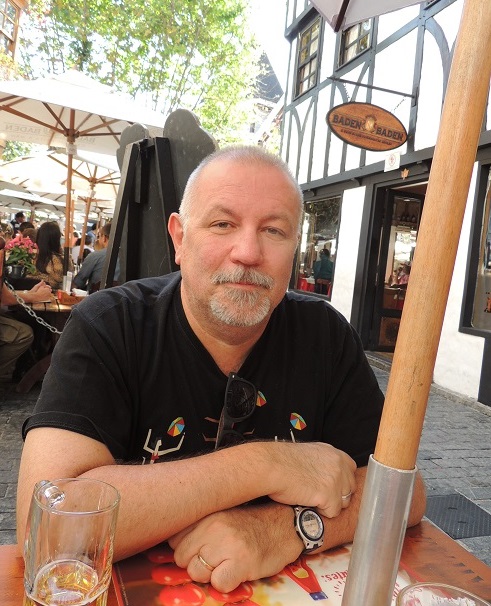
Sidney José Lima Ribeiro was born in Sao Paulo (Brazil) in 1959. In high school he signed up for a technical course in Chemistry in the seaside city of Santos. He later moved to Araraquara also in the state of São Paulo where he graduated with a bachelor`s (1982), master`s (1987) and then a doctorate degree (1992) in Chemistry at the University of the State of São Paulo Júlio de Mesquita Filho (UNESP). He began his teaching career in the Chemistry Institute – UNESP in 1986. From 2001 to 2003 he was the head of the General and Inorganic Chemistry Department. In 2008, he became a full professor. His postdoctoral fellowship was in France, at the École Centrale Paris (1994) and at the Centre National d’ Etudes des Telecomunications, CNET (1995).
Professor Sidney Ribeiro is a member of the editorial board of the Journal of Sol-Gel Science and Technology (Springer) and the Journal of Non-Crystalline Solids (Elsevier) and editor of the Eclectic Chemistry journal (Chemistry Institute of UNESP).
He is the author of over 300 peer reviewed articles published in international journals, 7 books or book chapters and 19 patent applications. His scientific production has approximately 5,000 citations. He has mentored or supervised a hundred research works, including doctoral theses, master`s dissertations, postdoctoral research and scientific initiation projects.
He was a visiting researcher at the National Institute for Research in Inorganic Materials (Japan) and visiting professor at the University of Trento (Italy), at the Universities of Angers and Toulouse (France), the University of Aveiro (Portugal) and the Federal University of Juiz de Fora (Brazil).
He has been a member of the São Paulo State Academy of Sciences since 2012 and full member of the Brazilian Academy of Sciences (ABC) since 2015.
Here is a brief interview with the researcher.
SBPMat newsletter: – Tell us what led you to become a scientist and work in the Materials area.
Sidney Ribeiro: – I am a chemist. I studied a technical Chemistry course at the Carmelite High School in Santos. Afterward, by now truly enjoying chemistry, I got my Bachelor`s Degree in Chemistry here in Araraquara. I graduated in 1982. I completed my Master`s in Spectroscopy of Lanthanide here at UNESP under the guidance of Professor Ana Maria G. Massabni which included a national doctoral “sandwich” program, with a part of the work done here in Araraquara and another part at the Federal University of Pernambuco under the guidance of Prof. Gilberto Sá. In my doctoral research I started to work in the interface between Chemistry – Physics – Materials Science, in which we participate until today. My post-doctoral research was at the École Centrale Paris and CNET France Telecom from 1994-95.
SBPMat newsletter: – In your opinion, what are your main contributions to the Materials area, considering all aspects of scientific activity?
Sidney Ribeiro: – We have worked with materials containing rare earth ions with applications in photonics and biomedicine. We have two very well-cited review papers that can serve as an example for those interested in learning more about our work:
1-Carlos, LD et al, Lanthanide-Containing light-emitting organic-inorganic hybrids: a bet on the future, Advanced Materials (2009) 21(5) 509-534.
2-Correia SFH et al, Luminescent solar concentrators: challenges for lanthanide-based organic-inorganic hybrid materials, J. of Materials Chemistry A (2014) 2 (16) 5580-5596.
Our postgraduate program is classified by Capes as level 7 (the highest) and our undergraduate courses are among the best in Latin America. This basic science work has resulted in the training of skilled labor (27 master’s degrees, 20 doctoral degrees and 23 postdoctoral supervisions and dozens of undergraduate students), the deposit of 19 patent applications, and spin-offs or cooperation with a dozen small businesses that now manufacture products developed in our laboratories. The trinomial research-education-extension is definitely well explored at IQ-UNESP.
SBPMat newsletter: – Please leave a message to the readers who are beginning their scientific careers.
Sidney Ribeiro: – We are all born liking science. Who, as a child, in a moment of scientific inspiration, didn’t mix our mother’s perfume with insecticide and some olive oil just to “see what came out of it”? This taste for science has to be preserved in our educational system. And for those who are starting out I say: go ahead. The country needs you. Someone said that when you do what you love you will never “have to work”. Work becomes your pastime and it’s really awesome.