
Sorry, this entry is only available in Brazilian Portuguese.
Author: Verónica Savignano
B-MRS newsletter. Year 4, issue 12.
|
||||||||||||||||||||||||||||||||||
|
||||||||||||||||||||||||||||||||||
|
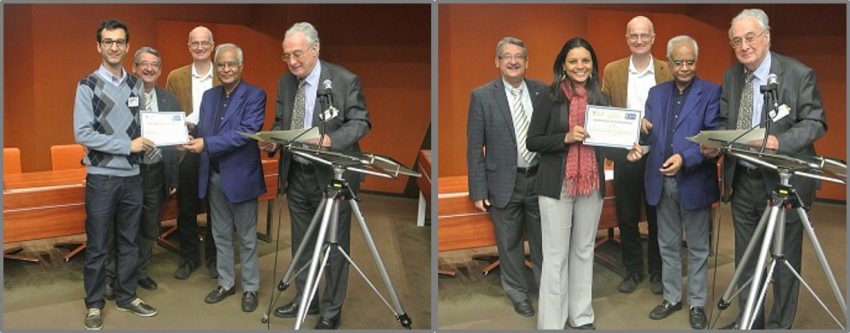
Co-founder of B-MRS awarded the “Global Ambassador” of the American Ceramic Society.
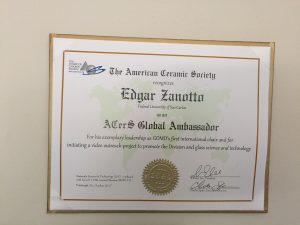 Edgar Dutra Zanotto, one of the founders of B-MRS, was awarded the title of “Global Ambassador” by the American Ceramic Society (ACerS). Zanotto is a Professor of the Department of Materials Engineering (DEMa) at the Brazilian Federal University of São Carlos (UFSCar). ACerS is one of the most important and traditional scientific societies in the field of Materials Science and Engineering and will complete its centenary next year. The title of “Global Ambassador” recognizes researchers who demonstrate leadership and exceptional service to the worldwide ceramic and glass research community.
On the occasion of the ceremony, held in Pittsburg (USA) in October of this year, Zanotto gave the prestigious lecture “Cooper Lecture” on “The ultimate fate of glass”.
A summary of the main subject of the talk can be seen in a 3-minute video: Glass transition, a theatrical version.
(Português) Eleições 2017: inscrição de chapas para diretoria e candidatos a conselheiros.
Participation of B-MRS young members in international events on sustainable materials.
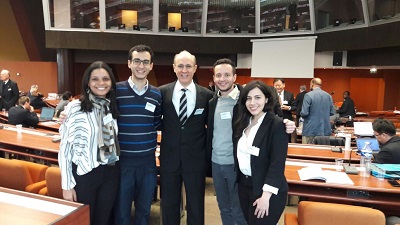
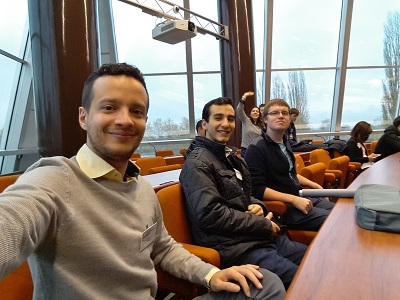
Four members of B-MRS were part of the select group of about 30 young researchers from several countries who participated in two events held in the city of Strasbourg, France, along with 60 other participants. The main subject of both events was material innovation for a sustainable society and a global circular economy (i.e., based on reduction, reuse, recovery and recycling of materials and/or energy). The events were organized by several research societies in materials research, the International Union of Materials Research Societies (IUMRS) and other entities, with the support of UNESCO.
Post-doctoral fellows Eduardo Guilherme Cividini Neiva (currently full-time professor at FURB, after completing a post-doc at UFPR), Gisele Amaral-Labat (USP), Kassio Papi Silva Zanoni (IFSC-USP) and Sedeyeh Parinaz Akhlaghi (UNICAMP) were the young B-MRS members who participated in the events. The four postdocs were selected from 20 candidates in the context of the B-MRS Young Researcher Award. They have earned the right to attend the events (which are not open to the public), as well as travel costs. The award was made in partnership with the European Materials Research Society (E-MRS).
The first of the events was the “Forum for the Next Generation of Researchers 2017,” held on 18 and 19 November of this year at the headquarters of the European Youth Center. The forum brought together different generations of researchers around science and technology for a sustainable world. The event included lectures by senior scientists, poster presentations of young researchers and discussions among all participants. In addition, all young scientists participated in the preparation of a report that was presented at the end of the event.
Then, on the 20th and 21st, the “6th World Materials Summit” was held at the headquarters of the Council of Europe. The subject of innovation in sustainable materials and the circular economy was discussed through lectures by scientists from various countries and round tables.
According to Kassio Zanoni, the discussions of the two events showed an academic, political, social and environmental view about themes related to sustainability, as well as the perspectives of Materials research in this context. According to the B-MRS participants, some of the topics addressed were the conversion, storage and distribution of energy (solar, for example); production of more efficient and less polluting batteries; capture and reuse of carbon dioxide; materials recycling; and many other topics.
The president of SBPMat, Osvaldo Novais de Oliveira Jr, professor at IFSC-USP, represented SBMat in the international committee of the summit and gave a lecture in the forum about nanomaterials and their applications.
Read our interview with the B-MRS young members who attended the events.
 B-MRS Newsletter: Briefly tell us about the work you presented in the “Forum for the New Generation of Researchers 2017”.
Eduardo Neiva: I presented a poster about my postdoctoral work, whose theme involved the application of graphene nanocomposites in the construction of energy storage devices.
Gisele Amaral-Labat: My panel discussion consisted of activities that are currently being developed in my postdoctoral fellowship. The work is based on the use of pulp and paper industry waste, crude black liquor, in the synthesis of porous carbon foams in the presence of nickel, for direct ethanol fuel cell applications. The synthesis form used generates a product with a greater amount of residues, besides the low cost when compared to the electrocatalysts used in the current market.
Kassio Zanoni: I presented a poster of the work I am developing in the postdocs, on ways and concepts for energy conversion and sustainability.
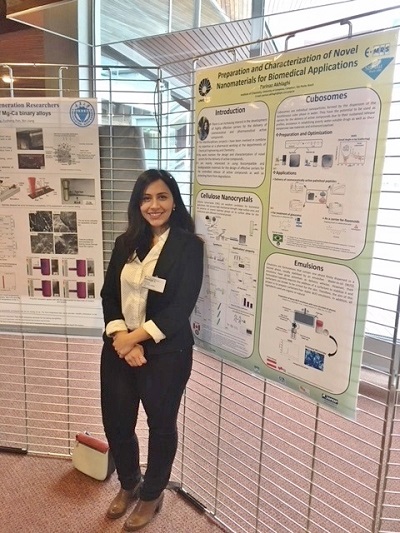
Parinaz Akhlaghi: I presented my postdoctoral work (referring to the years 2015-2017) at UNICAMP (Institute of Chemistry), still in progress, as well as part of the work developed during my doctorate (2010-2014) at the University of Waterloo (Dept. of Chemical Engineering) in the form of a poster titled “Preparation and Characterization of Novel Nanomaterials for Biomedical Applications.”
B-MRS Newsletter: How did your participation in these events contribute to your development?
Eduardo Neiva: Unlike other events, I had the opportunity to participate in discussions involving topics of global importance. My participation in this event will also result in future international and national partnerships, where in the event, I and the participant Gisele conceived projects to be developed in the near future.
Gisele Amaral-Labat: Undoubtedly, participating in these events was extremely important for my academic background, first due to the type of event, in which a common theme is discussed by two different communities, academic and business, enabling me to know different global views of the subject. Secondly, it created the possibility for collaboration with other research centers, including young and senior researchers, national and international. Furthermore, the event allowed getting to know the work of the other young Brazilian researchers, and a possible collaboration with Eduardo Guilherme Cividini Neiva is in progress. The objective is to synthesize sustainable carbon materials for application in the area of energy storage, taking advantage of the expertise of both of us.
Kassio Zanoni: The event provided the opportunity for meetings with several researchers, increasing our networks of collaborations. It was very interesting to hear the different views and this brought a great deal of professional growth. It really was very productive, perhaps the most productive meeting I’ve ever attended.
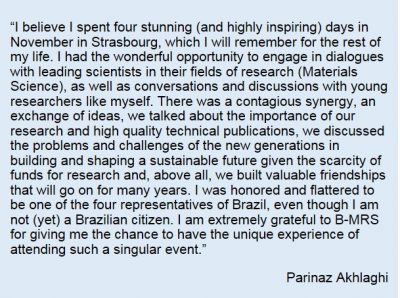
Parinaz Akhlaghi: I believe that my participation in these events was one of the most rewarding and most influential experiences in my career as a researcher and as a human being. I was affected in an extremely positive way by being in the presence of young researchers like myself, as well as experienced scientists, shaping my worldview (and my future), my ambitions and desires in the academic career. Being in the presence of scientists that I have admired for so long and being able to exchange ideas with them was very rewarding in several aspects. All the discussions were profound, passionate and motivating. It was certainly an experience shared by the other young scientists.
B-MRS Newsletter: What most attracted your attention in the events?
Eduardo Neiva: The direct and prolonged contact with renowned researchers.
Gisele Amaral-Labat: I was delighted with how receptive the senior researchers were with the young researchers. Moreover, the event showed a relevant multidisciplinarity of the professionals and the works presented.
Kassio Zanoni: The different views on the same theme, which vary widely between different countries.
Parinaz Akhlaghi: What at first could have been a barrier, soon proved to be extremely pleasurable. Despite the age difference between the main scientists (some older than 70) and the young researchers (some 25 years old), the exchange of information flowed naturally. On both sides there was passion when talking about science (as a whole), as well as new paths and alternatives for a more hopeful and better future.
New Year’s Message from B-MRS President.
With this New Year’s message, I greet the entire B-MRS community in Brazil and abroad.
2017 was especially difficult for the areas of science, technology and innovation in Brazil, and B-MRS has aligned itself with other scientific societies by echoing voices calling for more responsible policies by governments in our sector. It has been a difficult battle to convince leaders regarding the growing importance of research investment, given that society increasingly relies on knowledge to achieve sustainable development. For a country with so much social inequality, such as Brazil, there is no alternative means to create and incorporate technologies to improve the lives of the population. We all need to join in and repeat the slogan advocated by many of our colleagues: “Science is not an expense. It’s an investment!”
Despite the difficulties, the Brazilian scientific community has shown remarkable resilience. For B-MRS, for example, 2017 was marked by an excellent Meeting in Gramado, whose scientific level was equivalent to the best international meetings in materials science and engineering. The Meeting was also an exceptional opportunity to bring together researchers from Latin America, as well as from other continents, as part of B-MRS’s effort to position itself on the international landscape. In this regard, perhaps the greatest highlight of the year was the participation of Brazilian postdoctoral researchers at the Forum for Young Researchers in Strasbourg, France, organized by the European Society for Materials Research (E-MRS) and by the International Union of Materials Research Societies (IUMRS). These postdoctoral fellows were selected in a competitive national contest.
It is always gratifying to follow over the year, in the B-MRS Newsletter, some of the achievements and contributions of Brazilian researchers in various materials areas. In 2017, much was done in Brazil, a demonstration of the strength of our community.
I end by thanking the B-MRS community, with heartfelt wishes for health and success in 2018, hoping to meet many of you in Natal (state of Rio Grande do Norte), from September 16 to 20, in our next Meeting.
Professor Osvaldo Novais de Oliveira Junior
President of B-MRS
(Português) Concurso para professor do Departamento de Química Fundamental da UFPE.
B-MRS newsletter. Year 4, issue 11.
|
|||||||||||||||||||||||||||
|
|||||||||||||||||||||||||||
|
Featured scientist: interview with Prof. Oscar Manoel Loureiro Malta.
 Brazil, besides having one of the world’s largest reserves of ores with lanthanide elements, also occupies a prominent place in the research of these elements and their compounds, which have significant applicability in strategic areas such as energy, health and catalysis, as well as in many other areas.
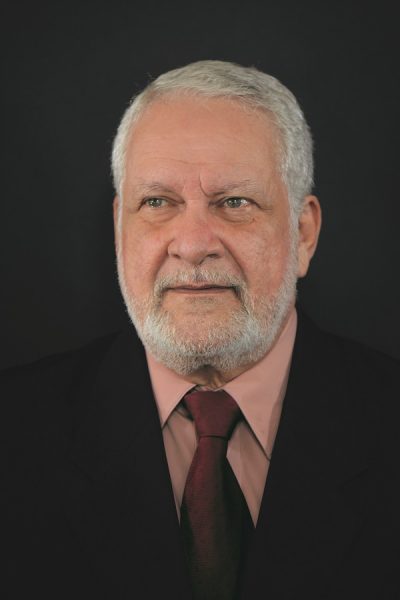
One of the most prominent Brazilian scientists in this research field is Oscar Manoel Loureiro Malta, born in the city of Recife (state of Pernambuco) 63 years ago. Malta is Professor at the Department of Fundamental Chemistry of the Federal University of Pernambuco (UFPE). Over the course of four decades, he has made important contributions to the research on lanthanides, both in the fundamental and applied fields.
Malta defined his interest in science during his high school years. In 1974, he started the Chemical Engineering course at UFPE and the Physics course at the Catholic University of Pernambuco. After completing his degree in Physics, he left the Chemistry course to join the Master’s degree in Physics at UFPE. There he carried out research work on spectroscopy of lanthanide compounds, mentored by Professor Gilberto Fernandes de Sá. In December of 1977, he obtained the master’s degree. He continued his studies on lanthanide spectroscopy in his doctorate at the University of Paris VI (France), also known as Pierre et Marie Curie Université, guided by Professor Yves Jeannin. He obtained his doctorate in March 1981. He then returned to Recife, where that same year he became professor at UFPE. In 1986, he returned to France for one year as a visiting researcher in the group of Paul Caro, a world-renowned scientist in the lanthanide area, linked to the French National Center for Scientific Research (CNRS).
Oscar Malta was visiting professor in several international institutions: University of Wroclaw (Poland) in 2015; University of Aveiro (Portugal) in 2005; Industrial University of Santander (Colombia) in 2000; University of São Paulo, USP, in 1995, 1996 and 1999, and Paulista State University Júlio de Mesquita Neto, UNESP, in 1994-95 and 1998.
At UFPE, he participated in the creation and consolidation of the Department of Fundamental Chemistry, where he served as department head (1987-89) and postgraduate coordinator (1991-93 and 1999-2001). He was also the coordinator of two national research networks: the National Network of Molecular Nanotechnology and Interfaces, RENAMI (2001 – 2009), and the National Institute of Science and Technology for Integrated Markers, INAMI (2009-2015).
Malta has received a number of acknowledgments for his scientific trajectory. On November 15, 2017, he received an honorary doctorate from the University of Wroctaw, an important institution in Poland where nine Nobel laureates have emerged. In 2016, a special edition of the Journal of Luminescence (publisher Elsevier) on lanthanide spectroscopy was dedicated to this researcher from Pernambuco (https://doi.org/10.1016/j.jlumin.2015.11.024). In 2015, Malta received the Ricardo Ferreira Award for Scientific Merit, recently created by the Foundation for Science and Technology of Pernambuco, Facepe. In 2014, he received the Professor Paulo José Duarte Medal from the Brazilian Chemistry Association. In 2003, he became a full member of the Brazilian Academy of Sciences, ABC.
In this year, Malta was chairman of the International Conference on Luminescence (ICL), which, after seventeen editions in the northern hemisphere, was held in the Brazilian city of João Pessoa.
With a productivity research grant 1A of CNPq, Oscar Malta is the author of approximately 180 papers published in international journals, with about 7,000 citations in the Web of Science. The scientist has a 42 H index.
Here is our interview with Oscar Manoel Loureiro Malta.
SBPMat newsletter: What do you believe are your main contributions to the Materials area and why do you consider them more relevant?
Oscar Malta: Since my master’s degree, which I started in 1977, my work has been in the areas of theoretical chemistry, binding field theory, 4f-4f spectral intensities, non-radioactive energy transfer, in particular intramolecular energy transfer in coordination compounds with lanthanide ions whose theory I developed between 1996 and 1998 and which until today I continue working on, as well as several groups in Brazil and abroad. Over the last three decades, in a work that involves great and extraordinary synergy between theory and experiment, we have been able to construct a very successful scheme for the modeling of highly functional luminescent lanthanide ion coordination compounds with the potential for diverse applications such as luminescent markers in bioassays. Many of these results were obtained during the time I coordinated two national nanotechnology networks. The first, National Network of Molecular Nanotechnology and Interfaces (RENAMI), was in force from 2001 to 2009, the second, the National Institute of Science and Technology for Integrated Markers (inct-INAMI), was in force from 2009 to 2015. Coupled to these results two important themes were also developed: the effect of metal nanoparticle plasmas on the luminescence of compounds with lanthanide ions, a subject that is currently linked to the so-called plasmon, and the concept of polarizability of the coating region in the chemical bond as a way to quantify covalence, which I introduced between 2002 and 2005 in order to better understand the chemical bond involving 4f orbitals. This concept was subsequently generalized to any chemical bonding, from single molecules to complex materials. In all these results it is important to emphasize the students’ participation, from scientific initiation to the doctorate.
SBPMat Bulletin: You started researching in the field of lanthanide ion compounds spectroscopy in your master’s degree, 40 years ago, and you’re still working in the area. What most appeals to you in this research topic? Is it still a promising area? What has changed in the research in this area in Brazil since the 1970s so far?
Oscar Malta: Lanthanides and their compounds are fascinating. They took me into the world of theoretical chemistry, in the world of angular momentum algebra, in the world of the interaction of radiation with matter, and into the world of spectroscopy. When I finished my master’s degree, everything was in place for me to go on to do a doctorate in England to work in atomic physics. At that time he was in Recife, at the invitation of Gilberto Sá and Ricardo Ferreira, Paul Caro, one of the most renowned researchers in lanthanide spectroscopy. He presented a seminar that really impressed me. I gave up on going to England and went to work for Paul Caro’s group at CNRS in Meudon-Bellevue in France. At first the plan was to develop an experimental thesis. However, I wanted to work on the theory. Paul Caro accepted this without problems, and a very fruitful theory/experiment interaction emerged that extended to other groups and continues to this day, always with much to do from a fundamental point of view and from the point of view of applications. Brazil is one of the world leaders in this field, with extremely active and internationally recognized research groups in the country. In fact there is again a discussion about the production of lanthanides since Brazil is a country rich with the minerals of these elements, so important for today’s technology and undoubtedly for the future. We cannot overlook this.
SBPMat Bulletin: Now we invite you to leave a message for the readers who are starting their scientific careers.
Oscar Malta: There is now a strong tendency of young researchers (I am referring to the scientific area under consideration here) to exacerbate the value of applied science in a short-sighted manner. As a result they forget the theoretical foundations and they often do not know the history of the subject, even the experimental history, that they work with or intend to work with. It is exhausting (a fact) to notice this in scientific meetings and I usually am amazed. This is like a linear inflationary process in which money is thrown into the market without having a stabilizer. Sooner or later it ends up in trouble, problems whose creative solutions (an assumption that must accompany a scientist) could be found if greater investment had been deposited in the theoretical foundation and greater attention given to the history of the situation at hand. Therefore, with respect to this question, my message is: do not neglect good theoretical formation and the knowledge of the origin of the subject with which you intend to work. Countries that are now developing and exporting good technology realize how important this is.
SBPMat Bulletin: Feel free to share other comments with our community.
Oscar Malta: Science and technology are more than ever a social activity that requires creativity (as always), training, and therefore education, dedication and strong interdisciplinary cooperation. And it requires investments. Without these ingredients, coupled with sound and sensible ethics committees, we will not be able to create intelligent and reliable science and technology policies that will ensure the continuation of human civilization. The great astronomer Carl Sagan said that not taking these ingredients seriously and the notion that five billion years from now our solar system will have been burned (by our red giant), we will have no chance of getting out of here. This sounds like science fiction, but it’s not. Hopefully the next generations, especially our leaders, will realize this. But I am optimistic in this regard, like a great neuroscientist (Miguel Nicolelis) who wrote “Beyond Boundaries”, which I recommend to my colleagues in Materials Science – especially with respect to emerging properties.