[Exploring Au Droplet Motion in Nanowire Growth: A Simple Route toward Asymmetric GaP Morphologies. Bruno C. da Silva*, Douglas S. Oliveira, Fernando Iikawa, Odilon D. D. Couto Jr., Jefferson Bettini, Luiz F. Zagonel, and Mônica A. Cotta*. Nano Lett., 2017, 17 (12), pp 7274–7282. DOI: 10.1021/acs.nanolett.7b02770]
Moving nanoparticles for asymmetric nanowires.
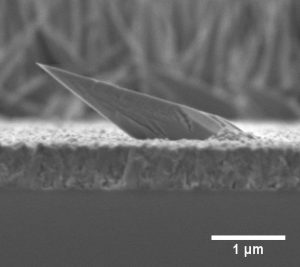
Scanning electron microscopy image of asymmetric gallium phosphide (GaP) nanowires.
A team of scientists presented a route to grow semiconductor nanowires having an asymmetric morphology, different from the traditional cylindrical one. The possibility of producing, in a controlled manner, nanowires with particular formats and without defects, can be exploited in several applications, including the production of more efficient solar cells.
The research was led by scientists from the Brazilian university UNICAMP and the Brazilian Nanotechnology National Laboratory (LNNANO), who reported their findings in a paper in NanoLetters.
The researchers discovered the process while studying the production of nanowires of gallium phosphide (GaP) for optoelectronic applications. The team chose to produce the nanowires by chemical beam epitaxy (CBE), preceded by a thermal treatment (annealing). In this technique, a substrate of a suitable material – in this case gallium arsenide (GaAs) – is placed inside a chamber. Then, chemical compounds in the form of vapor are introduced into the chamber. Some elements of the vapored material deposit over the substrate, layer upon layer, generating films. To promote the growth of nanowires instead of films, metallic nanoparticles (in this case, gold nanoparticles) are placed on the substrate before being exposed to vapor. During exposure, these catalytic nanoparticles cause the material to deposit preferentially underneath them, causing wire-like structures to grow.
While the researchers were analyzing the nanowires they had obtained in the first few months of the work, they found a significant amount of asymmetric nanostructures. “Besides having a particular morphology, we saw that these nanowires had an hexagonal crystal structure (wurtzite) and a very low density of crystallographic defects, which motivated us to study in detail the causes for the formation of this unusual structure,” says Bruno da Silva, PhD student at UNICAMP and corresponding author of the paper.
Da Silva and his supervisor Prof. Mônica Cotta then began to raise and test hypotheses for the cause behind the formation of the peculiar structures. After several experiments and analyses, they focused on a phenomenon that caught their attention: in the early stages of the process, the gold nanoparticles spontaneously moved over the substrate. Hence, the duo undertook a systematic work on heating substrates with nanoparticle catalysts, growing nanowires under various conditions, and analyzing the resulting samples through scanning and transmission electron microscopes and atomic force microscopy.
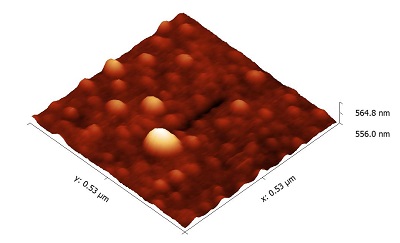
Atomic force microscopy image of a gold nanoparticle on GaAs substrate showing the trail left by its movement.
Da Silva, Prof. Cotta and their collaborators from UNICAMP and LNNano were able to find out why the growth process they used resulted in asymmetric nanowires. The main reason was the movement of the gold nanoparticles, which was thermally activated with the initial annealing. Based on that discovery, the team established a recipe for producing asymmetric semiconductor nanowires in a controlled manner. “Our work was the first to show that the mechanical instability of the nanoparticle catalyst can be used to modify the growth of semiconductor nanowires, in our case, particularly affecting their morphology,” says Bruno da Silva.
The mechanism of the asymmetric nanowires growth presented in the NanoLetters paper can be described as follow. When heated together with the substrate, the nanoparticles begin to crawl and advance through the substrate while consuming the oxide layer that naturally covers the gallium arsenide. Thus, the nanoparticles form asymmetric grooves a few nanometers deep and a few hundred nanometers long. These trails become fertile ground for the growth of the nanowires, since the deposition rate of the vapored material is greater there than in the rest of the substrate, which is covered by the oxide. A pedestal then forms along the grooves and the nanowire grows on top of the pedestal with an asymmetrical format. “We showed that the movement of the particle generates a zone of preferential deposition, and that the combination of this phenomenon with the axial growth “vapor – liquid – solid” leads to the asymmetry in the nanowire,” summarizes da Silva.
Besides describing the formation mechanism of asymmetric nanowires, the work of the Brazilian team generated detailed knowledge about the movement of heated metallic nanoparticles. “We have shown that in addition to temperature, vacuum conditions and surface quality of the substrate are crucial for nanoparticle stability, and that the motion direction is related to the asymmetry of gold dissolution on semiconductor surfaces III-V,” details the doctorate student.
Concerning possible applications, the asymmetry of these nanowires can be explored, for example, in the construction of antireflective layers that reduce the amount of light lost by reflection in solar cells. Another possibility would be to exploit the green emission of these wurtzite gallium phosphide nanowire in lighting devices. Or, why not, to develop an alternative process to electronic litography taking advantage of the gold nanoparticles movement and the trails it forms on the substrate.
The work was funded by Unicamp, the Brazilian federal agencies CNPq and CAPES and the São Paulo Research Foundation (FAPESP).
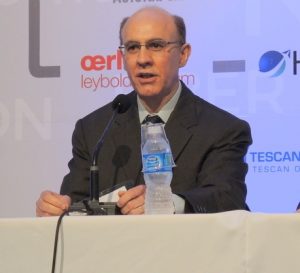
Reelected in January of this year, Professor Osvaldo Novais de Oliveira Junior (IFSC-USP) began his second consecutive mandate as president of the Brazilian Materials Research Society (B-MRS) this February, together with a partially renewed board of directors, composed of Professor Rubem Luis Sommer (CBPF) in the administration, finance and equity sector, and as scientific directors, Professors Antonio Eduardo Martinelli (UFRN), Daniel Eduardo Weibel (UFRGS), Glaura Goulart Silva (UFMG), Iêda Maria Garcia dos Santos (UFPB) and Mônica Alonso Cotta (Unicamp). This board will manage the society for two years until the end of 2019.
Currently, Professor Novais de Oliveira Junior (or “Chu”, as he is known) is a full professor at the São Carlos Institute of Physics – University of São Paulo (IFSC-USP) and associate editor of the journal ACS Applied Materials & Interfaces. With an H index of 58, his name is among the 100 scientists in Brazil of all areas with higher H index. He is author of about 500 articles and his works include nearly 15,500 citations (Google Scholar data).
In this interview, the re-elected president speaks a little about his first term in B-MRS, the management he will initiate in this new mandate and his current scientific activities.
B-MRS Newsletter: You have just completed your first term as president of B-MRS. Share with our readers your thoughts about the results achieved by the board you presided over.
Osvaldo Novais de Oliveira Junior: In the last mandate the board’s priority was to keep the Annual Meetings at a high level, despite the financial crisis Brazil’s science, technology and innovation system is undergoing. In addition to this priority, we continued the endeavors of previous boards in the internationalization of SBPMat, which include partnerships with scientific societies from other countries.
B-MRS Newsletter: – You have just accepted a new two-year term as president of SBPMat. Comment on your plans and expectations.
Osvaldo Novais de Oliveira Junior: The expectations of the Board of Directors are to be able to continue the activities that made SBPMat one of the most active and prestigious scientific societies in Brazil. The main plans I want to highlight concern working toward a greater insertion in the society, with the task of disseminating the contributions of science and technology to the country, and to increase the number of B-MRS members.
B-MRS Newsletter: About your scientific research work, share with us what you are doing.
Osvaldo Novais de Oliveira Junior: My group`s research work, in partnership with other groups in Brazil and abroad, focuses on two areas: i) the study and use of materials for biology and medicine, for example using biosensors for early diagnosis of cancer and determination of mechanisms at the molecular level of drugs to combat super-resistant bacteria. ii) the use of statistical physics methodologies and complex networks for text analysis, such as authorship identification of books and verification of multidisciplinarity in the scientific literature.
B-MRS Newsletter: If you wish, use this space to leave a message for the B-MRS members and the community that follows the news of this newsletter.
Osvaldo Novais de Oliveira Junior: I and the new board hope to have the enthusiastic support of the community, as in recent years.
TheBrazilian Materials Research Society (B-MRS) invites the international scientific community to submit symposium proposals for the XVII B-MRS Meeting.
The deadline to submit the proposals was extended until February 19th, 2018.
The XVII B-MRS Meeting will be held from September 16 to 20, 2018 in the city of Natal (state of Rio Grande do Norte, Brazil), in the convention center of Praiamar Hotel, located about 100 meters from the famous beach of Ponta Negra.The meeting chair is Prof. Antonio Martinelli, from the Brazilian Federal University of Rio Grande do Norte (UFRN).
Anyone with a doctoral degree, performing research in Brazil or abroad can submit a thematic symposium proposal on any topic within the field of Materials Science and Technology (fabrication, modification, properties, characterization and applications of materials). Proposals must be filled in online.
About B-MRS Meeting.Interdisciplinary and international, the B-MRS annual meeting is dedicated to the presentation and discussion, in English, of scientific and technological advances achieved in the field of materials. The meeting has gathered up to 2,000 participants from all Brazilian regions and dozens of other countries. Thematic symposia include oral and poster sessions and invited lectures, and are axes of B-MRS meetings program, besides plenary lectures, industrial exhibition and awards ceremony.
About Natal.Natal is the capital city of the state of Rio Grande do Norte. It was founded in 1599. The city features sea beaches, dunes, rivers, lagoons, Atlantic Forest reserves, historic buildings and a large tourism infrastructure. Also, a beatiful culture that can be experienced through music, crafts and cuisine. Natal has a modern international airport. In September, the climate of Natal, known as “city of the sun”, is dry and with average temperature of around 25°C.
Newsletter of the
Brazilian Materials
Research Society
Year 5 – issue 1. February 8, 2018.
B-MRS election process
The Electoral Commission released the results of the election. Professor Osvaldo Novais de Oliveira Jr will chair B-MRS for another two year term, accompanied by Rubem Luis Sommer (administration, finance and assets) and Antonio Eduardo Martinelli, Daniel Eduardo Weibel, Glaura Goulart Silva, Iêda Maria Garcia dos Santos and Mônica Alonso Cotta (scientific directors). The council members elected by this vote are José Antonio Eiras, Pedro Augusto de Paula Nascente, Luís Augusto Sousa Marques Rocha, Milton Sergio Fernandes de Lima and Manuel Henrique Lente.
XVII B-MRS Meeting
(Natal, Brazil, September 16 – 20, 2018)
Call for symposium proposals. The deadline was extended. You are invited to submit a symposium proposal until February 19. Know more.
Exhibitors and sponsors. 16 companies have already reserved their places in the exhibition. Companies interested in participating in the event with booths or sponsoring can contact Alexandre at comercial@sbpmat.org.br.
Organizers. The Meeting Chair is Professor Antonio E. Martinelli (Brazilian Federal University of Rio Grande do Norte, UFRN). Meet the Organization Committee.
Venue. The event will be held in the convention center of Hotel Praiamar, located a few meters from the famous beach of Ponta Negra. Know more.
City. Founded in 1599, Natal is the capital city of the state of Rio Grande do Norte. The city offers beautiful beaches, dunes, rivers, Atlantic Forest reserves, historic buildings and a complete tourist infrastructure. In addition, it has a rich culture that can be experienced through music, crafts and cuisine. The city has a modern international airport. In September, the climate of Natal, known as “city of the sun”, is usually dry with an average temperature of around 25 °C. Watch this short video about Natal.
Featured paper
A Brazilian scientific team has discovered that vulcanized natural rubber outperforms any other material already studied in its capacity to heat and cool when compressed and decompressed. This finding opens up concrete possibilities for applying rubber as a solid state refrigerant for refrigeration systems. The results, obtained in a thematic laboratory of the Brazilian Synchrotron Light Laboratory, were published in ACS Macro Letters. Know more.
Featured scientists
We interviewed 4 national winners of the last Capes Thesis Award, who defended their PhDs with works in the materials field: conductive polymers for solar cells, phase transformation in titanium dioxide and its application in self-cleaning ceramics, tribological coatings for internal combustion engines and (nano)photonic structures. See here.
History of Materials Research in Brazil
The IEA-R1 nuclear research reactor completed 60 years of operation, during which it provided neutron beams produced by nuclear fission to carry out research in several areas, including the Materials field. Although not so popular in the characterization of materials, neutrons can generate better or complementary results to those generated by X-rays. Know more.
News from the community
Professor Daniel Ugarte (IFGW-Unicamp) was awarded the 2018 TWAS Prize in Physics for his pioneering work on characterising electronic and structural properties of nanosystems. Know more.
Events
Escola de Caracterização de Nanomateriais e Nanoestruturas. Duque de Caxias, RJ (Brazil). March 5 – 9, 2018.Site.
Primer Encuentro de Jóvenes Investigadores en Ciencias de Materiales. Montevideu (Uruguay). April 13 – 14, 2018. Site.
6º Encontro Nacional de Engenharia Biomecânica (ENEBI 2018). Águas de Lindoia, SP (Brazil). May 8 – 11, 2018. Site.
8th International Symposium on Natural Polymers and Composites. São Pedro, SP (Brazil).May27 – 30, 2018. Site.
Photonic Colloidal Nanostructures: Synthesis, Properties, and Applications (PCNSPA 2018). Saint Petersburg (Russia). June 4 – 6, 2018. Site.
7th International Congress on Ceramics (ICC7). Foz do Iguaçu, PR (Brazil). June 17 – 21, 2018. Site.
International Conference on Electronic Materials 2018 (IUMRS-ICEM). Daejeon (South Korea). August 19 – 24, 2018. Site.
Symposium “Nano-engineered coatings, surfaces and interfaces” at the “XXVII International Materials Research Congress”. Cancun (Mexico). August 19 – 24, 2018. Site.
XVII B-MRS Meeting. Natal, RN (Brazil). September 16 – 20, 2018. Site.
International Conference of Young Researchers on Advanced Materials (ICYRAM 2018). Adelaide (Australia). November 4 – 8, 2018.Site.
Follow us on social media
You can suggest news, opportunities, events or reading tips in the Materials field to be covered by B-MRS Newsletter. Write to comunicacao@sbpmat.org.br.
The IEA-R1, the first nuclear reactor in Brazil and the first research reactor in Latin America, completed 60 years of uninterrupted operation. This was commemorated with an international workshop on the use of research reactors. The event was held from November 28 to December 1 2017 in the city of São Paulo, in the auditorium of the Nuclear and Energy Research Institute (IPEN), located on the main campus of the University of São Paulo (USP). According to the organizers, about 300 people from different countries participated in the event.
IEA-R1 is well known in Brazil for producing radioactive isotopes that are used in medicine, industry and agriculture, partially meeting the national needs. Examples are Iodine-131, produced in IEA-R1 since 1959 and used in the diagnosis and treatment of thyroid cancer, and Samarium-153, used as a palliative tool to treat pain in bone metastases.
In addition to providing these elements to hospitals, industries and other entities, the IEA-R1 has been used, since the beginning, in research in several areas, including the Materials area. This research filed uses beams of free neutron (neutrons that were separated from the nuclei of the atoms), generated in the nucleus of the reactor through the nuclear fission process. The interaction of the neutrons with the samples provides unique information on the structure and composition of the materials.
According to Frederico Genezini and Rajendra Narain Saxena, IPEN researchers and current and former manager of the Research Reactor Center (CRPq), respectively, neutrons have a very specific feature of interacting with matter. It is possible, through scattering, to carry out studies of crystalline structures, and since the neutron has a magnetic moment, it is also used to study the magnetic properties of materials.
IEA-R1.
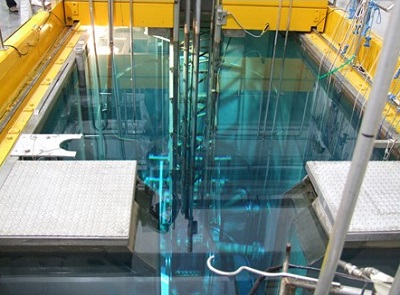
Located at IPEN, the reactor is formed by a 9-meter deep pool of deep blue waters. This color is originated by the so-called Cherenkov effect, in which charged particles (in this case, ions generated by nuclear fission) cross the medium (in this case, water) at a higher speed than light in that medium, emitting the flashy blue radiation. The pool water is contained by 1 to 3 meter thick walls constructed of very hard concrete. The bottom of the pool houses the reactor core, in which uranium is bombarded with neutrons, generating nuclear fission reactions. As a result, the nuclei of the uranium atoms are divided into two, while two or three neutrons and a large amount of energy are released (that very strong energy that holds the protons and neutrons together in the nucleus of the atom). While in the nuclear plants the released energy is harnessed, in the research reactors the most important product is the neutrons, the reason why the reactor components aim at preserving the free neutrons.
Water and concrete around the core perform important safety functions that prevent harmful levels of radiation from passing into the vicinity of the pool, where researchers, the team responsible for the reactor and the visitors circulate (about 2,000 people visit the IEA-R1 every year).
The process of producing uranium for IEA-R1 is completely carried out in Brazil. The ore is extracted and processed in the state of Bahia, enriched to a little less than 20% at the Navy Technological Center in Iperó (São Paulo state), and finally packed inside the “fuel elements”, which are then placed in the core of the reactor. Brazil belongs to the group of only 12 countries that can enrich uranium.
Neutrons to investigate matter
Around the pool – at the bottom, the IEA-R1 reactor has 12 experimental stations, in which neutron beams extracted from the reactor are available to be used in conjunction with several experimental techniques.
According to Genezini and Saxena, at present only three of the stations have equipment installed: the high-resolution neutron diffractometer, real-time neutron imaging systems, and the experimental system for boron neutron capture therapy (BNCT). However, other stations are available – on demand – for the installation of instruments. The first two facilities are very useful for studying materials, and have advantages over equivalent equipment that uses X-rays instead of neutrons. According to Genezini and Saxena, the diffractometer allows studying crystallographic structures of materials that an X-ray diffractometer cannot always observe, besides the study of magnetic structures.
“While X-rays interact with matter through electromagnetic forces, neutrons basically interact via nuclear forces,” explains Reynaldo Pugliesi, an IPEN researcher responsible for neutron imaging equipment, designed and built at IPEN and installed in one of the IEA-R1 stations. For example, a sample of 1 cm2 analyzed at this experimental station can receive about 8 million neutrons per second.
Neutron imaging provides, without destroying or damaging the samples, two or three dimension images (the latter called neutron tomography) of details that would otherwise be imperceptible to the human eye. In particular, hydrogen-rich materials (such as oil, water, adhesives and rubbers) are particularly well captured in neutron imaging, even when encapsulated in metals such as steel, aluminum and lead. In fact, the neutrons can penetrate several inches into the metals and reveal what’s inside them. Also in this regard, neutron imaging is complementary to X-ray imaging: while neutrons reveal light materials that are behind heavy materials (such as a crepe tape inside an aluminum frame), X-rays reveal heavy materials behind lightweight materials (such as the bones in the hand).
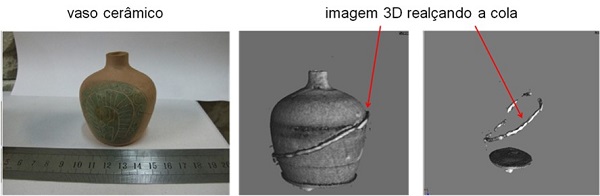
Neutron tomography: inspection of a restoration made in a ceramic vessel to check the degree of perfection of the work.
The IEA-R1 is open to the scientific and business community through collaborations with CRPq researchers. “In this model we have many examples of institutions and companies that have used the IEA-R1 neutron beams and other instruments in the CRPq laboratories for measurements,” says Genezini. According to him, other models are not possible because there are no technicians dedicated to each instrument. “However, this model has proven to be inefficient and we are investing in instrumentation and regulations to make neutron beam equipment more accessible to people outside the organization,” concludes the CRPq manager.
History
The origins of the IEA-R1 nuclear reactor date back to the mid-1950s, when the United States, under President Dwight Eisenhower, launched the “Atoms for Peace” program, which disseminated and encouraged worldwide the peaceful use of nuclear technology. In this context, Brazil and the United States signed agreements aimed at the discovery and research of uranium in Brazil and the development and use in Brazil of radioactive isotopes for agriculture and industry. For this, it was necessary to have a nuclear reactor in the national territory.
Thus, in August 1956, the Brazilian government decreed the creation of the Institute of Atomic Energy (IEA), which would later be called IPEN, to supervise the construction and operation of the IEA-R1. The construction was carried out by the US company The Babcock & Wilcox Company, accompanied by a Brazilian team led by the first director of the IEA-R1, the Brazilian nuclear physicist Marcelo Damy de Souza Santos, also the founder of the IEA. In August 1957, the construction of the reactor was completed and, on September 16 of that same year, the reactor reached the necessary conditions to start operating. The inauguration ceremony of the IEA-R1 was held on January 25, 1958, with the presence of President Juscelino Kubitschek and the State Governor of São Paulo Jânio Quadros.
With the IEA-R1, Brazil was able to develop national knowledge to produce nuclear fuel, neutron research instruments and radioisotopes that have been used in health, agriculture and in various industries. The reactor was also used to produce, through the neutron-induced transmutation technique, semiconductors for electronic components that were exported. In addition, it was used to train reactor operators and to conduct academic work. According to Genezini and Saxena, more than 250 doctoral theses and master’s dissertations were defended during this period in the areas of Nuclear Physics and Condensed Matter, and more than a thousand scientific articles were published in indexed journals.
In the near future…
Another chapter in the history of research reactors in Brazil is being written. The Brazilian Multipurpose Reactor (RMB), a more modern nuclear reactor with 30 MW of power (versus 5 MW of IEA-R1) is underway. In conjunction with its experimental stations, the RMB will be a national laboratory open to the community for research and for production of radioisotopes, installed on a 2 million m2 site in Iperó (SP).
According to José Augusto Perrotta, technical coordinator of RMB, the reactor is still in the design phase. The conceptual and basic projects have already been completed, and the detailed project is being executed. In addition, the IBAMA (Brazilian Institute of Environment and Renewable Natural Resources) license has been issued, as well as the site license of CNEN. However, the initial timeline was affected by problems related to financial resources. “The Ministry of Science, Technology, Innovations and Communications did not release the resources in 2017,” says Perrota. “The project continued with only the resources designated in 2014. Every year without resources is a year behind schedule!” he laments.
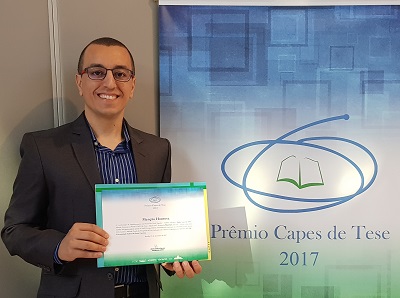
On December 7th in Brasília, the Brazilian Coordination for the Improvement of Higher Education Personnel (CAPES) awarded the prizes to the best doctoral theses defended in 2016 in graduate programs in Brazil. The authors of the theses selected received a diploma, medal and a national postdoctoral fellowship of up to 12 months, in addition to pay the travel expenses of the author and thesis supervisor to participate in the awards ceremony.
B-MRS Newsletter interviewed some of the winners, who were rewarded for their work on materials field. Meet these four young doctors and their works.
Interview with Eliézer Fernando de Oliveira, winner of the award for the best thesis in the Materials area
Eliézer Fernando de Oliveira
Thesis: Electronic structure of organic materials for applications in the active layers of solar cells.
PhD Course in Materials Science and Technology – POSMAT, State University of São Paulo Júlio de Mesquita Filho (UNESP).
Author: Eliézer Fernando de Oliveira
Advisor: Francisco Carlos Lavarda (UNESP – campus Bauru)
In his master’s thesis, Eliézer Fernando de Oliveira, who holds a degree in Physics, had already immersed in the topic of conductive polymers for solar cell application. During the PhD, his deep involvement continued, with great results. In fact, he was able to determine that by means of computational methods it is possible to predict certain properties of new polymers in order to choose, before producing them, the most suitable ones for the desired application. Using this method, Eliézer de Oliveira suggested in the thesis a series of new polymers that would be more efficient than the one used so far to convert solar energy to electric energy in solar cells. During his doctorate, Oliveira comprehensively used the computational resources of the Center of Scientific Computing of UNESP and carried out an internship at Instituto Madrileño de Estudios Avanzados en Nanosciencia (Spain). Oliveira is currently a postdoctoral fellow at Unicamp.
B-MRS Newsletter: In your opinion, what is the most relevant contribution of the awarded thesis?
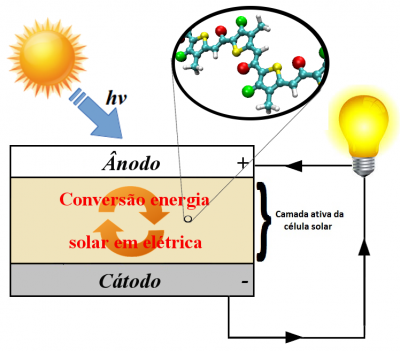
Representation of an organic solar cell.
Eliézer de Oliveira: My doctoral work focused on exploring new organic materials, more specifically conductive polymers for application in the active layers (where conversion from solar to electric takes place) of solar cells to obtain these materials in a planned way using calculation methods of the electronic structure of materials. This work contributed to the area, since we suggested several new polymers that display better electronic and transport properties than those already in use. In my opinion, most relevant aspect of the work was the fact that we demonstrated there is a way to predict in advance the electronic and optical properties of new copolymers with similar comonomers. In these types of polymers, the repeating unit (monomer) is formed by two comonomers that are similar to each other (based on the same compound), only differing the functional groups that are in each comonomer. This demonstrated, by means of a linear relation, that we can determine the electronic and optical properties of a copolymer constructed by various compositions of similar comonomers. This allows for an initial analysis to choose the copolymers that actually present a real application so that later they can be synthesized.
B-MRS Newsletter: Cite the main results generated from the award-winning thesis (papers, patents, products, startups, other awards, etc.).
Eliézer de Oliveira: Eight scientific articles related to the topic of my PhD thesis were published.
Oliveira, E. F.; Lavarda, F. C. Effect of the length of alkyl side chains in the electronic structure of conjugated polymers. Mat. Res. 2014, 17, 1369-1374 (DOI: 10.1590/1516- 1439.278814)
Oliveira, E. F.; Lavarda, F. C. Molecular design of new P3HT derivatives: Adjusting electronic energy levels for blends with PCBM. Mater. Chem. Phys. 2014, 148, 923-932 (DOI: 10.1016/j.matchemphys.2014.09.002)
Oliveira, E. F.; Lavarda, F. C. Copolymers with similar comonomers: tuning frontier orbital energies for application in organic solar cells. Polym. Eng. Sci. 2016, 56, 479-487 (DOI: 10.1002/pen.24275).
Oliveira, E. F.; Roldao, J. C.; Milián-Medina, B.; Lavarda, F. C.; Gierschner, J.; Calculation of low bandgap homopolymers: Comparison of TD-DFT methods with experimental oligomer series. Chem. Phys. Lett. 2016, 645, 169-173 (DOI: 10.1016/j.cplett.2015.12.059).
Oliveira, E. F.; Lavarda, F. C. Reorganization energy for hole and electron transfer of poly(3-hexylthiophene) Derivatives. Polymer 2016, 99, 105-111 (DOI: 10.1016/j.polymer.2016.07.003).
Oliveira, E. F.; Silva, L. C.; Lavarda, F. C. Modifying electronic properties of ICBA through chemical modifications for solar cell applications. Structural Chemistry 2017, 28, 1133–1140 (DOI: 10.1007/s11224-017-0916-0)
Oliveira, E. F.; Lavarda, F. C. Design of diblock co-oligomers as low bandgap small molecules for organic solar cells. Molecular Simulation, 2017, 43, 1496-1501 (DOI: 10.1080/08927022.2017.1321759).
Oliveira, E. F.; Shi, J.; Lavarda, F. C.; Lüer, L.; Milián-Medina, B.; Gierschner, J. Excited state absorption spectra of dissolved and aggregated distyrylbenzene: a TD-DFT state and vibronic Analysis. Journal of Chemical Physics, 2017, 143, 034903 (DOI: 10.1063/1.4993216)
B-MRS Newsletter: In your opinion, what are the main factors that led to the outstanding research at the national level (your thesis)?
Eliézer de Oliveira: A major factor was scientific funding. During my PhD I had a Fellowship from the São Paulo Research Foundation (FAPESP). This grant enabled my exclusive dedication to research, to participate in national and international conferences and to carry out an internship abroad. Another important factor regarding the theoretical computational aspect of the research was the resources provided by the Center of Scientific Computation (NCC) of the Sao Paulo State University (UNESP) that allowed the computational simulations indispensable for my research. Last but not least, I received great mentoring from my doctoral supervisor and support from my family and friends, all of which was crucial to the success of my scientific career.
B-MRS Newsletter: Leave a message to our readers who are undergraduate or graduate students.
Eliézer de Oliveira: Be patient and remain firm. Scientific trajectory depends on constant research and dedication; during this trajectory maintain a good relationship with your advisor, look for good partnerships and consider the quality of the work produced. There is much to investigate about the universe of science, as Isaac Newton said “What we know is a drop, what we don’t know is an ocean.”
Interview with André Luiz da Silva, winner of the honorable mention of the Materials area
André Luiz da Silva
Thesis: Anatase-rutile phase stability and photocatalytic activiy of Nb2O5-Doped TiO2. PhD Course in Materials Science and Engineering from the Brazilian Federal University of Santa Catarina (UFSC). Author: Andre Luiz da Silva. Advisors: Dachamir Hotza (UFSC), Ricardo H. R. Castro (UC Davis, USA) e Michele Dondi (ISTEC, Italy)
When he began his doctorate, André Luiz da Silva, Ceramics technologist with a Master’s in Materials Science and Engineering, proposed a useful contribution to the ceramic coating industry, a segment in which he had worked for 10 years. The chosen theme was the stabilization of one of the phases of titanium dioxide (TiO2) for application in self-cleaning ceramic coatings. Da Silva initially devoted his efforts to understand the scientific foundations that could help him solve the technological problem. Subsequently, the application of this knowledge led him to obtain more efficient self-cleaning ceramics than those available in the market. During his doctorate, André da Silva searched abroad for laboratory infrastructure that did not exist in Brazil and expertise through an internship at the Nanoceramics Thermochemistry Laboratory of UC Davis in the United States and another internship at the Istituto di Scienza e Tecnologia dei Materiali Ceramici (ISTEC-CNR), in Italy. At the end of his doctorate, da Silva gained in-depth knowledge on the topics covered in the thesis, fluency in English and Italian, and the satisfaction of having made contributions to science and industry. Silva is currently a postdoctoral fellow at USP.
B-MRS Newsletter: In your opinion, what is the most relevant contribution of the awarded thesis?
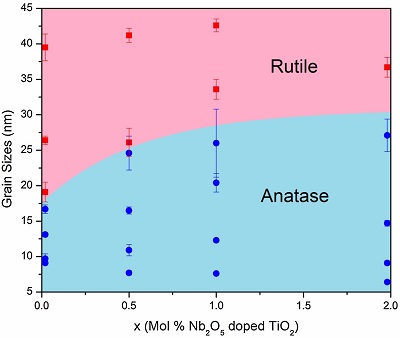
Phase diagram that predicts the anatase-rutile phase transformation as a function of grain size and dopant percentage. Blue region: region of thermodynamic stability of the anatase phase. Red region: region of thermodynamic stability of the rutile phase. The separation line between the two colors corresponds to the phase transformation crossover. Blue and red dots are experimental points, which represent the anatase and rutile phases, respectively. This diagram is published in the journal “Applied Surface Science”.
André da Silva: In my opinion, there were two very relevant contributions of the thesis.
The first concerns the scientific underpinnings of the anatase-rutile phase transformation of titanium dioxide (TiO2). It was proposed to chemically modify titanium dioxide by doping with niobium pentoxide (Nb2O5) and also understand the thermodynamic stability of the anatase-rutile phases. By means of the surface energy measurements and the enthalpy dissolution measurements, in which a non-existent laboratory structure was used in Brazil, a nanoscale phase diagram was created for TiO2 doped with Nb2O5, which predicts phase transformation through the crystallite size as a function of the chemical composition. It was observed that the doping of TiO2 with Nb2O5 thermodynamically stabilizes the anatase phase, delaying the phase transition temperature for rutile. Through the diagram it can be observed that niobium allows a larger growth of the TiO2 nanoparticles before the phase transformation occurs. This thermodynamic stability occurs through the segregation of Nb2O5 on the surface of the TiO2 nanoparticles, resulting in a decrease in the surface energy of the material.
The second contribution of the thesis is from the point of view of industrial application. The TiO2 doped with Nb2O5 in an optimized percentage was applied to the surface of ceramic coatings, which allowed the production of photocatalytic / self-cleaning ceramics with a higher performance than the current market. In addition, the proposed formulation allowed the sintering of the ceramic coatings at temperatures applicable to the industry, which was one of the major difficulties the companies faced in the manufacture of these coatings.
B-MRS Newsletter: Cite the main results generated from the award-winning thesis (papers, patents, products, startups, other awards, etc.).
André da Silva: During the time of the thesis, 9 international papers were produced, related directly or indirectly to the research theme, corresponding to high-impact indexed journals in areas related to Materials. Of these papers, I consider the first four (all in QUALIS A1 periodicals in the materials area) as the main ones related to the thesis.
DA SILVA, A. L.; HOTZA, D.; CASTRO, R.H.R. Surface energy effects on the stability of anatase and rutile nanocrystals: A predictive diagram for Nb2O5-doped-TiO2. Applied Surface Science, v. 393, p. 103-109, 2017. https://doi.org/10.1016/j.apsusc.2016.09.126
DA SILVA, A. L.; MUCHE, D.N.F. ; DEY, S.; HOTZA, D. ; CASTRO, R.H.R. . Photocatalytic Nb2O5-doped TiO2 nanoparticles for glazed ceramic tiles. Ceramics International, v. 42, p. 5113-5122, 2016. https://doi.org/10.1016/j.ceramint.2015.12.029
DA SILVA, A. L.; DONDI, M.; HOTZA, D. Self-cleaning ceramic tiles coated with Nb2O5-doped-TiO2 nanoparticles. Ceramics International, v. 43, p. 11986-11991, 2017. https://doi.org/10.1016/j.ceramint.2017.06.049
DA SILVA, A. L.; DONDI, M.; RAIMONDO, M.; HOTZA, D. Photocatalytic Ceramic Tiles: Challenges and Technological Solutions. Journal of the European Ceramic Society. https://doi.org/10.1016/j.jeurceramsoc.2017.11.039
GOMEZ, S. Y.; DA SILVA, A.L.; GOUVEIA, D.; CASTRO, R. H. R.; HOTZA, D. Nanocrystalline yttria-doped zirconia sintered by fast firing. Materials Letters (General ed.), v. 166, p. 196-200, 2016. https://doi.org/10.1016/j.matlet.2015.12.042
MIAGAVA, J.; DA SILVA, A.L.; NAVROTSKY, A.; CASTRO, R.H.R.; GOUVÊA, D. The Nanocrystalline SnO 2 -TiO 2 System-Part II: Surface Energies and Thermodynamic Stability. Journal of the American Ceramic Society, v. 99, p. 638–644, 2016. doi:10.1111/jace.13954
DA SILVA, A.L.; FELTRIN, J.; DAL BÓ, M.; BERNARDIN, A.M. ; HOTZA, D. Effect of reduction of thickness on microstructure and properties of porcelain stoneware tiles. Ceramics International, v. 40, p. 14693-14699, 2014.
DA SILVA, A. L.; FELTRIN, J.; BERNARDIN, A.M. Morphology and Fluidity of Spray-Dried Powder Transported by Compressed Air. Materials Science Forum (Online), v. 798-799, p. 334-339, 2014.
DA SILVA, A. L.; BERNARDIN, A.M.; HOTZA, D. Forming of thin porcelain tiles: a comparison between tape casting and dry pressing. Ceramics International, v. 40, p. 3761-3767, 2013.
B-MRS Newsletter: In your opinion, what are the main factors that led to the outstanding research at the national level (your thesis)?
André da Silva: There are several factors that allowed the realization/award of the work conducted. I will highlight some factors:
Planning activities in a concise but detailed and organized manner.
The support, help and teachings from the advisors, who were always present, Prof. Dr. Dachamir Hotza (UFSC), Dr. Ricardo Castro (University of California, Davis, USA) and Michele Dondi (ISTEC, Faenza, Italy), as well as the support of the Graduate Program in Materials Engineering at the Federal University of Santa Catarina (PGMAT).
My ability to accept new challenges, in search of the knowledge necessary to carry out the work and the awareness that learning must be a constant habit, certainly were fundamental for the favorable development of the thesis. In addition to technical knowledge, I also emphasize the importance of mastering a new language, especially English, which opened the door to international collaborations, conferences and writing papers.
My family’s support, especially from my wife Caroline, always by my side, providing strength and encouragement.
I also highlight the International collaborations with the University of California, Davis, USA, Dr. Ricardo Castro and the Institute of Science and Technology of Ceramic Materials, Faenza, Italy, through Dr. Michele Dondi. These collaborations were also possible thanks to the CAPES and CNPq internship programs abroad.
B-MRS Newsletter: Leave a message to our readers who are undergraduate or graduate students.
André da Silva: A graduate or postgraduate degree, especially when working with research, is done like the construction of a wall. You should lay a brick a day, that is, do a little every day, but constantly focused and dedicated. Often, because we do not see immediate results, students end up steering away and the results are not as good as expected. Focus your efforts on what will generate the most of your results, take time to study and update yourself in your area and have a well-defined end goal. Do not forget to take care of your health, have friends and family nearby. Believe in yourself and in your potential, your work is very important for our country.
Interview with Juliano Avelar Araujo, winner of the award for the best thesis in the area of Engineering II
Juliano Avelar Araujo
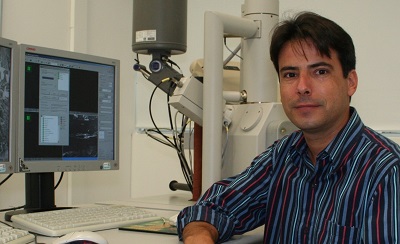
Thesis: Obtaining and microstructural and chemical characterization of multilayer NBN / CRN coatings for tribological applications by the physical vapor deposition process. PhD Course in Metallurgical Engineering from the Polytechnic School of the University of São Paulo (Poli-USP). Author: Juliano Avelar Araujo. Advisor: Andre Paulo Tschiptschin (Poli-USP).
When Juliano Avelar Araujo, a metallurgical engineer, decided to do his doctorate nine years after completing his master’s degree in Surface Engineering, he was already working as a researcher in the Mahle group, a supplier and development partner of the global automotive industry. The company supported this initiative, and Araujo was able to study in detail a multilayer coating that, when applied to components of internal combustion engines, saves fuel and consequently reduces traffic-related pollution. In the thesis, he also presented a model that allows developing other nanostructured coatings for automotive applications. Currently working on research and development projects at the Mahle Technology Center, he is taking advantage of the knowledge gained through his PhD to develop products that are likely to be marketed in 2019.
B-MRS Newsletter: In your opinion, what is the most relevant contribution of the awarded thesis?
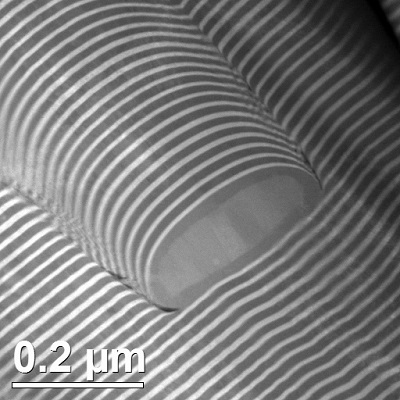
TEM of a NbN/CrN coating with periodicities of about 20 nm. Detail of a macroparticle. Credits: Juliano Araujo and Jefferson Bettini (CNPEM).
Juliano Araujo: The regulations of the automobile industry are increasingly oriented towards reducing the emission of polluting gases. Thus, components of the internal combustion engine must innovate characteristics such as mechanical losses by friction and wear reductions to obtain lower fuel consumption and consequently reduced emissions. In this line, the doctoral work explored and developed a coating that meets these characteristics, while also formulating a model that can be employed to accelerate the development of coatings to meet the functionality of the part throughout the engine’s lifespan.
B-MRS Newsletter: Cite the main results generated from the award-winning thesis (papers, patents, products, startups, other awards, etc.).
Juliano Araujo:: There were 3 articles in international publications: 2 journals (WEAR and Surface & Coatings Technology) and 1 journal (SVC), 1 paper published in annals of international conferences, 3 patent applications and the 2016 Environment AEA Award (Automotive Engineering Association ) – Honorable Mention – Academic Category, with the work “Morphology of nanostructured CrN/NbN coatings deposited by PVD,” of the authors Juliano Avelar Araujo, André Paulo Tschiptschin, Nelson Batista de Lima and Roberto Martins de Souza.
Papers:
ARAUJO, JULIANO AVELAR; ARAUJO, GISELA MARQUES; SOUZA, ROBERTO MARTINS; TSCHIPTSCHIN, ANDRÉ PAULO. Effect of periodicity on hardness and scratch resistance of CrN/NbN nanoscale multilayer coating deposited by cathodic arc technique. WEAR. , v.330-331, p.469 – 477, 2015.
ARAUJO, JULIANO AVELAR; SOUZA, ROBERTO MARTINS; LIMA, NELSON BATISTA DE; TSCHIPTSCHIN, ANDRÉ PAULO. Thick CrN/NbN Multilayer Coating Deposited by Cathodic Arc Technique. Materials Research-Ibero-american Journal of Materials. , v.20, p.200 – 209, 2017.
ARAUJO, JULIANO AVELAR; GIORJÃO, RAFAEL ARTHUR REGHINE; BETTINI, JEFFERSON; SOUZA, ROBERTO MARTINS; TSCHIPTSCHIN, ANDRÉ PAULO. Modeling intrinsic residual stresses built-up during growth of nanostructured multilayer NbN/CrN coatings. SURFACE & COATINGS TECHNOLOGY. , v.308, p.264 – 272, 2016.
ARAUJO, JULIANO AVELAR; MARQUES, G. A. Engineered PVD Coatings for Piston Rings application: Society of Vacuum Coaters. Spring Buletim, p. 46-52, 2012.
Patents:
ARAUJO, J.A.; Piston ring for internal combustion engine with a multilayer coating applied by PVD_Niobium nitride WO2009155677-A1 – PCT/BR2009/000184 (PI0901939-1) US20110148047-A1 26/06/2009. ANEL DE PISTÃO PARA MOTOR DE COMBUSTÃO INTERNA, 2009. Categoria: Produto. Instituição onde foi depositada: INPI – Instituto Nacional da Propriedade Industrial. País: Brasil. Natureza: Patente de Invenção. Número do registro: PI0901939. Data de depósito: 23/06/2009. Data da concessão: 26/09/2017. Depositante/Titular: Juliano Avelar Araujo.
ARAUJO, J. A. Multilayer CrN/Cr2N PVD, 2010. Categoria: Produto. Instituição onde foi depositada: INPI – Instituto Nacional da Propriedade Industrial. País: Brasil. Natureza: Patente de Invenção. Número do registro: PI09023399. Número do depósito PCT: 9023399. Data de depósito: 29/06/2010. Depositante/Titular: Juliano Avelar Araujo. Depositante/Titular: Mahle Metal Leve.
ARAUJO, JULIANO AVELAR; MORDENTE, P. J. R. ELEMENTO DESLIZANTE PARA MOTORES DE COMBUSTÃO INTERNA, 2016. Categoria: Produto. Instituição onde foi depositada: INPI – Instituto Nacional da Propriedade Industrial. País: Brasil. Natureza: Patente de Invenção. Número do registro: BR1020160153921. Data de depósito: 30/06/2016. Depositante/Titular: Juliano Avelar Araujo.
B-MRS Newsletter: In your opinion, what are the main factors that led to the outstanding research at the national level (your thesis)?
Juliano Araujo: I start with the teaching institution (University of São Paulo – USP/POLI) where I developed the doctoral work based on its tradition and recognized projection in the academic world, also the experienced guidance of Professors Dr. Andre Tschiptschin and Roberto Martins. Allied to this, the most modern techniques and equipment in the world were used, the exchange of experience with the most important laboratories and researchers in the area of coatings deposited by PVD, and the support and backing from MAHLE Metal Leve where I am a Research Engineer at the Technological Center. And finally, much discipline.
B-MRS Newsletter: Leave a message to our readers who are undergraduate or graduate students.
Juliano Araujo: Once or twice I thought about giving up on my doctorate because I believed I could not finish the thesis, I also thought about not enrolling in the Capes de Thesis Prize, because I felt I would not be competitive enough. We often underestimate ourselves… and sometimes it’s really good to be wrong! Do not give up!
Interview with Robson Rosa da Silva, winner of the honorable mention in the Chemistry area
Robson Rosa da Silva
Thesis: New photonic structures: I – Self assembly of 1D Te structures; II – Multifunctional biopolymers and reused plastics.
PhD Course in Chemistry from the Araraquara Institute of Chemistry of the São Paulo State University Júlio de Mesquita Filho (UNESP).
Author: Robson Rosa da Silva.
Advisors: Sidney Jose Lima Ribeiro (UNESP) and Pedro H. C. Camargo (USP)
During Robson da Silva’s doctorate there was no lack of collaborations or scientific discussions, both with Brazilian laboratories and with international groups (the latter, from the internships at the NIMS, Japan, and Georgia Institute of Technology, USA). Robson da Silva’s thesis presents a collection of nanostructures, including one-dimensional structures, produced in order to control the shape (helices, wires and tubes) from tellurium, silver and copper. The work also reports the manufacture of films based on natural and synthetic polymers. All these materials have in common their applications in the Photonics area. Robson da Silva holds a Bachelor’s degree, a Master’s and a PhD in Chemistry. He is currently a postdoctoral fellow at the São Carlos Institute of Physics at the University of São Paulo (IFSC-USP).
B-MRS Newsletter: In your opinion, what is the most relevant contribution of the awarded thesis?
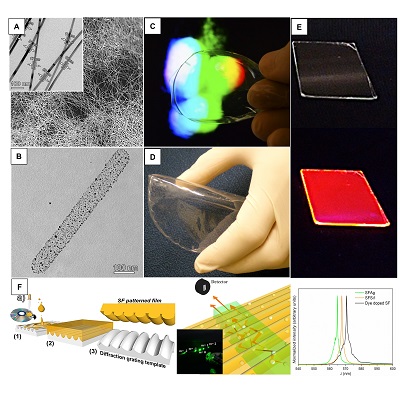
A) SEM and MET of ultra-fine silver nanowires and, B) nanohybrid phenolic resin modified with nanoparticles of gold. 1D tellurium nanostructures were used as mold of sacrifice. C) and D) Hybrid Film Photographs of fibroin and cellulose acetate, respectively, modified with fibroin epoxysilane; E) Thin films of recycled expanded polystyrene containing europium under white light illumination (upper part) and black light (lower part); F) Bragg gratings of silk doped fibroin with rhodamine obtained by the replica of the diffraction of a DVD. The introduction of light scattering nanoparticles (such as silver and silica nanoparticles) in the Bragg grids of fibroin has been shown to be efficient for laser distributed feedback.
Robson Rosa da Silva: I believe that the best description of the thesis is that it is the result of multifaceted and interdisciplinary works in the field of photonics and nanomaterials. Due to its anisotropic structure, tellurium (Te) is one of the simplest materials to produce one-dimensional structures on a nanoscale, assuming different forms such as wires and tubes. From the work developed in the master’s, we discovered a scalable synthesis route to produce nanohelices, until then not found in the literature. We used Te nanohelices and functionalized their surface with phenolic resin for developing multifunctional 1D hybrids. Regarding the preparation of optically active materials, we have demonstrated that Te nanohelices are excellent sacrificial molds for the preparation of one-dimensional hybrid structures containing metallic nanoparticles (Ag and Au) and luminescent ones based on lanthanide ions. This work includes the collaboration of Professor Katsuhiko Ariga and Dr. Lok Shrestha who supervised me during the two-month internship period at the National Institute for Materials Science (NIMS), Japan.
I worked under Prof. Younan Xia of the Georgia Institute of Technology, USA, for one year, and continued working with one-dimensional nanostructures, however, obtained through metals such as silver and copper. During this period, I adapted the polyol synthesis to obtain ultrafine silver nanowires and collaborated with two other works related to the synthesis of ultrafine copper nanowires and silver nanorods. I also investigated the preparation of photonic crystals and magnetic nanocomposites encapsulated in metallic particles.
The thesis presents a series of studies that evaluate the potential of biopolymers (natural polymers and their derivatives) as host matrix for the incorporation of optically active species. In this case we evaluated luminophores (nanoparticles and complexes) derived from lanthanide ions. Some of the matrices investigated are soluble derivatives of cellulose, fibroin extracted from the cocoon of silkworms and cellulose biosynthesized by bacteria. These matrices can be processed in the form of transparent films, micrometric waits, sponges, etc., and also modified with dielectric, magnetic and metallic nanoparticles to produce functional materials.
Although biodegradable and transparent in the visible region, films derived from these biopolymers have few functional groups and are fragile. One of the contributions of this thesis is the successful modification of these matrices with organic-inorganic hybrids based on epoxysilanes by the sol-gel process and the simultaneous incorporation of lanthanide ion-based luminophores. This allowed producing films with excellent optical quality, rich in functional and non-cytotoxic groups and with superior mechanical properties compared to the pure biopolymer matrix with potential application in biophotonics.
In particular, we have demonstrated that silk fibroin is an extremely interesting matrix for replicating diffraction gratings and for harboring light scattering nanoparticles. Together with physicists from the Federal University of Pernambuco, we combined these materials to evaluate the synergism of a hybrid laser system formed by a distributed feedback laser and a random laser.
Finally, we investigate the recovery of plastics, whose recycling by traditional routes is not attractive, for the manufacture of high-optical quality thin films and with the potential to be used as wave guides. Some of the plastics studied include expanded polystyrene (Isopor®) and polycarbonate. The most important contribution is the fact that we used a dissolution route based on green solvent derived from plants, which allow incorporating emitting luminophores in the visible region.
B-MRS Newsletter: Cite the main results generated from the award-winning thesis (papers, patents, products, startups, other awards, etc.).
Robson Rosa da Silva: The results of the studies investigated during the doctoral period were published in scientific journals, book chapters and patents, besides national and international conferences.
From these publications, I would highlight the following works:
ACS Applied Materials and Interface: Fabrication of Biocompatible, Functional, and Transparent Hybrid Films Based on Silk Fibroin and Epoxy Silane for Biophotonics. v.9 (33), 27905-27917.
ACS Nano: Facile Synthesis of Sub-20 nm Silver Nanowires Through a Bromide-Mediated Polyol Method. v. 10 (8), 7892-7900, 2016.
Journal of Materials Chemistry C: Silk fibroin biopolymer films as efficient hosts for DFB laser operation. v.1 (43), 7181-7190, 2013
Journal of Sol-Gel Science and Technology: Multifunctional organic–inorganic hybrids based on cellulose acetate and 3-glycidoxypropyltrimethoxysilane. v.81(1), 114–126, 2017.
ACS Nano: Facile synthesis of Ag nanorods with no plasmon resonance peak in the visible region by using Pd decahedra of 16 nm in size as seeds. v.9 (10), 10523-10532, 2015.
B-MRS Newsletter: From your point of view, what are the main factors that led to the outstanding research at the national level (your thesis)?
Robson Rosa da Silva: I believe that the factors that allowed conceiving the works that comprise the thesis arise from when we identified the balance between opportunity, confidence and pleasure in what is being done.
The main factor I emphasized here was the support, guidence, credibility and friendship of Professor Sidney J. L. Ribeiro. The dynamic mentoring I received has certainly helped to spark a definite variety in the research, sowing opportunities to interact with high-level researchers and research centers of excellence. The Laboratory of Photonic Materials in Araraquara has always advanced an environment of rich scientific discussions and collaborations, as well as provide an excellent infrastructure for the characterization of the materials in this thesis.
I attribute the research success to the co-orientation of Prof. Pedro Camargo from USP in São Paulo, who undoubtedly helped perfect the thesis with very productive and challenging discussions.
The internships abroad were in fact one of the factors that positively allowed to accomplish high quality work. Posture, professionalism, administration and discipline in research are values that have contributed greatly to my evolution as a researcher.
I also think it is very important to supervise and coordinate scientific activities in the post graduate program. The assistance of these researchers was indispensable to carry out the projects. Moreover, assemble an efficient and solid network of collaborators during my post-graduate studies has been an essential point to develop the research carried out. y of Microscopy of the National Laboratory of Nanotechnology and the institutional infrastructure of the National Institute of Photonics (INFO) was fundamental, in addition to the financial support of CAPES and FAPESP (13/12367-6) during the doctorate.
Above all, family support was crucial.
B-MRS Newsletter: Leave a message to our readers who are undergraduate or graduate students.
Robson Rosa da Silva: The message I would like to leave is inspired by a phrase I saw during the internship at NIMS, of unknown authorship: “The fruits of your research are proportional to the number of conversations with others.” So talk, question, but also listen, interpret the criticisms and do not stop trying to seriously solve the daily demands that surround us… and there are many. In research, feel uncomfortable because everything that is very comfortable creates inertia.
[Paper: Giant Barocaloric Effects in Natural Rubber: A Relevant Step toward Solid-State Cooling. N. M. Bom, W. Imamura, E. O. Usuda, L. S. Paixão, and A. M. G. Carvalho. ACS Macro Lett. 2018, 7, 31-36. dx.doi.org/10.1021/acsmacrolett.7b00744]
Rubber under Pressure for Solid-State Cooling
A team of researchers from Brazil has found that vulcanized natural rubber prevails over any other material already studied in its capacity to change temperature by being compressed and decompressed – a phenomenon known as “barocaloric effect.”
The discovery opens up interesting possibilities of using vulcanized natural rubber in advanced applications, especially in the area of “solid-state cooling.” This term refers to refrigeration systems (such as refrigerators or air conditioners) that are based on the use of solid state refrigerant materials to absorb the heat of the system to be cooled and transferred to an external environment. Conventional devices use fluids (gaseous and liquid states). The research was reported in an article recently published in ACS Macro Letters, a journal of the American Chemical Society publisher in the field of Polymer Science and the related matters, whose impact factor is 6,185.
“Since natural rubber heats up when pressed (more than 20 degrees above the initial temperature) and cools when the pressure is released (at least 20 degrees below the initial temperature), we believe it can be used as refrigerant material in a refrigerator,” explains Alexandre Magnus Gomes Carvalho, researcher at the Brazilian Synchrotron Light Laboratory (LNLS) and corresponding author of the article.
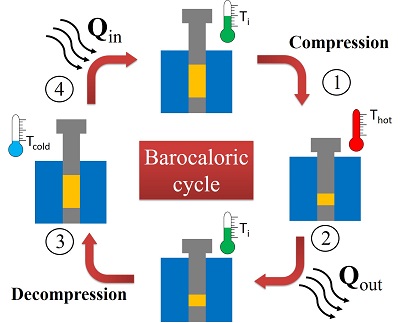
Schematic representation of the barocaloric cycle, based on confined compression and decompression processes.
The representation of the barocaloric cycle of a solid material, shown on the side, gives an idea of how vulcanized natural rubber can cool a system, removing heat from it and releasing it to the external environment. In process 1 of the cycle, the rubber (represented by the yellow rectangles) compresses quickly and consequently its temperature increases abruptly (Thot). In process 2, pressure on the rubber is kept constant, but its temperature is reduced by releasing heat to the external environment for thermal equilibrium. Interestingly, in nature two bodies or systems with different temperatures tend to seek thermal equilibrium – the state in which both temperatures are equal. This equilibrium is achieved by transferring heat from the system or hotter body to the cooler one. In process 3 of the cycle, when the rubber reaches its initial temperature (Ti), the pressure rapidly drops, causing the rubber temperature to decrease abruptly (Tcold). In process 4, the external environment transfers heat to the rubber, again for thermal equilibrium. When the rubber reaches the initial temperature, the cycle resumes from a new compression process.
To investigate the barocaloric effect of rubber, Carvalho and the other authors of the paper used samples of vulcanized natural rubber of about 1 cm in diameter. They carried out a systematic study changing the pressure exerted on the samples and their initial temperature and measuring the temperature and entropy variations (both directly related to the heat variation of a system). The experiments were carried out at the Laboratory of i-Caloric Materials (LMiC), one of the thematic laboratories of LNLS, at CNPEM, whose coordinator is Alexandre Carvalho.
After obtaining the experimental measurements of the barocaloric properties of vulcanized natural rubber, the researchers compared them with the results, found in the scientific literature, of other materials with giant or large barocaloric effect. In this comparison, vulcanized natural rubber surpassed all its “competitors.”
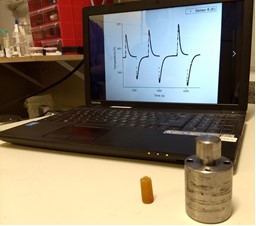
Foreground: pressure cell and sample of vulcanized natural rubber subjected to several cycles of compression and decompression. Background: chart showing temperature measurements as a function of time for different pressure variations.
The barocaloric effect of vulcanized natural rubber also has advantages with respect to caloric effects generated from the application of a magnetic or electric field, for example – effects that are also studied for solid refrigeration applications. In fact, while relatively low pressures have generated a giant caloric effect on rubber, to produce significant magnetocaloric and electrocaloric effects, very high fields and much more expensive materials than natural rubber are necessary, explains Carvalho.
Besides reporting for the first time in the scientific literature the giant barocaloric effect of vulcanized natural rubber, the paper in ACS Macro Letters contains another important scientific contribution. “The second major contribution is the fact that, for the first time, the effect of the glassy transition of a polymer on the barocaloric effect has been shown,” states Carvalho. The glass transition is a reversible change that occurs in rubber and other materials at a certain temperature. Above the transition temperature, the polymer chains of the rubber acquire more mobility, making the material “rubbery” (more flexible and less hard). Below that temperature, the mobility of the chains decreases and becomes “vitreous” (rigid and relatively brittle). In the ACS Macro Letters article, the authors proposed that the temperature and entropy changes that derive from the compression and decompression of natural rubber are related to the heat generated by the mobility of the polymer chains. Compression of the rubber would lead to a decrease in mobility, which would explain the much lower temperature changes in the vitreous state than in the rubbery state.
As for the application of the discovery, the cooling mechanism based on the barocaloric effect of solid state materials may seem simple, but transferring it to a real device is not easy. “The barocaloric effect on different materials has been studied for several years, but there is still no barocaloric refrigerator prototype patented or described in a paper, as far as we know,” says Carvalho. “Despite the difficulties, we are considering developing a prototype together with researchers from the Department of Mechanical Engineering at the Brazilian State University of Maringá (UEM),” he announces.
History of the work
The idea of the work reported in ACS Macro Letters began in mid-2016 at CNPEM, when the researcher Alexandre Carvalho, the postdoc Nicolau Bom and the student Érik Oda Usuda came across a paper on the elasto-caloric effect of natural rubber (the temperature variation induced by stretching the material), published in Applied Physics Letters. The scientific trio then wondered if an equivalent effect would occur if the rubber were compressed rather than stretched. “More specifically, we wanted to know what would happen in a confined compression,” Carvalho details. They performed the first tests with simple equipment: a pressure cell developed by them and a manual hydraulic press to apply different loads. To prepare the sample, the team used an old school eraser turned into a billet to be fitted into the pressure cell. “The results were encouraging, as we observed that the rubber heated and cooled about 10 degrees from ambient temperature under a relatively low pressure range,” says Carvalho. In early 2017, PhD student William Imamura and postdoc Lucas Soares de Oliveira Paixão joined the group and also devoted their efforts to studying the barocaloric effect of vulcanized natural rubber and other polymers. “We improved our experimental apparatus and our methodology, culminating in the results published in ACS Macro Letters, which will be part of Érik Usuda’s master’s dissertation,” relates Carvalho, who coordinates the LMiC as well as the LNLS XRD1 beamline. In this line, which will be transferred to Sirius (the latest generation synchrotron light source under construction at CNPEM), studies of thermomechanical properties of polymers can be carried out simultaneously with synchrotron radiation analyses, announces Carvalho.
The research was carried out with funding from Brazilian agencies Fapesp, CNPq and Capes, and also LNLS and CNPEM funding.
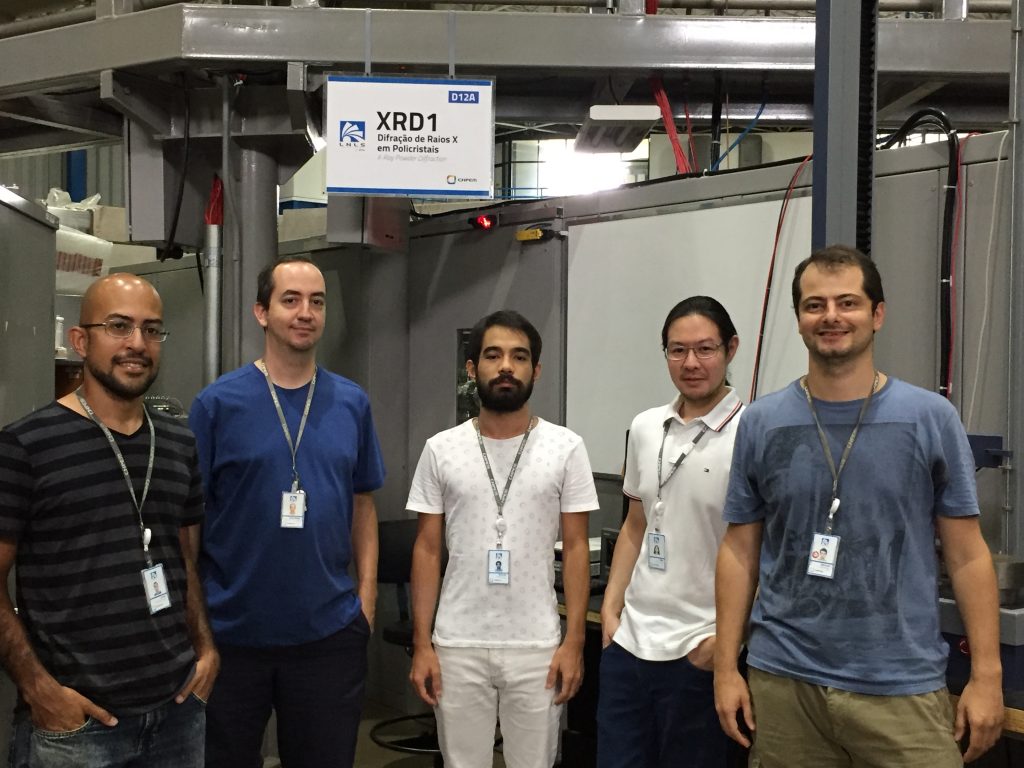
The authors of the paper in the XRD1 beamline. From left, Lucas Soares de Oliveira Paixão (LNLS postdoc), Alexandre Magnus Gomes Carvalho (LNLS researcher), William Imamura (PhD student at Unicamp and LNLS), Érik Oda Usuda (master student at Unifesp and LNLS), and Nicolau Molina Bom (LNLS postdoc).
Informamos que a partir do dia 05/01/2018 estarão abertas até dia 26/01/2018 as votações para a escolha da Diretoria Executiva e dos novos membros do Conselho Deliberativo da SBPMat. Esclarecemos que a votação será feita diretamente no portal da SBPMat no endereço www.sbpmat.org.br.
Em reunião realizada hoje dia 29/12/2017 foi homologada a chapa candidata à Diretoria abaixo:
Presidente: Osvaldo Novais de Oliveira Junior.
Diretor de Administração, Finanças e Patrimônio: Rubem Luis Sommer.
Diretores Científicos: Antonio Eduardo Martinelli, Daniel Eduardo Weibel, Glaura Goulart Silva, Iêda Maria Garcia dos Santos e Mônica Alonso Cotta.
Neste arquivo, disponibilizamos a proposta de programa elaborada pela chapa candidata à Diretoria Executiva.
Além disso divulgamos abaixo os candidatos que mostraram interesse em serem votados para o Conselho Deliberativo:
José Antônio Eiras – UFSCar
Luis Augusto Rocha – UNESP
Manuel Henrique Lente – UNIFESP
Milton Sergio Fernandes de Lima – CTA
Pedro Augusto de Paula Nascente – UFSCar
Sydney Ferreira Santos – UFABC
Informamos também que todos os sócios em situação regular junto à SBPMat estão aptos a votarem.