
Sorry, this entry is only available in Brazilian Portuguese.
Author: Verónica Savignano
B-MRS Newsletter. Year 5, issue 12.
|
||||||||||
|
||||||||||
|
New Year Message.
With this New Year message, I greet the entire B-MRS community in Brazil and abroad.
The year of 2019 was once again a major challenge for science, technology and innovation in Brazil, as well as for public universities. B-MRS concern with the scenario in the country was expressed in public notes and in the manifestation entitled Carta de Camboriú, which once again highlighted the fundamental role that knowledge generation and transfer plays in society. In 2020 we need to remain attentive to the actions and policies implemented by governments at different levels, as Brazil’s sustainable development cannot be expected without this generation of knowledge, today essentially done by universities and public organizations. There will be no development if the diligent work of researchers from Brazil is not accompanied by continued funding. No country in the world has developed or develops without public resources to build a technological base.
Despite the difficulties mentioned, the resilience of the Brazilian scientific community, and that of materials research in particular, made major contributions in 2019. Many of them were recorded in B-MRS monthly newsletters and our other communication channels. Our annual meeting in Balneário Camboriú had a record number of registrations and one of the largest audiences of all time. The enthusiasm of students and researchers was in stark contrast to the justified pessimism since the beginning of the year. This gives us reason for optimism in 2020, and B-MRS will continue its efforts to provide a space for debate and dissemination of the scientific-technological contributions of researchers from Brazil and abroad.
After two terms, ending in February 2020, at the head of B-MRS, this is my last message as president. I would like to thank very much my Board and Council colleagues, and I wish the whole materials research community health and success in 2020, looking forward to meeting many of you in Foz do Iguaçu (PR), from August 30 to 3 September, for our next meeting.
Professor Osvaldo Novais de Oliveira Junior
B-MRS President

B-MRS members are editors of an Elsevier book on nanocomposites for photonics and electronics.

Professor Luciana Reyes Pires Kassab (Faculdade de Tecnologia de São Paulo / CEETEPS) and Professor Sidney José Lima Ribeiro (UNESP – Araraquara Campus), both B-MRS members, are co-authors of the book “Nanocomposites for Photonic and Electronic Applications”. Also participating in the edition was Professor Raúl Rangel-Rojo, from Universidad Autónoma Metropolitana (Mexico). The work of editing the book was motivated by an invitation from Elsevier.
Recently published by Elsevier, the book addresses the applications of nanocomposites in photonics, electronics, optics, biophotonics and renewable energies, as well as their properties and preparation and characterization techniques. More information about the book: https://www.elsevier.com/books/nanocomposites-for-photonics-and-electronics-applications/pires-kassab/978-0-12-818396-0
B-MRS member wins the prize to the best Brazilian doctoral thesis in the Materials field.

B-MRS member Miguel Henrique Boratto won the prize to the best doctoral thesis in Materials Science defended in Brazilian institutions in 2018. The prize was awarded by Capes, the Brazilian federal government agency under the Ministry of Education, responsible for quality assurance in undergraduate and postgraduate institutions in Brazil.
Boratto´s doctoral dissertation, entitled “Semiconducting and insulating oxides applied to electronic devices “, was defended in 2018 in the Graduate Program in Materials Science and Technology of Unesp-Bauru, and conducted under the guidance of Professor Luis Vicente de Andrade Scalvi.
Boratto received the award in Brasilia on December 12th.
Papers by the materials community in the Annals of the Brazilian Academy of Sciences.
 Seven scientific articles on topics in the area of materials are part of the latest volume of the Annals of the Brazilian Academy of Sciences (AABC). This is the result of the AABC call for articles in 2018, made in partnership with B-MRS, with the theme “Materials Sciences for a Better Future”. “This was a great opportunity to celebrate the success of materials research in Brazil,” says Professor Frank Crespilho, associate editor of AABC. To participate in the call, the authors submitted their work through the journal’s website at SciELO (an electronic library covering a selected collection of Brazilian scientific journals).
AABC publishes scientific articles from all fields of knowledge, and Materials Science and Technology works are welcome in all editions. AABC publications are free of cost to authors and open access. More information for authors can be found at http://www.scielo.br/revistas/aabc/iinstruc.htm.
According to the president of B-MRS, Professor Osvaldo Novais de Oliveira Junior, the growing importance of materials research has been revealed in major technological advances in all areas. In this context, B-MRS has played the role of bringing together students and researchers from Brazil, and their collaborators from other countries. “The partnership with the Brazilian Academy of Sciences is an important milestone of this performance of B-MRS, consolidated with this series of articles published in the Annals of the Brazilian Academy of Sciences,” says the president of B-MRS. “The quality of the articles and variety of topics in this edition of the Annals are representative of the strength of the materials research community in Brazil,” he adds.
Published articles can be accessed free of charge (open access) in volume 91, number 4 of the Annals of the Brazilian Academy of Sciences. Following is the list of articles on topics in the area of Materials published in this issue of the magazine:
- “Metallic Phthalocyanines: impact of the film deposition method on its supramolecular arrangement and sensor performance” http://www.scielo.br/pdf/aabc/v91n4/0001-3765-aabc-91-04-e20181201.pdf
- “Materials from renewable resources: new properties and functions” http://www.scielo.br/pdf/aabc/v91n4/0001-3765-aabc-91-04-e20181160.pdf
- “Proteins and Peptides at the Interfaces of Nanostructures” http://www.scielo.br/pdf/aabc/v91n4/0001-3765-aabc-91-04-e20181236.pdf
- “Weathering Resistance of Waterborne Polyurethane Coatings Reinforced with Silica from Rice Husk Ash” http://www.scielo.br/pdf/aabc/v91n4/0001-3765-aabc-91-04-e20181190.pdf
- “Hydrogen production from aqueous glycerol using titanate nanotubes decorated with Au nanoparticles as photocatalysts” http://www.scielo.br/pdf/aabc/v91n4/0001-3765-aabc-91-04-e20190082.pdf
- “Dendritic Gold Nanoparticles Towards Transparent and Electroactive Electrodes” http://www.scielo.br/pdf/aabc/v91n4/0001-3765-aabc-91-04-e20180817.pdf
- “Size and shape-controlled nanomaterials based on modified polyol and thermal decomposition approaches. A brief review” http://www.scielo.br/pdf/aabc/v91n4/0001-3765-aabc-91-04-e20181180.pdf
B-MRS member is awarded a Royal Society – Newton Advanced Fellowship.

Prof. Carlos Alejandro Figueroa (UCS) has been selected by the Royal Society, one of the oldest and most renowned scientific societies in the world, based in London, to receive a Newton Advanced Fellowship, with which he will develop research over two years on ultra-low friction materials in collaboration with a group from the University of Southampton (UK).
Figueroa is a member of B-MRS and was elected member of the Deliberative Council of the Society for 2020-2024.
(Português) Concurso para professor de Química Teórica Computacional na UFSCar.
B-MRS Newsletter. Year 6, issue 11.
|
|||||||||||||||||||||
|
|||||||||||||||||||||
|
Featured paper: Defect-free doped graphene for use in electronic devices.
Graphene-based products are already being used by manufacturers, from heat-dissipating helmets to antistatic packaging. However, this wonderful material, as it is often called, still has much to deliver to society. As it is two-dimensional, flexible and excellent conductor of electricity, among other properties, graphene can be the basis of a series of high-performance miniaturized electronic and optoelectronic devices. However, this requires producing, at an industrial scale, a graphene whose network of atoms is free of unwanted impurities, but which contains, besides the carbon inherent in the graphene, small amounts of other elements (doping) in order to control its electronic properties.
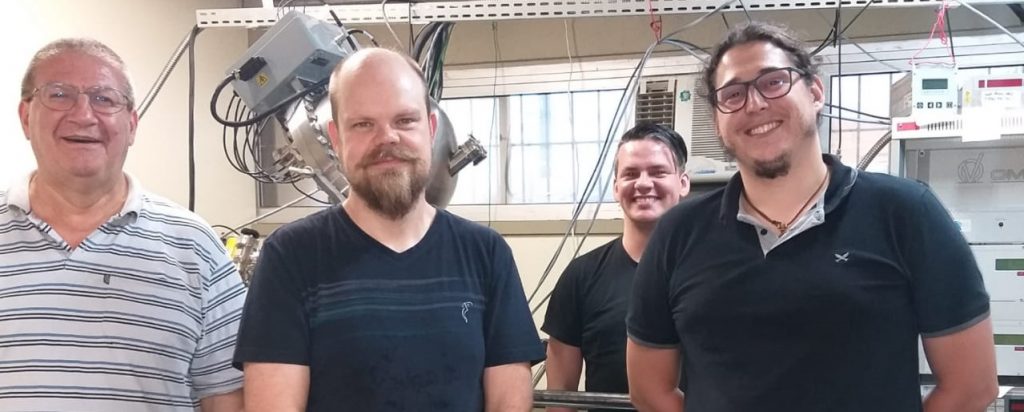
In a work totally carried out in Brazil, a scientific team has proposed a process that can help produce large-scale graphene that is suitable for electronic devices. “The process developed in our group allows us to improve and adjust the graphene properties, as well as the removal of contaminants from its surface,” said Professor Claudio Radtke (UFRGS), corresponding author of an article reporting the study, recently published in The Journal of Physical Chemistry C.
The team acquired graphene samples produced by chemical vapor deposition (CVD) and transferred to silicon substrates. This technique is currently one of the most suitable for large-scale production of relatively large area graphene sheets, but it leaves residual impurities and generates defects in the graphene. To remove impurities, it is common to apply a heat treatment in an atmosphere of carbon dioxide (CO2), which is efficient in removing contaminants, but ends up generating new defects in the graphene sheet. The good news is that these defects can be neutralized (passivated).
While looking for strategies to passivate these defects, then PhD student Guilherme Koszeniewski Rolim found a scientific paper from 2011, which pointed to, through theoretical calculations, the possibility of using nitric oxide (NO) to passivate graphene defects with nitrogen atoms, while doping it to modulate its electronic properties (mainly transforming it into a semiconductor material, an essential condition for using graphene in electronic devices).
The team then decided to experimentally verify the theoretical prediction and, after performing the traditional treatment with CO2 at 500 °C, they applied a second heat treatment to the samples, this one in nitric oxide atmosphere and at different temperatures, from room temperature to 600 °C.
After the process, the researchers used various characterization techniques to check the results and gladly confirmed that nitrogen doping had taken place and that it had passivated the defects, thus improving the material’s electronic properties. However, the researchers also noted an unwanted effect of nitric oxide treatment: etching of graphene sheets at some points. After much scientific work, the team was able to determine the cause. During heating, there was a conversion of NO to NO2, which, as it is a much more reactive compound than the former, eventually oxidized the graphene.
However, the Brazilian team found a solution to this problem. The “eureka” moment occurred as the researchers were trying to determine the amount of nitrogen atoms that had been incorporated into graphene using a technique based on the analysis of nuclear reactions triggered by the effect of an ion beam on the graphene samples. In order to apply this technique, the team had to use an isotopically enriched nitric oxide in the heat treatment, which has a purity of 99.9999% instead of 99.9% of the gas previously used.
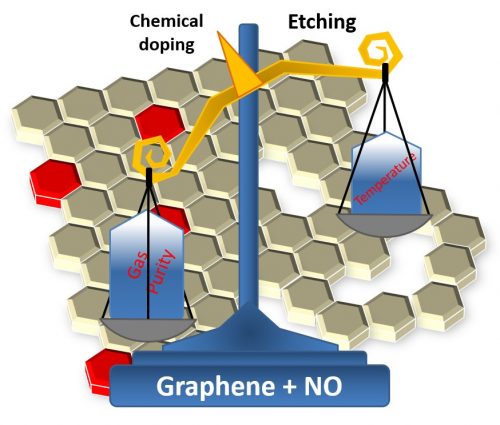
The analysis did not yield the expected results as it failed to quantify nitrogen, which was below the detection limit. However, the use of the enriched gas eventually brought great satisfaction to the team. Indeed, when the researchers compared the electronic properties of both sample types, they found that graphene treated with enriched gas always had superior properties. “Initially, such a result created much confusion in the interpretation of the results,” says Professor Radtke. “But after a few more experiments, it became one of the most important points of the article, highlighting the importance of gas purity during processing,” he adds. Specifically, the conclusion was that by properly controlling the temperature and purity of the gas during the treatment one can eliminate the problem of oxidative graphene degradation.
Thus, based on solid knowledge and scientific method, as well as some serendipity, the UFRGS team was able to develop a process of waste removal, defect neutralization and graphene doping, which improved the electronic properties of the material without producing deleterious side effects. Because it is a heat treatment in a gas atmosphere, a step that is now part of the industrial production of graphene, the process proposed by the Brazilian team could be easily applied in the production of graphene sheets for devices.
“The insertion of heteroatoms (such as nitrogen) into the graphene network without the degradation of its properties is especially important in the production of optoelectronic devices, high speed transistors, low power electronics and photovoltaic cells,” says Radtke, noting that manufacturing these graphene-based devices may be a reality in years to come. “The Graphene Flagship (European consortium of industries, universities and institutes) has announced the implementation of a pilot plant to integrate graphene at different production stages of devices as early as 2020,” comments the professor from UFRGS.
The study, which was funded by the Brazilian agencies CNPQ (mainly through INCTsNamitec and INES), Capes and Fapergs, was developed within the PhD in Microelectronics by Guilherme Koszeniewski Rolim, held at the UFRGS Graduate Program in Microelectronics and defended in 2018. The experimental work was carried out at the UFRGS Solid Surface and Interfaces Laboratory and the Brazilian National Synchrotron Light Laboratory.
[Paper: Chemical Doping and Etching of Graphene: Tuning the Effects of NO Annealing. G. K. Rolim, G. V. Soares, H. I. Boudinov, and C. Radtke. J. Phys. Chem. C, 2019, 123, 43, 26577-26582. https://doi.org/10.1021/acs.jpcc.9b02214.]