

Author: Verónica Savignano
The manufacturing of LNLS accelerators and the national materials, by Prof. Cylon Gonçalves da Silva.
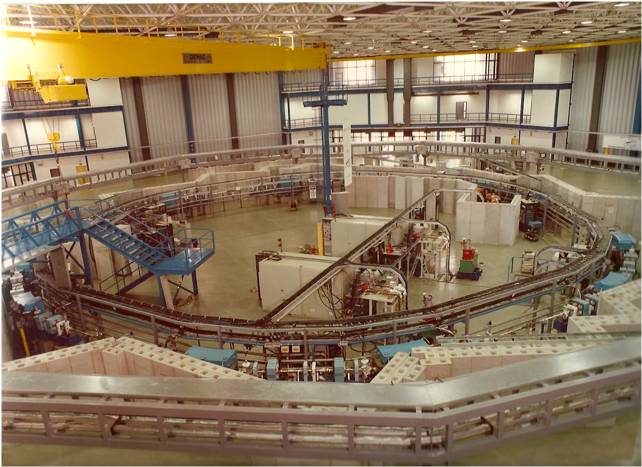
When we started the construction of LNLS, in 1986, and much before that, in its “pre-history”, there already was the intention of involving the Brazilian national industry in the construction of the equipment. Looking back from 2015, it is difficult to imagine what the Brazilian industry was in 1985. It is even more difficult to conceive that, in some sectors, among them the metal-mechanical sector, it was more sophisticated than it is today. The opening of the Brazilian economy, required, but conducted in a confused and trapping manner by Collor Government, terminated with a good part of the most sophisticated industry that was in Brazil at that time. Out of all the materials required to construct the accelerators, two got highlight for their weight (literally): steel and copper. To the magnets and vacuum chambers, we needed steel, and to the coils of the electromagnets we needed OFHC copper with low content of oxygen.
I remember the visit made to our hangar, by an specialist in ultra-high vacuum of Balzers that states to us, in an arrogant manner, that “it is impossible to manufacture ultra-high vacuum chambers” with Brazilian steel. “You will have to import”. It is not required to say that it was a wonderful incentive so that we would look for a Brazilian supplier to our needs. Ricardo and I shared a healthy disregard to such type of specialist. I think we both thought, without speaking up, each time we´ve heard statements of such type, more or less the same thing: “Ah, yes! No way? You will see!” To the manufacturing of the magnets and vacuum chambers, there were two questions not answered. There would be in Brazil steel with the required characteristics? And the laser-cutting method that we intended to use would not affect in a negative manner the magnetic properties of the material on its edges? No one has used such technique to manufacture precision electromagnets until LNLS considered it as an option, given the very special conditions we were facing. When we started, no one had the answers to such questions. The experience showed that there was the required steel in Brazil, for the magnets (SAE1006, acquired in the national market and re-laminated by Mangels), as well as for the chambers (AISI 316L), and that the laser cutting was a feasible and very flexible technique to the production of batches relatively small of electromagnets*. This, naturally, did not occur from night to day. In another occasion, we could told the long history of the development of the processes for steel, for example, the vacuum chambers cleaning and welding, and, for the magnets, the improvement of the magnetic properties.
Another history, funnier, is the one of copper for the coils of the electromagnets. CERN has recommended the Finnish company Outokumpu to us, which was their supplier. It is clear that, with such recommendation, we were calm regarding the quality of the Finnish product. But, I was not satisfied with having to import copper. A research revealed the existence of Termomecânica in São Paulo, property of Salvador Arena. Referencing to my “specialists”, all of them were unanimous in two points: it was a best-quality company and a company owned by an exceptional businessman, one of the most dedicated to the technological development of his products, only a little moody. I thought he fitted in the profile of a potential supplier to LNLS, and there I went to explain the LNLS project and its needs to him. I was welcomed, I have heard for hours an explanation on the beautiful educational program that was the project of his heart, I could expose our project in a brief manner, but Arena was precise about it – “I do not enter in such business. I do not want anything with the government. I will not go right. Forget it, you will not reach it. Termomecânica will not supply to you.” (I put the text between quotes, safeguarding that they could not have been Arena’s exact words, but the sense is the same.)
I confess I got disappointed, but the talk was not in vain. It served to me to understand how he thought, and to outline a strategy to convince him. We imported, with the help of CERN, a ton of OFHC copper from Outokumpu (a fraction of what we needed) in the specifications required to the coils of the dipole of the ring. The copper supplied by Outokumpu was OFHC/OFE – 99.99% minimum Cu with up to 0.0010% max of oxygen. As soon as the material arrived, I called to Salvador Arena to tell him: “You did not want to supply, I imported from Outokumpu, your competitor”. What was heard on the other side of the line cannot be reproduced in the profusion of the insulting words where Arena was prodigal. Underneath, I was referred to as frivolous and unreliable, and he assured me in the most emphatic terms that he has never said that Termodinâmica would not provide us with the copper of low content of oxygen we needed. And he virtually ordered me to go back there immediately with the specifications that they would develop the material to us. And it was what they did. Thanks to Outokumpu’s import strategy, the copper supplied by Termomecânica is until today complying with its role with distinction, not only in the dipoles, but in all electromagnets of LNLS (OHFC/OF certificate – 99.95% minimum Cu + Ag with up to 0.0010% max of oxygen, but with OFE quality). Also here, there is a long story of development made by the LNLS team, from the materials up to the finished product. But, let’s leave it to another opportunity.
Prof. Cylon Gonçalves da Silva
* I thank Guilherme Franco, Osmar Bagnato, and Ricardo Rodrigues, of LNLS team, for having refreshed my memory on the types of steel deployed, as well as the technical details of OFHC copper.
Professor Victor Pandolfelli appointed Associate Editor of the Journal of the American Ceramic Society.
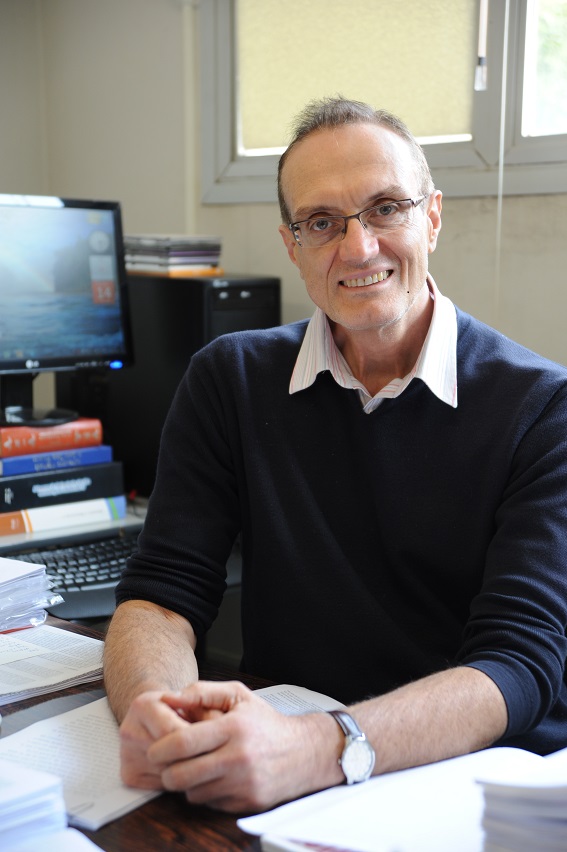 The researcher Victor Carlos Pandolfelli, full professor of the Materials Engineering Department at the Federal University of São Carlos (UFSCar) was appointed associate editor of the Journal of the American Ceramic Society. The scientific magazine has occupied the first ranks in the area of Material Science – Ceramics in the Journal Citation Reports by Thomson Reuters.
According to Pandolfelli, in the 98 years of existence of the journal, it is the second time a Brazilian scientist is chosen for such position. Professor José Arana Varela, current CEO at the São Paulo Research Foundation (FAPESP), was, until the appointment of Pandolfelli, the only Latin-American to belong to the group of associate editors.
Pandolfelli is full member of Brazilian Sciences Academy, of the World Academy of Ceramics and of the Brazilian National Engineering Academy, fellow of the American Ceramic Society, and guest professor of Wuhan University of Science and Technology (China). Pandolfelli is member of the editorial committee of 12 technical magazines in the area of ceramic materials. He is member of the advisory board of the World Academy of Ceramics (2014-2018) and Latin-American coordinator of the Federation for International Refractories Research and Education (FIRE), which comprehends 11 universities in different countries, and 16 global companies in the area of refractories. He published 459 articles in scientific journals with peer review and received 12 international awards. He has one published book and 8 registered patents.
SBPMat in the organization of IUMRS’ international conference.
 The Brazil Materials Research Society (SBPMat), represented by its president Roberto Mendonça Faria is part of the organizing committee of IUMRS-ICAM 2015 (14th International Conference on Advanced Materials organized by the International Union of Materials Research Societies). Particularly, professor Faria composes the international advisory board of the conference with other scientists in the world, among them, directors of Materials Research Societies of Australia, Europe (E-MRS), Japan, Singapore, and Taiwan.
The abstract submission for the conference symposia is open until May 31.
Learn more about the conference: http://www.iumrs-icam2015.org/html/index.html
SBPMat newsletter. English edition. Year 2, issue 2.
|
||||||||||||||||||||||||||||||||||||||
History of the Synchrotron Light Brazilian National Laboratory – part 2. The construction in Brazil of the source of synchrotron light and its first beamlines.
[See the first part of the story here].
During the military dictatorship, the dream of having a source of synchrotron light in Brazil was embraced by the national research foundation, CNPq, and by teams of scientists that were able to transform it into a project. At the end of such period, the Brazilian Synchrotron Radiation National Laboratory (LNRS) was conceptually created. Also, Campinas, a city in the state of São Paulo that headquarts the university Unicamp, was chosen as the place where the laboratory would be located.
In 1985, having José Sarney as the first civil President of Brazil after 21 years, and Renato Archer as the minister of the newly-created Ministry of Science and Technology, a group of four people connected to LNRS carried out a three-month mission in the United States, at Stanford Linear Accelerator Center (SLAC), where there is a source of synchrotron light. There, the Brazilian team worked under the supervision of the scientist Helmut Wiedemann, specialist in synchrotron light. “Our purpose was to learn the traces of the theory and technology involved in the construction of our synchrotron light”, says Antonio Ricardo Droher Rodrigues, best known as Ricardo Rodrigues, who was part of such mission.
However, the government gave one step back in the project after some demonstrations of resistance of groups of the scientific community: criticism to the creation of the Brazilian synchrotron and an offer to move the laboratory to Rio de Janeiro. Renato Archer decided then to carry out a new evaluation and, on January 30th, 1986, he created an advising commission, coordinated by Roberto Lobo, who delivered a favorable opinion for the effective implementation of the laboratory in the city of Campinas.
In the second semester of 1986, the first board of directors of the laboratory was appointed, with Cylon Gonçalves da Silva (Professor of the Unicamp Institute of Physics) in the position of director of the laboratory, Aldo Craievich (researcher of the Brazilian Center for Research in Physics, CBPF) as vice-director and head of the scientific department of the laboratory, and Ricardo Rodrigues (Professor of the Institute of Physics and Chemistry at USP São Carlos) as the project leader (technical coordinator). In fact, this was the board of directors of a laboratory that didn´t exist yet and these men had, as their main mission, the implementation of the laboratory.
From the room to the house, from the house to the hangar, from the hangar to the campus
The team worked in a lent room in the building of the Unicamp´s Dean Office until the end of the year. In the first semester of 1987, it moved to a rented house, with four rooms, located in the district of Chácara Primavera in Campinas. At that time, the laboratory already had its definitive name, Synchrotron Light National Laboratory (LNLS in Portuguese) and the staff was formed by the members of the board of directors, another professor of the Unicamp Institute of Physics, Daniel Wisnivesky, and about six other collaborators.
“Initially, the team members earned as independent employees”, tells Ricardo Rodrigues. “Such labor situation was “regulated”, initially, by 35 openings of CNPq and then, to maintain the required growth, through an agreement signed between CNPq and a foundation of Unicamp to develop the project and construction of the linear accelerator (LINAC), injector of the future Brazilian synchrotron”, he adds. The legal or bureaucratic hindrances to hire people only had a better solution as from 1998 with the sanction of Law no. 9.637, which created the social organizations (private legal entities, non-profits, dedicated to education, scientific research, technological development, protection and preservation of the environment, culture, and health). “The institution of the social organizations was a result of a Herculean work of Cylon”, says Ricardo Rodrigues.
In July 1987, the staff, with approximately 40 people, moved to the district of Fazenda Santa Cândida in Campinas, occupying an hangar of 1,800 m2 that had been purchased by CNPq and refurbished during that first semester. At the end of that year, the group had 50 people. “The first members were in its majority, newly-graduated physicists that learned by doing all the required knowledge”, tells Ricardo Rodrigues.
In 1990, the government of the State of São Paulo purchased and assigned to LNLS a property of approximately 500 x 800m2 (the campus) in the neighborhood of Guará, in the district of Barão Geraldo, for its definitive installation. In 1992, the LNLS team left the hangar at Santa Cândida and occupied the new buildings of the campus, the definitive headquarter of LNLS.
Let’s get down to work!
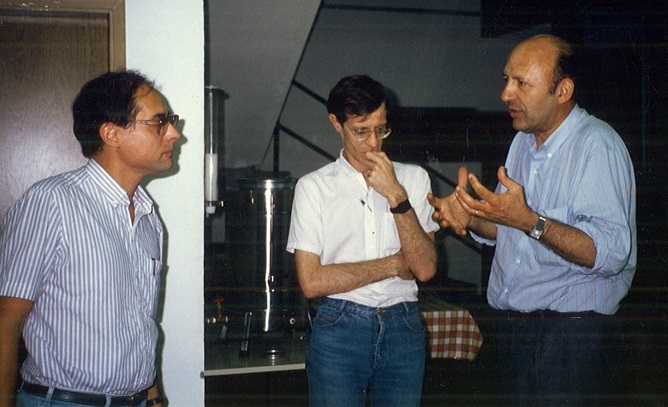
Between 1987 and 1997, the team of LNLS, which could count on 70 people, worked in the construction of the source of synchrotron light. Such project could foresee a linear accelerator or LINAC and a circular accelerator known as storage ring, in addition to a series of beamlines (the laboratories around the ring where the users use the radiation for their studies through several scientific instruments). “Over all those years, almost on a daily basis, we saw technical problems being solved in our team”, says Ricardo Rodrigues, who directed the construction of the source while Aldo Craievich led the construction of the first seven beamlines and developed an extensive program of courses, schools, and workshops aiming at the training of new users of synchrotron light.
The first component of the source that got ready, at the end of 1989, was a LINAC able to accelerate the electrons up to a power of 50 to 60 million of electrons-volt (MeV). Such linear accelerator will later be part of the definitive LINAC, of 18 m of length and 120 MeV.
Also in 1989, the team prepared the project of the circular accelerator, which in fact was not a circle but a polygon of 93 meters of length. According to this project, the ring would be able to accelerate electrons up to a power of 1.15 billion of electrons-volt (GeV). Between 1990 and 1991, still in the hangar, the prototypes of components of such circular accelerator were built.
The construction of the beamlines was progressing in parallel. In order to fund it, requests were sent to science agencies, especially the one from São Paulo (FAPESP) and the national one (CNPq).
From 1992 on, already in the definitive headquarter, in the campus of Guará, the civil works were progressing. The beamlines were installed and the components of the circular accelerator were produced – some of them in series, such as the more than 100 electromagnets of the ring.
In 1995, the assembly of the ring started, as well as its connection to the LINAC of 120 MeV, which was installed in an underground tunnel.
In the same year, the first beamline constructed in LNLS (toroidal grating monochromator, TGM), was taken to the synchrotron light laboratory CAMD, in the United States, where it was operated during two years by members of LNLS. Then, it returned to Campinas to be part in LNLS. The X-ray monochromator, another development of LNSL, also left the country to be tested in the LURE synchrotron laboratory, in France.
In June, 1996, the source of synchrotron light was completed, assembled, and tested, operating at 1.15 GeV. In October of such year, the synchrotron light arrived for the first time to an beamline, the TGM.
Finally, in July, 1997, LNLS started its activities of national laboratory, counting on a source of synchrotron light operating at a power greater than the designed one (1.37 GeV), seven beamlines ready for use, a staff able to maintain the laboratory and a structure ready to asssess by peer review the research projects submitted by the reasearchers who wanted to use this laboratory. Only in 1997, 100 projects were carried out in the LNLS beamlines.
A homemade laboratory
In summary, such laboratory, which has worked without stopping for 17 years making feasible scientific and technological research projects in Materials and other areas, was almost fully designed and constructed in Brazil, more precisely in the city of Campinas by a team of scientists and their collaborators. These people were. over a decade, successfully overcoming several technological, financial, macro-economical, legal, bureaucratic, human, psychological and other types of challenges.
Such team went further to the design and assembly of the big scientific machine. Its members manufactured most part of the pieces and components of the big laboratory, except for the shelf parts as pumps and valves.
At least a part of such work could have been made in collaboration with industrial companies, but that did not occur. According to Ricardo Rodrigues, the national industry from that time was not equipped to meet the demands of such project and was not interested in small contracts which required great engineering work. On the other hand, there were import restrictions that hindered the participation of foreign companies. “The economy was quite closed in relation to foreign companies”, he says.
Last but not least, the project leaders were interested in training an internal team that would master all technology deployed in the accelerators, so that LNLS would have a long life through continuous improvements – what have been happening indeed. The LNLS of 2014 has components that the LNLS of 1997 did not have: notably the intermediate accelerator (booster), an inverter, two wigglers, and eight new beamlines.
The training of the LNLS team consisted mainly in “learning by doing”, complemented by visits of one or two weeks in institutions abroad similar to LNLS. Besides, since the beginning, LNLS counted on an international committee of specialists who participated in annual meetings in Campinas, where the Brazilian team presented their projects and results so that they could be evaluated.
Acoording to Yves Petroff, who directed centers of synchrotron light in Europe, followed up the implementation of LNLS, and was its scientific director from November 2009 to March 2013, the “extremely low” budget available summed to the fact that almost everything was constructed in the laboratory, expanded the construction of the machine of LNLS, which took more time than usual to be built. “Finally this has been a chance because the technical staff has acquired a complete knowledge of accelerator and today, if there is a failure, it can be fixed quickly ; the reliability of the machine (97%) is among the best in the world.”, states Petroff. According to the French physicist, such experience allowed LNLS to suggest the construction of the SIRIUS accelerator, which is being led by Ricardo Rodrigues. The machine will have a power of 3 GeV and an emission of 0.28 nm.rad. “This will be a fantastic opportunity for the materials science community in Brazil and Latin America”, says Petroff.
To learn more:
– Cylon Gonçalves da Silva. The National Laboratory for Synchrotron Light. The Brazil experience. Available at: http://www.slac.stanford.edu/pubs/beamline/26/1/26-1-dasilva.pdf
– Aldo F. Craievich, Ricardo Rodrigues. The Brazilian synchrotron light source. Hyperfine Interactions 113 (1998) 465-475. (Springer)
——————————————————————————————————
BOX 1. Mini-interview with Cylon Gonçalves da Silva, first director of LNLS (1986-1998).
SBPMat newsletter: – Was it difficult to the team to carry out a project of such size, persisting over a decade?
Cylon Gonçalves da Silva: – From my point of view, as a general responsible for the project, the greatest difficulty was financial-budgetary. It is good to remember that LNLS was constructed in one of the worst periods of the Brazilian economical history. For years with the inflation out of control, in the beginning of the month I didn’t know if there would be resources for remuneration at the end of the month. And it was a piece of information that I had to keep with myself, not to affect the team’s morale. Regarding sources for funding and investment, I remember a year (1992) when we had the fortune of 800 thousand dollars to move the project forward. There was a fight each month which we won with a lot of effort and with the help of friends of the project in the Board of Directors and in Brasilia. Some day, it will be required to record such facts and their names. We had a small number of congressmen in the Congress that supported the project, “LNLS bench”. It is interesting that it comprised all shades of the political spectrum, what facilitated (a little) our life at the time of discussing the budget.
The inability of the three directors in synchronizing their depressions contributed to the continuity of the project. If we had a synchronous group, the project would have failed. As the three had never been depressed at the same time, the other two cured the third one from depression and the project continued. Without disregarding the inability of reaching an agreement about who would commit suicide first: the team and then the general director (as he wanted to), or if the general director would commit suicide first and then the team would do so later (as the team wanted to).
With Ricardo in the Technical Direction, the technical difficulties seemed not to exist. And with Aldo taking care of the scientific part, I did not need to worry. They will probably have another view of the difficulties they faced.
SBPMat newsletter: – What were the most thrilling ties of such history you can remember?
Cylon Gonçalves da Silva: – When we saw working the first LINAC of 50 MeV (in December, 1989), that one I called the “Great Post-Graduation Project”, we had the first evidence that we were on the right track and had met the right team. The difficulties of importing anything were huge at that time and there were components, such as klystrons, which we could not manufacture or acquire in Brazil. We started the manufacturing of the accelerating structures, when an opportunity of acquiring them from China came up, then we shortened the way. For the imports, until 1990, the aid from CERN was decisive. But it is another story.
The international panels of revision of the project showed the incredible professional growth of the young team in a few years. Especially in the second panel, when the youngsters of the technical team started to talk to great specialists of accelerators as mates, not as students.
To me, the construction of LNLS was an excuse to train quality professionals after all. The success we had was more than demonstrated by the number of members of our team who (unfortunately) emigrated and now occupies outstanding positions in great laboratories abroad. It is the reason why I consider Sirius a very important project too, for the opportunity of training top-class technicians and engineers; not only to work in the Laboratory but to contribute in the industry and with the creation of companies to the elevation of the technological level in Brazil, and not to loose what was reached with the first steps taken by LNLS.
Despite all difficult times we lived, which were not a few, I had never doubted a thing: that if we persisted, the project would reach a good end. The great skepticism that surrounded our job for the majority of the scientific community was a good encouragement to us to proceed. Without wanting and knowing, even the opposition helped us to make LNLS concrete. The first injections and storage of electrons in the ring and the view of the first synchrotron light were the thrilling coronation of such certainty. They marked the admission of Brazil in the group of countries able to design and construct particle accelerators of great size.
The beamline operating in CAMD (Louisiana, USA), an (temporary) export of the first complex scientific instrument of the project, built in Brazil, showed to our team and the international community that it was not only the construction of the ring that progressed satisfactorily, but also the project and construction of the instruments required to use the light. Thanks to such operation, part of the technical team started to become familiar with the difficulties involved in real life of an instrument connected to a source of synchrotron light, even before we had our own.
The transformation in Social Organization (1998), after a long battle, with the creation of a new institutional model for science in Brazil was another exciting moment to me. Maybe, the most important of the contributions that I may have given to the project. Here, it is needed to acknowledge the former Federal Congresswoman Irma Passoni (PT-SP) to have taken me to meet Dr. Aloysio Campos da Paz (deceased in 2014) of Hospital Sarah, in Brasília. It was from the long talk with him that I conceived the institutional model that took me to formulate the proposal of the Management Contract, a long time before Minister Bresser Pereira raised the flag of the Reform of the State (abandoned much earlier, it is certain). It is another history that would deserve to be told one day.
From the personal point of view, I got touched with the concession of the title of the Emeritus Researcher of LNLS when I left the Laboratory, which entitled me to maintain a room and a relationship with the Laboratory that I had helped to create. I always imagined living again someday with that extraordinary environment of scientific and technological research, following the work and the enthusiasm of young researchers, even if as mere spectator on the bleachers. I feel sorry about having gave back such title, years later in very unpleasant circumstances. Not having been invited to the visit that the Minister Raupp made to LNLS for the celebration of the 25-year anniversary of the Laboratory, nor to the launching of the cornerstone of Sirius, it can undoubtedly be explained by the fact that when CNPq granted me with the title of Emeritus Researcher, the communication addressed to me at LNLS was returned with the note “Unknown Addressee, return to sender”. Sic transit gloria mundi.
—————————————————————————————————————————————————————————————————-
BOX 2. Mini-interview with Ricardo Rodrigues, technical coordinator of the implementation of LNLS and leader of SIRIUS project since 2009.
SBPMat newsletter: – Which were the main challenges faced during the construction of LNLS in your opinion?
Ricardo Rodrigues: – As a technical coordinator, it was to accept my own errors of optimistic evaluation of the terms to overcome technical difficulties. To counteract such frustrations, we could always transfer the guilt to the lack of organization of our country, where projects are approved, but without commitment of the Governments. It was and continues to be the great difficulty of any project of such kind. In such aspect, we were lucky to have an intelligent General Direction able to do the exhausting negotiations required to maintain a reasonable rhythm in the releases of resources. The lack of commitment of the governments with the projects officially approved induces to the lack of focus on their execution, since the delay in the release of financial resources allows the projects to be continuously revised.
SBPMat newsletter: – Was it difficult to the team to carry out a project of such size, persisting over a decade?
Ricardo Rodrigues: – No. The people that got involved in the Project were looking for great technological challenges. There was always an appropriate technical infrastructure working, so that at times of little money it was possible to test new ideas or improve technical solutions with few resources. Almost everything could be made “at home”. For young enthusiasts of science and technology it is very important since it brings promptness to the process. Another aspect is the participation of everyone in the technical decisions. Everyone felt they were greatly responsible for the results and they were very proud for their successes.
Featured paper: Traveling on a random way to emit ultraviolet laser light.
Paper: Multi-photon excited coherent random laser emission in ZnO powders. Dominguez, CT; Gomes, MA; Macedo, ZS; de Araujo, CB; Gomes, ASL. Nanoscale, 2015, 7, 317-323. DOI: 10.1039/C4NR05336B.
A team of Brazilian scientists developed a random-type laser (random laser) that opens new possibilities of applications for this type of device, especially in medicine. The novelty was reported in an article recently published on the scientific journal Nanoscale.
In a laser, the light is generated by the emission of photons in cascade effect: electrons properly stimulated emit photons, which stimulate new electrons that emit other photons, which stimulate other electrons and so on. In order to have a laser working, it is required to have more excited electrons than non-excited ones – situation which is called “population inversion”.
In the conventional laser, the population inversion only occurs when the light is confined in a “gain medium”, which is confined within an arrangement of parallel mirrors, known as optical cavity. In such gain medium, the light goes and comes, stimulating electrons and generating the cascade effect explained above. But in the random laser, the confinement of the light occurs due to the strong scattering performed by nanometric particles that are embedded in the gain medium material. An optical cavity is not needed in this case. Before leaving the random laser, the light travels a long random path producing stimulated emission. If at the end of the path, the light comes back to its original scattering center, it is a random laser of coherent feedback.
In the work reported in Nanoscale, the authors used zinc oxide (ZnO) powder as gain medium. Its particles also worked as scatterers. The material was synthesized by a green and low-cost method, called proteic sol-gel, following an innovative route based on the use of coconut water in the polymerization stage of the metallic precursor. The process generated a compound of quality equivalent to the one produced by traditional manners.
“Our team developed for the first time a random laser with coherent feedback emitting ultraviolet light, from a powder composed by sub-micrometric particles of ZnO, using optical excitation in the infrared,”, summarizes Christian Tolentino Dominguez, first author of the article published in Nanoscale.
According to him, the work opens possibilities for several applications of the random laser light; for example, in the activation of fluorophores or drugs for therapeutic use, as lighting source to obtain high quality biomedical images, and also as lighting source in optical coherence tomography (OCT) devices, pico projectors, and cinema projectors.
The team also obtained experimental evidence to state that the emission of UV of the random laser of ZnO powder was induced by the simultaneous absorption of 3 photons in the near infrared region. “Due to its broad band gap (~3.37 eV), the ZnO is virtually transparent at visible light, but its conduction band may be accessed by electrons excited by light with wavelenght located in the the near infrared region, by a non-linear optical process that involves the absorption of several photons in a simultaneous manner”, explains Tolentino.
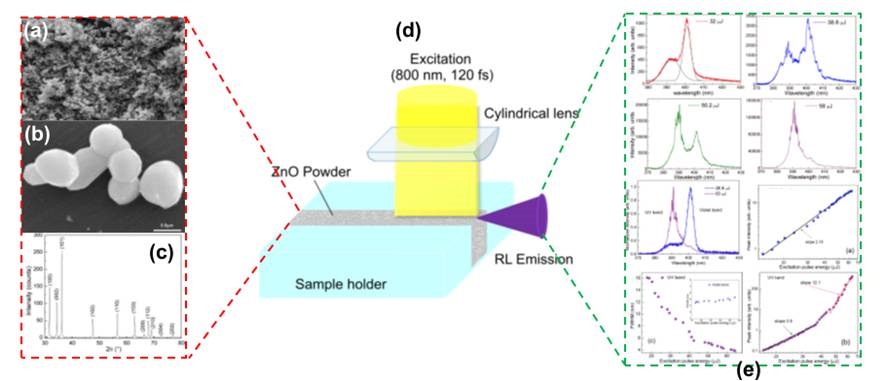
(a) and (b) Images of electronic scanning microscope showing the particles of ZnO in different magnifications, (c) X-ray diffraction of the particles, (d) Scheme showing the experimental configuration, (e) Emission spectra at different excitation energies and curves showing the characterization of the random laser: band narrowing and non-linear behavior due to the excitation energy.
The work was developed, mainly, in the Photonics and Biophotonics Laboratory at the Federal University of Pernambuco (UFPE), headed by Professors Anderson Gomes e Cid B. de Araújo. It was carried out during a post-doctoral internship of Christian Tolentino, who currently works in the Biomedical Engineering Laboratory, also at UFPE. The synthesis of the particles was performed by the group of Advanced Ceramic Materials at the Federal University of Sergipe (UFS), headed by the Professor Zélia Soares Macedo.
The research was funded by the Brazilian national research foundation (CNPq) and by the Pernambuco state research foundation (FACEPE). It was held in the context of the National Institute of Science and Technology in Photonics, which has performed active research in the area of random laser, having several papers.
Abstract submission is open for the 27 symposia and 2 workshops of the XIV SBPMat Meeting.
 The submission of abstracts regarding the XIV Meeting of the Brazilian Materials Research Society (SBPMat) is open until May 30th. The event will be held from September 27th to October 1st in Rio de Janeiro at the convention center SulAmérica.
Works of researchers and students from Brazil and abroad in the areas of the symposia can be submitted. In this edition of the annual meeting of SBPMat, the number of symposia exceeded all the previous ones: 27 symposia and 2 workshops.
The symposia were selected by the organizing committee among the proposals received in a call launched in November 2014. According to the chairmen of the event, Marco Cremona and Fernando Lázaro Freire Junior, there were more than 50 proposals of symposia for this edition. Thus, it was impossible to put up all of them due to the limitations of time and physical space at the convention center. To select the symposia, the committee considered frontier research topics having an active community in the country.
In addition to a diverse range of themes (nanomaterials, electronics and photonics, biomaterials, modeling, materials for energy, among others), the list of symposia includes a symposium organized by the SBPMat University Chapters, coordinated by students, and two workshops organized in cooperation with industries. The list of symposia coordinators is also diverse, including researchers of universities and other research institutions from South, Southeast, and Northeast Brazilian regions, and from abroad (Argentina, Denmark, England, Germany, Italy, Ireland, Japan, Portugal, Spain, Switzerland and USA).
About SBPMat meetings
The annual SBPMat meeting is a traditional international forum dedicated to the recent progresses and perspectives in Materials science and technology. In addition to the presentation of technical works that occur in the symposia, the scientific program of the event counts on plenary lectures given by renowned researchers from worldwide. In the edition of 2014, held in the city of João Pessoa, around 2,000 works were presented in 19 symposia.
List of symposia and workshops: http://sbpmat.org.br/14encontro/symposia/?lang=en#title
Instructions for authors: http://sbpmat.org.br/14encontro/authors/?lang=en#title