Public note of the the Brazilian Materials Research Society (SBPMat).

The directory and the board of the Brazilian Materials Research Society (SBPMat) express their unease in light of the lack of prospects for science, technology and innovation (STI) in Brazil. The sector has experienced deep budget cuts in recent years, cuts that threaten to derail programs and research projects and crucial advancements for the Nation. The government has shown no signs of repealing these cuts, hence ensuring a budget that can minimally maintain Brazil in the upward trajectory of recent decades.

Even more worrying is the absence of a strategic plan for STI, a key requirement to help Brazil overcome the severe crisis we are experiencing. The unification of the Ministry of Science, Technology and Innovation with the Ministry of Communications, for example, does not seem to adhere to any logic that allows us to envisage the formulation of public policies to boost Brazil’s economic and social development.

In the very short term, our suggestion is that the government should reinstate the budgets and provide the means for the ongoing initiatives of the funding agencies such as CAPES, CNPq and Finep, because the interruption or reduction of STI programs – even for short periods of time –may cause irreparable damage to Brazil.

The area that most concerns our Scientific Society is with regard to the fact that Brazil is a major producer of raw materials and lacks sufficient investment in STI to add value to products, provide high-tech companies and create jobs. It is relevant to point out that the knowledge generated in the STI activities is an essential element to build an egalitarian and developed society, which is what we aspire for our country.

SBPMat

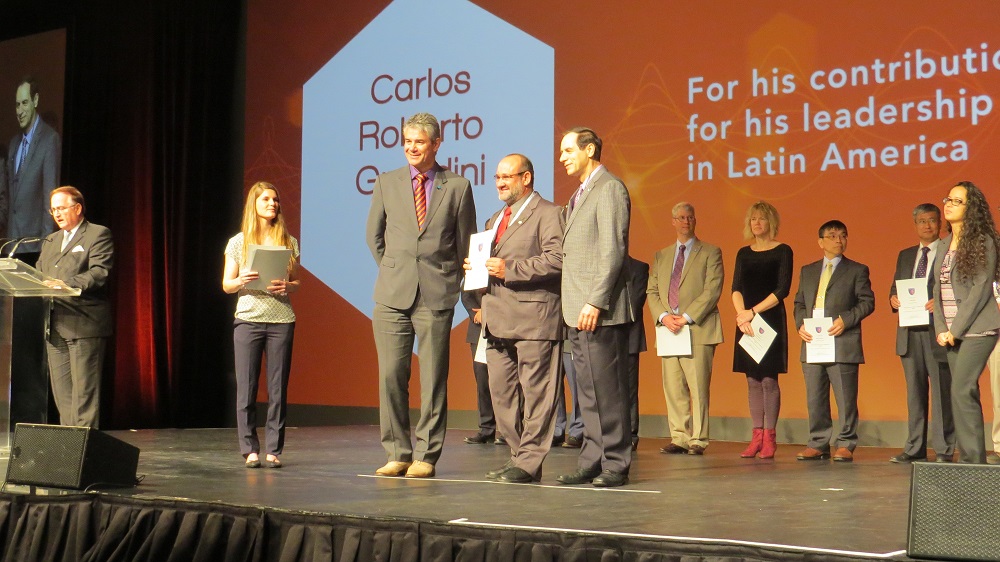
People in SBPMat community: SBPMat council member Carlos Roberto Grandini and three other researchers from Brazil integrate the international college of fellows of the International Union of Biomaterials Societies.

Brazilian researchers were awarded the status of “Fellow, Biomaterials Science and Engineering” (FBSE) by the International Union of Biomaterials Science (World’s Biomaterials Societies). The honorary title is a recognition of excellence in professional performance and the achievements made in the field of Biomaterials Science and Engineering. The new fellows now are part of an international college, joining 300 researchers who are committed to strengthening and divulging the field of Biomaterials. The honor was awarded in a ceremony at the opening of the 10th World Biomaterials Congress, held in Montréal (Canada) in May.

One of the new FBSE of Brazil is Professor Carlos Roberto Grandini (from the State University of São Paulo, UNESP, campus Bauru), counselor of SBPMat and 1st Vice President of the Latin American Society of Biomaterials and Artificial Organs (SLABO). Grandini received the honorary title for his contributions in the field of metallic biomaterials and for his leadership in the Latin American scientific community. Besides Grandini, the other new fellows are the Brazilian researchers Aron Jose Pazin de Andrade (Instituto Dante Pazzanese de Cardiologia), Luís Alberto Loureiro dos Santos (Federal University of Rio Grande do Sul, UFRGS) and Marivalda de Magalhaes Pereira (Federal University of Minas Gerais, UFMG).

Professor Grandini receiving the title of “Fellow, Biomaterials Science and Engineering”.

José Arana Varela: Note of Condolences.

It is with deep regret that SBPMat announces the passing of Prof. José Arana Varela of the Chemistry Institute of Unesp, Araraquara, on 05/17/2016. Professor Varela was one of the founders of SBPMat, and its president from 2010 to 2011.

SBPMat sympathizes with the family of Professor Varela, in a sad day when Brazilian science loses one its exponents.

SBPMat newsletter. English edition. Year 3, issue 4.

Brazilian Materials Research Society (SBPMat) newsletter

News update from Brazil for the Materials community

English edition. Year 3, issue 4. 

SBPMat news: XV Meeting - Campinas (SP), Sept 25-29, 2016 

Registration: Registration for the event is now open. Early registration discount deadline is 31 August. Here.

Authors: Abstract submission is open until 30 May. Acceptance notifications will be sent to the authors by July 10. Authors should read the submission guidelines. Here.

Symposia: See the list of 22 approved symposia, to which the abstracts can be submitted.  Here.

Awards: Those interested in participating in the event’s student prize competition, the Bernhard Gross Award, which selects one oral and one poster presentation in each symposium, must submit an extended abstract by August 22. Know more in the instructions to authors. 

Exhibitors: There are still stands available. Companies interested in participating in the event with stands and other forms of dissemination should contact Alexandre, via the e-mail comercial@sbpmat.org.br.

Plenary sessions:  View the abstracts of the plenary lectures and the memorial lecture of our event and bios of the scientists presenting them. Here.

Accommodation and tickets: See the list of the travel agency “Follow Up” with hotels, hostels, guesthouses and the forms to book flights. Here. 

Vacation packages: The Follow Up website also suggests tour packages for before and after the event. Here.

Venue: See video of the city of Campinas and folder about the Expo Dom Pedro convention center. 

Organizers: This edition of the event is coordinated by Prof. Ana Flávia Nogueira (Unicamp, Institute of Chemistry) and Prof. Mônica Alonso Cotta (Unicamp, “Gleb Wataghin” Institute of Physics). See who are the members of the local committee and view the photos of the organizers. Here.


Featured paper 

Two researchers from the Brazilian Federal University of Mato Grosso (UFMT) conducted a theoretical study, based on computer simulations, on troilite (iron sulfide) doped with lithium ions. The scientists studied the coordinated behavior of electrons from different orbitals. In a recently published paper in the Journal of Applied Physics, the authors present troilite as promising material for rechargeable lithium batteries and report that doping with lithium can generate non-conventional conducting states in the insulator material. See our story about the study.


People in the Materials community 
We interviewed the Brazilian physicist Ado Jorio de Vasconcelos (professor at the Brazilian Federal University of Minas Gerais, UFMG), expert in the application of optics in nanostructure studies. In 2001, Jorio became the first researcher to use an optical technique to study carbon nanotubes individually. Jorio holds an H index of 74, one of the highest in Brazil, and is the author of approximately 200 publications with over 30,000 citations. Jorio will deliver a plenary lecture at the XV Brazil-MRS (SBPMat) Meeting on the use of Raman spectroscopy for the study of carbon nanostructures. Read our interview and learn more about this scientist’s contributions and background. See our interview.
International award to Edgar Dutra Zanotto (Federal University of São Carlos, UFSCar): He was elected a fellow of the American Ceramic Society (ACerS). Here.

Reading tips
Scientific articles

  • Scientists induced non-photosynthetic bacteria to perform photosynthesis by the insertion of inorganic nanoparticles (based on paper in Science). Here.
  • Researchers discover how to align carbon nanotubes in rows, and then make centimeter-size films (with text and video, based on paper in Nature Nanotechnology). Here.
  • Quantum dots kill antibiotic-resistant bacteria and don´t harm mammalian cells (based on paper in Nature Materials).  Here.

Books

  • Book of the American Ceramic Society (ACerS) on ceramics engineering includes chapter on oxide ceramics written by scientists from Brazil. See more.

Patents

  • Brazilian Federal University of São Carlos (UFSCar) patents on bioactive glass are licensed and may result in new Brazilian products for the health area. See more.

Events

  • 5th School of SAXS. Campinas, SP (Brazil). May, 2 to 6, 2016. Site.
  • 1st User Workshop on Coherent X-ray Imaging and Small Angle X-ray Scattering. Campinas, SP (Brazil). May, 5 to 6, 2016. Site.
  • 40th WOCSDICE ‐ Workshop on Compound Semiconductor Devices and Integrated Circuits held in Europe & 13th EXMATEC ‐ Expert Evaluation and Control of Compound Semiconductor Materials and Technologies. Aveiro (Portugal). June, 6 to 10, 2016. Site.
  • Photonic Colloidal Nanostructures: Synthesis, Properties, and Applications (PCNSPA Conference 2016). Saint – Petersburg (Russia). June, 27 to July, 1, 2016.  Site.
  • 1st International Symposium on Advanced Photonic Materials. Saint – Petersburg (Russia). June, 27 to July, 1,  2016. Site.
  • XXV International Conference on Raman Spectroscopy (ICORS2016). Fortaleza, CE (Brazil). August, 14 to 19, 2016. Site.
  • 26th LNLS Annual Users´ Meeting (RAU). Campinas, SP (Brazil). August, 24 to 25, 2016. Site.
  • XV Brazil-MRS Meeting (XV Encontro da SBPMat). Campinas, SP (Brazil). September, 25 to 29, 2016. Site.
  • Aerospace Technology 2016. Stockholm (Sweden). October, 11 to 12, 2016. Site.

Featured paper: Virtues of a bad metal.

[Paper: Electronic localization and bad-metallicity in pure and electron-doped troilite: A local-density-approximation plus dynamical-mean-field-theory study of FeS for lithium-ion batteries. Craco, L; Faria, JLB. J. Appl. Phys. 119, 085107 (2016); http://dx.doi.org/10.1063/1.4942843]

Virtues of a bad metal

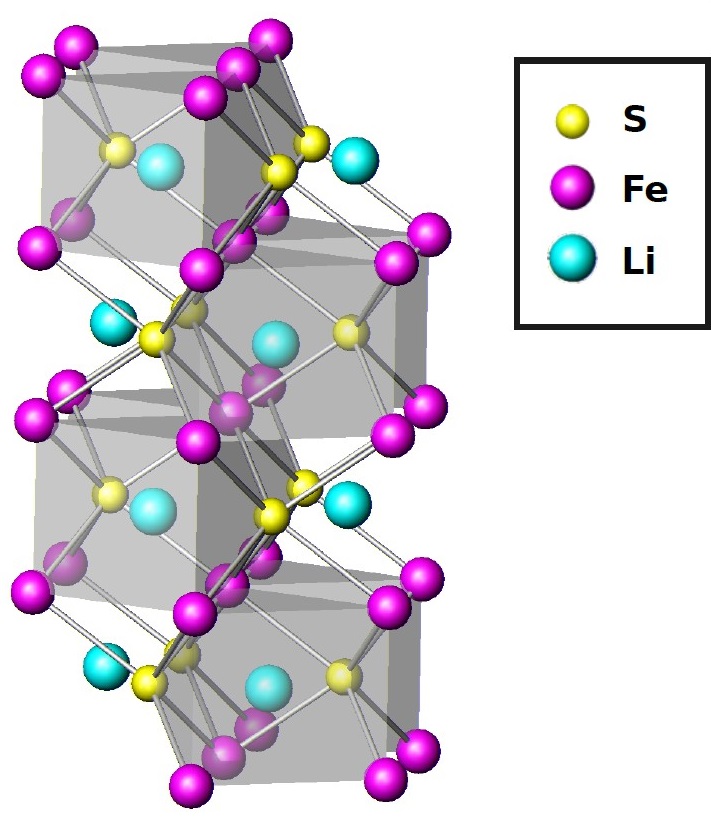
Computer image of the troilite crystal structure (FeS) with lithium ion insertion. The image, produced by Professor Jorge Faria, began with the modeling of pure troilite. Subsequently, numerical analyses were carried out by local density approximation (LDA) using methods based on the functional density theory (DFT) to obtain the network parameters with different concentrations of lithium and by observing its most stable position in the unit cell.

Because of their numerous advantages, rechargeable lithium-ion batteries are the most commonly used to power portable electronic devices (smartphones, tablets, laptops…). In addition, these batteries have great potential to be used in electric cars and in other applications.

Motivated by the potential application of iron sulfides (FeS) to be used as electrodes for next generation lithium-ion rechargeable batteries, Luis Craco, professor at the Institute of Physics of the Brazilian Federal University of Mato Grosso (IF-UFMT), undertook, along with his colleague, Jorge Luiz Brito de Faria, a theoretical study on the behavior of troilite (a phase of iron sulfide that is an insulator at ambient pressure and temperature) doped with lithium ions.

In the study, Craco and Faria sought to understand what happened in troilite after the electronic doping – a procedure that can transform an insulator into semiconductor or bad metal by inserting atoms (lithium ions) causing a structural reorganization of the material, by introducing electrons into it.

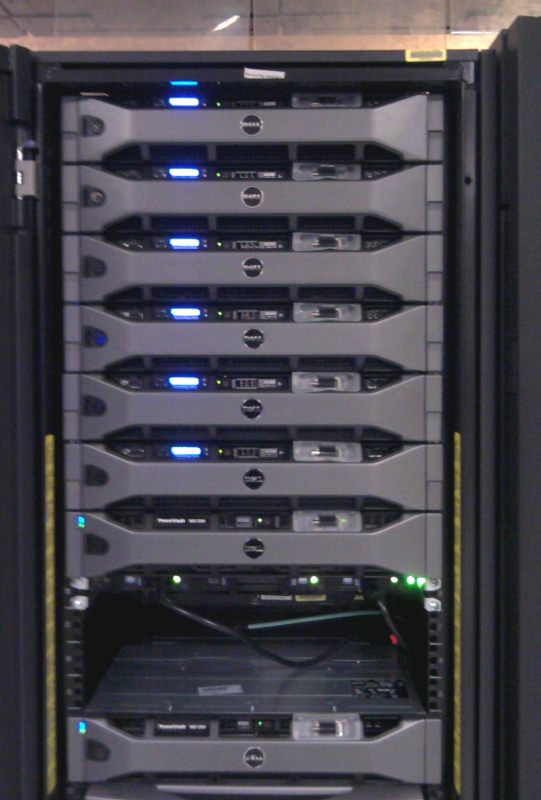
High-Performance Computing Cluster of IF-UFMT: the calculation time can be shortened using parallel processing.

The work began with a series of calculations by first-principles based on the density functional theory (DFT) performed by Jorge Faria. These calculations use crystal structure data obtained experimentally. Next, Luis Craco carried out a detailed study using calculations based on dynamical mean-field theory (DMFT), to study the effect of electronic correlations between electrons in different orbitals (regions around the nucleus of an atom in which an electron has some probability of being found). In these correlations, a change experienced by an electron in an orbital causes a related change in another electron from another orbital. Correlated electrons act coordinately, although they are spatially separated. According to Luis Craco, “We should bear in mind that the theoretical description introduced in this work is entirely new in the context of troilite and its derivatives, as well as in other compounds containing iron and sulfur as constituent elements”.

In a recently published paper in the Journal of Applied Physics, the professors from UFMT reported a description of the electronic and transport properties of the doped troilite and showed that the material exhibits unconventional behavior. In fact, although the iron sulfide is an insulator even with high concentrations of lithium, their computer simulations showed the emergence of metallic states after high electron doping. Near this insulator-metal transition state, the material can be classified as a Mott insulator. Furthermore, the authors found that the metal states emerged only in certain atomic orbitals, which is the behavior of a bad metal; in other words, a different behavior from that expected from a metal within consolidated theories in Physics.

Being a bad metal, however, does not imply being banned from the overall applications. On the contrary, according to the article, the inconsistent behavior of electrons in the doped iron sulfide can be used to achieve unconventional optical and transport effects within room temperature and pressure.

“This work is a continuing effort involving many researchers in Brazil and abroad, which aims to clearly demonstrate that systems with correlated electrons represent an important class of materials for various technological applications”, said Professor Craco.

“Now we hope the scientific community, related to the physics of correlated electron systems and / or materials physics, for example, becomes aware of our study and results, and that in the near future corroborates our theoretical description of the electronic properties and unconventional transport in electron-doped troilite, thereby consolidating the relevance of our study for future applications of troilite and its derivatives in renewable energy storage or to generate new unconventional non-Fermi liquid electronic phases, with great contemporary scientific and technological appeal”, concludes Craco.

The research was funded by the Brazilian National Council for Scientific and Technological Development (CNPq).

Interviews with plenary speakers of the XV B-MRS Meeting: Ado Jorio (UFMG, Brazil).

Sixteen years ago, working as a post-doctoral fellow at the Massachusetts Institute of Technology (MIT) in the group of professor Mildred Dresselhaus, the Brazilian physicist Ado Jorio de Vasconcelos headed a study that would produce the first successful result of the application of Optics, more precisely Raman spectroscopy, in the individual characterization of carbon nanotubes – keeping in mind that nanotube´s walls are just one atom thick, with diameters typically about one nanometer. In the MIT website, the page of Professor Mildred, who has been studying carbon nanostructures at MIT for more than 50 years, reinforces the importance of the work she has carried out with Jorio: 5 of the 6 publications selected by the emeritus professor are co-authored by Jorio.

When Ado Jorio began his postdoc he was 28 years old and had just finished his doctorate in Physics from the Federal University of Minas Gerais (UFMG). His thesis was on phase transitions in incommensurate systems, conducted under the guidance of Professor Marcos Assunção Pimenta. Prior to that, he earned his bachelor’s degree in Physics, also from UFMG, after studying Electrical Engineering for three years.

After the postdoc at MIT, Jorio returned to UFMG and was later accepted as associate professor of the university in 2002 via a public selection procedure. From 2007 to 2009 he held a position at the Brazilian National Institute of Metrology, Quality and Technology (Inmetro) to develop nanometrology-related activities. In 2010, he became full professor of UFMG and that same year took over the direction of the Coordination of Transfer and Innovation of the University until 2012. In 2013 he was at ETH Zurich (Switzerland) as a visiting professor, carrying out teaching and research activities. In August 2016 he became Dean for Research of UFMG.

Since 2002, Jorio has expanded the subject of his post-doctoral work. He has conducted research in optics and the development of scientific instrumentation, namely the study of carbon nanostructures with various applications. An example of this diversity is a study in which Jorio participates, in which nanotechnology field techniques are used to understand details of the composition of the “Indian black earth”, a highly fertile soil with carbon sequestration potential, which is found in places formerly inhabited by Indians in the Brazilian Amazon.

Jorio holds one of the highest H-index among scientists in Brazil: 74, according to Google Scholar. He is also one of the most cited researchers in the world, evidenced by the inclusion of his name in the latest Thomson Reuters international list, which tabulated 1% of the most frequently cited papers in each knowledge area among all the indexed scientific articles between 2003 and 2013. Jorio is the author of over 180 scientific articles and 20 books or book chapters, and 8 patent applications. According to Google Scholar, his publications combine more than 30,000 citations.

His contributions have received numerous acknowledgments from prestigious institutions, such as the Somiya Award from the International Union of Materials Research Societies in 2009; the ICTP Prize of the Abdus Salam International Centre for Theoretical Physics in 2011, and the Georg Forster Research Award by the Humboldt Foundation in 2015, among many other national and international awards.

In the XV Brazil-MRS (SBPMat) Meeting, Ado Jorio will deliver a plenary lecture on a topic in which he is one of the world’s leading experts, the use of Raman spectroscopy to study carbon nanostructures. The Brazilian scientist will talk about how the technique evolved until reaching the nanoscale. He also promises to reveal some tactics that allow using light, whose wavelength is at least hundreds of nanometers, as a probe to investigate structures of only few nanometers.

See our interview with this member of the Brazilian research community in Materials and plenary speaker at our annual event.

SBPMat Newsletter: – Tell us what led you to become a scientist and work in the Materials area.

Ado Jorio: – It was a winding path! I entered university to study electrical engineering. Back then I played in a progressive rock band, so I looked for scientific research in the area of music. I was told to talk to a teacher at the physics department who enjoyed music, studied acoustics and materials. That’s how my career began and which ended up in materials science.

SBPMat Newsletter: – In your own words, what are your main contributions to the Materials area.

Ado Jorio: – I would say there are two main contributions. The first is in the area of carbon nanotubes, I have shown that optics could be brought to the level of individual nanotubes. This gave way to a very broad research field because there are various types of nanotubes, depending on their diameter and chirality. Before this work, people were studying nanotubes. After this work, people began to study specific types of nanotubes. It would be equivalent to saying that researchers studying the atom then realized that there are different types of atoms. The article that was the linchpin of this discovery was the [PRL86, 1118 (2001)]. The second contribution was the advancement of optics to study carbon nanostructures more broadly. I worked on several fronts, from scientific instrumentation for optical measurements below the diffraction limit, to the study and characterization of defects, approaching materials of interest in soil science, biotechnology and biomedicine. Some key references are the books “Raman Spectroscopy in Graphene Related Systems” and “Bioengineering Applications of Carbon Nanostructures”.

SBPMat Newsletter: – We always invite the interviewee to leave a message for the readers who are beginning their scientific careers. Many of these readers would like to one day achieve an H index like yours. What do you say to them?

Ado Jorio: – Make a big effort to attend conferences and make great presentations, always! Science is a debate and you have to be heard. Never repeat the same presentation. Each public requires a specific focus. Of course this advice depends on funding, but since the beginning of my career I have always spent my own money to fund my travels, and I still do this.

SBPMat Newsletter: – Leave a message or invitation to your plenary lecture for the readers who will participate in the XV Brazil-MRS (SBPMat) Meeting.

Ado Jorio: – After all of the above, and since the title and abstract are available, I can only offer my thanks to those who will honor me with their presence. It will be an honor to have these colleagues in the auditorium.

————————
Link to the summary of the plenary lecture of Ado Jorio: http://sbpmat.org.br/15encontro/speakers/abstracts/7.pdf

Recognition of the American Ceramic Society (ACerS) to the Brazilian scientist Edgar Zanotto: elected fellow of the society.

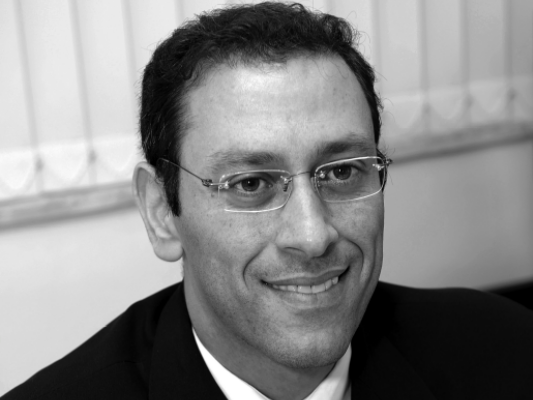
Edgar Dutra Zanotto.

Edgar Dutra Zanotto, Professor at the Federal University of São Carlos (UFSCar), one of the founders of SBPMat and researcher in the Materials area for nearly 40 years, was chosen as a fellow of the American Ceramic Society (ACerS) – a recognition conferred annually upon few select members.

The elevation to fellow is a peer recognition by ACerS members for outstanding contributions to ceramics science or art. In fact, the fellows of ACerS are chosen from the almost 10,000 members of the society, located in 70 countries, in a nomination and election process that has the participation of members, fellows, and with the final approval of the directors of ACerS. For scientists working in academia, scientific and technological production is one of the main points considered in the election.

Professor Zanotto currently has more than 5,500 citations and an H index of 40, according to Google Scholar. Among the other positions he holds, he is director of the Center for Research, Technology and Education in Vitreous Materials (CeRTEV) and editor of the Journal of Non-Crystalline Solids.

The election of the new fellows of ACerS will be celebrated at the awards and recognition banquet of the 118th annual meeting of the society on 24 October 2016 in Salt Lake City, Utah, in the United States.