Two-dimensional materials, those whose thickness goes from an atom to a few nanometers, have unique properties related to their dimensionality and are protagonists in the development of nanotechnology and nanoengineering.
A team of scientists from five Brazilian institutions and one American institution took an important step in the development of the two-dimensional diamond version. This work on 2D diamond was reported in a paper published in Nature Communications (impact factor 12,124) with open access.
“Our work presented spectroscopic evidence of the formation of a two-dimensional diamond, which we named diamondene”, says Luiz Gustavo de Oliveira Lopes Cançado, professor at the Brazilian Federal University of Minas Gerais (UFMG) and corresponding author of the paper. In choosing the name of the new material, the scientists followed the tradition of using the suffix “ene” for two-dimensional materials, as with graphene, 2D version of the graphite.
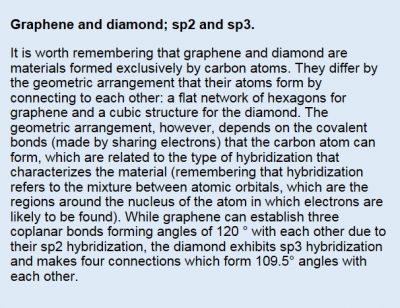
In fact, it was from the compression of graphene sheets that the diamondene was obtained by the team led by Professor Cançado. Initially, the team deposited two layers of graphene one on top of the other and transferred the graphene bilayer to a Teflon substrate, chosen for being chemically inert, preventing the formation of bonds with the graphene.
The sample of bi-layered graphene on Teflon was then subjected to high pressures and simultaneously analyzed by Raman spectroscopy at the Laboratory of Vibrational Spectroscopy and High Pressure of the Department of Physics of the Brazilian Federal University of Ceará (UFC). The experimental system used was a diamond anvil cell with a coupled Raman spectrometer. This equipment allows high pressure to be applied to small samples that are immersed in a pressure transmitting medium (in this case, water). The pressure is applied through two pieces of diamond (material chosen for being one of the hardest and resistant to compression), which compress the transmitting medium, which passes the pressure to the sample. At the same time, the spectrometer allows to monitor the changes that occur in the structure of the sample material against the different pressures applied. “In Raman spectroscopy, light behaves like a probe that measures vibrational states of the material,” explains Cançado. As a result of the probing, the spectrometer generates graphs (spectra), through which it is possible to identify the structure of the material being studied.
By analyzing the spectra, the team of scientists observed changes in the two-dimensional material that indicated the transition from a graphene structure to a diamond structure. The researchers were able to conclude that the diamondene was obtained at a pressure of 7 gigapascals (GPa), tens of thousands of times higher than the atmospheric pressure. “The evidence we present in this work is a signature in the vibrational spectrum obtained from a two-dimensional carbon material that indicates the presence of sp3 bonds, typical of the structure of the diamond,” says Professor Cançado.
To explain the formation of diamondene, the team used first principles calculations following the Density Functional Theory and Molecular Dynamics simulations. “These theoretical results guided the experiments and allowed us understanding the experimental results,” says Cançado.
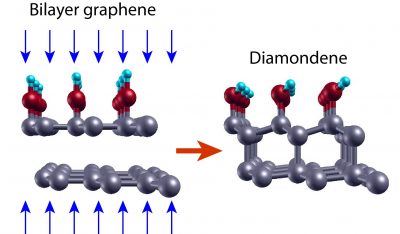
Scheme of the diamondene formation mechanism from two layers of graphene submitted to high pressures (blue arrows) in water as pressure transmitting medium. The gray colored balls represent the carbon atoms; the red ones, the oxygen atoms, and the blue ones, the hydrogen atoms.
According to the theoretical results, when the bilayer graphene system on inert substrate with water as pressure transmitting medium is subjected to high pressures, the distances between the elements of the system decrease and new connections occur among them. “When applying this level of pressure on graphene, connections can change, going from the sp2 configuration to the sp3 configuration,” explains Professor Cançado. The carbon atoms in the upper graphene layer then establish covalent bonds with four neighboring atoms: the atoms of the lower layer and the chemical groups offered by water (OH- and H). The latter are fundamental to stabilize the structure. In the lower layer, in contact with the inert substrate, half of the carbon atoms are bound to only three neighboring atoms. “The pending connections give rise to a gap opening in the electronic structure, as well as polarized spin bands,” adds Cançado.
This feature makes diamondene a promising material for the development of spintronics (the emerging strain of electronics at the nanoscale in spin-bases electronics). According to Cançado, diamondene could also be used in quantum computing, microelectromechanical systems (MEMS), superconductivity, electrodes for electrochemistry-related technologies, DNA engineering substrates and biosensors – applications in which thin diamond films have already proven to have good performance.
However, there is still a long way to go before demonstrating the diamondene applications. Firstly, because the diamondene shown in the article dismantles under normal pressure conditions. To overcome this limitation, the group of Professor Cançado at UFMG is setting up an experimental system that will allow the application of much higher pressures to the samples in the order of 50 GPa and analyze them using Raman spectroscopy. “With this we intend to produce stable diamondene samples, which remain in this form even after having the pressure reduced to the level of ambient pressure,” says Cançado.
In addition, since Raman spectroscopy provides indirect evidence of the structure of the material, it will be necessary to perform direct measurements of the diamondene to know its structure in detail. “The most promising techniques in this case would be X-ray diffraction in synchrotron light sources or electron diffraction,” suggests Cançado. “The complicating factor in this experiment is the need to have the sample subjected to high pressures,” he adds.
The Brazilian history of diamondene
The idea of the 2D diamond formation originated in the doctoral research of Ana Paula Barboza, conducted under the guidance of Professor Bernardo Ruegger Almeida Neves and defended in 2012 in the Department of Physics of UFMG. In this work, Cançado says, atomic force microscopy (AFM) tips were used to apply high pressures on one, two and several layers of graphene. Indirect evidence of the formation of a two-dimensional diamond was obtained by means of electric force microscopy (EFM). The work showed the importance of the presence of two layers of graphene and water for the formation of the sp3 two-dimensional structure. The main results of the research were reported in the article Room-temperature compression induced diamondization of a few-layer graphene [Advanced Materials 23, 3014-3017 (2011)].
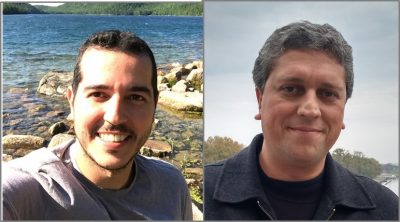
Main article authors. On the left, Luiz Gustavo Pimenta Martins (MSc from UFMG and doctoral student at MIT). On the right, Professor Luiz Gustavo Cançado (UFMG).
“The idea of measuring the Raman spectrum of graphene under high pressure conditions (using anvil diamond cells) came after Luiz Gustavo Pimenta Martins, an undergraduate student at the time, developed a very efficient method of transferring graphene to different substrates,” says Professor Cançado. This development was carried out during a visit to the laboratory of Professor Jing Kong at the Massachusetts Institute of Technology (MIT), after having won a grant for international mobility of the Formula Santander Award. During his master’s degree at the Physics Department of UFMG, carried out under the guidance of Professor Cançado and defended in 2015, Pimenta Martins carried out an extensive and systematic work to obtain Raman spectra of graphene samples subjected to high pressures. “There were many visits to UFC and much study until understanding the diamondene formation mechanisms,” explains Cançado.
The research reported in the Nature Communications paper was made possible by the collaborative work of several Brazilian research groups with recognized expertise in various subjects, as well as the participation of the MIT researcher in the sample preparations. Scientists from the physics departments of UFMG and UFC have contributed their recognized expertise in Raman spectroscopy applied to carbon nanomaterials and, in the case of UFC, in experiments under high pressure. Also participating in these experiments were researchers from the Brazilian Federal Institute of Education, Science and Technology of Ceará and the Brazilian Federal University of Piauí (UFPI). In addition, theoretical physicists from the Brazilian Federal University of Ouro Preto (UFOP) and UFMG performed calculations and computational simulations.
The research was funded by Brazilian federal agency CNPq, state agencies FAPEMIG and FUNCAP, Formula Santander Program and UFOP.
[Paper: Raman evidence for pressure-induced formation of diamondene. Luiz Gustavo Pimenta Martins, Matheus J. S. Matos, Alexandre R. Paschoal, Paulo T. C. Freire, Nadia F. Andrade, Acrísio L. Aguiar, Jing Kong, Bernardo R. A. Neves, Alan B. de Oliveira, Mário S.C. Mazzoni, Antonio G. Souza Filho, Luiz Gustavo Cançado. Nature Communications 8, Article number: 96 (2017). DOI:10.1038/s41467-017-00149-8. Disponível em: https://www.nature.com/articles/s41467-017-00149-8]
Symposium proposals for the XVII Brazilian MRS Meeting can be submitted from October 31st, 2017 to January 31st, 2018.
The meeting will take place at the Praiamar Natal Hotel & Convention Center, located at the Ponta Negra Beach, Natal, RN, from September 16th to 20th, 2018. The meeting chair is Prof. Antonio Eduardo Martinelli (Federal University of Rio Grande do Norte).
Proposals may be submitted by any PhD professor or researcher affiliated to a Higher Education and/or a Research Institution in Brazil or abroad, in any current field of Materials Science and Engineering. A submission form is available at http://sbpmat.org.br/proposed_symposium/.
The following data is required:
– Description of the symposium scope
– List of topics of interest
– Tentative list of invited speakers
– Names and contacts of symposium organizers
The organizing committee looks forward to having your contribution and participation at the 2018 B-MRS Meeting in Natal.
Professor Edgar Dutra Zanotto (UFSCar), a member of B-MRS and one of its founders, was elected “Scientist of the Year” in the area of fine materials chemistry: sustainable routes and new (nano) materials in the “Scientist and Entrepreneur of the Year Award”. In total, eight professors, six students and one company were awarded in the various categories. The award was presented on October 20 in a ceremony held at the Institute of Chemistry of the University of São Paulo (USP).
The winners were chosen through a process that involved nominating candidates by the Nanocell Institute site users, that community`s online voting, and voting by a pool of researchers (members of scientific committees, foundations, associations and societies).
The “Scientist and Entrepreneur of the Year Award” is sponsored by the Nanocell Institute, a non-governmental organization whose mission is “to promote science and education, developing technology and innovation for social welfare” and the Brazilian Society of Cellular Signaling (SBSC). The award aims to recognize and disseminate innovative works in the areas of science, education and public health.
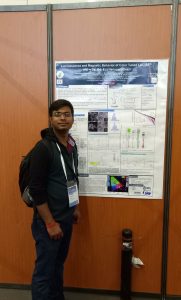
Navadeep Shrivastava at the E-MRS Spring Meeting 2017 presenting the awarded poster.
So far this year, B-MRS member Navadeep Shrivastava has won four awards for his work on materials with magnetic and luminescent properties developed in the context of his doctoral research being conducted at the Federal University of Maranhão (UFMA) under the guidance of Professor Surender Kumar Sharma.
In February, Shrivastava was selected to receive a registration exemption at the E-MRS 2017 Spring Meeting, within an existing agreement between B-MRS and the European Materials Research Society (E-MRS). The award allowed the participation of the doctoratal student in the event, which was held in Strasbourg (France) from 22 to 26 May 2017.
At the E-MRS event, Shrivastava won an award for the poster he presented at the symposium entitled “Luminescence and Magnetic Behavior of Color Tuned LaF3:RE3+ (RE= Ce, Gd, Eu) Nanoparticles”. In addition, he presented another contribution at symposium V (“Green emitting magneto-luminescent iron-oxide/ZnS coated by codoped lanthanum fluoride nanomaterials”), which drew the attention of the audience, initiated a collaborative relationship with a group from the Université de Strasbourg (France) and expanded his network of professional contacts. “I want to express my gratitude for the opportunity to participate in the E-MRS 2017 Spring Meeting,” says Shrivastava.
In third place, the doctoral student was one of the winners of the 2017 Bernhard Gross Award, awarded by SBPMat to the best works presented by students at the annual events of the society. Shrivastava was awarded for the work “Facile synthesis and magneto-luminescence study of aliance of iron oxide and NaGdF4:RE3+ into nanoentity”, presented in an oral session at symposium B. The award was delivered on September 14 this year in the city of Gramado, during the closing ceremony of the XVI B-MRS Meeting.
Finally, the UFMA PhD student has just been selected to receive a travel assistance from the IEEE Magnetics Society to present two papers at the 62nd edition of the International Conference on Magnetism and Magnetic Materials, called MMM 2017, to be held in Pittsburgh in November of this year.
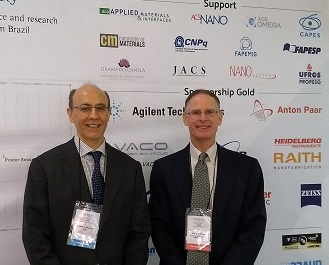
Prof. Novais de Oliveira Jr (left), associate editor of ACS Appl. Mater. Interfaces with editor-in -chief Prof. Schanze at XVI B-MRS Meeting.
B-MRS President Osvaldo Novais de Oliveira Junior is the newest associate editor of ACS Applied Materials and Interfaces, an ACS Publications journal with an impact factor of 7,504. The full professor of IFSC – USP (Institute of Physics of São Carlos of the University of São Paulo) assumed this post in early September. At B-MRS, Oliveira Junior has been administrative director and counselor, and has been chairing the society since early 2016.
The Solar Energy journal (impact factor 4,018) also recently incorporated a member of B-MRS among its editors, Carlos Frederico de Oliveira Graeff, full professor and pro-rector of research at Unesp (Universidade Estadual Paulista Júlio de Mesquita Filho). Graeff was named associate editor in the area of Photovoltaics in this periodical of the publisher Elsevier. A member of B-MRS since its beginning, Graeff was scientific director of the society and served on the scientific committee of the B-MRS Newsletter.
Finally, Carlos José Leopoldo Constantino, also a professor at Unesp and a member of the B-MRS community, took over as Associate Editor in the Nanomaterials area of the Journal of Nanoscience and Nanotechnology (Impact Factor 1,483) from American Scientific Publishers.
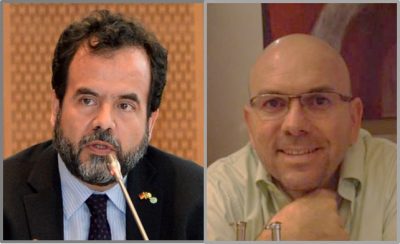
Prof. Graeff (left) and Constantino, associate editors of international journals.
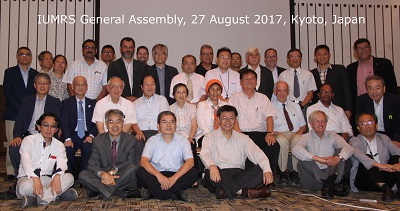
Participants of IUMRS General Assembly. Prof. Bianchi (B-MRS) is the sixth standing from the left.
Professor Rodrigo Fernando Bianchi (Brazilian Federal University of Ouro Preto, UFOP), scientific director of B-MRS, represented the society at the General Assembly of IUMRS (International Union of Materials Research Societies), held on August 27, 2017 in Kyoto, Japan, during the IUMRS-ICAM 2017 (fifteenth edition of the International Conference on Advanced Materials).
B-MRS is one of fourteen materials research societies in the world that currently make up IUMRS. The other societies are from Africa, Australia, China, Singapore, Korea, Europe, India, Indonesia, Japan, Mexico, Russia, Thailand and Taiwan.
According to Bianchi, the meeting made clear the interest of several associations to collaborate with Brazil.
In addition to representing SBPMat at the meeting, Professor Bianchi presented, at the IUMRS-ICAM 2017, his research group’s work focused on developing printed radiation sensors. The event attracted about 1,900 participants from dozens of countries.What most attracted the attention of B-MRS scientific director were presentations on the application of materials science and characterization techniques in the conservation of cultural resources (paintings , monuments and etc.). “That is, the cultural valuation within the area of materials – very important for the conservation of artistic, historical and cultural heritage of a country, and which is present in Kyoto, cultural capital of Japan. Brazil could follow the same trend!” said Bianchi.
At the event, Professor Ado Jorio (UFMG), also a member of the Brazilian materials community, delivered a plenary lecture on inelastic light scattering in carbon nanostructures.
Award ceremony of the Honorary Fellow of the European Ceramic Society (ECerS), at the closing dinner of the “15th Conference and Exhibition of the ECerS” in Budapest. Pandolfelli is third from left.
Professor Victor Carlos Pandolfelli, of the Materials Engineering Department of the Federal University of São Carlos (DEMa-UFSCar) was elected Honorary Fellow of the European Ceramic Society (ECerS).
The statute of that society determines that only scientists from the European Community can be elected as members. The title of Honorary Fellow was created in 2017 for researchers from other regions to be recognized for their scientific contribution in the area of ceramic materials. In this first selective process that occurred through internal voting by the Council of ECerS, without the candidates’ knowledge, Professor Victor Carlos Pandolfelli of the Department of Materials Engineering at UFSCar was the first Latin American chosen for this honor. Also on the list of honorary members are Professor Gary Messing (Penn State, EUA), Dr. M. Singh (NASA, USA) and Professor M. Yoshimura (Tokyo Institute of Technology, Japan, and University of Taiwan).
If you are unable to view this message correctly, click here
Newsletter of the Brazilian Materials Research Society
Year 4, issue 9. September 30th, 2017.
Special issue: XVI B-MRS Meeting
Gramado (Brazil), September 10 to 14, 2017
In numbers
Participants
– About 1,400 participants.
– 26 countries represented.
– 92.7% of registered participants from Brazil (from 5 regions of the country and from 22 states); 2.4% from Latin America and 4.9% from other countries.
– 58% students: 41% graduate students and 17% undergraduate students.
– About 52% men and 48% women.
Presentations
– More than 1,900 approved works (76% for poster presentations) in 22 symposia.
– 7 plenary lectures and 1 memorial lecture, 13 technical lectures from companies, 1 tutorial and 1 workshop.
– 15 rooms for simultaneous oral presentations (over 300 oral presentations).
– 25 companies at the exhibition.
Awards
– 20 students received awards by ACS Publications, B-MRS, E-MRS, and IUMRS.
Multimedia report
Learn about or look back through an account of the event with texts, photos and presentation files.Here.
In real time
During the meeting, we posted on our new Instagram pictures and comments of some of the main moments. If you haven´t seen, do it now, here.
Album
On Google Photos, see pictures of the awards winners, symposia coordinators and meeting organizers, and many others that you may want to download. Here.
Files of the presentations
Access on Slideshare the files of the opening, plenary and closing sessions that were provided by the authors.Here.
XVII B-MRS Meeting
Save the date! The next annual meeting of B-MRS will be held in the city of Natal, northeast of Brazil, from 16 to 20 of September, 2018. The chairman will be Prof. Antonio Eduardo Martinelli, from the Federal University of Rio Grande do Norte. More info soon in B-MRS communication media.
Follow us on social media
You can suggest publication of news, opportunities, events or reading tips in the Materials field. Write to comunicacao@sbpmat.org.br.
Unsuscribe if you do not want to receive our newsletter anymore
Sunday. Tutorial, opening, memorial lecture and welcome.
“We made it.” With those words the president of B-MRS opened the sixteenth annual meeting of the society on Sunday, September 10, 2017, at around 7pm. Professor Osvaldo Novais de Oliveira Junior (IFSC-USP) was referring to the difficulties experienced not only by the event organizers but also by all the Brazilian scientific community, in a year which recorded the lowest budget for science and technology in the history of the country.
In contrast to this situation, the room that held the opening of the XVI B-MRS Meeting, at the FAURGS event center in the city of Gramado (RS), was nearly full. Close to 900 people were there to celebrate the ceremony. The opening panel assembled on the main stage the representatives of Materials Societies from Latin America, Asia and Europe, as well as the International Union of Materials Research Societies. The composition of the panel table anticipated a point that would be emphasized shortly afterwards in the opening speech and throughout the event in several plenary sessions – the importance of scientific collaboration, not only between different areas, but also between countries, as a source of ideas, resources and skills.
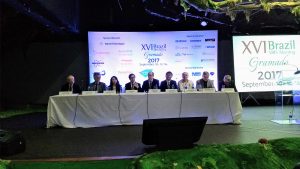
Opening session table. From the left, Robert Chang (general secretary of IUMRS), Hyeongtag Jeon (President of the Materials Research Society of Korea), Claudia Gutiérrez (President of the Mexican Materials Society, SMM), Daniel Eduardo Weibel (Chairman of the event), Osvaldo Novais de Oliveira Jr (President of B-MRS), Soo Wohn Lee (President of the International Union of Materials Research Societies, IUMRS), Roberto Arce (President of the Argentine Materials Society, SAM), Luis da Cunha Lamb (Vice Provost for Research from the Federal University of Rio Grande do Sul, UFRGS) and Rodrigo Martins (Representative of the European Materials Research Society, E-MRS).
After the welcome greetings and wishes for a good event given by the chair of the meeting, Professor Daniel Weibel (IQ-UFRGS), it was time for the traditional Memorial Lecture “Joaquim da Costa Ribeiro”, which name honors and keeps alive the memory of one of the pioneers of Brazilian materials research. The lecture is also a recognition given by B-MRS to researcher every year, highlighting his/her trajectory in the area.
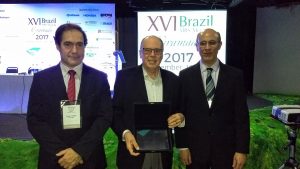
Prof. Jornada (center) with the meeting Chair (left) and B-MRS President.
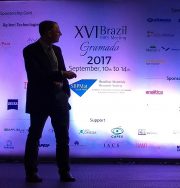
The awarded and speaker of the night, João Alziro Herz da Jornada, was then called to the stage. Jornada, among many other positions, is a retired professor from UFRGS and former president of Inmetro (Brazilian Institute of Metrology Standardization and Industrial Quality). The renowned Brazilian scientist touched on a subject of significant importance in times of funding cuts to science and technology, the relationship between science and innovation and better quality of life. Through news articles recently published in some of the most renowned journals and magazines in the world, Jornada highlighted that this discussion is already the subject of intense and in-depth debate. The Professor presented some models that depict this relationship, either in a simplified, or in a more complex and realistic manner. The honored scientist highlighted some important extra scientific factors for technological innovation: society’s knowledge absorptive capacity, the “learn by doing” practical knowledge entrepreneurial approach, the possibility for entrepreneurs to easily access knowledge, communication and interaction between different agents. To conclude, Jornada asked all researchers to make an effort to systematically and objectively understand the relationship between science and the welfare of society, and thus, to prepare to the discussion on the social and economic impact of science, which is already taking place among the general public.
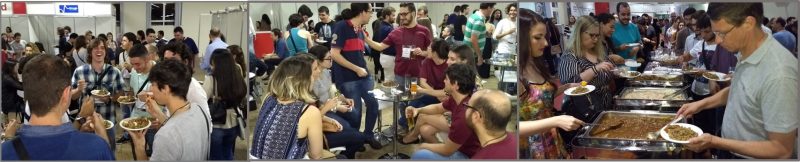
The welcome cocktail awaited the participants at the end of the lecture. Friends and colleagues of the international Materials research community reconnected and socialized around a tasteful dinner of meat, risotto and pasta, as well as beer and soft drinks.
Welcome cocktail, on Sunday night at the convention center.Tutorial with Prof. Valtencir Zucolotto.
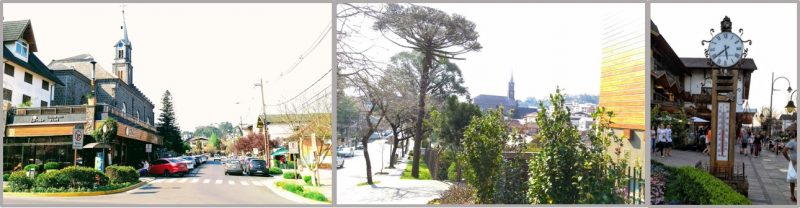
Earlier, in the streets of Gramado, at a temperature of about 30 °C (above average for end of winter at more than 800 m above sea level), the sun was shining and the flowers of the charming city seemed even more colorful. Meanwhile, from 1:30 to 5:30pm, at the event center of FAURGS, more than 200 people benefited from a tutorial on high-impact scientific research – free to participants of the XVI B-MRS Meeting. In the tutorial, Professor Valtencir Zucolotto (IFSC-USP), researcher in the Materials area and creator of online courses on scientific writing and related topics, in an interactive, relaxed and humorous manner addressed the production process of a high-impact paper, from writing to publication in a journal. “The public’s concern to reconcile high-level research with financing difficulties was evident”, commented Zucolotto. Before raffling among the participants two vouchers for a free online course in the platform he created, Zucolotto ended the tutorial encouraging the attendees to engage in high-impact research. “Yes, it’s hard, of course, but with commitment it is less difficult. You cannot be discouraged; there is nothing better than seeing your paper published, divulged and cited,” said the scientist.
Sunny and hot Sunday in Gramado.
From Monday to Thursday: plenary talks, symposia, meetings and party.
The next morning, at about 8:30 am, the main hall of the event received approximately 600 participants to attend the first of the seven plenary lectures of the meeting, which all had excellent attendance and numerous questions at the end of the lectures.
Prof. Hajo Freund
In the first plenary lecture, Professor Hans-Joachim Freund gave an example of how minute scales can have an enormous complexity. This h=97 index scientist shared his broad and deep knowledge on heterogeneous catalysis (the one in which the phase of the catalyst material is different from the phase of the reagents, for example, catalyst nanoparticles in reactions involving gases). The plenarist captured and held the attention of the public by sharing some of his studies on the topic being carried out in a Berlin research institute dedicated to the study of surfaces and interfaces, the Fritz Haber Institute of the Max Planck Society, where Freund is the director. As the catalysts are very complex materials, Freund said, to understand them at the atomic scale, his research group creates model-systems of increasing complexity and growing resemblance to the actual catalysts. Using instrumentation, computational methods and advanced knowledge of surface science, the group has been able to solve step-by-step the various scientific problems involved in understanding catalysts and as a result develop more reactive catalysts. Despite having all of the Physics Chemistry department (which used to have 80 people and now has 35) allocated to the study of heterogeneous catalysis, Professor Freund joked that he still has a lot of work ahead of him and that to deal with such complexity he would require some 200 researchers!
After the lecture of “Hajo” Freund, the participants distributed themselves in the 15 rooms with parallel programming, dedicated to oral presentations of the 22 symposia – a constant activity repeated throughout the meeting in the mornings and early afternoons. Nearly 2,000 abstracts were submitted to the symposia of the XVI B-MRS Meeting, of which 1,919 were approved for oral and poster presentations. The symposia covered a wide range of research topics in materials, from the study, manufacturing and modification of various materials (polymers, metals, composites, hydrogels, nanomaterials, biomaterials) to its use in the energy, aerospace, health, electronics, bioelectronics, photonics, plasmonics, photocatalysis and other sectors. The manufacturing and safety environmental impact concerning the use of some materials were also addressed in the symposia.
Oral presentations and invited talks of the symposia had a good turnout of attendees. On the right, symposia coordinators from all Brazilian regions and several other countries, such as Argentina, Canada, Spain, USA, Portugal and the United Kingdom.
At the end of the oral sessions that morning, as well as on the other days of the event, hundreds of participants, many in small groups, strolled the picturesque streets of Gramado in search of restaurants for lunch. Not a difficult search in this small town that is particularly geared towards tourism, and which concentrates within a few blocks dozens of quality restaurants of different types and different prices, offering international cuisine specialties – from Italian pasta and German pork knuckle to fondue, trout and soups.
Thanks to the good location of the convention center, by 2 pm the participants were back to the afternoon oral sessions, followed by a plentiful coffee break, quite like the generous morning coffee break, which nourished the participants until the end of the day’s schedule, at around 7:30 pm. The coffee breaks were accompanied by the visits to the stands of the 25 exhibitors that participated in the XVI B-MRS Meeting, distributed around both sides of the coffee break tables.
Contacts, information exchanges, short trainings, gifts and even a raffle in the booths of the industrial exhibition.
Also at the beginning of the afternoon, within the activities of the workshop on sustainable development of materials for energy, electronics and transportation, a meeting was carried out on the possibilities for university-industry interaction. The meeting gathered a representative of Umicore – a multinational materials technology and recycling company; an entrepreneur a startup on materials segment (Develop Now) in the Brazilian city of São Carlos; researchers from areas related to sustainable development; the Chairman of the XVI B-MRS Meeting; the President of B-MRS and the general secretary of IUMRS.
Prof. Alexander Yarin
The afternoon plenary lecture began at 4:45 pm and was given by Professor Alexander Yarin, of the University of Illinois – Chicago. After highlighting that Brazil is a leading country in materials derived from agricultural waste, the scientist showed that waste from agriculture and fishery can be harnessed to produce biopolymers and in order to manufacture nanomaterials that can be used in a variety of applications. In his lab, Yarin has produced nanofibers, some with very good mechanical properties, from soybean protein, cellulose, gluten, wood components and fish protein, among other wastes. Yarin and his team are currently developing a project to use sugarcane bagasse. The method used is solution blowing, in which a biopolymer solution jet is “blown” by a coaxial air blast. In the interaction between the two jets, the solvent evaporates and the biopolymer acquires a lengthened and thin format. Thus, dry nanofibers are formed which fall on a surface composing tangled fibers, which can finally be presented as something similar to a roll of thin paper. The process can be easily carried out at an industrial scale, Yarin said. The scientist also showed some already demonstrated nanofibers applications, such as the membranes that protect grapevines from the esca funghi, responsible for tremendous grape harvest losses around the world. Another application mentioned was the adsorption of heavy metal ions from contaminated waters, a problem that occurs, for example, in India. Yarin ended his presentation comparing his powerful green nanomaterials to the footballer Pele, who he greatly admires.
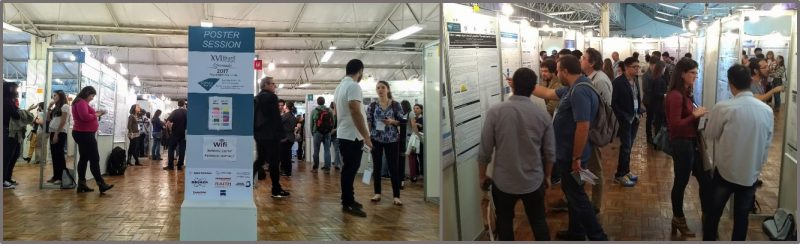
The day’s program ended with an interactive poster session. In three sessions along the event, always taking place at the end of the afternoon, almost 1,400 contribuitions were displayed and discussed. Again, the event provided a QR code for each poster and a code reader in the event app, which was downloaded on 378 mobile devices. By positioning the smart phone in front of the code printed on the poster, the participant could access and save the data from that specific work.
The poster sessions took place at the end of the afternoon on Monday, Tuesday and Wednesday.
That night it got colder and wetter in Gramado. The next morning, with temperatures at around 13 °C, the participants had to wear winter coats or raincoats to go to the convention center. Fog covered the landscape – typical of winter in Gramado region – which restricted visibility more than 50 meters away.
Fog in Gramado on Tuesday.Prof. Katsuhiko Ariga
Inside the convention center, the mood was different. Professor Katsuhiko Ariga (WPI-MANA NIMS and University of Tokyo) received the public in the plenary room expressing his great joy to be there. He had been invited to give a plenary lecture two days before to replace Professor Susan Trolier-McKinstry who could not travel for reasons beyond her control. Ariga’s humorous plenary began with a hot theme, molecular machines, last year’s Nobel Prize in Chemistry. The Japanese scientist (h=144 index) showed a race of nano cars created by scientific teams from different countries with just one molecule, each with a particular format. Ariga also showed other molecular machines developed by him and his group, such as nanopliers that open and close in reaction to movements made by human hands. How is this done? Through a simple equipment these macroscopic human hand movements cause compression and expansion of an air and water medium where the nanopliers are in the interface, causing the molecules to reconfigure again and again in the form of opened or closed pliers. The lecture ended with the image of a future in which we humans will perform nanotechnology with our hands in our day-to-day routine.
13 technical lectures were given by experts from instrumentation companies.
Perhaps wondering how this world predicted by Professor Ariga will be, the participants left the plenary hall toward the oral sessions of the symposia, and also to the technical lectures on materials characterization, manufacturing and modification techniques that were given by experts from instrumentation companies in the mornings and afternoons of Tuesday and Wednesday.
In an increasingly damp Gramado, alternating between fog and rain, the second plenary session began. Professor Kenneth Gonsalves (Indian Institute of Technology Mandi, IIT Mandi) led the public toward the ever current theme of chip miniaturization. This trend, explained the researcher, has brought superior performance and lower costs to the infinite range of products that use chips, from everyday electronic devices to health care, transportation and defense devices, among others. To have a sense of sizes, in 2012 the 22 nm node technology was launched (which means that the gate controlling the passage of electric current in the integrated circuit has this dimension). Two years later, the 14 nm node technology was introduced, and in 2016 the 10 nm node. For 2018, the launch of the 7 nm node and, two years later, a 5 nm node is predicted. To make this possible, researchers from many countries are working against the clock making important adjustments to the manufacturing techniques of integrated circuits. And Professor Kenn Gonsalves is one of these researchers.
Prof. Kenn Gonsalves
Gonsalves leads from IIT Mandi an international consortium that includes Brazilian groups, dedicated to developing photosensitive materials suitable for one of the most promising manufacturing techniques for integrated circuits with nodes of less than 10 nm, the extreme ultraviolet litography (EUVL). Known as “resists,” these materials in the form of thin films play a key role in the process of fabricating the circuits that will forward the current through the chip. In large lines, the resists, deposited on silicon wafers, receive the radiation that passes through grooves made in the so-called masks, in which the desired circuit design is reproduced. In places where they receive the light, the resists react chemically, generating grooves or elevations that follow the design of the circuit. According to Gonsalves, who has worked with resist research and development for 20 years, the development of EUVL resists is still a challenge that requires collaborative effort involving numerous competencies, institutions and companies, especially in order to improve the photosensitivity of the materials. At the end of the lecture, Gonsalves said he is also working on the development and production of resists with Indian technology to manufacture chips with bigger nodes, but suited to that country’s industry needs.
After the plenary, while the participants circulated among the poster panels, members of B-MRS directory and board attended a presentation by the president of IUMRS who focused on the possibilities of increasing cooperation between the Brazilian society and the international union, in particular the participation of students in ongoing global research programs in Asian countries. That same night, representatives of materials research communities in Latin America and representatives of IUMRS got together for dinner at a quaint restaurant in Gramado at the invitation of the President of IUMRS.
IUMRS presentation to B-MRS board and council and dinner with delegates of materials research societies/communities from Argentina, Brazil, Korea, Europe, Mexico and Peru.Prof. Kirk Schanze
Wednesday, the longest day of the XVI B-MRS Meeting started with a plenary lecture on conjugated polyelectrolytes, a class of water-soluble polymers capable of conducting electricity and emitting light. This was one of the sessions that showed the relationship between the understanding of natural phenomena (fundamental research) and the development of social impact applications – which was the theme of the memorial lecture of the event. Professor Kirk Schanze (University of Texas at San Antonio) showed how detailed understanding of the mechanisms that underlie the properties of a material allows developing or improving products. Schanze and his team have in fact been conducting fundamental and applied research on conjugated polyelectrolytes, and have also generated a startup to market products derived from their laboratory work. In the lecture, the scientist presented some of his group’s work in the use of these materials as sensors of several ions and molecules that provoke or cancel their fluorescence. Processed as films, polyelectrolytes can also be used in organic photovoltaic cells to generate electricity from solar energy, Schanze said. At the end of the lecture, the professor demonstrated that these polymers can also be extremely useful in eliminating bacteria. In fact, particles covered with polyelectrolyte coatings have the ability to attract and adsorb bacteria in solution, besides emitting green light when the target has been seized. In his closing statement, Schanze, who is editor in chief of the renowned journal ACS Applied Materials and Interfaces, presented the newest associate editor of the journal, Professor Osvaldo Oliveira Jr (President of B-MRS!), and showed the papers of the most cited authors from Brazil in the journal (also members of B-MRS!).
Prof. Frédéric Guittard
In the afternoon, fog had already gone in Gramado, but not in the screen of the main room at the convention center. Professor Frédéric Guittard (Université Nice Sophia Antipolis, France) opened his speech with a photo of a narrow suspension bridge partially immersed in thick fog – a photographic summary of the scientific work, in which only one step can be taken at a time, the future is always uncertain, but it is necessary to go forward. The theme of the lecture, incidentally, also had to do with humidity. Guittard coordinates one of the leading groups in the world on wettability research, more precisely on hydro and oleophobic materials and their “super” versions. Some time ago, the French scientist said, in order to obtain materials of this type, researchers worked only with the chemical modification of surfaces, obtaining contact angles (angle between a drop of the liquid and the surface with which it came in contact) of 100 to 120 degrees for water and 40 degrees for oil. Currently, using a combination of physical and chemical methods, it is possible to produce “super-liquid-phobic” surfaces, which are those whose contact angle is greater than 150 degrees. These physico-chemical approaches contemplate surface roughness, porosity, topology and composition, among other factors, and considers both micro and nano levels. The inspiration for the scientific community to follow a more complex approach, Guittard said, came from biomimetics (the human quest to understand the strategies used by nature to reach the properties of plants and animals, and their scientific-technological application). “In nature, the macro, micro, nano and subnano scales communicate permanently,” exemplified the plenarist. In his particular case, the source of inspiration for developing superphobic surfaces was an artichoke planted to satisfy a desire of his children. The plant did not get wet while being watered. “I’ve rediscovered the Lotus effect,” Guittard said. From the fisrt steps at 40 degrees of contact angle to the present of over 150 degrees, the wettability area has generated a huge amount of papers, patents, production processes, books and review articles, said the scientist. Not only on the manufacture and characterization of surfaces with low wettability, but also, more recently, on the uses that can be made of them: antifreeze, anti-fog, self-cleaning, antiadhesion of bacteria, water harvesting and many others.
In the late afternoon, representatives from materials research societies / communities gathered in a room of the convention center to discuss ways to collaborate, from promoting student exchanges to encouraging greater participation of their communities in the events of the societies of other countries.
Delegates of materials research societies/communities: from the left, Jorge Guerra (Peru), Francisco Rumiche (Peru), Daniel Weibel (chair of the event), Claudia Gutiérrez Wing (Mexico), Roberto Arce (Argentina), Soo Wohn Lee (IUMRS), Juliano Casagrande Denardin (Chile), Osvaldo Novais de Oliveira Junior (B-MRS), Guillermo Solórzano (B-MRS founder), Robert Chang (IUMRS) and Roberto Mendonça Faria (B-MRS and IUMRS).
And the longest day of the event lasted, in fact, until the next day. In fact, on Wednesday night, about 350 participants packed the Harley Motor Show, a themed bar and museum that honors the legendary motorcycle brand, to take part in the always-awaited “Conference Party”. Starting at 9:00 pm, groups settled down at the tables to drink, eat and enjoy the DJ’s varied musical repertoire, took pictures of the collection bikes that adorned the environment (lit and furnished in the style of Las Vegas casinos) and danced to the dawn. The party was sponsored by the journals ACS Applied Materials and Interfaces, ACS Nano, NanoLetters, Chemistry of Materials, JACS, Langmuir, ACS Central Science, ACS Energy Letters and ACS Omega.
The conference party was held in a theme bar dedicated to tha passion for motorcylces.Prof. Pulickel Ajayan
The morning after the party, the last plenary of the event had, surprisingly, as much public as the previous ones. Why? Perhaps for starting a little bit later, at 10:45 am, and probably because of the interest in the speaker (one of the pioneers of nanotechnology, h index = 144) and in the subject (challenges and opportunities of nanoengineering). The first words of Professor Pulickel Ajayan (Rice University), which has research groups from Brazil among his collaborators, were in solidarity with the Brazilian scientific community regarding the financial problems. Then, the lecture began with a reference to biomimetics. From a photo of sea shells, Ajayan recalled that nature has always known how to do nanoengineering and that it uses the methods known as bottom-up – those that consist of joining or manipulating one by one the smallest bricks possible (atoms, molecules and even electrons) to construct functional structures. Throughout the plenary, the scientist shared several strategies and some secrets, based on solid results of fundamental research, on manufacturing functional nanomaterials. Ajayan, who pioneered the filling of a carbon nanotube 14 years ago, showed a series of nanomaterials (films, foams, nanoparticles, nanocomposites) through beautiful images of the nanoworld, accurately developed in his research group through various bottom-up methods. The scientist, who said he was very fond of basic science but confessed to be more excited when there is an application, also presented some of the devices he has created with his team and collaborators, mainly in the area of energy storage (batteries and supercapacitors), and companies that are marketing some of these innovations. Despite so many results from his nanoengineering strategies, Professor Ajayan said he believes that someday mankind will be able to develop better ways of producing nanomaterials – something that nature has already achieved.
Thursday. Students awards and closing cerimony.
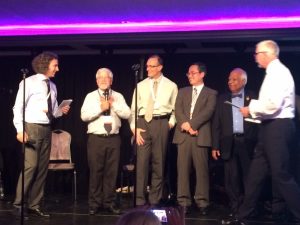
After the lecture, the plenary room was transformed into a ceremony room to host the students awards ceremony, another tradition of B-MRS annual meetings, which this year had prizes bestowed by four different entities. Between palms and photographs, 20 students received awards for their work. B-MRS, represented by its president, gave the certificates of the “Bernhard Gross Award”, which honors by its name a pioneering scientist of materials research in Brazil. Among these finalists, five students received the awards from ACS Publications, whose certificates were delivered by Professor Kirk Schanze. These five award winners also won cash awards, sponsored by the American Chemical Society (ACS) journals ACS Applied Materials and Interfaces, ACS Nano, NanoLetters, Chemistry of Materials, JACS e ACS Omega.
Next, the four E-MRS award winners were announced for the best oral and poster of symposium K and three IUMRS poster award winners were also announced. The winners that were in the cerimony received the certificates in the hands of representatives of the two entities, respectively, Jeffrey Kettle and Soo Wohn Lee.
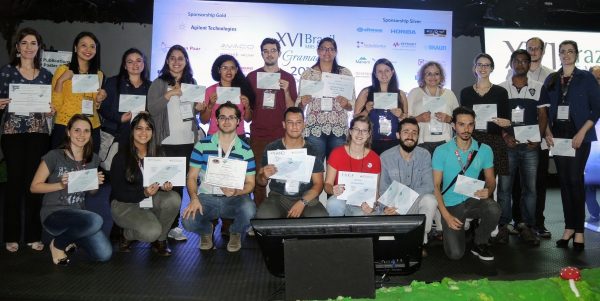
20 students received awards from B-MRS, ACS Publications, E-MRS and IUMRS for the contributions they presented in the event.
To conclude, the president of B-MRS and the chair of the event said some words. Both expressed their gratitude to all participants, organizing team, committees, students who help with the organization, symposia coordinators, plenarists, funding agencies, exhibitors, sponsors of the prizes and the party, host institution (UFRGS). Professor Novais de Oliveira also thanked Professor Weibel for being “a tremendous chair” and turned the “farewell” into “see you next year” by remembering that the next society meeting, the XVII B-MRS Meeting, will be held in Natal , capital of Rio Grande do Norte Brazilian state, from September 16 to 20, 2018.
It is with great satisfaction that SBPMat announces the 17th edition of its annual event (XVII Meeting of SBPMat / B-MRS Meeting) to be held in the city of Natal (Rio Grande do Norte State), at the Convention Center of Hotel Praiamar, from September 16 to 20, 2018, under the coordination of Professor Antonio Eduardo Martinelli (Federal University of Rio Grande do Norte, UFRN).


 In fact, it was from the compression of graphene sheets that the diamondene was obtained by the team led by Professor Cançado. Initially, the team deposited two layers of graphene one on top of the other and transferred the graphene bilayer to a Teflon substrate, chosen for being chemically inert, preventing the formation of bonds with the graphene.