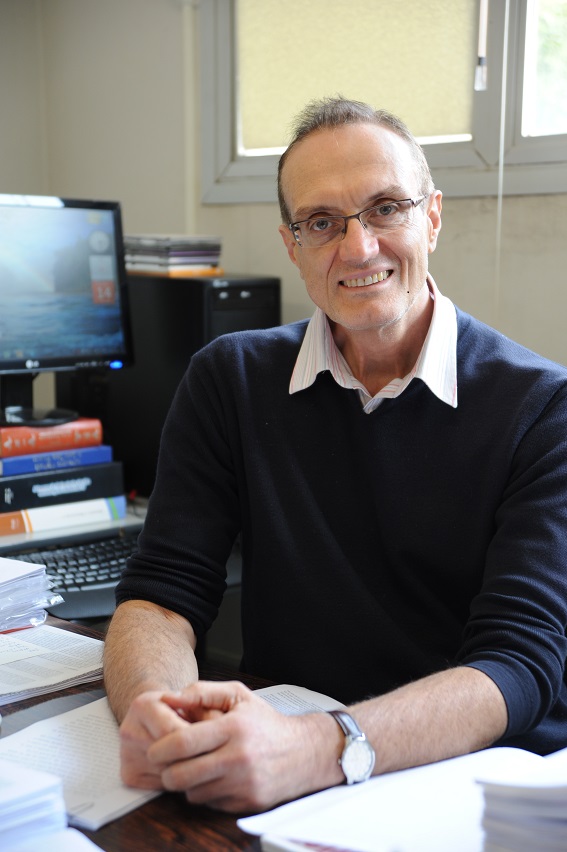
SBPMat´s community people: interview with Victor Carlos Pandolfelli.

Victor Carlos Pandolfelli, full Professor at the Materials Engineering Department of the Federal University of São Carlos (DEMa – UFSCar), assumed his position as a member of the advisory board of the World Academy of Ceramics (WAC) in a ceremony held on June 11, in Montecatini Termi (Italy), during the International Conference on Modern Materials and Technologies (CIMTEC). In that occasion, there was also the first meeting of the advisory board. Elected for the 2014-2018 term, Pandolfelli is one of the two representatives of the Americas for this period, jointly with a researcher from the United States.

Graduated in Materials Engineering at the DEMa – UFSCar (1979), Victor Carlos Pandolfelli has been researching subjects in the field of ceramic materials since the time of for his master’s thesis, defended in 1984, at DEMa-UFSCar. It was also in that field that he conducted the research for his doctorate, at the University of Leeds (United Kingdom), concluded in 1989, and his postdoctoral scholarship, held from 1996 to 1997 at the Polytechnique Montreal, in Canada.

Pandolfelli is a full member of the Brazilian Academy of Sciences (ABC) and fellow of the American Ceramic Society (ACerS), as well as a member of the WAC. He is or was part of the editorial boards of the journals  InterceramRefractories Manual and Refractories World Forum (Germany), Materials Research, Revista Cerâmica and Journal of Materials Research and Technology (Brazil), China’s Refractories (China),  Cerámica y Vidrio (Spain), Refractory ApplicationsRefractories Applications Transactions  and American Ceramic Society Bulletin (USA), and Ceramics International (Italy).

He is a visiting Professor at the Wuhan University of Science and Technology (China) and Latin American Coordinator of the Federation for International Refractories Research and Education (FIRE), an organization comprising universities in different countries and major companies in the field of refractories. Since 1993, he coordinates the ALCOA (Aluminum Company of America) laboratory at UFSCar.

Holder of a 1A-level fellowship for research productivity in the Brazilian Council for Scientific and Technological Development (CNPq), Professor Pandolfelli is the coauthor of more than 400 peer-reviewed papers, a book and eight deposited patents. He advised 50 master’s theses and 16 doctoral dissertations. Many studies developed or advised by him were awarded by entities such as the German Ceramic Society (Germany), Technical Association of Refractories of Japan, American Ceramic Society, Petrobras, Alcoa Alumínio S.A., Magnesita S.A, Brazilian Industrial Federation, and the Brazilian Associations of Aluminium, Ceramics and Metallurgy, Materials and Mining, among others. In his professional activities, he has interacted with 380 collaborators, coauthoring scientific papers.

Below is our interview with the researcher.

Tell us a little about your history: what led you to become a scientist and work in the field of ceramic materials?

The first aspect I would like to highlight is that life is made of choices that many times are not very logical or well planned. Actually, I studied Materials Engineering and, in the beginning, used to think about working with metals, but throughout the time I held a curricular traineeship in a company, still during my undergraduate studies, I had to meet a demand in ceramic materials. Then, I graduated specializing both in metals and in ceramic materials. In a time when the industry offered more jobs and better wages, I disregarded this scenario and chose to start my master’s studies in ceramics in the recently founded Materials Engineering program offered by UFSCar. Very soon after I enrolled for the master’s, there was a call for an selection to be a lecturer at UFSCar. I applied, was approved, and only then my life was truly dedicated to ceramic materials.

The professional turning point happened in my doctoral and postdoctoral studies abroad, when my network of contacts was tremendously expanded, just as the visibility of the work I was coordinating. Another aspect that collaborated a lot is that, even from the start, I endeavored to establish projects with companies, which taught me how to conduct the research that I consider “use-oriented basic research”. Then, I could really conciliate the fundaments acquired and developed at the university with the needs of the industry, while also creating opportunities so the students could take traineeships, as well as providing jobs.

This “use-oriented basic research” is a road with two ways that constantly interact to build a firm bridge between the university and the industry. We, as researchers, must comprehend the needs of the industry, and use the research and foundation tools we have at the university to help companies solve real issues. Many times, it is through an actual problem that we are motivated to understand the fundaments and use them to perceive new opportunities for applying and creating technologies.

Today, the path I chose enables me to take part in the Federation for International Refractories Research and Education, FIRE, which is a non-profit organization that gathers eleven universities around the world and seventeen companies. FIRE’s goal is to invest in the education of students in their master’s or doctoral years, providing them with a financial aid so they may spend six months to a year in affiliated universities or companies, have an international experience and apply or expand their knowledge in the field.

Therefore, my life as a researcher in the field of ceramic materials started more as an accident, and now, actually, it is focused on Complex System Engineering, considering that, at this moment, there are no materials defined only by a single field of expertise.

What do you consider to be your main contributions to the field of Materials?

Since I became a Professor, my project in the professional field always consisted of establishing three pillars, which feed one another and are the foundations to everything I do: teaching, research and industrial partnerships. This cycle is vital because, through teaching, I can meet good students, have the opportunity to invite them to conduct researches, which may subsequently serve the national and international industry, or the academia. Only by means of a good partnership we detect the needs of the industry and are able to illustrate our lectures, applying those foundations so they don´t become sterile, but may be filled by said needs.

Concerning teaching, it is certain that training people who are now developing great projects in the academic and industrial communities would be the main point of my contribution to education. As the tradition says, good teachers are measured by the number of people they taught, who now are better than them. Fortunately, today I have very well employed students, whether in research, teaching or companies, what proves my contribution.

The main aspect in regard to research, according to my self evaluation, was selecting a complex field to develop, with great opportunities to deepen and test my knowledge.  Once I returned to Brazil, after obtaining my doctoral degree in advanced ceramics, I felt it was very difficult to establish this subject as a research field here; however, the capacities I had acquired could be easily applied to other necessities of the country.  It was then that I realized how what I learned could be useful for the steel, metallurgy, aluminum and refractories industry. So, I adapted my expertise to the local reality, instead of trying to bring the international study to Brazil for a direct application of the advanced ceramics, which still is, up to this date, an incipient market. Within this scenario, my research tried to comprehend the different stages of the production cycle of the refractories. I defined a strategy to commit myself, every four or five years, to one topic related to the cycle of producing and understanding such materials. Throughout the more than 20 years I spent working in this field, it allowed me to know the complete cycle, not just the data collected by the literature.  As a result, we are writing a book to be released until the end of the year, in English, by a German publisher, filled with the product of the research we conducted involving from raw materials and processing to properties and simulations, providing a very clear and deep perspective on the microstructure engineering in refractory ceramic materials.

On the subject of industrial partnerships, which is the third pillar, I would say there is no way to do engineering only in a laboratory. We need to know how the market goes, as well as to learn to work with deadlines, to expose the data to industrial testing, to understand that the material is just one item within the whole. This I really owe to my industrial partnerships, which have always accompanied me, since I concluded my doctorate. We have partnerships that have been lasting for 24 straight years, as is the case with Alcoa Alumínio, where several people earned their master’s and doctoral degrees, and some of them work for the company. Many other companies, in Brazil and abroad, also contributed for the creation of this use-oriented basic research environment. We have solid partnerships with Petrobras, with Magnesita, a refractories company, with FIRE, etc. Thus, a large portion of the resources and opportunities of the group come from industrial partnerships, or federations working on this company-university bridge.

In your opinion, what are the main challenges to Science and Materials Engineering today?

I would highlight two major challenges. The first one would be the “materials genome” initiative. Due to the need to save time and costs with research, it is increasingly necessary to create a database and apply simulations in order to minimize the time spent in laboratorial experiments, reaching the expected result in the fastest way possible. Said “materials genome” consists of detecting their DNA and, by the association of computer tools, trying to conceptualize new materials still unimagined by the current technology, each time sooner. So I predict that the materials laboratory of the future will have less equipment, multidisciplinary teams and more computers with high processing speed, which will provide a more objective idea on what to do in the laboratory to produce new materials.

The other great challenge is 3D printing, comprising the class known as additive manufacturing, which has emerged with a tremendous force, considering that companies have been noticing how labor costs in developing countries are already high. In a first moment, the industries in developed countries started to realize that the manufactured products would be more competitive if produced abroad. So, as a first wave, they brought the manufacturing process to the developing countries, but this environment changed with time, and in countries such as China and Brazil, labor is starting to become very expensive. In addition to that, the legislation ruling exports and taxes only makes the scenario worse. So, countries such as Germany and the United States are once again manufacturing at home, using an entirely automated system, based on 3D printing, which is similar to regular printing, but, instead of printing X Y, prints X Y Z, and, instead of toner, uses materials. 3D printing is simply revolutionizing the whole market, keeping in mind that today it is possible to own a materials printer at home and do the build yourself for jewelry, toys, etc. Furthermore, it is already making implants, using stem cells as a component to create organs in 3D printers.

With this technique, associated with the first item I mentioned, simulation, we will have new materials that we are not able to obtain with the traditional processing methods. The idea I propose to you now was the same I presented in my first meeting of the WAC advisory board. It was so well received by the committee that it became the theme of the forum for members of the academy to be held in two years, which is going to bring together the best researchers and companies in the world dedicated to this field.

Another interesting point to elaborate is that we are experiencing the age of Complex Systems Engineering. No one speaks about specialization fields anymore. What we need, more than ever, is the sum of the knowledge of the different fields. For example, as to materials printed in three dimensions, having the equipment is not enough. We require computer programmers, mechanical engineers, production engineers, materials engineers, chemists, physicists, biologists, managers, all working closely, because we are no longer dealing with knowledge that a single person is able to hold.

In your opinion, how did you build the recognition of the international ceramic research community, attested, for example, by your election as a member of the advisory board of the WAC?

In addition to all that was already said, I would add that every victory is a collective effort. There were 34 years of intense work in national and international partnerships with industries and supporting agencies. I believe that the standard formula to achieve anything is: teamwork, persistence, associating yourself to the best and promoting your name nationally and internationally.

Leave a message for our readers who are starting their careers as scientists.

My answer is going to have some traditional elements, others not so much. The traditional suggestion is widely known: energy and commitment, work and sweat. The part that is not so traditional is about not confusing the opportunities we have today with a convenient life. Living is not easy. The professional life is full of challenges and the current opportunities are here to make competition even more intense. Now, competition is set in a global scale. In any place around the world someone may be doing the same thing I am developing in my laboratory. Because of that, every young scientist must be really aware that companies and financing agencies will seek who can do it in the best, fastest and cheapest way, producing the highest possible amount of return to the society.

One point that I would really like to stress is that the real world is not Facebook, victories are reached after many battles, and many defeats. This virtual universe where we are always surrounded by famous people, enjoying accomplishments and partying does not exist.

Another issue is that, due to the many opportunities we have today, young people take one already looking for another, fulfilling neither. Instead of firmly grabbing a branch, they are always thinking about leaping for the next one. They must be very careful. Do at least one task competently, at a time. If you are studying for your master’s, develop a good productivity rate, establish a network, then you may change your subject, if it is the case. The scientific communities are not as big as we think they are. We need to do a very good job from the very start, with high quality and great respect for the group in which we work.  The world spins quickly, and in a not so distant future, the same people may open or close doors to you. In our professional life, to a certain degree, we may rise based on our own capacities, but then we are seriously going to need to be inserted by the national and international community. It is at that point that I may need those people to whom I gave a bad impression.
SBPMat´s community people: interview with Reginaldo Muccillo.

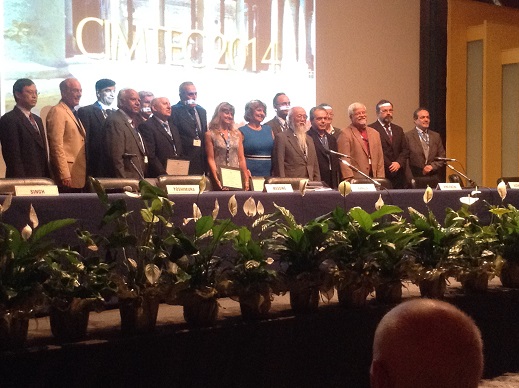
The new WAC members in their inaugural ceremony. Prof. Muccillo is the first from right to left. 

On the morning of June 09th, in the Italian district of Montecatini Terme, the Materials researcher Reginaldo Muccillo, managing director of our SBPMat from 2012 to 2013, was sworn in as member of the World Academy of Ceramics (WAC). WAC is an international entity, with its main office located in Italy, dedicated to promoting progress in the field of ceramics, as well as to spread awareness regarding the social impact and cultural interactions offered by science, technology, history and arts in the field of ceramics.

Reginaldo Muccillo was one of the seventeen selected members in the 15th election process conducted by the WAC academicians, which recognizes the merit of those who substantially contributed to the field of ceramics. Being the only Brazilian member elected this time, Muccillo shared the induction ceremony with researchers and other professionals from China, Spain, the United States, Finland, Italy, Japan, Poland, Portugal and Sweden. The ceremony was held during the opening session of the International Conference on Modern Materials and Technologies (CIMTEC).

Researcher from the Materials Science and Technology Center of the Nuclear and Energy Research Institute (IPEN), Reginaldo Muccillo earned his undergraduate, Master’s and Doctoral degrees in Physics, at the University of São Paulo (USP). He did research stages abroad, first at the National Research Council in Ottawa (Canada) during his Doctorate, then, during his postdoctoral studies, at the Max Planck Institut fuer Festkoerperforschung, in Stuttgart (Germany) and the Institut National Politechnique de Grenoble (France). He was the (co) coordinator of seven issues of the Brazilian Electroceramics Symposium, the VII SBPMat Meeting (2008), and the 6th International Conference on Electroceramics (ICE 2013). He has been the main editor of the journal Cerâmica, an official publication of the Brazilian Association of Ceramics (ABCeram) for 15 years. He holds a 1A-level fellowship for research productivity in the Brazilian Council for Scientific and Technological Development (CNPq).

What follows is a brief interview with the scientist:

Tell us a bit about your history: what led you to become a scientist and work in the field of ceramic materials?

Already in my undergraduate studies, I left the Engineering course in USP’s Polytechnic School to attend Physics. Holding a research scholarship in the field of Nuclear Physics, I met renowned researchers in the USP’s Physics Institute, who effectively influenced me to pursue a scientific career. Once I graduated, I proceed to IPEN, for my Master in Solid-State Physics. Then, when I concluded my Master’s studies, I went to Canada for a research stage beeing part of my Doctorate course. After returning the IPEN, having defended my doctorate at the USP, I started to conduct researches with ceramic materials, moving from Solid-State Physics to Materials Science and Engineering.

In your opinion, what were your main contributions to the field of Materials?

Working in a research institute, I could focus all my time to conduct the research work itself, to raise resources in supporting entities (São Paulo Research Foundation – FAPESP, and CNPq) for improving the infrastructure of the laboratory (I am an experimental researcher dedicated to assembling and collecting data from equipment, analyzing such data and wrinting articles to be submitted to indexed and peer-reviewed journals), to train and instruct staff, to organize events, to edit scientific journals and to interact with the productive sector. In addition to the development of fundamental research in the field of Materials, my expertise allows me to seek applications in devices concerning many industrial sectors.

In your opinion, what are the main challenges to your current research topics in Materials Science and Engineering? 

Explaining, modeling and providing theoretical equations to several physical and chemical phenomena that occur in the Ceramic Materials Science.

In your opinion, how did you receive the recognition of the international Ceramics research community, as expressed by your election as a WAC scholar? 

Developing research work, training staff at undergraduate, master’s, doctoral and postdoctoral levels, assembling laboratories for the scientific community (multi-users), editing journals (the Cerâmica) in the field of ceramic materials, and researching materials for producing sensors and alternative energy sources, as well as, most recently, flash sintering.

Featured paper: papaya and cinnamon – ingredients in antimicrobial films for food packaging.

The scientific paper by members of the Brazilian community on Materials research featured this month is:

Caio G. Otoni, Márcia R. de Moura, Fauze A. Aouada, Geany P. Camilloto, Renato S. Cruz, Marcos V. Lorevice, Nilda de F.F. Soares, Luiz H.C. Mattoso. Antimicrobial and physical-mechanical properties of pectin/papaya puree/cinnamaldehyde nanoemulsion edible composite films. Food Hydrocolloids. Volume 41, December 2014, Pages 188–194. DOI: 10.1016/j.foodhyd.2014.04.013.

Papaya and cinnamon: ingredients in antimicrobial films for food packaging.

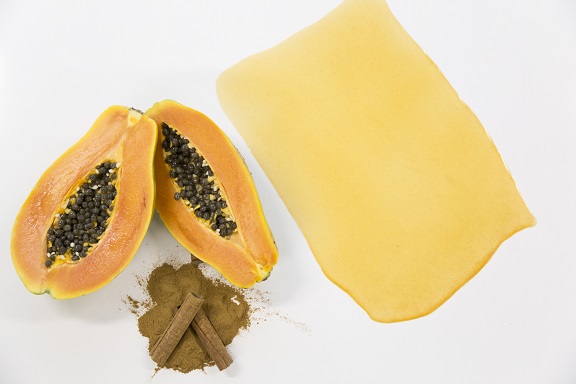
The ingredients and one of the films. Photo: Flavio Ubiali. – Núcleo de Comunicação Organizacional, Embrapa Instrumentação.

Edible packagings are films that may be eaten without harming one’s health. They may be used to wrap food in order to protect it, to improve its appearance or to provide some texture or flavor. Such films already are on the markets, replacing animal tissue in cold meats or seaweeds in sushi, just to name a few uses.

Besides being interesting under an environmental perspective, as they may use wasted residues from fruit and vegetables in their composition, they are even more attractive when provided with antimicrobial properties, because it allows the decrease in the amount of preservatives in the food they wrap.

In Brazil, a team comprising materials engineers, chemists and food engineers has produced edible films with antimicrobial properties, based on renewable sources: pectin, papaya and cinnamon essential oil.

The project was developed in three main stages. The first one was performed at the National Nanotechnology Laboratory for the Agribusiness in the instrumentation unit of Embrapa (the Brazilian Agricultural Research Corporation) and consisted in obtaining and characterizing nanoemulsions of cinnamaldehyde, the main component in the cinnamon essential oil.  Using mechanical stirring in a controlled way, with several speeds, the researchers obtained emulsions with cinnamaldehyde particles of different sizes, from 20 to 500 nm of diameter.

For the second stage, also conducted at Embrapa Instrumentation, the researchers produced films based on pectin (a natural polymer found in plant tissues and known for its gelling capacities), added with papaya puree and the obtained emulsions. Finally, the team characterized the films. Their mechanical and antimicrobial properties were analyzed at the Packaging Laboratory of the Federal University of Viçosa, UFV, in Minas Gerais State, while their properties as a water barrier were assessed at Embrapa Instrumentation. Professors from the State University of Feira de Santana in Bahia State and São Paulo State University, UNESP, performing at that moment their postdoctoral researches at Embrapa and UFV’s laboratories contributed to the project as well.

The results of their studies were recently published by the journal Food Hydrocolloids.

The films

Incorporating cinnamaldehyde nanoemulsions to the films inhibited the development of four pathogenic bacteria tested by the team of researchers (Escherichia coli, Salmonella enterica, Listeria monocytogenes and Staphylococcus aureus).

“The most interesting result is that decreasing the size of the nanoemulsions particles notably potentiated the inhibitory activity of the films”, highlights Caio Otoni, main author of the paper, Master’s student in Materials Science and Engineering at the Federal University of São Carlos, UFSCar. “That may impact the use of polymeric packaging with antimicrobial capacites for wrapping food, considering that the same food security guaranteed by the active packaging may be obtained using lower amounts of preservatives, if encapsulated in smaller particles, which is an advantage for manufacturers (lower production costs) and consumers (ingestion of less preservatives)”, concludes Caio, who developed the project with other seven authors, while attending the Food Engineering undergraduate course at UFV.

In addition to providing antibacterial properties to the films, the nanoemulsions made them less permeable to humidity and less plastic (more rigid and less extensible). On the other hand, the papaya pulp caused an inverse effect, concerning those attributes.

The authors Luiz Henrique Capparelli Mattoso, Marcos Vinicius Lorevice e Caio Gomide Otoni (from left to right) at Embrapa Instrumentation. Photo: Flávio Anselmo Faria Ubiali – Núcleo de Comunicação Organizacional, Embrapa Instrumentação.

E-MRS Meeting in France: SBPMat organization and Brazilian presence at organic electronics symposium.

SBPMat was part of the organization of the E-MRS (European Materials Research Society) Spring Meeting, held from May 26th to 30th, in Lille, France. SBPMat’s President, Roberto Mendonça Faria, full professor at the Institute of Physics of the University of São Paulo (USP) was among the Conference Chairs, jointly with four European scientists.

In addition to that, SBPMat has supported one of the event’s 30 symposia, the DD “Functional materials and devices for organic electronics”, which was also assisted by the Brazilian National Institute of Science and Technology in Organic Electronics (INEO). The symposium displayed substantial Brazilian attendance. It was organized by SBPMat’s Financial Director, Professor Marco Cremona (Pontifical Catholic University of Rio de Janeiro, PUC-Rio), by SBPMat´s current Scientific Director Rodrigo Bianchi (Federal University of Ouro Preto, UFOP), and Carlos Graeff (São Paulo State University, UNESP), SBPMat´s former Scientific Director, as well as by a German and an Italian scientists.

“The symposium was a success, both regarding the researchers invited – all highly qualified and leaders in their field of expertise – as to the level of results presented in the technical sessions and the subjects approached, all current concerns in the field of organic electronics”, summarized Professor Cremona. “Not only that, but the symposium has contributed to improve the image of Brazil in this field, and to start new collaborations, while still strengthening the ones that already exist”, he adds.

Dedicated to the subject of organic electronics, the symposium comprised oral presentations, posters and 23 invited lectures in sessions on organic light-emitting devices, organic transistors, flexible devices, sensors, organic solar cells, bioelectronic devices, graphene and other transparent conductive films. Other sessions approached the relation between nanostructure and function in advanced organic devices, and the modeling, simulation, characterization methods and new horizons for materials and organic devices.  “The topics were well balanced among basic and applied researches in the field of organic electronics, including electronic devices and biosensors”, as Professor Bianchi comments.

During the four days of the symposium, over 140 studies were presented, by researchers from European Union member countries, Korea, Japan, Brazil, the United States, Russia, Australia, among others. “The presentations in the Symposium DD brought high-impact lectures to E-MRS, with great participation of Brazilian researchers, proving that the country and SBPMat have been working in fields with scientific impact, and in the knowledge frontier”, Bianchi adds. Indeed, Brazil contributed to the symposium with approximately 20 papers, and two invited lectures.

Award

The symposium also featured awards for the best three posters and two papers presented in oral form:

Oral presentations:

  • Jean Nicolas Tisserant, ETH Zürich, D-AGRL Food and Soft Materials (Zürich, Switzerland). “Growth and Alignment of Thin Film Organic Single Crystals from Dewetting Patterns”, Empa.
  • Daniele Sette, CEA, LETI, DCOS (Grenoble, France). “Influence of the Annealing Temperature on the Properties of Inkjet Printed Porous Silver Layers”.

Posters:

  • Anshuma Pathak, TU Munich, Molecular electronics (Munich, Germany),
  • Structural and Electrical Study of Organophosphonate SAMs on AlOx/Al”.
  • Jung-Hung Chang, National Taiwan University, Graduate Institute of Photonics and Optoelectronics (Tapiei, Taiwan), “All–solution processed transparent organic light emitting diodes with graphene as top cathodes”.
  • Lidiya Leshanskaya, Institute for Problems of Chemical Physics, Kinetics and Catalysis, Academician Semenov (Moscow, Russia), “Origin of the advanced charge transport properties of indigo thin films: influence of the dielectric on the crystal structure of the semiconductor”.


Inscrições abertas para Mestrado Profissional em Materiais e Catálise da Univap (São José dos Campos, SP).

O Programa de Pós-graduação em Materiais e Catálise da Universidade do Vale do Paraíba (Univap) está com inscrições abertas para o segundo semestre de 2014. O mestrado possui três linhas de pesquisa principais: (1) Desenvolvimento de materiais para suporte catalítico; (2) Processamento e caracterização de materiais metálicos; e (3) Processamento e caracterização de materiais compósitos, cerâmicos e poliméricos.

As inscrições podem ser feitas, pela internet, até 04/07. A prova de conhecimentos e entrevistas serão realizadas no dia 30/07, das 13:30h às 18:00h, no Instituto de Pesquisa e Desenvolvimento do campus Urbanova em São José dos Campos (SP). Podem participar do processo seletivo egressos de Engenharia, Química ou Física incluindo bacharéis e tecnólogos de áreas afins.

Mais informações em http://www.univap.br/ipd/proc_materiais_catalise/mestrado_proc_materiais_catalise/proc_seletivo.php ou pelo e-mail ivone@univap.br.

Concurso para professor do Instituto de Química da Unicamp em Síntese Inorgânica.

CONCURSO PÚBLICO PARA O CARGO DE PROFESSOR DOUTOR – MS 3.1

Área: Síntese Inorgânica, na disciplina QI 242 – Química Inorgânica Teórica.

Requisito mínimo para inscrição no concurso: ter o título de doutor.

Perfil desejável do candidato: É desejável que o candidato possua experiência em estratégias ou métodos contemporâneos em síntese inorgânica envolvendo elementos representativos, de transição ou de pós-transição; que seja portador do título de Doutor em Química ou em áreas afins, que possua produção científica caracterizada pela publicação de artigos científicos em revistas indexadas relacionada com a área do concurso, capacidade de liderar atividades de pesquisa e de formar recursos humanos. É desejável também que o candidato possua experiência no exterior bem como habilidade ou experiência didática. A inscrição de candidato que deixar de atender ao perfil desejável não será indeferida por este motivo.

Inscrições: podem ser feitas na Secretaria do Departamento de Química Inorgânica, Instituto de Química/UNICAMP – Bloco D sala 349 – R. Josué de
Castro s/n – cidade universitária Zeferino Vaz – distrito de Barão Geraldo – Campinas – SP

Período de inscrições: todos os dias úteis até dia 17.07.2014 das 9h00 às 11h30 e das 14h00 às 17h00.

O edital completo do concurso pode ser consultado no sítio: http://www.sg.unicamp.br/dca/concursos/abertos/concursos-para-professor-doutor/instituto-de-quimica
O e-mail onde podem ser obtidas mais informações é dqi@iqm.unicamp.br.

UFABC abre inscrições para Pós-Graduação em Nanociências e Materiais Avançados.

O aumento da importância e competitividade tecnológica no domínio de nanomateriais e na ciência de materiais é reconhecido como um dos grandes pilares do desenvolvimento científico, tecnológico e social no século XXI. A possibilidade de desenvolver moléculas e materiais que podem substituir os materiais tradicionais terá um profundo impacto em muitos aspectos do desenvolvimento de diversos produtos. O campo emergente de materiais funcionais é, portanto uma tecnologia estratégica para o futuro.

Diante desta realidade o programa de Pós-Graduação em Nanociências e Materiais Avançados da Universidade Federal do ABC (UFABC) busca capacitar profissionais com formação interdisciplinar que apresente uma visão abrangente e diferenciada, qualificando-o para a pesquisa de ponta e as inovações tecnológicas nas áreas do programa.

As inscrições para o processo seletivo para o Mestrado e Doutorado estão abertas até o dia 24 de Junho.

Mais informações em http://nano.ufabc.edu.br.

Processo seletivo para mestrado e doutorado em Física e Química de Materiais na UFSJ (MG).

O Programa de Pós-graduação em Física e Química de Materiais (FQMat) divulga o Edital 001/2014 do processo seletivo – 2° semestre de 2014, para preenchimento de vagas de mestrado e doutorado.

As inscrições acontecerão no período de 18 a 27 de junho de 2014, 15h às 17h, Sala 3.05 do bloco C do Departamento de Ciências Naturais, Campus Dom Bosco – São João del Rei. As inscrições podem ser feitas via Sedex, desde que a correspondência seja postada até o dia 25 de junho de 2014.
Para mais informações sobre inscrição, documentos necessários, datas das provas e preenchimento da GRU, confira o edital no link
http://www.ufsj.edu.br/fqmat/processo_seletivo.php

Outras informações pelo telefone (32) 3379-2535 , (32) 3379-2444 ou pelo e-mail fqmat@ufsj.edu.br.

SBPMat newsletter. English edition. Year 1, issue 5.


Brazilian Materials Research Society (SBPMat) newsletter

News update from Brazil for the Materials community


English edition. Year 1, issue 5.

Greetings, .

SBPMat’s news

XIII SBPMat meeting:

João Pessoa, September 28th, to October 2nd.

– The deadline for submitting papers for SBPMat’s symposia was extended to June 06th.  Submit yours.

– Hosting options in João Pessoa? See some of them here.

Interviews with plenary speakers

We have interviewed Professor Alberto Salleo, from Stanford University, who is going to give a plenary lecture on organic electronic devices in the XIII SBPMat Meeting. Young, yet holding a career that stands out internationally, Salleo told us about the work conducted by his group, which has been developing a deeper understanding on the role provided by the defects in charge transport in organic semiconductors. He also shared with us his main papers, published in Nature Materials. Finally, Salleo discussed the next challenges and applications on organic electronics, and anticipated what he is going to address in the plenary lecture, which promises to be very informative while mild enough for a wider audience. Read our interview with Alberto Salleo.

SBPMat’s community people

Upon his inauguration as a full member of the Brazilian Academy of Sciences (ABC), we talked to Professor Fernando Lázaro Freire Junior, SBPMat’s former president, financial director and scientific director. Throughout his scientific path, Professor Fernando Lázaro has been specially committed to researching carbon-based materials: DLC films, nanotubes and graphene. The researcher told us how he became a scientist, and commented on his most highlighted contributions to the field of Materials. Having a great portion of his career developed in the Pontifical Catholic University of Rio de Janeiro (PUC-Rio),  the Professor emphasized, in his message to younger readers: it is possible to do research with an international impact in Brazil. Read our interview with Fernando Lázaro Freire Junior. 

History of SBPMat

We talked again to Professor Fernando Lázaro Freire Junior, President of the society during two turns in a roll, from 2006 to 2009. During such time, SBPMat held, in addition to the 4 annual meetings, with an increasing number of attendees, the International Conference on Advanced Materials (ICAM 2009). It was also in those years that the society organized its office. Professor Fernando Lázaro presented a brief overview on his administration, regretted some pending issues (proximity with members and the interaction with the industry) and, to conclude, said that young people should be more involved in SBPMat’s decisions. Read it here.

Featured papers with Brazilian participation

– Our “featured paper” (release about a scientific paper made in Brazil) about ultra-small crystals with modulated shell thickness was posted at the webpage of Materials Today. Read it.

– “A new ozone sensor“, another SBPMat “featured paper”, is among the 10 most read in the month of April at the webpage of Materials Today. Read it.

Reading recommendations

Science journalism stories based on papers published in journals with high impact factor.

– Breakthroughs on molybdenum disulfide lead to new technique and advance the applications of this two-dimensional material (Science). Read it. 

– In a blender, scientists create graphene production route in large scale for composites and coatings (Nature Materials). Read it.

Biomaterials: silk microstructures are produced with photolithography and guide cell adhesion (Advanced Materials). Read it.

Biomimetics: new discoveries on the anatomy of the gecko inspired a high-performance adhering material, developed without nanotechnology (Advanced Materials). Read it.
Materials news from the Brazilian National Institutes of Science and Technology (INCTs).

– In order to monitor air pollution rates, project from university-industry partnership develops low-cost sensors, without batteries. Read it.
Another news.

– New Brazilian laboratory for the development of low-weight, high-resistance structures, components and parts. Read it.

– In the United Kingdom, £ 3 million project on nanoparticles for diagnosing and treating cardiovascular diseases. Read it. 

Opportunities

Postdoctoral fellowship on micro-nanomaterials, monitoring and processing for industrial application in the Brazilian Federal University of Rio Grande do Sul. Here.

– Selection of the new director for the Brazilian Center for Research in Energy and Materials (CNPEM). Here.

– Call for collaborative projects São Paulo State – Finland on some Materials topics. Here.

– L´Oréal-Unesco-ABC Award “For women in Science” for research projects conducted by young female Doctors. Here.

Upcoming events in the area

– 13th International Conference on Modern Materials and Technologies (CIMTEC 2014). Here.

– 1st International Conference on Polyol Mediated Synthesis. Here.

– 2º Workshop Adesão Microbiana e Superfícies. Here.

– 13th European Vacuum Conference + 7th European Topical Conference on Hard Coatings + 9th Iberian Vacuum Meeting. Here.

– 19th International Conference on Ion Beam Modification of Materials. Here.

– XIII SBPMat Meeting. Here.

– MM&FGM 2014 – 13th International Symposium on Multiscale, Multifunctional and Functionally Graded Materials. Here.

– X Brazilian Symposium on Glass and Related Materials (X-BraSGlass). Here.

To suggest news, opportunities, events or reading recommendations items for inclusion in our newsletter, write to comunicacao@sbpmat.org.br.
Unsubscribe here.

Interviews with SBPMat’s former presidents: Fernando Lázaro Freire Junior (2006-2007 and 2008-2009).

An active participant of the creation process of SBPMat and member of its founding board, Fernando Lázaro Freire Junior was elected the president of our society for two consecutive terms, chairing SBPMat’s board from 2006 to 2007, and from 2008 to 2009. During the whole time, Professor Fernando Lázaro counted with Professor Osvaldo Novais de Oliveira Júnior as managing director. The financial office was held by Glória Dulce de Almeira Soares in the first tenure, then by Sérgio de Souza Camargo Júnior in the second one. Aldo Felix Craievich and Paulo Fernando Papaleo Fichtner were the scientific directors for both terms, being joined in the latter by Antonio Eduardo Martinelli and Margareth Spangler Andrade.

It can be said that Professor Fernando Lázaro is a physicist from the Pontifical Catholic University of Rio de Janeiro (PUC-Rio), as it was there that he earned his Bachelor’s degree in Physics, in 1978, his Master’s in 1981 and Doctorate in 1985. In 1979, he started teaching in the same university and, in 2012, became a Full Professor. He was the Director of PUC-Rio’s Physics Department from 2003 to 2008. In Europhysics Letters (a journal from the European Physical Society), Professor Lázaro worked as coeditor between 2006 and 2010, and advisory editor from 2010 to 2013. In the Research Foundation of the State of Rio de Janeiro (FAPERJ), he was the coordinator of the Physics and Astronomy field, from 2008 to 2012, and currently is a member of the Higher Board.

Since 2011, Professor Fernando Lázaro is the director of the Brazilian Center for Research in Physics (CBPF). In December 2013 he was elected full member of the Brazilian Academy of Sciences (ABC). Author of over 170 scientific articles, with more than 2.500 citations, he is a Level 1A researcher in the Brazilian National Research Foundation, CNPq.

Which follows is an interview with this SBPMat’s former president on his two terms:

 1.  List the main actions performed during your terms as SBPMat’s president.

 In addition to organizing the annual meetings, which had an ever increasing audience in that time, we held the International Conference on Advanced Materials (ICAM) in Rio de Janeiro, structured the SBPMat office, as well as established the cooperation with the sister institutions MRS and E-MRS, the American and European Materials societies, but also with the International Union of Materials Research Society (IUMRS), when SBPMat attended the Second World Materials Summit on Advanced Materials in Energy Applications and Sustainable Society Development, in Lisbon. From a financial perspective, the coffer of the society had funds when we leave. By the way, such practice started in the administration of Professor Longo, leaving the presidency free of financial or labor problems for the next one, and it has still been followed in the administrations that succeed mine.

2. List the main difficulties faced during your terms as SBPMat’s president.

Initially, there was the lack of an administrative structure in the society, which, up to that point, depended entirely on the work of its directors and of the researchers organizing the annual meetings. I had more luck than the previous administration, and with the funds available, we could hire a secretary and interns to run the society. Later, we hired a second secretary and the management became more professional. Another issue was organizing the ICAM. An events agency was hired, but it could not deliver, which caused a great stress, due to the hardship to organize an international meeting with more than 1600 researchers.

3. What could have been done, but was still pending?

Take the Society closer to its members. This was very poorly attempted with SBPMAt’s electronic panel, which used to spread news of the interest of its associates. Nowadays, our newsletter is orders of magnitude better. Such process requires time; we can’t compare a society like ours, with little more than 10 years, to others, holding over 40, 50 years of existence. It was still lacking a major interaction with the productive sector, which is still far from occurring in a level that truly represents the importance held by the Materials research in several fields of our economy.

4. What would you highlight about the SBPMat meetings that were organized and held in your administration?

First, there was the increasing participation of students and researchers, proving that the SBPMat’s Annual Meeting came to fill a gap in the Brazilian scenario. In addition to that, there is the itinerant nature of the meeting. In those four years, we held meetings in Natal and Florianópolis, as well as Rio de Janeiro and Guarujá. As the meeting counts with the substantial attendance of foreign researchers, this aspect is important as it brings the possibility of gaining access to scientific events to new students in all regions of the country. Another important point is the good scientific level of the contributions which have been presented and the interdisciplinary nature of the symposia, making the SBPMat Annual Meeting the most important event in the field of Materials, in Brazil.

5. Would you like to leave a message to our readers, concerning the election process of our SBPMat?

The participation rate is still very low, and I think the effective involvement of its associates is crucial to strengthen SBPMat. The current board and its council represent an important renewal when compared to previous ones, and that is good, it is good for the younger people to take part in the society, its decisions and management.