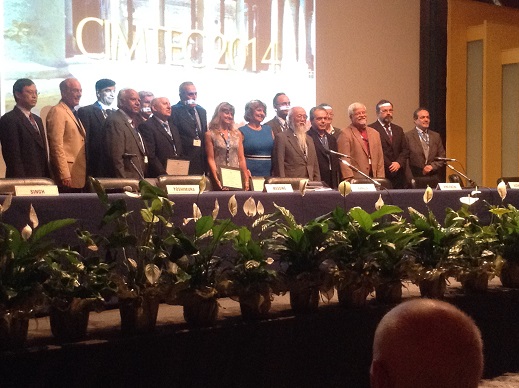
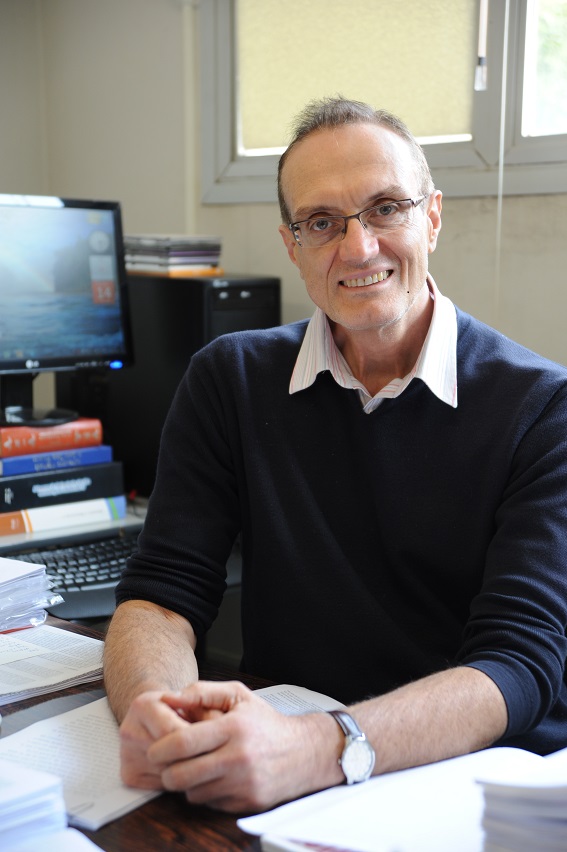
 Victor Carlos Pandolfelli, full Professor at the Materials Engineering Department of the Federal University of São Carlos (DEMa – UFSCar), assumed his position as a member of the advisory board of the World Academy of Ceramics (WAC) in a ceremony held on June 11, in Montecatini Termi (Italy), during the International Conference on Modern Materials and Technologies (CIMTEC). In that occasion, there was also the first meeting of the advisory board. Elected for the 2014-2018 term, Pandolfelli is one of the two representatives of the Americas for this period, jointly with a researcher from the United States.
Graduated in Materials Engineering at the DEMa – UFSCar (1979), Victor Carlos Pandolfelli has been researching subjects in the field of ceramic materials since the time of for his master’s thesis, defended in 1984, at DEMa-UFSCar. It was also in that field that he conducted the research for his doctorate, at the University of Leeds (United Kingdom), concluded in 1989, and his postdoctoral scholarship, held from 1996 to 1997 at the Polytechnique Montreal, in Canada.
Pandolfelli is a full member of the Brazilian Academy of Sciences (ABC) and fellow of the American Ceramic Society (ACerS), as well as a member of the WAC. He is or was part of the editorial boards of the journals Interceram, Refractories Manual and Refractories World Forum (Germany), Materials Research, Revista Cerâmica and Journal of Materials Research and Technology (Brazil), China’s Refractories (China), Cerámica y Vidrio (Spain), Refractory Applications, Refractories Applications Transactions and American Ceramic Society Bulletin (USA), and Ceramics International (Italy).
He is a visiting Professor at the Wuhan University of Science and Technology (China) and Latin American Coordinator of the Federation for International Refractories Research and Education (FIRE), an organization comprising universities in different countries and major companies in the field of refractories. Since 1993, he coordinates the ALCOA (Aluminum Company of America) laboratory at UFSCar.
Holder of a 1A-level fellowship for research productivity in the Brazilian Council for Scientific and Technological Development (CNPq), Professor Pandolfelli is the coauthor of more than 400 peer-reviewed papers, a book and eight deposited patents. He advised 50 master’s theses and 16 doctoral dissertations. Many studies developed or advised by him were awarded by entities such as the German Ceramic Society (Germany), Technical Association of Refractories of Japan, American Ceramic Society, Petrobras, Alcoa Alumínio S.A., Magnesita S.A, Brazilian Industrial Federation, and the Brazilian Associations of Aluminium, Ceramics and Metallurgy, Materials and Mining, among others. In his professional activities, he has interacted with 380 collaborators, coauthoring scientific papers.
Below is our interview with the researcher.
Tell us a little about your history: what led you to become a scientist and work in the field of ceramic materials?
The first aspect I would like to highlight is that life is made of choices that many times are not very logical or well planned. Actually, I studied Materials Engineering and, in the beginning, used to think about working with metals, but throughout the time I held a curricular traineeship in a company, still during my undergraduate studies, I had to meet a demand in ceramic materials. Then, I graduated specializing both in metals and in ceramic materials. In a time when the industry offered more jobs and better wages, I disregarded this scenario and chose to start my master’s studies in ceramics in the recently founded Materials Engineering program offered by UFSCar. Very soon after I enrolled for the master’s, there was a call for an selection to be a lecturer at UFSCar. I applied, was approved, and only then my life was truly dedicated to ceramic materials.
The professional turning point happened in my doctoral and postdoctoral studies abroad, when my network of contacts was tremendously expanded, just as the visibility of the work I was coordinating. Another aspect that collaborated a lot is that, even from the start, I endeavored to establish projects with companies, which taught me how to conduct the research that I consider “use-oriented basic research”. Then, I could really conciliate the fundaments acquired and developed at the university with the needs of the industry, while also creating opportunities so the students could take traineeships, as well as providing jobs.
This “use-oriented basic research” is a road with two ways that constantly interact to build a firm bridge between the university and the industry. We, as researchers, must comprehend the needs of the industry, and use the research and foundation tools we have at the university to help companies solve real issues. Many times, it is through an actual problem that we are motivated to understand the fundaments and use them to perceive new opportunities for applying and creating technologies.
Today, the path I chose enables me to take part in the Federation for International Refractories Research and Education, FIRE, which is a non-profit organization that gathers eleven universities around the world and seventeen companies. FIRE’s goal is to invest in the education of students in their master’s or doctoral years, providing them with a financial aid so they may spend six months to a year in affiliated universities or companies, have an international experience and apply or expand their knowledge in the field.
Therefore, my life as a researcher in the field of ceramic materials started more as an accident, and now, actually, it is focused on Complex System Engineering, considering that, at this moment, there are no materials defined only by a single field of expertise.
What do you consider to be your main contributions to the field of Materials?
Since I became a Professor, my project in the professional field always consisted of establishing three pillars, which feed one another and are the foundations to everything I do: teaching, research and industrial partnerships. This cycle is vital because, through teaching, I can meet good students, have the opportunity to invite them to conduct researches, which may subsequently serve the national and international industry, or the academia. Only by means of a good partnership we detect the needs of the industry and are able to illustrate our lectures, applying those foundations so they don´t become sterile, but may be filled by said needs.
Concerning teaching, it is certain that training people who are now developing great projects in the academic and industrial communities would be the main point of my contribution to education. As the tradition says, good teachers are measured by the number of people they taught, who now are better than them. Fortunately, today I have very well employed students, whether in research, teaching or companies, what proves my contribution.
The main aspect in regard to research, according to my self evaluation, was selecting a complex field to develop, with great opportunities to deepen and test my knowledge. Once I returned to Brazil, after obtaining my doctoral degree in advanced ceramics, I felt it was very difficult to establish this subject as a research field here; however, the capacities I had acquired could be easily applied to other necessities of the country. It was then that I realized how what I learned could be useful for the steel, metallurgy, aluminum and refractories industry. So, I adapted my expertise to the local reality, instead of trying to bring the international study to Brazil for a direct application of the advanced ceramics, which still is, up to this date, an incipient market. Within this scenario, my research tried to comprehend the different stages of the production cycle of the refractories. I defined a strategy to commit myself, every four or five years, to one topic related to the cycle of producing and understanding such materials. Throughout the more than 20 years I spent working in this field, it allowed me to know the complete cycle, not just the data collected by the literature. As a result, we are writing a book to be released until the end of the year, in English, by a German publisher, filled with the product of the research we conducted involving from raw materials and processing to properties and simulations, providing a very clear and deep perspective on the microstructure engineering in refractory ceramic materials.
On the subject of industrial partnerships, which is the third pillar, I would say there is no way to do engineering only in a laboratory. We need to know how the market goes, as well as to learn to work with deadlines, to expose the data to industrial testing, to understand that the material is just one item within the whole. This I really owe to my industrial partnerships, which have always accompanied me, since I concluded my doctorate. We have partnerships that have been lasting for 24 straight years, as is the case with Alcoa Alumínio, where several people earned their master’s and doctoral degrees, and some of them work for the company. Many other companies, in Brazil and abroad, also contributed for the creation of this use-oriented basic research environment. We have solid partnerships with Petrobras, with Magnesita, a refractories company, with FIRE, etc. Thus, a large portion of the resources and opportunities of the group come from industrial partnerships, or federations working on this company-university bridge.
In your opinion, what are the main challenges to Science and Materials Engineering today?
I would highlight two major challenges. The first one would be the “materials genome” initiative. Due to the need to save time and costs with research, it is increasingly necessary to create a database and apply simulations in order to minimize the time spent in laboratorial experiments, reaching the expected result in the fastest way possible. Said “materials genome” consists of detecting their DNA and, by the association of computer tools, trying to conceptualize new materials still unimagined by the current technology, each time sooner. So I predict that the materials laboratory of the future will have less equipment, multidisciplinary teams and more computers with high processing speed, which will provide a more objective idea on what to do in the laboratory to produce new materials.
The other great challenge is 3D printing, comprising the class known as additive manufacturing, which has emerged with a tremendous force, considering that companies have been noticing how labor costs in developing countries are already high. In a first moment, the industries in developed countries started to realize that the manufactured products would be more competitive if produced abroad. So, as a first wave, they brought the manufacturing process to the developing countries, but this environment changed with time, and in countries such as China and Brazil, labor is starting to become very expensive. In addition to that, the legislation ruling exports and taxes only makes the scenario worse. So, countries such as Germany and the United States are once again manufacturing at home, using an entirely automated system, based on 3D printing, which is similar to regular printing, but, instead of printing X Y, prints X Y Z, and, instead of toner, uses materials. 3D printing is simply revolutionizing the whole market, keeping in mind that today it is possible to own a materials printer at home and do the build yourself for jewelry, toys, etc. Furthermore, it is already making implants, using stem cells as a component to create organs in 3D printers.
With this technique, associated with the first item I mentioned, simulation, we will have new materials that we are not able to obtain with the traditional processing methods. The idea I propose to you now was the same I presented in my first meeting of the WAC advisory board. It was so well received by the committee that it became the theme of the forum for members of the academy to be held in two years, which is going to bring together the best researchers and companies in the world dedicated to this field.
Another interesting point to elaborate is that we are experiencing the age of Complex Systems Engineering. No one speaks about specialization fields anymore. What we need, more than ever, is the sum of the knowledge of the different fields. For example, as to materials printed in three dimensions, having the equipment is not enough. We require computer programmers, mechanical engineers, production engineers, materials engineers, chemists, physicists, biologists, managers, all working closely, because we are no longer dealing with knowledge that a single person is able to hold.
In your opinion, how did you build the recognition of the international ceramic research community, attested, for example, by your election as a member of the advisory board of the WAC?
In addition to all that was already said, I would add that every victory is a collective effort. There were 34 years of intense work in national and international partnerships with industries and supporting agencies. I believe that the standard formula to achieve anything is: teamwork, persistence, associating yourself to the best and promoting your name nationally and internationally.
Leave a message for our readers who are starting their careers as scientists.
My answer is going to have some traditional elements, others not so much. The traditional suggestion is widely known: energy and commitment, work and sweat. The part that is not so traditional is about not confusing the opportunities we have today with a convenient life. Living is not easy. The professional life is full of challenges and the current opportunities are here to make competition even more intense. Now, competition is set in a global scale. In any place around the world someone may be doing the same thing I am developing in my laboratory. Because of that, every young scientist must be really aware that companies and financing agencies will seek who can do it in the best, fastest and cheapest way, producing the highest possible amount of return to the society.
One point that I would really like to stress is that the real world is not Facebook, victories are reached after many battles, and many defeats. This virtual universe where we are always surrounded by famous people, enjoying accomplishments and partying does not exist.
Another issue is that, due to the many opportunities we have today, young people take one already looking for another, fulfilling neither. Instead of firmly grabbing a branch, they are always thinking about leaping for the next one. They must be very careful. Do at least one task competently, at a time. If you are studying for your master’s, develop a good productivity rate, establish a network, then you may change your subject, if it is the case. The scientific communities are not as big as we think they are. We need to do a very good job from the very start, with high quality and great respect for the group in which we work. The world spins quickly, and in a not so distant future, the same people may open or close doors to you. In our professional life, to a certain degree, we may rise based on our own capacities, but then we are seriously going to need to be inserted by the national and international community. It is at that point that I may need those people to whom I gave a bad impression.

 The Italian chemist Roberto Dovesi, full professor at Universita´degli Studi di Torino, where he heads the Theorical Chemistry Group, will be one of the plenary speakers in our XIII SBPMat Meeting. Dovesi will talk about theoretical calculations applied to materials.