
Sorry, this entry is only available in Brazilian Portuguese.
Author: Verónica Savignano
(Português) Oportunidade de doutorado direto em crescimento e caracterização de monocristais com bolsa FAPESP na UNIFESP.
(Português) Vaga para pesquisador na linha EMA do Sirius (CNPEM).
Postdoctoral fellowship at the Federal University of Santa Catarina (Brazil).
The Graduate Program in Physics of Federal University of Santa Catarina – PPGFSC/UFSC, Florianópolis, announces the vacancy of 1 (one) postdoctoral scholarship from the (Programa Nacional de Pós-doutorado da Coordenação de Aperfeiçoamento de Pessoal de Nível Superior – PNPD/CAPES), to the period of 2 (two) years, it can be renewed annually at a maximum of 60 months.
The monthly amount of the scholarship is R$ 4.100.00 (four thousand one hundred reais) beyond the values destined to assets.
The candidate has to act in THEORETICAL or EXPERIMENTAL research lines at one of the following areas of research: Astrophysics, Atomic and Molecular Physics, Condensed Matter Physics and Statistical Mechanics, Mathematical Physics and Quantum Field Theory and Nuclear Physics and Hadrons.
The complete regulation of the Graduate Program (Programa Nacional de Pós-Doutorado – PNPD) is described at: Portaria nº 086, de 03 de julho de 2013.
To make your application: click here
B-MRS Newsletter. Year 6, issue 8.
|
|||||||||||||||||||||||
|
|||||||||||||||||||||||
|
From idea to market: nanotechnology for wellness.
 A mix of entrepreneurial spirit, born in childhood, and scientific training, developed in the university stage, led Brazilian Amanda Luizetto dos Santos to create Nanomed two years after completing her doctorate. “The foundation of Nanomed was a natural thing, I always wanted to undertake it, I just needed some time to mature the concept as I imagined,” Amanda states.
Early on in her childhood, Amanda used to set up a street stall to sell her drawings. “From an early age entrepreneurship aroused my heart,” she says. Time passed and pastimes became a life goal. At the end of her undergraduate years in Pharmacy, she participated in an initiative to train young entrepreneurs, in which she opened, maintained and closed (with a positive balance, she explains) a decorative candles company. “This experience was very enriching and, in fact, revived my interest in the world of entrepreneurship,” she recalls.
From her undergraduate degree, Amanda went straight to a doctorate in Analytical Chemistry, at the São Carlos Institute of Chemistry (USP), where she dealt with research in essential oils. The doctorate program included a scientific internship in the United States at Cleveland State University. Then, working closely with the cosmetics industry, Amanda noted this market’s demand for innovation and managed to design a first version of the company. “I found what I had been looking for since I was a young girl,” she says.
Located in São Carlos, in the state of São Paulo (Brazil), Nanomed is dedicated to developing and marketing innovative nanosystems, designed to solve specific challenges of the industry segments such as cosmetics, health and wellness. An example of Nanomed’s technology is nanocapsules that protect substances of interest (skin moisturizing molecules, medicine flavorings, insect repellents), transport them in minimal doses and deliver them to the desired location. Nanomed’s nanocapsules and other nanoparticles, Amanda emphasizes, undergo scientific evaluations to check for toxicity to living tissues and the environment.
In addition to developing nanosystems for other companies, the startup is building its product portfolio. The first products, two nanotechnology-based cosmetic lines, will enter the market (via e-commerce) soon. And between the end of this year and the beginning of next, new products of the food and sanitizing segments will be launched.
Nanomed was formally created in 2012 following the approval of a project in the PIPE program of the São Paulo Research Foundation (Fapesp). PIPE supports scientific and technological research in small companies in the state of São Paulo. Shortly after its creation, Nanomed was incubated in the São Carlos Technology Park (ParqTec), where it remained until 2017.
Since its inception, the startup has been dedicated to R&D of its technologies and products and, at the same time, has taken advantage of its ability to perform analysis and testing to provide services, especially to companies in the cosmetics and pharmaceutical segment. Thanks to the provision of services, Nanomed today is self-sustaining, states Amanda, who is the company’s CEO. “However, profit is still being reinvested,” she says.
For its R&D and service activities, Nanomed has equipment at the company’s headquarters, some of them acquired in projects supported by Fapesp and the Brazilian federal agencies Finep and CNPq. In addition, the startup hires specific assays at university labs and other partners.
Fifteen people currently work at Nanomed – partners, employees, fellows and consultants. Most of the team consists of masters and doctors with degrees in Pharmacy, Chemistry, Engineering and Physics, who work in product development and service provision. The startup also has professionals working in the legal and administrative areas.
Below is our interview with Amanda Luizetto dos Santos, founding partner and CEO of Nanomed.

B-MRS Newsletter: What were the most important factors that enabled the creation and development of the startup?
Amanda Luizetto dos Santos: The key factors that enabled Nanomed include the support of Fapesp and ParqTec. Since the beginning of Nanomed, Fapesp has been a fundamental pillar in technology and product developments by financing innovative and high risk projects. ParqTec, which is the oldest incubator in Latin America and is located in São Carlos, was very important because it allowed immersing in the environment of innovative entrepreneurship, as well as supporting the business construction.
B-MRS Newsletter: What were the most important moments for you in the history of the startup?
Amanda Luizetto dos Santos: The most important moment was participating in a meeting at Anvisa’s parliamentary meeting to defend a grade 2 cosmetic product developed by Nanomed and which will be launched and marketed later this year.
[Editor´s Note: Grade 2 products are toiletries or cosmetics whose characteristics require proof of safety and/or efficacy, as well as information on use mode and restrictions].
B-MRS Newsletter: What were the main difficulties the startup has faced thus far?
Amanda Luizetto dos Santos: The main difficulty, still encountered, is the slowness and regulatory bureaucracy that is related to the fact we work in the health area.
B-MRS Newsletter: What do you think is the main contribution of the startup to society?
Amanda Luizetto dos Santos: The main contribution is to offer safe and innovative products to society and contribute to the population’s quality of life.
B-MRS Newsletter: What is your goal/dream for the startup?
Amanda Luizetto dos Santos: Nanomed’s goal is to make people happy and satisfied by offering a line of innovative and high performance products in the domestic and international market.
B-MRS Newsletter: Leave a message to our newsletter readers and social media followers who are considering starting a startup.
Amanda Luizetto dos Santos: I believe we need to be realistic when we think about the future, especially when it comes to opening a business of our own. The idea that to undertake is to have no boss does not exist, in fact, you have thousands of bosses, such as client, employee, government, and many others. So, entrepreneurship means working hard and in all sectors of the business (all of them!). Creating a startup and keeping it alive requires a great deal of work (quite a lot), dedication, resilience and a cool head.
The universe of entrepreneurship is a constant adrenaline rush, particularly addictive, while it brings immense satisfaction to see things come to fruition, that cold feeling in the belly is inevitable. I can’t live without it (I still don’t know if fortunately or unfortunately!).
Featured paper: Nanorods to develop new anti-inflammatory drugs.
[Paper: Characterization of the structural, optical, photocatalytic and in vitro and in vivo anti-inflammatory properties of Mn2+ doped Zn2GeO4 nanorods. Suzuki, V. Y.; Amorin, L. H. C; Lima, N. M; Machado, E. G; Carvalho, P. E.; Castro, S. B. R.; Souza Alves, C. C.; Carli, A. P.; Li, Maximo Siu; Longo, Elson; Felipe La Porta. J. Mater. Chem. C, 2019, 7, 8216. DOI: 10.1039/c9tc01189g]
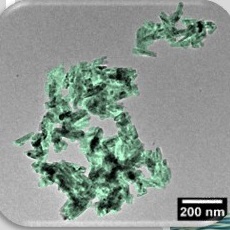 A team of researchers from Brazilian universities found, in cylindrical nanostructures known as nanorods, an anti-inflammatory effect equivalent to that achieved by commercial drugs. Researchers have also demonstrated the effectiveness of these nanorods as catalysts (accelerators) in the degradation of a pollutant. These applications are even more relevant considering that the scientific team was able to produce large quantities of the material through a simple and fast process. The work carried out shows the potential of these nanorods for the development of new medicines and for the treatment of effluents.
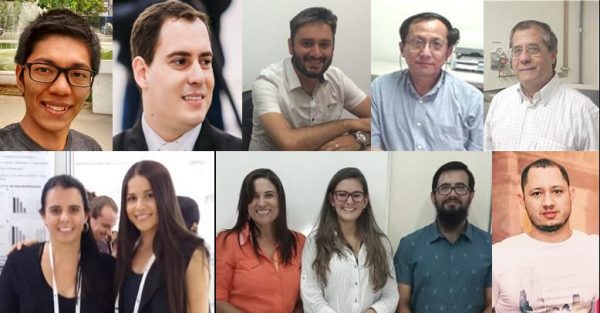
The work originated about three years ago when Professor Felipe de Almeida La Porta, who had recently joined the faculty of the Federal Technological University of Paraná (UTFPR), Londrina campus, was implementing a research group on nanotechnology and computational chemistry at this university. “Our laboratory was investigating some classes of emerging materials, with the perspective of aligning theory and practice, thus driving new discoveries and applications,” says La Porta. One of the materials studied by the group was zinc germanate (Zn2GeO4), a versatile semiconductor with well-known applications in sensors, catalysts, batteries and other devices.
Together with undergraduate researcher Victor Yuudi Suzuki, the professor started a project in which he synthesized pure Zn2GeO4 nanorods at the UTFPR laboratory with very small percentages of manganese ions. To produce this series of nanorods, they used “microwave assisted hydrothermal synthesis.” The method consists, in broad lines, of mixing aqueous solutions containing certain compounds, heating the final solution in a microwave oven and allowing the compounds to react for a certain period of time at controlled pressure and temperature. In this study, the manganese ion-doped Zn2GeO4 was prepared, and the reactions were performed at 140 °C for 10 minutes. The resulting material from these reactions was collected at room temperature, then washed and dried, which generate the nanorods.
Professor La Porta and his research group were able to optimize one of the process steps, the crystallization of materials, thus reducing the synthesis time from hours to a few minutes, but maintaining the quality of the material and the possibility to control its shape.
After preparing the samples, they traveled from Londrina (state of Paraná) to São Carlos (São Paulo state) to characterize the materials at the Center for Functional Materials Development (CDMF) at the Federal University of São Carlos (UFSCar) and at the Institute of Physics at the University of São Paulo (USP). Together with the local researchers, they were able to analyze the shape, structure and luminescence of the four types of nanorod compositions produced: manganese-free and with 1, 2 and 4% of this element incorporated into the structure of Zn2GeO4.
Finally, knowing that compounds containing zinc, germanium or manganese exhibit considerable effects on living things, the team contacted some collaborators to investigate these properties in the nanorods. Thus, several experiments were performed at the Departments of Chemistry and Pharmacy of the Federal University of Juiz de Fora and at the Federal University of Vales do Jequitinhonha and Mucuri, both in the state of Minas Gerais.
To study the anti-inflammatory action, the team performed in vitro tests (in contact with cells in laboratory containers) and also in vivo tests (using rats with paw edema, within the norms of the Brazilian code for laboratory animal use). Both types of experiments revealed that nanorods with about 4% manganese were the most effective in controlling inflammation. The in vitro tests showed these nanostructures were able to modulate molecules that regulate inflammation without causing cell death (without cytotoxicity). In the in vivo experiments, the nanorods reduced the induced rat paw edema with results similar to that of the application of dexamethasone, a well-known drug of the corticoid group.
“At first, we thought that combining these elements to form a ternary oxide could somehow potentiate these effects. But we had no idea the results would be so significant. Given that the drugs currently available in therapy are proving to be less effective every day, these results may encourage the use of these nanorods, for example in the production of a new pharmaceutical formulation, especially for cases of inflammation,” says Felipe La Porta, who is the corresponding author of the paper that was recently published by the research team in the Journal of Materials Chemistry C (impact factor 6,641).
In addition to proving the potential of the material for this application in the health area, the authors of the paper have experimentally verified the ability of nanorods to degrade a chemical dye widely found in industrial effluents, known as methylene blue. For this application, 2% manganese nanostructures were the most efficient, completely decomposing the dye in 10 minutes. “Due to the manufacture simplicity of this system, coupled with its excellent properties, this material is also promising for cleaning various environmental pollutants, and can be easily recovered at the end of this process,” adds Prof La Porta.
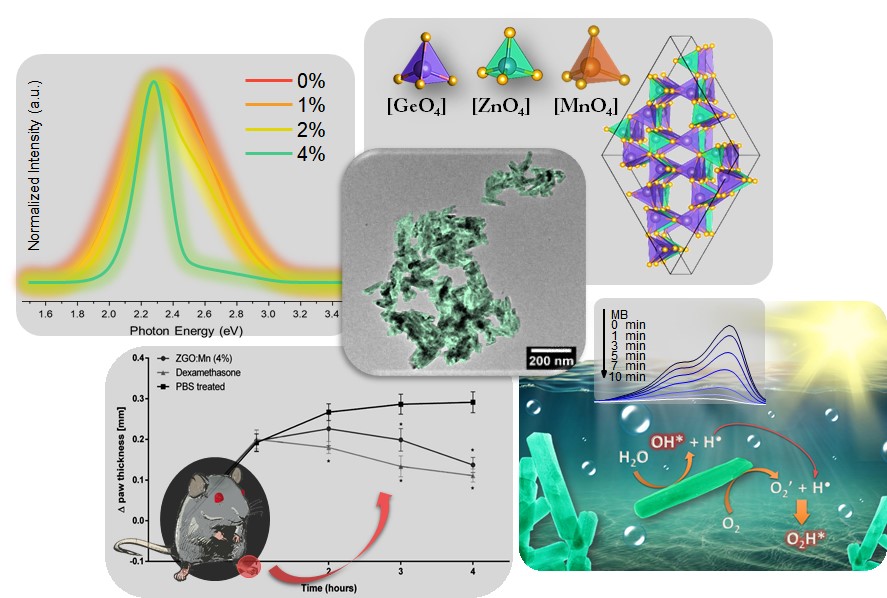
The superior properties that the Brazilian scientific team found in the nanorods with manganese can be related to the structural defects observed in these samples. In fact, the three-dimensional network of atoms that forms zinc germanate is crystalline, that is, organized in regular patterns. The introduction of manganese generates irregularities, and new properties emerge.
The scientific paper that reports this work was selected to be part of the Materials and Nano Research in Brazil collection, prepared by the Royal Society of Chemistry in celebration of the 18th B-MRS Meeting, and can therefore be accessed free of charge until October 15 of this year, here.
The work was carried out with funding from Brazilian research support agencies: the federal CNPq and Capes, and the state Araucaria Foundation, Fapesp and Fapemig.
Royal Society of Chemistry put together a collection of paper of Brazilian authors in honour of XVIII B-MRS Meeting.
 The Royal Society of Chemistry (RSC) has prepared an online collection of articles by Brazilian authors in celebration of the XVIII B-MRS Meeting (Balneário Camboriú, September 22-26, 2019). The Royal Society of Chemistry is a supporter of this edition of B-MRS’s annual event.
Titled Materials and Nano Research in Brazil, the collection brings together 55 articles published in RSC journals between 2017 and 2019. All selected articles are open access until October 15, 2019.
The collection is available at www.rsc.li/brazil-mrs-2019
Postdoctoral fellowship opportunity in Brazil (Sao Paulo).
Abstract
The Institute of Chemistry of São Carlos (IQSC) of University of São Paulo (USP) is offering a postdoctoral fellowship linked to the Project “Study and application of electrochemical technology for the analysis and degradation of endocrine interferents: materials, sensors, processes and scientific dissemination” coordinated by Prof. Dr. Marcos Lanza (Grant 2017/10118-0).
The project aims at the production of new materials with electrocatalytic activity and their application in electrochemical analysis sensors and in advanced effluent treatment processes. In addition to the publication of the scientific knowledge through scientific articles, the dissemination of results will also occur through scientific popularization. Through the production of didactical material to improve the teaching of physicochemistry in Basic Education and the realization of interactive expositions open to students and the general population, it is hoped to arouse interest in science, especially among school-age youth.
Requirements
The candidate will work on the development and application of new carbon matrix (electrocatalytic) materials for the electrogeneration of H2O2 in situ, from the oxygen reduction reaction, to be applied to cells and reactors electrochemical processes aimed at the degradation of organic compounds with endocrine interference activity.
The desirable requirements for the candidate are: (1) knowledge of morphological-structural analysis techniques and electrochemical techniques for the analysis of electrocatalysts; (2) knowledge of advanced oxidative electrochemical processes (PEOA) of degradation of organic compounds, as well as the notion of instrumental techniques of chemical analysis.
The candidate must have immediate availability to reside in São Carlos / SP / Brazil and have completed his doctorate for less than 7 years.
If selected, the candidate will have a FAPESP postdoctoral fellowship (www.fapesp.br/270) in the monthly amount of R $ 7,373.10 (approximately US$ 1,800.00/month) for up to 24 months, with the possibility of financial assistance for the displacement and installation. It is noteworthy that there is no income tax levied on the scholarship amount and it corresponds to the amount with legal discounts of a newly hired lecturer of public university from the State of Sao Paulo. As a reference, the minimum salary in Brazil is US$ 250.00.
São Paulo Research Foundation – FAPESP – is an independent public foundation with the mission to foster research and the scientific and technological development of the State of São Paulo (Brazil).
More information on FAPESP postdoctoral fellowships:
http://www.fapesp.br/en/postdoc
The inscriptions should be made through the email marcoslanza@usp.br to the supervisor Prof. Dr. Marcos Lanza until September 10, 2019. The following documents must be attached to the e-mail:
1) Curriculum Vitae containing the academic training and publications (maximum of 4 pages). Experience in the areas of Materials Chemistry (and related areas) and Electrochemistry must be proven through publications in international scientific journals.
2) Letter of the candidate justifying the interest on the vacancy (maximum of 200 words).
3) Two (2) letters of recommendation.
4) Work plan with its own title describing one (1) research proposal involving the following topic: Production and characterization of new electrocatalyst materials supported in carbon for the electrogeneration of H2O2, from the oxygen reduction reaction, aiming the application in Electrochemical Advanced Oxidative Processes (EAOP) of degradation of organic compounds with endocrine interference activity.
The proposal should include a brief introduction and a description of the strategies for obtaining results, bibliographical references and international journals of interest for submission (maximum of 10 pages).
B-MRS Newsletter. Year 6, issue 7.
|
||||||||||||||||||||||||||
|
||||||||||||||||||||||||||
|