
|
|||||||||||||||||||||||||
|
|||||||||||||||||||||||||
|
|
|||||||||||||||||||||||||
|
|||||||||||||||||||||||||
|
The Brazilian Materials Research Society (B-MRS/SBPMat) and the International Union of Materials Research Societies (IUMRS) invite the international scientific community to submit symposium proposals.
 Until
Until October 31st NOVEMBER 18th 2019, the call for symposium proposals is open for the event that will bring together the XIX B-MRS Meeting (the annual B-MRS event) and the IUMRS – ICEM 2020 (seventeenth edition of the International Conference on Electronic Materials). The event will be held from August 30 to September 3, 2020 in Foz do Iguaçu (Brazil), a tourist town near the border with Argentina and Paraguay, which serves as a base for visits to the stunning Iguazu Falls and to others attractions in the surroundings.
Symposium proposals may be submitted by groups of researchers, preferably of international composition, who wish to organize a thematic symposium within the event. The conference will have a special focus on electronic materials due to the realization of IUMRS-ICEM. However, as in all editions of the B-MRS Meeting, the event will cover a wide range of materials science and technology topics. The organizers therefore welcome symposium proposals on topics relating to all types of materials, from synthesis to applications.
To submit a symposium proposal, simply fill out the online form available at http://sbpmat.org.br/proposed_symposium/.
The symposia will be the main focus of the event with plenary lectures, which will feature internationally renowned scientists such as Alex Zunger (University of Colorado Boulder, USA), Edson Leite (LNNano, Brazil), John Rogers (Northwestern University, USA) , Luisa Torsi (Università degli Studi di Bari “A. Moro”, Italy) and Tao Deng (Shanghai Jiaotong University, China).
Symposium proposals will be evaluated by the event committee, and by the end of 2019 the list of approved symposia will be released. In February 2020, the call for papers will be opened, which should be submitted within the scope of the thematic symposia. Symposium organizers will be responsible for evaluating the submitted abstracts and scheduling the symposium.
The joint event XIX B-MRS Meeting + IUMRS – ICEM 2020 is coordinated by professors Gustavo Martini Dalpian (UFABC) as the Conference Chair, Carlos Cesar Bof Bufon (LNNANO) as the Program Chair and Flavio Leandro de Souza (UFABC) as General Secretary. At the international committee, the event features scientists from America, Asia, Europe and Oceania.
The latest editions of the B-MRS Meeting brought together between 1,100 and 2,000 participants from various countries around the world, who presented their contributions within the symposia.
See the event website: https://www.sbpmat.org.br/19encontro/.

A delicate sand strip curve of about 7 km. Tall buildings along the curve on the waterfront, including some of Brazil’s tallest skyscrapers. The meeting of waters of the Camboriú river and the Atlantic Ocean. The intense green of the Atlantic Forest on the hillsides, surrounding the city and, further ahead, the mountains. This unique mix comprises the landscape of Balneário Camboriú, a tourist destination on the coast of Santa Catarina that hosted the eighteenth edition of the B-MRS Meeting, the annual event of the Brazilian Materials Research Society.

Without a doubt, a certain altitude is required to appreciate this landscape. And it was at one of the highest points in the city, at the Cristo Luz Complex, that around 1,200 people from the Materials research community from dozens of Brazilian cities and around the world gathered to attend the opening of the XVIII B-MRS Meeting in the early evening of September 22, 2019.
Cristo Luz is one of those “must see” tourist visits in Balneário Camboriú, with its unforgettable views of the city and the sea and its 33 meter high Christ monument holding a powerful light source that mirrors a sun, responsible for the colorful light show that takes place every night in the city sky.
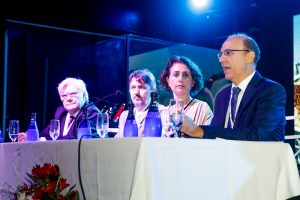
“This event is part of the history of many researchers and of materials research in Brazil,” said the XVIII B-MRS Meeting chairman Ivan Helmuth Bechtold, professor at the Department of Physics at the Federal University of Santa Catarina (UFSC), beginning the opening lines on stage. Bechtold then told his own story at the B-MRS Meeting, from his first appearance in 2004 to present the results of his doctoral research, to the role of chairman in the 2019 edition, including as symposium organizer in three editions of the event. With these lines, Professor Bechtold encouraged the students and young researchers to also be part of this story.
After highlighting the participation of a large number of Brazilian institutions in the event (over 400) and the historical record in the number of papers submitted (over 2,500), the chairman thanked everyone for their presence at a very special moment in the country, a time when science, technology and public higher education are under attack. “The scientific community here demonstrates that technological development coupled with high level education qualifies the new generations, which is essential to promote a better future for our country,” said Bechtold, who concluded by thanking the sponsors and financial support received to carry out the event.
Following this, the vice coordinator of the event, Hugo Gallardo (professor at the Department of Chemistry in UFSC) and professor Cristiane Derani, the Dean of Graduate Studies at UFSC, spoke. Both addressed the importance of research and postgraduate studies. “Brazil needs to double the number of doctors trained to reach that of developed countries,” Gallardo pointed out, while Derani said that research transforms personal and professional lives and results in a more sustainable, equitable and peaceful world.
Closing the opening table, B-MRS president Osvaldo Novais de Oliveira Junior, professor at the São Carlos Institute of Physics at the University of São Paulo (IFSC-USP), said that participation in a scientific event such as the XVIII B -MRS Meeting is a form of resistance to resource cuts and attacks that Brazilian universities and research funding agencies have endured. “We must resist; we can’t lose hope,” he proclaimed.
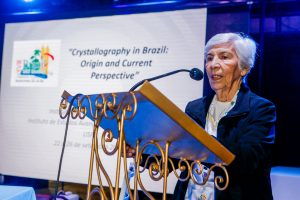
Following this, the Memorial Lecture Joaquim da Costa Ribeiro began, an honor that B-MRS bestows annually to a researcher with a distinguished trajectory in Brazil. In this case, the tribute went to the scientist Yvonne Primerano Mascarenhas, an 87-year-old retired professor at USP, who has held various leadership positions throughout her career, and to this day remains very active in research and extension activities. Beginning in the early 1960s, Yvonne led the introduction and development in Brazil of X-ray crystallography, now widely used in research, development and innovation in the country. The technique allows us to fully understand how the atoms and molecules that make up the organized structure of crystalline materials and biological molecules are arranged in space.
Learn more about Professor Yvonne Primerano Mascarenhas: https://www.sbpmat.org.br/en/cientista-em-destaque-yvonne-primerano-mascarenhas/
As might be expected, at the memorial lecture, this pioneer spoke about crystallography. Initially, she contextualized the development of this technique within the succession of advances made by science as far back as the seventeenth century in order to see the invisible. “Seeing is believing!” said the scientist. In the second part of the lecture, she told a little about the history of X-ray crystallography in Brazil, an area that has generated impactful and large quantities of knowledge in the country, with the determination of the structure of the Zika virus as a recent example. Finally, Professor Yvonne highlighted the possibilities offered to the area of X-ray crystallography by synchrotron light sources, notably Sirius, the next Brazilian source, which will be a last generation synchrotron light source. “Enjoy Sirius!” Wished the scientist.
See the file of the memorial lecture of Professor Yvonne Primerano Mascarenhas: https://www.slideshare.net/SBPMat/crystallography-in-brazil-origin-and-current-perspective.
After the presentation, the president of B-MRS handed a plaque to the honoree, and all present were invited to attend the welcome cocktail, a traditional reunion at B-MRS ‘s annual events, this time marked by the night views of Balneário Camboriú, the photos of the groups at the foot of the Christ and a dance that arose spontaneously to the sound of the band that animated the cocktail.
See photo album of the opening: https://photos.app.goo.gl/qb2uAFGXBwqUkbAF6
Eight one-hour plenary lectures were given by the international leading scientists throughout the event, always in the main room of Hotel Sibara, located 300 meters from the beach, in the commercial center of Balneário Camboriú.
The plenarists showed striking results, based on advances in experimental and computational techniques, multidisciplinary approaches and new ways of seeing old problems. The importance of understanding and controlling materials at the nano scale appeared in every lecture. Another constant was the direct relationship between knowledge generated and various societal demands such as healthy eating, more efficient electronic devices, better bone grafts, lighter cars and airplanes, longer lasting batteries, more sustainable energy sources and healing of spinal cord injuries.
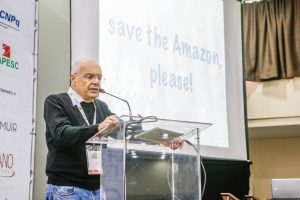
The first plenary, which inaugurated the technical program of the event, was given early in the morning of the 23rd (Monday) by Professor Stefano Baroni, Italian theoretical scientist, known worldwide for having developed computational tools for the study of nanoscale materials. Baroni is a professor at Scuola Internazionale Superiore di Studi Avanzati (SISSA), located in Trieste (Italy). In his lecture, metaphorically titled “Looking at flowers through silicon glasses,” Professor Baroni showed that computational methods (“silicon glasses”) based on quantum mechanics allowed him to advance the understanding of how color expression occurs in natural pigments – a fundamental science problem that has generated great interest in the food industry. Surprising the audience, Baroni closed his plenary with “save the Amazon, please” on the last slide.
See the file of Stefano Baroni’s plenary lecture: https://www.slideshare.net/SBPMat/watching-flowers-through-a-silicon-glass
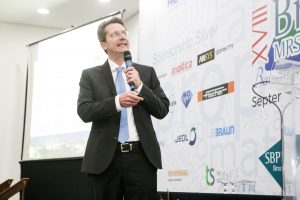
The afternoon plenary on the 23rd was delivered by Norbert Koch, professor at Humboldt-Universität zu Berlin and leader of a research group at Helmholtz-Zentrum Berlin (Germany), author of striking findings on the fundamental mechanisms governing optoelectronics device performance. Koch shared with his audience his extensive knowledge of optoelectronics, an area that will surely increase to meet the social demand that will come in the coming decades for information processing and display, energy conversion and light emission devices. The scientist showed that to improve the performance of current devices and to develop new functions, it is necessary to combine different materials in order to maximize their benefits and minimize their limitations. However, to do this successfully, the scientist proved, one must understand in detail the interfaces between the materials.
See the file of Norbert Koch’s plenary lecture: https://www.slideshare.net/SBPMat/hybrid-inorganicorganic-semiconductor-structures-for-optoelectronics
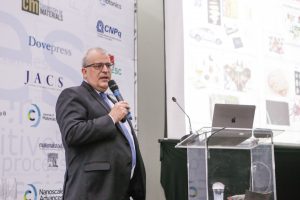
On the 24th, the program opened with a lecture on Sirius, the new fourth generation Brazilian synchrotron light source (one of the very first of its kind in the world) developed with mainly national technology and production, which will soon increase exponentially the research and development possibilities in the area of materials, as well as many other areas. The plenary was given by Professor Antonio José Roque da Silva, general director of the Brazilian National Center for Research in Energy and Materials (CNPEM), where he also leads, from the outset, the Sirius project. The technical characteristics of the source (high brilliance and coherence), added to the modern instrumentation of the experimental stations, the care taken in the construction of the building and the data processing capacity, explained the plenarist, will make Sirius a tool available to the international community capable of making a difference in the investigation of matter in different dimension and time scales, always with high resolution and speed. No wonder the director of CNPEM opened and closed his presentation citing prominent scientists who stated that new truths become evident when new tools become available.
See the file of Antonio José Roque da Silva’s plenary lecture: https://www.slideshare.net/SBPMat/sirius-the-new-brazilian-synchrotron-light-source
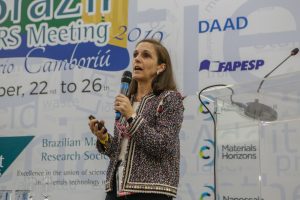
The afternoon plenary was given by Maria-Pau Ginebra, professor at the Universitat Politècnica de Catalunya (Spain). A scientist with an extensive production of articles and patents on biomaterials, Ginebra also faced the challenge of turning knowledge into products. Thus, along with other members of her research group, she founded a company dedicated to providing nature-inspired solutions that help the body perform the bone regeneration process needed in various situations, such as dental implants, fractures, bone malformations and tumors. In the lecture, the scientist and businesswoman presented a new generation of bone graft biomaterials that brings together the advantages of natural and artificial grafts. In addition, Professor Ginebra discussed the possibilities and potential of customizing graft fabrication using 3D printing techniques.
See the file of Maria-Pau Ginebra’s plenary: https://www.slideshare.net/SBPMat/bioinspired-strategies-for-bone-regeneration
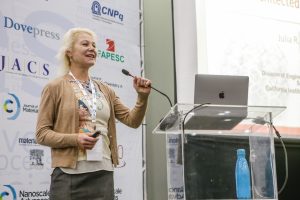
On the 25th the programming began with all the energy of Julia Greer, scientist, teacher, pianist and mother. And with all the strength of the metamaterials she develops, characterizes and tests with her group at the California Institute of Technology, Caltech (USA). In plenary, the audience was surprised to watch videos of very light nanostructures resisting stresses of compression and tension far beyond expectations. In order to achieve these results, which promise very interesting applications, it is essential, she said, to develop the material by thinking of its structure at the atomic level, the properties manifesting at the nano scale and the final architecture. It is necessary to go beyond the composition of materials, use nanoengineering to develop innovative materials and use them to design intelligent three-dimensional structures. However, not forgetting to assess the impact of the defects, which make materials, as well as people, more interesting, expressed Greer.
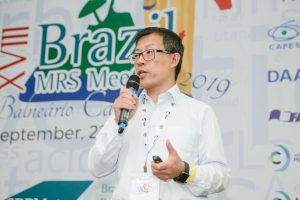
The afternoon plenary was delivered by Mingzhong Wu, a professor at Colorado State University (USA), who specializes in the difficult task of experimenting with topological insulators – materials that act as insulators in their interior but have conductive states on surface – whose existence was proven just over a decade ago. After a didactic explanation of topological insulators, the scientist showed that a thin layer structure of interacting magnetic and topological insulators can be used as a platform to study the properties of the topological insulator and to control the magnetism of the magnetic insulator. Professor Wu’s studies will find applications in the near future in the development of quantum computing and spintronics.
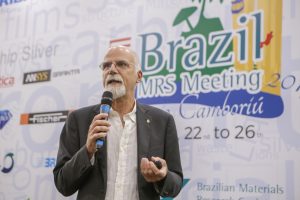
On the morning of the 26th, it was difficult for many to wake up early after the success of the conference party held the night before. However, those who bravely arrived at the main room of Hotel Sibara at 8:15 am were rewarded to see that carbon nanotubes can help heal spinal cord injuries that cause loss of movement and sensitivity and even severe paralysis. In fact, carbon nanotubes with properly modified surfaces not only promote nerve tissue growth but also generate more active neurons, shown in vitro, in vivo and ex vivo experiments in the plenary. The lecture was given by Maurizio Prato, professor at the Università degli Studi di Trieste (Italy), a specialist in adding organic molecules to the surface of carbon nanomaterials, who has produced very high impact scientific production (h index 119). In the plenary, Prato showed another exciting application of his surface-modified nanotubes, which, combined with nanocatalysts, can make artificial photosynthesis viable, a process that generates fuel from carbon dioxide.
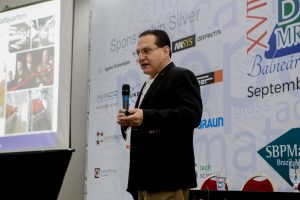
That same morning, at 11:30, Alan Taub started the last plenary of the XVIII B-MRS Meeting. Taub became professor at the University of Michigan (USA) in 2012 after a 30-year career at Ford, General Electric and General Motors, and culminating as GM’s vice president of research and development worldwide. He is also a technology advisor to Lightweight Innovations for Tomorrow (LIFT), an American institute that works at the interface between industry and a network of national universities and laboratories, with the goal of reducing tomorrow’s transportation weight, from cars to spaceships, to reduce their fuel consumption. The main challenge, Taub revealed, is to lower the ultimate cost of ultralight materials, to which computer simulations have contributed significantly by providing information on material properties and performance, faster and more cost-effectively than experimental techniques.
See the file of Alan Taub’s plenary: https://www.slideshare.net/SBPMat/challenges-in-processing-of-materials-to-reduce-weight-of-structural-components
See the photo album of the plenary lectures: https://photos.app.goo.gl/4eUA5e3YcdfW9Ta69
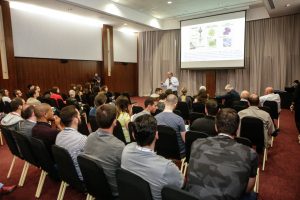
Within the 23 thematic symposia that made up this edition of the B-MRS event, around 1,700 students and researchers presented and discussed their work with people that conduct research on similar topics. In addition, the symposium participants were able to follow and discuss the advances presented by their peers. In this environment of knowledge exchange, which is vital for scientific activity, students and researchers had the opportunity to think new ideas and establish collaborations to continue their work.
Thus, on four mornings and three afternoons, more than 2,000 scientific research papers were disseminated and discussed at the XVIII B-MRS Meeting. The seven poster sessions, held on the 17th floor of the Sibara Hotel, featured approximately 1,500 works. At the oral sessions, which took place simultaneously in eleven rooms of the Sibara Hotel and three rooms of the Mercure Hotel, located less than 300 meters from each other, some 400 contributions were presented, not to mention the approximately 100 invited lectures presented.
While some symposia extended over the four days of technical programming, others lasted one, two or three days, depending on the number of papers accepted for presentation, which ranged from just over 20 to about 350 according to the symposium.
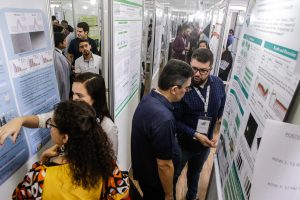
The set of symposia covered research on a wide range of materials: carbon nanomaterials, glass ceramics, new metal alloys, biopolymers, nanofibers, molecular sieves and magnetic and superconducting materials, among others. The works showed not only new materials, new properties and new applications, but also advances in experimental and theoretical methods and processes used at all stages of material “life”: design, synthesis, processing, modification, characterization, fabrication and recycling. As for the applications covered in the papers, the list is also wide, including medicine, dentistry, environmental remediation, electronics, power generation and storage, lighting, aeronautics and textile industry, among many other segments.
In addition to the exchange of technical knowledge, the symposia provided affective exchanges in the reunions of colleagues and friends and in the memory of those absent. The symposium F, dedicated to organic electronics, had a very special moment at the opening, on the 23rd, when Professor Marco Cremona (PUC-Rio) paid tribute to his late colleague Ivo Alexander Hümmelgen (UFPR), deceased prematurely and unexpectedly earlier this year.
See the slides of the tribute to Professor Ivo Alexander Hümmelgen: https://www.slideshare.net/SBPMat/tribute-to-prof-ivo-alexander-hmmelgen-26-march-1963-1-march-2019
The symposia of the 18th B-MRS Meeting were organized by over 100 researchers who worked in teams, from Brazil, Canada, the United States, France, Italy, the United Kingdom, Russia, Sweden and Switzerland.
See the highlights of some of the symposia sent by the organizers: https://www.sbpmat.org.br/en/xvii-b-mrs-meeting-some-highlights-of-the-symposia/
See the photograph album of the symposia oral and poster sessions, and the collective photos of the symposia organizers: https://photos.app.goo.gl/mWuHZoihAiRikGsdA
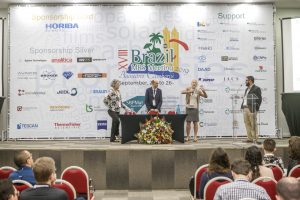
Outside the technical program schedule, participants of the 18th B-MRS Meeting were able to enjoy, at no extra cost, a series of activities held at the Hotel Sibara. On Sunday afternoon of the 22nd, Professor Valtencir Zucolotto (IFSC – USP) gave, to a crowded room of about 130 people, a tutorial on how to perform high impact research, focusing on the preparation and publication of scientific articles, the “Young Researchers School.”
On Tuesday and Wednesday, three activities took place at lunch time, all with a lunch box included. On the 24th, the German government iniciative “Research in Germany” offered a presentation and Q&A session on research possibilities in Germany and Brazil-Germany collaborations. About 160 people participated in the activity.
On the 25th, ACS Publications, editor of American Chemical Society (ACS), promoted the panel discussion “Mastering the Art of Scientific Publication,” which brought together ACS editors Osvaldo N. Oliveira Jr. (Brazil) of Applied Materials & Interfaces, Julia Greer (USA) of Nano Letters, and Monica Cotta (Brazil) from ACS Applied Nano Materials. The panelists provided insight into the process of producing and publishing articles, in response to audience questions and issues raised by session moderator Carlos Toro, also an editor at ACS Publications. More than 130 people participated in the activity.
At the same time, in another room, ANSYS Granta professionals demonstrated the software developed by the company for materials education (CES EduPack) and for the research area (CES Selector), in a nearly full room of about 80 people.
See the photo album of the extra activities: https://photos.app.goo.gl/FkyRWM8aPNdX4snR6
Two collective manifestoes in defense of research and education in Brazil were held at the XVIII B-MRS Meeting. On the 25th, at the request of community members, the B-MRS team organized a photographic manifesto and, through social networks, invited the event participants to be part of this.
The act took place shortly after the afternoon plenary lecture. A few hundred participants of all ages, including some foreigners, moved from the audience to the stage and stood among the screens projecting a slide with the phrase “In Defense of Science and the Public University.” The result was a photo that was widely publicized on social networks with the hashtag #todospelaciência (“everyone for science”).
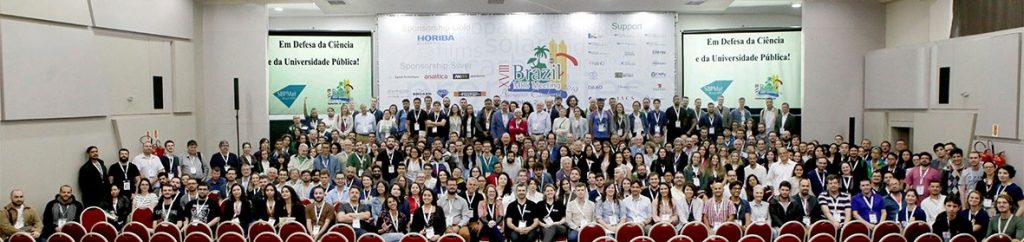
See the album with photo manifesto https://photos.app.goo.gl/EaamwGQPXVzuJTo46
In addition, B-MRS’s Board of Directors and Deliberative Council prepared during the event the Camboriú Letter, a written document expressing their concern about the cuts and contingencies of funds for education and research in Brazil. The Camboriú Letter was also published on social networks, on the B-MRS website and in the Jornal da Ciência, among other media.
Read the Camboriú Letter: https://www.sbpmat.org.br/en/carta-de-camboriu/
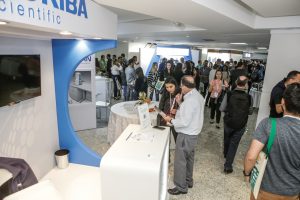
Seventeen companies in the field of instrumentation, research inputs and software were sponsors and exhibitors in the XVIII B-MRS Meeting. Sharing a large space with the coffee break tables and the secretariat, and also in the hall of the plenary room, the companies received visits at their booths by the event participants, with information, gifts and special activities.
In addition, throughout the 23rd, interested participants were able to learn more about various techniques of materials characterization and manufacture in thirteen technical lectures given by professionals of exhibiting companies.
Also noteworthy in this edition of the event was the massive presence of scientific journals in the area, such as supporters of the event, including renowned titles from the publishers ACS, RSC (Royal Society of Chemistry) and Elsevier.
See the photo album of the booths and technical lectures: https://photos.app.goo.gl/pvgYHHeV5493QLap7
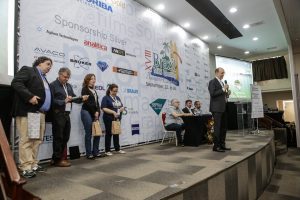
The audience in the plenary room was almost full at the closing session. On stage, at the closing table, were the coordinator and vice coordinator of the event that was being finalized, the president of B-MRS and the coordinator of the next B-MRS Meeting, Professor Gustavo Dalpian (Federal University of ABC).
In a brief presentation, Professor Ivan Bechtold shared the main data of the XVIII B-MRS Meeting and made public his appreciation to all who made it possible: plenary speakers, invited speakers, organizers and symposium participants, B-MRS team (secretariat, communication, logistics and software), program committee, local and national committees, student volunteer staff, sponsors, and supporters. In the final words, the chair resumed the motivational messages from the opening table in defense of science and public universities, urging all to resist, not give up and not lose hope.
See the file of Professor Ivan Bechtold’s closing presentation: https://www.slideshare.net/SBPMat/xviii-bmrs-meeting-closing-ceremony-presentation
The word was then passed to Professor Osvaldo Novais de Oliveira Junior, who will conclude later this year his second term as president of B-MRS. He expressed pride in presiding over the Society and thanked everyone who worked with him throughout his administration. In particular, the president paid tribute by presenting plaques to two members who have been doing volunteer work as scientific editors of the B-MRS Newsletter: André Avelino Pasa (UFSC professor) and Fernando Lázaro Freire Junior (PUC-Rio professor).
Learn more about this tribute and honored members: https://www.sbpmat.org.br/en/homenagem-da-sbpmat-a-dois-socios-por-suas-contribuicoes-a-sociedade/.
Following this, the president of B-MRS surprised the team of professionals who work steadily throughout the year for the society, with public recognition and awarding gifts. Thus, Verónica Savignano (journalism and dissemination), Marcia Bicalho (executive secretary), Alexandre Alves (event coordination) and Leandro D´Agostino Amaral (software) were called on stage.
At this point, the roles were reversed, and it was Professor Osvaldo who received a thank-you from B-MRS, represented by the chairman of the event, for the priceless contribution he has made in holding the presidency for four years – a function that is worth noting is not paid.
Finally, Professor Dalpian took the floor to invite those present to participate in symposium proposals and, subsequently, to send papers, from the XIX B-MRS Meeting, which will be held together with the IUMRS-ICEM, International Conference on Electronic Materials, from August 30 to September 3, 2020 in Foz do Iguaçu. “We will be in one of the most amazing places in the world,” said the chairman, referring to the Iguassu Falls.
See the file of Professor Gustavo Dalpian’s presentation about the XIX B-MRS Meeting: https://www.slideshare.net/SBPMat/xix-bmrs-meeting-iumrs-icem-2020
See the photo album of the closing session: https://photos.app.goo.gl/aakmQtSW4u46c6ZJ9
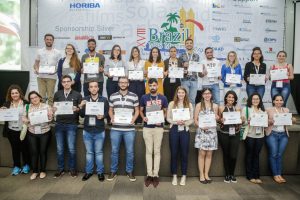
The event concluded with the traditional awards ceremony for the best works presented by students, which in this edition of the event had three different awards. The “Bernhard Gross Award”, awarded by B-MRS to the best oral and best poster of each symposium, recognized 34 undergraduate and postgraduate students from various institutions in all regions of Brazil, as well as France, the United Kingdom and Switzerland. Among these winners, fourteen works were chosen for their evaluation scores as the best contributions of the entire event to receive the cash prizes. Thus, ten students received the ACS Publications Prizes, sponsored by a group of journals from the publisher of American Chemical Society, and four students won the RSC Prizes, sponsored by journals of the Royal Society of Chemistry.
See the list of student award winners: https://www.sbpmat.org.br/en/english-xviii-b-mrs-meeting-students-awards-and-prizes/
See the award photo album: https://photos.app.goo.gl/M5FHLP812NEyp5XZA
Symposium K: i-Caloric Materials and Applications.
The general impression from participants and organizers is that the symposium was very successful. The number of abstracts, although not as high as other symposia, was higher than we expected. All the speakers, invited or not, attended. The works presented, both the seminars and the posters, were of excellent quality.
Alexandre Magnus Gomes Carvalho (CNPEM)
Symposium S: Computational Design for Development of Functional Materials – Synergy between Theoreticians and Experimentalists
The symposium had a high level of presentations, with the participation of national and international researchers. The questions and discussions were intense. We highlight the participation of researchers Elson Longo, and Stefano Baroni, São Carlos, Brazil and, Trieste, Italia, respectively. Both presented the state of the art in applications and correlations between theoretical and experimental research. The poster section also had a high level and with the intense participation of young researchers, demonstrating that the future of theoretical research applied to materials is promising.
Julio Ricardo Sambrano (Unesp)
Symposium T: Nanofibers, Applications and Related Technology.
The symposium T was organized by Profa. Dra Claudia Merlini (UFSC), Prof. Dr. Cicero R. Cena (UFMS), Prof. Dr. Deuber L. S. Agostini (UNESP) and Profa. Dra Roselena Faez (UFSCar). We received 75 abstracts, 6 oral presentations and 5 invited speakers. Interesting and highly quality works were presented in two days of the symposium by authors from different regions of Brazil and international institutions of different countries. The invited speakers were Prof. Dr. Enzo Menna (Università degli Studi di Padova – Italy), Dr. Gilberto Siqueira (Swiss Federal Laboratories for Materials Science and Technology (EMPA), Switzerland), Profa. Dra. Ana Paula Immich (Universidade Federal de Santa Catarina (UFSC), Prof. Dr. Hernane da Silva Barud (Universidade de Araraquara (UNIARA), Prof. Dr. Eliton S. Medeiros (Universidade Federal da Paraíba (UFPB). The invited speakers, all experts and distinguished professors in the field, have made important contributions to the scientific community, bringing innovations related to the manufacture, applications and characterizations of natural and synthetic nanofibers. The Symposium was financial supported by FAPESC (Edital PROEVENTOS 2019/2020). This was the second edition of Symposium focused exclusively to Nanofibers and Applications in the B-MRS Meeting, with an expressive numbers of participants.
Claudia Merlini (UFSC)
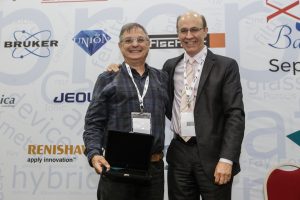
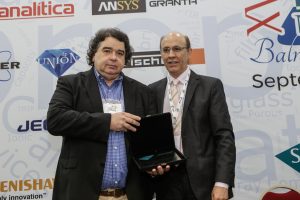
On September 26 of this year, during the closing of the XVIII B-MRS Meeting (Balneario Camboriu), Prof. Fernando Lázaro Freire Jr. (PUC-Rio) and Prof. André Avelino Pasa (UFSC) were honored for their contributions to B-MRS in especially for their volunteer work as scientific editors of the B-MRS Newsletter.
On the occasion of the presentation of the plaques that accompanied the honor, the president of B-MRS, professor Osvaldo Novais de Oliveira Junior, stated that the contributions of Professors Fernando Lázaro and André Pasa leave a legacy for B-MRS and an example to follow. “As president of B-MRS I wanted to express my gratitude to my colleagues and friends Fernando Lázaro and André Pasa for their volunteer work in communicating our society with its members and the general public. And for being always ready to assist B-MRS in the challenges that we have faced to make our society one of the most important in the country. ”
Professor Fernando Lázaro Freire Junior is a founding member of B-MRS. He was a member of the founding board, president of the Society from 2006 to 2009, scientific director from 2004 to 2005 and financial director from 2012 to 2013. He has served in the B-MRS Newsletter since the creation of this electronic vehicle in 2012.
Professor André Avelino Pasa was a scientific director of B-MRS from 2014 to 2015 and has been in the newsletter since 2014.
 Approximately 1,700 participants.
– Opening session, memorial lecture (Yvonne Mascarenhas) and welcome cocktail:
https://photos.app.goo.gl/qb2uAFGXBwqUkbAF6
– Plenary lectures:
https://photos.app.goo.gl/4eUA5e3YcdfW9Ta69
– Symposia – oral and poster sessions:
https://photos.app.goo.gl/mWuHZoihAiRikGsdA
– Young Researchers School, Materials Bonds (Research in Germany), ACS Publications´Meet the Editors, e ANSYS Granta demo:
https://photos.app.goo.gl/FkyRWM8aPNdX4snR6
– Manifesto in defense of science and the public university:
https://photos.app.goo.gl/EaamwGQPXVzuJTo46
– Conference party:
https://photos.app.goo.gl/m9ScFuEMwsw6mw9J7
– Booths exhibition and technical lectures:
https://photos.app.goo.gl/pvgYHHeV5493QLap7
– Closing ceremony:
https://photos.app.goo.gl/aakmQtSW4u46c6ZJ9
– Students awards: