In August, the last 2020 technical webinars of the B-MRS Lives & Webinars program were held. Five online lectures on scientific instrumentation and material characterization were given by professionals from instrumentation companies, from Brazil and abroad. Between 30 and 160 participants attended each of the lectures, held on B-MRS’s Zoom and Facebook.
The Lives & Webinars program is a B-MRS learning and training initiative during the period of social distancing due to the Covid-19 pandemic, carried out in partnership with instrumentation companies.
Watch the webinars held in August, whose recording was authorized by the speakers:
How Vacuum Innovation Drives Instrumentation (Agilent). See here.
Instrumented Indentation Techniques on Polymers (Nanovea e Altmann). See here.
Caracterização Elétrica de Materiais (Keysight). See here.
Not just for experts – PDF analysis in the home laboratory (Bruker). See here.
Soluções de vácuo para pesquisa em materiais (Edwards Vacuum). See here.
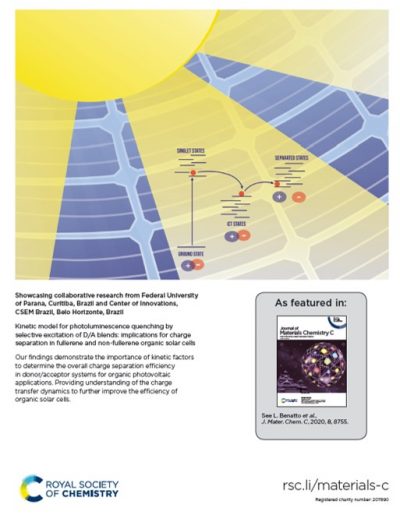
Back cover of the J. Mater. Chem. C highlights the paper of the Brazilian team.
Unlike other solar cells that have dominated the market for a long time, such as silicon cells, the organic ones are thin, light, flexible and semi-transparent. With these characteristics, they become very attractive for specific segments. In Brazil, for example, which has national production, some of the largest installed surfaces in the world can be seen in business buildings, as well as some installations in shopping centers, trucks and bus stops.
Although the organic version of solar cells also offer advantages in large-scale production (simpler industrial processes with lower carbon footprint, such as the roll-to-roll), conquering big markets largely depends on an ongoing efficiency improvement to convert sunlight into electricity. To overcome this challenge, it is essential to develop materials with suitable properties and to combine different materials within the device.
A scientific team from the Brazilian Federal University of Paraná (UFPR) studied in detail, using experimental and theoretical tools, the charge generation mechanism in organic solar cells – a complex process that is not yet fully understood. In practice, the results of this work help choosing which materials should be used and how they should be synthesized, so that their properties enhance the efficiency in converting light into electricity. The research paper was reported in the Journal of Materials Chemistry C (impact factor 7.059), where it was highlighted on the back cover.
Unraveling the exciton dissociation
In the sandwich of layers that forms solar cells, the active layer (responsible for absorbing light and generating electric charges) is composed of semiconductor materials that, for organic devices, are polymers or other carbon-based molecules. When excited by light, these materials do not generate free electric charges, as is the case with inorganic semiconductors. They generate excitons, which are electron–hole pairs connected by forces of attraction between the negative charge of the first and the positive charge of the second.
In order to generate free charges, which form the electric current, it is necessary to break this connection, in a phenomenon called exciton dissociation. One way to achieve this is to create, in the active layer, an interface between an electron donating material and an electron acceptor. “Depending on the combination of these two materials, exciton dissociation processes can occur at a very low time scale, resulting in a more efficient charge generation,” explains Leandro Benatto, corresponding author of the paper. “However, this process is still not well understood,” he adds.
In their work, Leandro and the other authors focused specifically on trying to understand the exciton dissociation and the generation of free charges at the interface between the donor and acceptor material. The team carried out photoluminescence experiments, which are generally used to measure the efficiency in generating free charges in systems of this type, and developed a mathematical model that simulates the process. The experimental and theoretical results were very similar, proving the model’s accuracy. “We developed a model that simulates the kinetics of the process, including the several stages of exciton dissociation and considering the main characteristics of the interface,” he says. “Based on the kinetic model, it was possible to reproduce the experimental results in a comprehensible manner and more clearly observe the main factors that influence the efficiency of the free charge generation process in donor/acceptor interfaces,” he adds.
Fullerenes vs. Non Fullerenes
The study that produced the article was coordinated by two professors from the Physics Department of UFPR, Marlus Koehler and Lucimara Stolz Roman, who have a longstanding partnership in the theoretical and experimental study of organic solar cells. “The theoretical part began to be developed in 2019, at the end of my PhD in Physics at UFPR under the guidance of Professor Marlus, and continued in my postdoctoral work at the Nanostructured Devices Laboratory (DINE) under the coordination of Professor Lucimara,” says Leandro. Also participating in the research were Maiara de Jesus Bassi, PhD student in Physics in the group of Professor Lucimara, and Luana Cristina Wouk, PhD in Physics who was also under the supervision of Professor Lucimara Roman, and currently working at CSEM Brazil, a private applied research center, which helped contextualize the problem in the large-scale development scenario.
The initial idea of the work was to understand the difference between two types of electron acceptor molecules: those derived from fullerene (a carbon allotrope), which have excellent performance in the collection and transport of electrons but have a limited spectrum of light absorption, and compounds not derived from fullerenes, which in recent years have optimized the collection and transport properties. “This is a very interesting topic since, recently, the efficiency of organic solar cells based on non-fullerenes surpassed the efficiency of those based on fullerenes, although, a few years ago, it could not be imagined that fullerenes would be surpassed,” reports Leandro. “Currently, laboratory produced organic solar cells based on non-fullerenes have reached 18% efficiency,” he adds.
This research received funding from Brazilian agencies Capes, CNPq and FAPEMIG, INCT–Nanocarbono and COPEL (Companhia Paranaense de Energia).
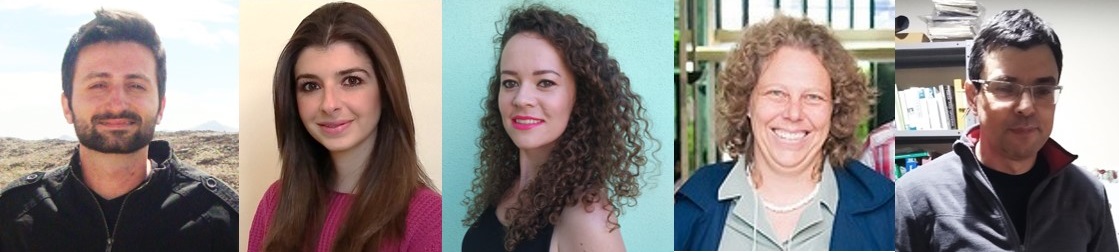
The authors of the paper, from the left: Leandro Benatto, Maiara de Jesus Bassi, Luana Cristina Wouk, Lucimara Stolz Roman and Marlus Koehler.
[Paper: Kinetic model for photoluminescence quenching by selective excitation of D/A blends: implications for charge separation in fullerene and non-fullerene organic solar cells. L. Benatto, M. de Jesus Bassi, L. C. Wouk de Menezes, L. S. Roman and M. Koehler. J. Mater. Chem. C, 2020,8, 8755-8769].
Professor Ana Flávia Nogueira (UNICAMP), B-MRS member, joined this year the advisory boards of two renowned journals in the field of Materials, both from the Royal Society of Chemistry (RSC). These are the Journal of Materials Chemistry A(impact factor = 11.301), where the Brazilian scientist is the only representative from Latin America, and Journal of Materials Chemistry C (impact factor = 7.059), where Professor Ana Flávia and Professor Carlos Graeff, also a B-MRS member, are the only scientists from Latin American institutions.
We are organising a special issue for Journal of Chemical Technology and Biotechnology (JCTB) (published by Wiley, Impact Factor = 2.75, https://onlinelibrary.wiley.com/journal/10974660). We would like to invite authors to submit contributions.
The theme of this special issue is Latest Development of Nanotechnology in Latin America. We would particularly encourage new academics for contribution as we aim to promote research works in nanotechnology with new ideas. Initially, we have set several key areas for the issue:
– Nanotechnology applied to sensors and biosensors
– Nanoparticles and its interactions with plants
– Risk assessment of nanomaterials
– Drug delivery systems
– Development of new functional organic, inorganic and hybrid materials
– Nanotechnology applied to gene transfer
– Molecular simulations in nanotechnology
– Bio-based nanomaterials aiming agriculture and environmental applications
– Magnetic nanomaterials and its applications
– Nanoparticles aiming topical applications
– Biomimetic silica nanoparticles
– Hybrid biofilms aiming for food applications.
We aim to set the deadline for December 31st and to publish the special issue online in 2021. JCTB does not impose publication charges but it provides open access options with a fee.
Once the invitation is accepted, please inform one of the Guest Editors prior to manuscript submission.
Submissions should follow the general guidelines for submitting an article to a Special Issue in JCTB:
Authors should consult the author guidelines for details relating to formatting and article types. These can be found at:
Authors should submit their papers using the manuscript submission system at: http://mc.manuscriptcentral.com/jctb-wiley and should mention the Special Issue in the cover letter.
Authors must ensure they select “YES” when asked if their paper has been invited for a Special Issue during the submission process. They should also enter the name of the Special Issue in the field provided.
Authors should suggest at least two referees for each paper with email contact information.
Authors should submit their papers in the given time frame. Please contact the guest editor if you encounter any problems with meeting the submission due date.
All papers will be subject to the journals usual, rigorous, peer review process and papers will be handled by an editor from the journal.
If you would like your images to be considered for the cover, please email your suggestions to covers@wiley.com once your article has been accepted for publication.
If you have any further enquiry, please contact us.
Best Regards
Guest Editors:
Dr. Renata de Lima (University of Sorocaba, Brazil)
Dr. Leonardo F. Fraceto (UNESP, Brazil)
Dr. Humphrey H. P. Yiu (Heriot-Watt University, UK)
Newsletter of the
Brazilian Materials
Research Society
Year 7, issue 7. August 7, 2020.
From Ideia to Innovation
Doctors and nurses wearing masks are icons of the current Covid-19 pandemic. Going back to the history of respiratory protection masks, one can find advances, made in different places on the planet, in materials, technologies, concepts and methods that enabled the development of current, efficient and certified masks. Get to know a bit of this history, here.
Featured Paper
Scientific work carried out at IQSC-USP generated a low cost and easy to manufacture nanostructured material, based on non-precious metals inserted in carbon layers, which demonstrated high performance as a catalyst for electrochemical reactions used in the generation of renewable energies. The work was recently reported in the Journal of Materials Chemistry A. Know more.
B-MRS Lives & Webinars
– The XIX B-MRS Meeting + IUMRS ICEM Organizing Committee and the B-MRS Board of Directors invite the entire community to participate in a brief ONLINE meeting in the late afternoon of August 30, 2020, when the event opening, which was postponed due to the pandemic, was scheduled to take place in Foz do Iguaçu. Know more.
– Eight technical webinars were held throughout July (second month of the Lives & Webinars program). Learn more and access the recordings of the already held webinars, here.
– Access the schedule for August, choose the webinars you are interested in and register (free), here.
B-MRS News
– FNDCT. B-MRS endorsed the manifesto for the total release of FNDCT resources. Know more.
– Capes. B-MRS endorsed manifesto against the centralizing management mode of the current presidency of Capes.Know more.
– CNPq. B-MRS endorsed letter to the president of CNPq, pointing out problems and possible solutions in the implementation of the 25/2020 master’s and doctoral scholarships. Know more.
– Webseries. Webseries episodes about Brazilian science related to materials research have an exclusive premiere for B-MRS channels. Know more.
– Science and democracy. B-MRS participated in the “Virada pela Democracia” (Turning-point for Democracy), held on July 4 and 5, with a video statement on the relationship between science and democracy, which was included in a panel organized by SBPC. Watch the video of Professor Ivan Bechtold, scientific director of B-MRS, recorded for this occasion, here.
News from B-MRS Members
– Professor Luciana Reyes Pires Kassab (Faculty of Technology of São Paulo/CEETEPS), B-MRS member, was distinguished with the category of Senior Member of OSA (The Optical Society). Know more.
Opportunities
– Postdoctoral fellowship at UFRGS (Brazil) in surface chemistry for the development of technology for SARS-Cov-2 detection tests. Know more.
Events and ONLINE events
– Webinars on research and teaching techniques and tools in the materials field. June – August, 2020. ONLINE. Organization: B-MRS. Site.
– IV Simpósio de Fotobiofísica – UV e Vírus. 21 de agosto de 2020. ONLINE. Organização: Departamento de Física da USP. Folder para download.
– XLI Congresso Brasileiro de Aplicações de Vácuo na Indústria e na Ciência. Foz do Iguaçu, PR (Brasil). 5 a 7 de outubro de 2020. Site.
– 5th International Conference of Surfaces, Coatings and NanoStructured Materials – Americas (NANOSMAT-Americas). Foz do Iguaçu, PR (Brazil). October 7 – 10, 2020. Site.
– 7th Meeting on Self Assembly Structures in Solution and at Interfaces. Bento Gonçalves, RS (Brazil). November 4 – 6, 2020. Site.
– Pan American Ceramics Congress and Ferroelectrics Meeting of Americas (PACC-FMAs 2020). Panama (Panama). November 15 – 19, 2020. Site.
– 4th Workshop on Coated Tools & Multifunctional Thin Films. Campinas, SP (Brazil). November 16 – 19, 2020. Site.
– International Conference on Defects in Insulating Materials (ICDIM 2020). November 23 – 27, 2020. ONLINE. Organization: UFS. Site.
– XIX B-MRS Meeting + IUMRS ICEM (International Conference on Electronic Materials). Foz do Iguaçu, PR (Brasil). August 29 – September 2, 2021. Site.
XIX B-MRS Meeting + IUMRS ICEM
(Foz do Iguaçu, Brazil, August 29 – September 2, 2021)
You can suggest news, opportunities, events or reading tips in the materials field to be covered by B-MRS Newsletter. Write to comunicacao@sbpmat.org.br.
Unsubscribeif you don´t want to receive our newsletters anymore.
Where: On B-MRS Zoom and Facebook (https://www.facebook.com/SBPMat/).
Language: Portuguese.
The afternoon of August 30, 2020 was reserved on the agenda of many members of our community for the opening of the XIX B-MRS Meeting, which would take place at the Hotel Rafain in Foz do Iguaçu. Due to the Covid-19 pandemic, the event was moved to next year (from August 29 to September 2, 2021). In this context, the event’s organizing committee and B-MRS’s board invite the community to meet on that day and time – when we would open the annual event of the Society – to participate in a brief online meeting. The organizing committee of the XIX B-MRS Meeting will address the transfer of the event, the new agenda and the call for symposia, which is already open. The B-MRS board will speak about the society’s activities during the pandemic and about the University Chapters program. To close this brief virtual meeting of the community, the former president of B-MRS Professor Osvaldo Novais de Oliveira Junior (IFSC-USP) will offer a brief lecture on the prospects for science in the post-pandemic scenario.
IMPORTANT! To participate in the Zoom room, with limited spaces, it is necessary to register here.

 In August, the last 2020 technical webinars of the B-MRS Lives & Webinars program were held. Five online lectures on scientific instrumentation and material characterization were given by professionals from instrumentation companies, from Brazil and abroad. Between 30 and 160 participants attended each of the lectures, held on B-MRS’s Zoom and Facebook.