[Text by Professor Petrus Santa Cruz (DQF/UFPE), B-MRS member.]
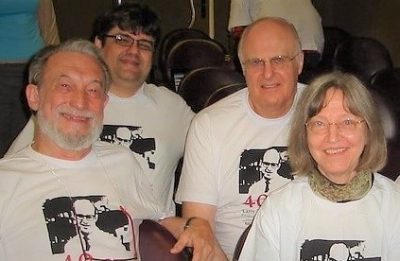
Behind and to the left, Petrus Santa Cruz (UFPE) next to Larry Thompson (UMD). At the front, Osvaldo Serra and Vitória Lakatos (USP) during the 40-year international cooperation “Larry Thompson and Brazil” workshop in 2009 at DQF/UFPE.
Some researchers make a difference in contributing for consolidating important areas of Science in Brazil. In the case of Professor Larry Clark Thompson, of the University of Minnesota-Duluth, he will always be remembered not only for his significance in the area of coordination compounds in the country, but also for his generosity. During the workshop “Larry Thompson and Brazil” held to celebrate 40 years of international cooperation in 2009, the beginning of his contributions to Brazilian science in 1970 was remembered, when he received professors Gilberto Sá (DQF/UFPE) and Oswaldo Serra (USP/Ribeirão Preto) in his group in the USA, resulting in collaborations that extended throughout his academic life.
Over the past 50 years, several episodes have been marked by his generosity.
In 2002 Professor Thompson participated in a thesis panel at DQF/UFPE on pioneering works in exploring the degradation of lanthanide complexes, which resulted in an innovative dosimeter device for measuring UV radiation, but before participating in the panel, Thompson hosted the doctoral student at his residence in Minnesota -Duluth, so that she could show him in his laboratory that the complexes actually degraded under the action of UV radiation, giving rise to a new line of research on devices for the prevention of skin cancer, currently explored for individual monitoring of vitamin D in a project of the Sibratec Nano program. Several other applications use as an active part the luminescent materials derived from his work.
Thompson was in Brazil for the last time in 2017, but unfortunately this year circumstances prevented the workshop “Larry Thompson and Brazil” of the 50 years of collaborations. He passed away at the age of 85 on August 15th, leaving behind many memories.
The Brazilian Materials Research Society (B-MRS/ SBPMat) and the International Union of Materials Research Societies (IUMRS) invite the scientific community to submit symposium proposals for the joint event on materials research that will take place from August 29 to September 2, 2021.
Symposium proposals can be submitted until November 2 11, for the event that will bring together the XIX B-MRS Meeting (B-MRS annual event) and the IUMRS – ICEM (seventeenth edition of the international conference on electronic materials organized every two years by IUMRS).
The event, initially scheduled to take place in 2020, was postponed due to the pandemic, and will be held from August 29 to September 2, 2021. The place remains the same: the Rafain Palace Hotel and Conventions, located in Foz do Iguaçu, a tourist Brazilian city close to the border with Argentina and Paraguay, which serves as a base for visits to Iguassu Falls and other attractions in the surroundings.
Symposium proposals can be submitted by teams of researchers, preferably of international composition, who wish to organize a thematic symposium within the event. Proposals that had been submitted and approved for the 2020 event are also expected to be resubmitted. “All symposium proposals will need to be sent by the deadline, including those that had been accepted for the 2020 event”, reinforces Professor Gustavo Dalpian, chair of the event. “The organizers of the symposia that had previously been approved will notice, when accessing the system, that the data from the 2020 proposal was automatically copied to the 2021 event. In this way, the organizers will be able to make the necessary adjustments and resubmit, but without having to enter everything again ”, he completes.
As in all editions of the B-MRS Meeting, the event will cover a wide range of topics in Materials Science and Technology, with a special emphasis on electronic materials, due to IUMRS-ICEM. Therefore, proposals for symposia are welcome on topics related to all types of materials, from design and synthesis to applications.
The symposia will be the main focus of the event along with plenary lectures, which will feature internationally renowned scientists who have already confirmed their presence: Alex Zunger (University of Colorado Boulder, USA), Edson Leite (LNNano, Brazil), Hideo Hosono (Tokyo Institute of Technology, Japan), John Rogers (Northwestern University, USA), Luisa Torsi (Università degli Studi di Bari “A. Moro”, Italy), Tao Deng (Shanghai Jiaotong University, China) and Thuc-Quyen Nguyen (University of California Santa Barbara, USA). The traditional Memorial Lecture “Joaquim da Costa Ribeiro” will be given by Cid Bartolomeu de Araújo (UFPE, Brazil).
Symposium proposals will be evaluated by the event committee, and, by the end of 2020, the list of approved symposia will be released. On February 1, 2021, the call for papers will be opened, for abstract submission within the thematic symposia. The symposium organizers will be responsible for the evaluation of the submitted abstracts and for the symposium schedule.
The joint event XIX B-MRS Meeting + IUMRS ICEM 2021 is coordinated by professors Gustavo Martini Dalpian (UFABC) in the general coordination, Carlos Cesar Bof Bufon (LNNANO) in the program coordination and Flavio Leandro de Souza (UFABC) as general secretary. The international committee comprises scientists from America, Asia, Europe and Oceania.
The latest editions of the B-MRS Meeting brought together between 1,100 and 2,000 participants from various countries around the world presenting their works within the symposia.
POSTDOCTORAL POSITIONS (Four positions available) Center for Research in Optics and Photonics – CEPOF University of São Paulo Brazil
CEPOF is looking for excellent and motivated candidates of any nationality with experience in BIOPHOTONICS, in one or more topics of interest, as:
– Advances in Photodynamic Therapy
– Microorganisms control using photonic strategies
– Photobiomodulation
– Photoimunotherapy for targeting cancer and microorganisms
– New photosensitizers for PDT from natural molecules
– Organic synthesis and photocatalyzed reactions
– Digital agriculture (methods and sensors)
– Food safety using photonic techniques
– Quantum biophotonics
– Microscopy and spectroscopy techniques
– Optical instrumentation for medical devices
– Artificial intelligence, Imaging and data analysis
A full list of research projects can be found at http://cepof.ifsc.usp.br
The candidate will develop research in one of the laboratories of CEPOF.
The projects aim to investigate innovative aspects in Biophotonics for designing new optical applications and instrumentation in Life Sciences. We expect to generate new knowledge in the topics of interest.
The candidate must have obtained PhD degree in Physics, Biology, Engineering, Chemistry, Computational Sciences, Biomedical Sciences or related areas, during the past 5 years.
Necessary documents (to be sent by email: cristina@ifsc.usp.br):
– Two recommendation letters
– CV with list of publications and expertise
– One-page letter of interest (the specific topic(s) of interest must be clear)
– Name and contact information of the providers of the recommendation letters.
Application deadline: October 10th, 2020
Candidates selection will be done by the faculties of the CEPOF.
Selected candidates are expected to start the postdoctoral fellow in January – February, 2021. The selected candidate will receive a Post-Doctoral fellowship from the São Paulo Research Foundation (FAPESP) in the amount of R$ 7,373.10 monthly and a research contingency fund, equivalent to 15% of the annual value of the fellowship which should be spent in items directly related to the research activity.
Olivia: back at her parents’ house after having developed a sensor for early detection of disease.
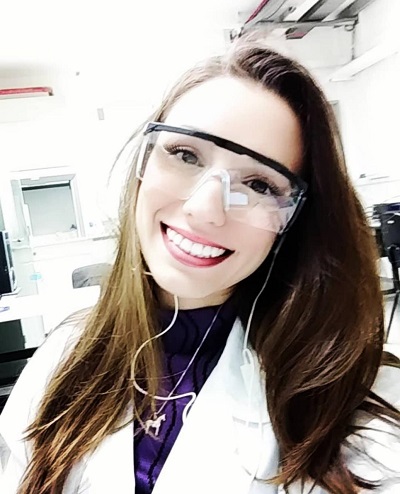
Olívia Carr at the lab during her doctorate at the end of 2018.
Head and neck cancer affects thousands of Brazilians every year. About 60% of these people are diagnosed late, which reduces their quality of life and makes treatment difficult. In her PhD in Materials Science and Engineering, carried out at USP, Olivia Carr generated a low-cost sensor that can detect the propensity of a person developing this cancer.
Olivia’s work was highlighted on the cover of a renowned international scientific journal (Talanta), in addition to generating a patent application, as well as other published articles. And furthermore, the technology developed in this work could be adapted to detect other diseases, including Covid-19.
Olivia, who is 30 years old, wants to continue contributing to society through research, which is the professional activity she most enjoys doing and for which she trained for over a decade. However, since the end of her doctorate, November of last year, she has only seen doors and opportunities closing.
Initially, she received, with great enthusiasm, three proposals to carry out post-doctoral studies in company projects, but two of them did not come through due to the pandemic (the companies decided not to make this investment in light of the new scenario) and the third did not succeed for other reasons. The young PhD then participated in a call from CNPq (the main Brazilian federal research funding agency) for projects related to the fight against Covid-19, in which she would receive a scholarship. However, her project was not approved for funding. After these initial frustrations, Olivia continued to participate in selection processes in research institutions and sent her resume to companies in Brazil that have a research and development area. Unfortunately, this path was not successful.
In parallel, in order to remain active and continue her career, she has worked with old and new collaborators, writing scientific articles and an academic book chapter for publication. All without receiving any payment, which is why she had to return to her parents’ house in the city of Rio Claro, which she had left to do her doctorate in São Carlos.
But it is not the first time that Olivia has experienced financial constraints in order to do research. In the four years of her doctorate, she spent more than half of that time without a scholarship. And here it is noteworthy to clarify that it is wrong to think that a doctoral student receives a scholarship to have more time for study or leisure. The doctorate is, in most cases, a full-time activity, which includes both the student’s theoretical training (the subjects taken) and the practical training (the doctoral research). Moreover, doctoral research is, in addition to training, a complete scientific undertaking, with results that contribute to the advancement of world science and industrial innovation.
Thus far, Olivia has not given up being a researcher, a profession that captivated her at the end of her undergraduate degree in Physics, when she discovered the day-to-day life of a research laboratory. However, after 10 months without pay, this science professional, trained to develop devices that can have great impact on people’s health, has started to evaluate other options, such as teaching Physics.
*Opportunity: the Laboratory of Nanostructured Materials for Environmental and Biological Analyses invites applications for a post-doctoral research fellowship funded by São Paulo Research Foundation (FAPESP: https://www.fapesp.br/en). This fellowship is linked to the Thematic Project “Toward a convergence of technologies: from sensing and biosensing to information visualization and machine learning for data analysis in clinical diagnosis” (FAPESP process number: 2018/22214-6).
*Supervisor: Carlos José Leopoldo Constantino (full professor).
*Institution: Department of Physics, São Paulo State University (UNESP), campus in the city of Presidente Prudente, São Paulo State, Brazil (https://www.international.unesp.br/).
*Fellowship components: it includes a monthly stipend (R$ 7,373.10) and research contingency funds (15 per cent of the annual value of the fellowship for using in activities developed by the Fellowship holder, strictly related to the fellowship research project).
*Duration of the post-doctoral fellowship: up to 48 months (starting: December/01/2020 or as soon as possible; ending: up to February/28/2025).
*Candidate requirements: she or he should have concluded the Ph.D. less than seven years before the beginning of the post-doctoral fellowship. Applicants must have a Ph.D. in physics, chemistry, materials science or related fields. The successful candidate must have excellent communication skills and excel in a highly collaborative research environment. In addition to the timely publication of research results in peer-reviewed journals, the responsibilities of the post-doctoral include drafting progress reports. The successful candidate will conduct research on: Detection of pesticides using surface-enhanced Raman scattering (SERS) spectroscopy. Therefore, this research includes experimental activities using techniques such as:
(i) Synthesis of colloid of metallic nanoparticles applied as “SERS substrate”.
(ii) Characterizations of the “SERS substrates” through microscopy, UV-Vis extinction spectroscopy, zeta potential, and dynamic light scattering (DLS).
(iii) Micro-Raman and surface-enhanced Raman scattering (SERS) spectroscopies.
(iv) Computational methods for data analysis.
*Deadline for application: October/13/2020.
*Application: interested individuals should send to carlos.constantino@unesp.br the following documents:
(i) CV with the list of publications.
(ii) Two letters of recommendation.
(iii) Work plan: 4-pages maximum with title, justification, objectives, and methodology.
Newsletter of the
Brazilian Materials
Research Society
Year 7, issue 8. September 8, 2020.
Featured Paper
A study carried out at UFPR revealed important details of the charge generation mechanism in organic solar cells and elaborated a mathematical model that helps choosing the most suitable materials for solar-to electrical conversion efficiency in these devices. The study was recently reported in Journal of Materials Chemistry C. Learn more.
Special: Unpaid Researchers
We are gathering statistical data and personal stories from PhDs who are without income and have had no opportunities to continue their scientific career in Brazil – a negative situation for these people and their families, for the research groups in the country and for society that would benefit from the fruits of research. See our first article here.
B-MRS Lives & Webinars
Five more technical webinars were held in August (last month of the Lives & Webinars 2020 program). Learn more and access the recordings of the webinars, here.
XIX B-MRS Meeting
The submission of symposium proposals for the XIX B-MRS Meeting + IUMRS ICEM is open until November 2. The event will be held from August 29 to September 2, 2021 in Foz do Iguaçu. The organizing committee invites the community to submit proposals. Go to the website.
B-MRS Advocacy
PL 529/2020. B-MRS sent a letter to all the members of the Legislative Assembly of São Paulo state, rejecting the bill that would allow withdraw resources from state universities and research foundation (FAPESP) .Know more.
News from B-MRS Members
– Professor Ana Flávia Nogueira (UNICAMP), B-MRS member, joined this year the advisory boards of two renowned journals in the field of Materials, both from the Royal Society of Chemistry (RSC). Know more.
Reading Tips
– For the first time, scientists manage to perform an interaction between two “time crystals” – crystalline structures experimentally proven a few years ago, whose structure is repeated not only in space, but also in time. Discovery opens up possibilities in the development of quantum devices (Nature Materials). Know more.
– Document gathers research carried out by Brazilian public universities and institutes with important results in combating the Covid-19 pandemic. The material was prepared by scientists from the materials community, B-MRS member Oswaldo Alves (Unicamp) and Antonio Gomes Souza Filho (UFC). See here.
– ONLINE. First Global Symposium on Janus Particles. October1 – 2, 2020. Site.
– 5th International Conference of Surfaces, Coatings and NanoStructured Materials – Americas (NANOSMAT-Americas). Foz do Iguaçu, PR (Brazil). October 7 – 10, 2020. Site.
– ONLINE. Meeting on natural polymers. October 21 – 23, 2020. Site.
– ONLINE. International Conference on Defects in Insulating Materials (ICDIM 2020). November 23 – 27, 2020. Organization: UFS. Site.
– 4th Workshop on Coated Tools & Multifunctional Thin Films. Campinas, SP (Brazil). July 20 – 23, 2021. Site.
– XIX B-MRS Meeting + IUMRS ICEM (International Conference on Electronic Materials). Foz do Iguaçu, PR (Brasil). August 29 – September 2, 2021. Site.
– 7th Meeting on Self Assembly Structures in Solution and at Interfaces. Bento Gonçalves, RS (Brasil). November, 3 – 5, 2021.Site.
Follow us on social media
You can suggest news, opportunities, events or reading tips in the materials field to be covered by B-MRS Newsletter. Write to comunicacao@sbpmat.org.br.
Post-doc researcher: essential professional for an efficient research group
In the Covid-19 pandemic the world is now experiencing, the importance of science and technology has become more evident to many people, with examples ranging from diagnostic tests and vaccines to the electronic devices that allow us to do almost everything remotely.
However, few know in detail how scientific and technological knowledge is produced in universities, which are the main scientific knowledge “factories” in Brazil. For each advance reported in a scientific article or patent, or transformed into a product or process, there are months or years of reading, laboratory experiments, computer simulations, discussions, analysis, writing.
Furthermore, there is the administrative work necessary in all research, which includes, among other tasks, project preparations to compete for financing, the recruitment of human resources and the purchase of inputs and equipment – often involving bureaucratic imports.
Far from the image of a scientist working alone in the laboratory, the reality is that to accomplish all of this, each scientific project must have a team of collaborators. Ideally, these teams are made up of people with different degrees of qualification and experience: undergraduate and graduate students (human resources in training process), postdoctoral fellows (junior science professionals) and professors, devoted to teaching, research and mentoring students (group leaders).
In addition to working on their research projects, “post-docs” assist in the intermediation between the group leader and the students, and gain experience in research management, as they more actively participate in administrative activities. Unlike the professor, the post-doc has no obligation to teach, nor does he need to hold an administrative position at the university. “The postdoctoral student can dedicate his/her efforts entirely to research projects, ensuring efficiency,” says Osvaldo Novais de Oliveira Junior, professor at the São Carlos Institute of Physics at USP.
Everyone benefits in this structure. Scholarship students receive more attention in their training, the post-doc gains experience as scientist in the profession and the group becomes more productive. “In a group, the post-doc leverages research and allows for more complex work,” says Professor Mônica Cotta, leader of the Laboratory of Nano and Biosystems at UNICAMP.
Postdoctoral fellowships are shrinking
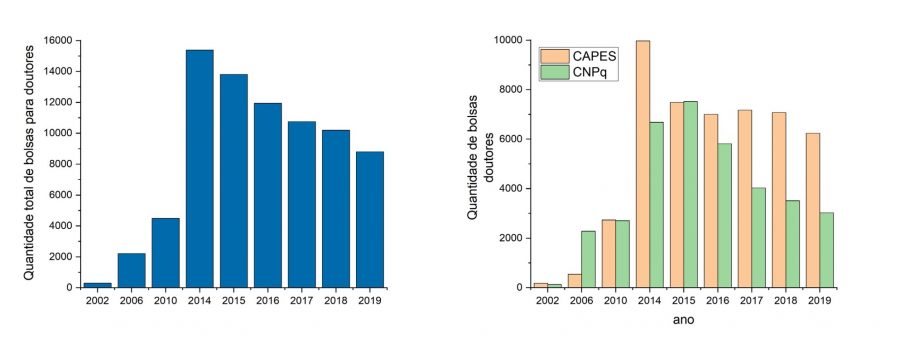
An apparently large number of trained PhDs are currently in an unsuccessful search for opportunities to exercise scientific activity in Brazil. This situation is related to the decrease in the number of scholarships offered by federal agencies that deal with research grants: CNPq and Capes. In fact, after reaching maximum values between 2014 and 2015, the number of postdoctoral fellowships has decreased significantly, as shown in these graphs.
Number of total scholarships (left) and by federal agency (right) for PhDs (postdoctoral scholarships, technological development, etc.) over the years. Scholarships for senior doctors or professors and scholarships for activities abroad were excluded. Data extracted from CAPES and CNPq.
Without remuneration, these highly trained and specialized professionals, whose training takes, on average, a decade, look for positions abroad, adding to the “brain drain” that occurs in times of little appreciation of science in the country. Or worse, they abandon science to ensure their financial survival.
Unlike other groups that are suffering from a decrease or lack of income during the pandemic, the group of unpaid PhDs is not visible in society, nor has it been addressed by any government aid program.
Faced with this scenario, B-MRS is gathering stories of PhDs who have not found opportunities to remain active in research, in order to sensitize society and the government to the difficulties these people and their families are going through and understand the negative impacts of this situation for the country. B-MRS also request the restoration of the number of postdoctoral scholarships, in addition to a policy aimed at valuing and encouraging the placement of PhDs in development and innovation activities in our society.
Tales: PhD in Chemistry, freelancer and volunteer researcher
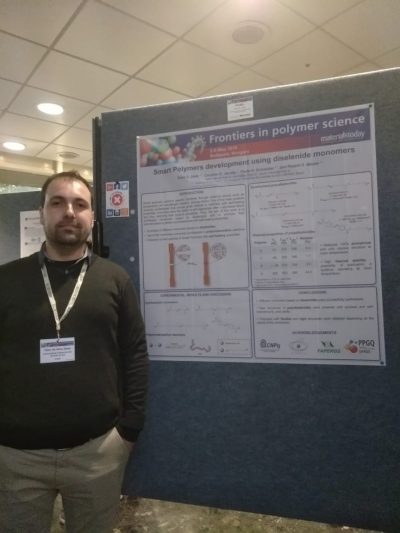
Tales da Silva Daitx presenting his doctoral research during a conference in Hungria em 2019.
To be a professor in some Brazilian university, performing research, teaching and mentoring. That is what Tales da Silva Daitx chose to do as a profession. He has liked science since he was a child, but it was at the university that he found the passion to discover new things and to transmit knowledge to others through research and teaching. Tales then went through the required path to properly train and be able to compete in a public or private teaching and research institution.
After graduating in Chemistry from the Federal University of Rio Grande do Sul (UFRGS), he entered the Chemistry graduate program at this university – a program of excellence and with the highest score in the evaluation of Capes (entity in charge of expansion and consolidation of graduate studies in Brazil). He spent six years there working on his master’s and doctorate, both focused on research in the field of intelligent materials.
In mid-March of this year, a few days after the World Health Organization (WHO) declared the Covid-19 pandemic, Tales defended his thesis, the final stage of every doctorate, at the Chemistry Institute of UFRGS. It was one of the last in-person defenses at the institute, together with his wife, who completed her doctorate at the same time. Since then, the couple, who live in Porto Alegre, are trying to earn an income to pay their bills and, at the same time, remain active and productive in research, two objectives that have not been possible to conciliate.
After his doctorate, Tales intended to move on to the next stage of his scientific career, a postdoctoral fellowship (popularly called “post-doc”). Thus, he contacted a research group from the Federal University of Santa Catarina (UFSC), where he could apply the knowledge acquired in graduate school in a project to develop smart nanoparticles for biodegradable packaging.
Thus, after defending his doctorate, already in the middle of a pandemic, Tales participated in two calls for proposals from CNPq, the main federal research funding agency, to try to obtain a post-doc grant, of around 4 thousand reais. Trained to carry out the project and with a competitive curriculum, with eleven scientific articles published in international journals and two patents (one filed and one already granted), Tales obtained a score close to the maximum in the first call. However, he was informed he would not be awarded a grant due to the resources available. The second notice, that would have the result in August, was suspended due to the pandemic.
Currently, while looking for other opportunities, Tales works as a voluntary postdoc (without a grant or any other type of remuneration) in the research group where he completed his doctorate. He participates in meetings, does bibliographic searches, and writes projects. However, he is unable to dedicate his efforts to these activities full time, since, to meet the couple’s basic financial needs, Tales became a freelancer. This 30-year-old professional, highly trained and specialized in an area of knowledge, is currently spending much of his time performing services, such as data entry in computer systems, which do not require such qualification.
“I think this situation in Brazil is a shame, the lack of opportunities for PhDs. In the past there was investment in science and technology, and it had good results. The country was well positioned in research around the world. But the investment did not continue, and that will bring it back to square one,” says Tales. “In addition, the pandemic has affected the research system. Public S&T policies should be revised,” he adds.

 Symposium proposals can be submitted until November
 *Opportunity: the Laboratory of Nanostructured Materials for Environmental and Biological Analyses invites applications for a post-doctoral research fellowship funded by São Paulo Research Foundation (FAPESP: