
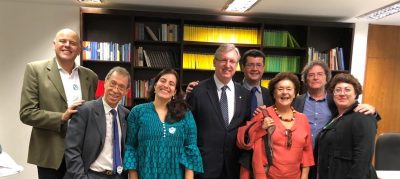
We can call her a lobbyist; she doesn’t mind. Quite the opposite. Mariana Mazza, 41 years old, a lobbyist for ST&I, believes that there should be more professionals like her monitoring the actions of the Executive and Legislative Branch with an impact on ST&I and negotiating priorities with parliamentarians for the collective benefit of certain areas of research and innovation. Under names like “congressional fellow” or “advocacy dashboard,” this work has more visibility in scientific societies in other countries, such as the United States, but also exists in Brazil.
A journalist who graduated from the University of Brasília, Mariana changed, at the end of 2016, her routine as a reporter with that of parliamentary advisor to the Brazilian Society for the Advancement of Science (SBPC), a society to which B-MRS is affiliated. In turn, SBPC is one of the eight entities that coordinate ICTP.br, an initiative that brings together the efforts of Brazilian institutions relevant to CT&I in joint actions in the National Congress.
In an interview with the B-MRS Newsletter, Mariana talks about her daily activities as a parliamentary advisor in ST&I, the main achievements and the challenges for the immediate future, in a time of resources scarcity and a pandemic.
B-MRS newsletter: What is your job? What activities do you carry out in your day-to-day parliamentary assistance?
Mariana Mazza: The activities I carry out for the SBPC have a broader scope than simply talking to congressmen and senators, as anyone unfamiliar with the National Congress may think. It’s quite dynamic, actually. There are basic activities such as evaluating the agendas of the House and Senate commissions and screening everything that may have an impact on ST&I. As SBPC has hundreds of associates in multiple areas, this is a very broad job. But the most critical part is to identify and evaluate political actions that can be passed in the National Congress. For example, we have done a very thorough job of recovering the budget for ST&I and R&D. This requires that I follow the budget proposal from the beginning, calculate the variations in relation to previous budgets and suggest strategies to the SBPC board. Once the strategies are outlined, the negotiating part begins with amendments that put more money into projects, which means writing these proposals and explaining them to the advisors of each office. To give you an idea, just for the 2020 Budget, I personally went to more than 300 offices of the Congress and the Senate. And this is just a part of what we do. Basically, any action by the Executive that can be reversed in Congress requires an action by the advisors in some aspect. And there are also bills from the Legislative itself that affect the scientific community and often need repair. I mediate the representatives of the SBPC with the representatives of these projects and members of the committees that can improve the proposal. We also organized scientific dissemination exhibitions, such as the Centennial of Eclipse in Sobral last year, which was very well received by visitors to the Congress. And there is also the work to expand awareness of the SBPC itself by parliamentarians. As the SBPC is a very active entity in the political discussions important for the country, there is no lack of work for parliamentary assistance.
B-MRS newsletter: Who do you interact with? How do you choose who to interact with?
Mariana Mazza: It depends on the subject we are dealing with. Parliamentarians have their niche. So, if the subject is the environment, there is a group of parliamentarians open to dialogue in line with SBPC’s activities. If it’s innovation, it’s another group. For budget, it’s other parliamentarians. And so on. But as Brazilian science increased its presence in the National Congress, we expanded our network of parliamentarians allied to CT&I, which we look for in the most strategic matters regardless of the specific area, so to speak. This web of science-friendly parliamentarians was woven in various ways. There are historical allies, who have supported science for years, and those who have identified themselves with the agendas we have taken on, better understanding how science works and its implications in the lives of Brazilians. It would be difficult to list them because it would leave out many of them. After the 2018 elections, we lost many congressmen and senators aligned with the scientific agenda. But luckily we have been able to open a new space in Congress, getting support from many leaders using the strategy of defending specific agendas. In the withdrawal of the FNDCT from the PEC Funds, for example, we were able to articulate with the leaders and other entities in the sector a supraparty support for the preservation of science resources. It is very gratifying when we can demonstrate that science is not an ideological agenda, of the left or right. It is an agenda for the benefit of all. Politicians are starting to see this.
B-MRS newsletter: You have a degree in Social Communication – Journalism and experience as a TV journalist. What skills do you use in this parliamentary advisory work?
Mariana Mazza: Yes, I am a journalist by training. Before joining SBPC, I worked at Grupo Bandeirantes as an editor and columnist. In my career as a reporter, I specialized in the area of infrastructure, which actually led me to Band media group, as a columnist for Telecommunications. It is public knowledge that the infrastructure sector is very active in the political lobby, although much of the social perception is on the negative side. Major service providers – such as telcos, energy distributors, fuel producers, airlines, contractors and media groups, which make up an infra reporter’s agenda, are extremely active in lobbyism. Following the operation of these sectors in the National Congress for more than a decade has taught me very much about how sectoral negotiations work in parliament. For instance, what kind of arguments work with politicians, how to approach them and how to present a cross-sectoral agenda.
B-MRS newsletter: Your work is not common in Brazil in the scientific environment, right? Do you get inspired or learn from professionals in other fields or from other countries?
Mariana Mazza: It’s not that uncommon, actually. Entities such as Fiocruz and Embrapa, which belong to the National System of Science, Technology and Innovation (SNCTI), are very professional in their work in the National Congress, with teams dedicated only to negotiating with parliamentarians and analyzing actions in the legislature. And there are important civil entities that do very diligent work in congress, defending and guiding the benches in specific sectors. The Socio-Environmental Institute (ISA), for example, has a very important role in the environmental agenda. I think what happens is that this is an “in the shadows” job, most of the time. When it works, it looks like it hasn’t even been done. The lobbyism is still very frowned upon in Brazil, because we are usually only aware of it when it is used for the benefit of some sector rather than for the collective benefit. This results in lobbyists in Brazil disguising their activities with other names, “parliamentary advisers,” “directors of institutional relations,” and so on. This helps to hide the bad lobby service, so to speak, but it also ends up taking away the visibility of the republican work of negotiating priorities with parliament. I believe that all sectors have the right to negotiate with representatives elected by society. It is like the work of a lawyer. Guilty and innocent people have a right to defend themselves. I am privileged to advocate in defense of a sector that I sincerely believe is beneficial for the development of any nation. But when working with politics, one must keep in mind that there is always a perspective that is opposite to ours. We have to face the negotiations without sentimentality. We need to find a common ground. Ironically, I end up being more inspired by business lobbyists, considered “bad” by society, simply because they are efficient in their performance. As a reporter I met many lobbyists, and became close over the years, and I learned quite a bit from them.
B-MRS newsletter: What is the Science and Technology Initiative in Congress (ICTP.br)? Does your work fall under this initiative?
Mariana Mazza: ICTP.br is an initiative to join the efforts of national entities relevant to ST&I in joint actions in the National Congress. It derived from an idea by SBPC’s chair Professor Ildeu de Castro Moreira to create an observatory for the Legislature. The idea was developed in partnership with former-minister Celso Pansera, who held a mandate as a federal congressman, when we started to prepare the project in 2018. Today, Pansera takes care of the executive secretary of ICTP.br, articulating the major guidelines that impact ST&I with the party leaders in an agenda of priorities that we jointly defined among the eight institutions that make up the coordination of ICTP.br: SBPC, ABC, Andifes, Consecti, Confap, Forum of Secretaries of ST&I, Conif and Confies. As a parliamentary advisor to SBPC, I have worked together with the ICTP.br agendas, but not all actions overlap. There are several guidelines that I have to address and because they are specific they are not on the Initiative’s agenda. On the other hand, the establishment of this coordinated operation eased performance in the heaviest national guidelines, which before ICTP.br they would fall on the advisors in an unarticulated way. Today, such actions on these high-impact agendas are much more organized, with former-minister Pansera at the head of the broader political articulations, with advisers like me taking on the ground work of building arguments and assisting the offices to implement the agreements signed. It is still work in the makings, but we have already had great results in improving the interaction between entities and winning gains in Congress.
B-MRS newsletter: What were the achievements achieved so far with the help of your work?
Mariana Mazza: There are many. Especially because most, as I said before, don’t even get visibility because they end up as a task to put out small fires. However, in terms of general repercussions, we have been very successful in the budget agenda, although today this action is more about containing losses than increasing resources for ST&I. I can safely say that the financial situation of the sector would be much more precarious if it were not for the work of the advisors and directors of the entities in containing the bleeding. Also regarding the big agendas, the action in Congress was what guaranteed the missing funds for the payment of CNPq scholarships in 2019. That maintained the existence of Finep, by blocking the initiative to transfer the executive secretary of the FNDCT to the MCTIC. That saved the FNDCT from possible extinction by removing it from the PEC of the Funds. That prevented the contingency of science resources at MCTIC in 2020. That also protected the entire budget of Embrapa, Fiocruz, IBGE and Ipea this year. Not to mention the countless denunciations that SBPC makes in its public notes and open letters that have enormous repercussions in Congress, containing the advance of harmful measures for Brazilian science. The testimonial of this type of work, as you can see from the examples I cited, is that we are currently being compelled to act more in containment than in proposition. It is important to remember, for example, that it was the performance of science in Congress that embodied the Legal Framework of CT&I, an operation that lasted many years of dedicated negotiation by advisers at that time.
B-MRS newsletter: What have been the main challenges or difficulties?
Mariana Mazza: The main difficulty is that we have many entities in the scientific area, but few with political activities in Brasília. As a result, many opportunities for specific actions are lost, which an advisor like me, from a national entity, cannot follow with the necessary dedication. It would be especially positive if associations and civil entities that do not operate in Congress started to insert this on their agendas. But it should be understood that parliament works with concrete guidelines. Acting in Congress in the pursuit of “defense of ST&I” quite simply – this is in fact true for any sector – becomes very frustrating very quickly. Because parliamentarians deal with dozens of topics at the same time and are therefore pragmatic. You need to know what you want before stepping into the National Congress. The challenge is that we are in a political and economic moment of deep retraction in public investments. And the ST&I sector is an expensive sector in the view of many parliamentarians, who are unaware of the vast Brazilian research network and its fruits throughout history. Although we have made significant progress in recent years, science is still seen by many in Congress as having low political repercussions in the electorate of these parliamentarians. And then we lose support for guidelines considered by them to be of greater social appeal. Therefore, the greater the presence of scientific entities in parliament, the greater the space for parliamentarians to discover the benefits of Brazilian science for their political agendas. We have seen this path opening up. Our collective goal is to naturalize the stimulus to science in the National Congress. The latest victories achieved this year show that we are on the right path, but there is still much to do, such as moving from a just reactive agenda to the continuation of propositional guidelines. But, as Bismarck’s famous phrase: “Politics is the art of the possible.” At this time, what is possible is to prevent further setbacks.
B-MRS newsletter: In this new and difficult scenario, marked by the advance of the Covid-19 pandemic in Brazil, unpaid funds, budget cuts and various uncertainties and instabilities, what are your action plans for the coming times?
Mariana Mazza: We are very concerned with the little attention given to science by the government in plans to fight the coronavirus outbreak. To repair the low budget for research in this area, we are already negotiating increases in resources with parliamentarians using the budget instruments sent by the Executive Branch. We are also already preparing to work on raising ST&I and R&D funds in the emergency plan announced by the federal government to mitigate the economic effects of the pandemic. We understand that investing in science, as other countries have done, is also vital for the national economy and we are in daily dialogue with the closest offices, drawing up action strategies. One of our great battles, inside and outside the National Congress, has been the end of the capture of FNDCT resources by the Contingency Reserve. This is a tax mechanism that is essentially illegally withdrawing money from science to meet government tax targets. We also want this reserve to be released now, in its entirety, to fight the coronavirus and foster science in general, recognizing its role in the economic recovery of the recession that will certainly hit Brazil after overcoming the pandemic. At the present time, all energy is focused on ensuring the presence of science in emergency plans and blocking any action that would harm science in this period of crisis.



 Owing to the uncertainties related to the COVID-19, and in order to reduce the risk of hampering the health of our community, the Organizing Committee, the Executive Board of the B-MRS and the IUMRS decided to postpone the 2020 B-MRS and the IUMRS/ICEM meetings.