
Author: Verónica Savignano
(Português) Prêmio da ACS para mulheres brasileiras na Química e ciências relacionadas.
Webseries episodes about Brazilian science related to materials research have an exclusive premiere for B-MRS channels.
 HPC Spotlight is the name of the Brazilian science web series that shows some of the challenges and achievements of scientists in Brazil, through their scientific, professional and personal stories, told in episodes of about 10 minutes. Conceived by Versatus HPC, a Brazilian high performance computing company, and carried out together with Ibirá Filmes, the web series currently presents its second season, focused on scientists from the state of Minas Gerais.
B-MRS’s partnership with Versatus brings to the audience of B-MRS channels the opportunity to watch episodes related to the materials area first hand, before the official premiere. The launching takes place on Wednesdays, in the late afternoon, on B-MRS’s social media channels.
How the web series came about
The idea of making this innovative web series arose in the Versatus team after almost a decade of interaction with scientists from Brazilian institutions. “We know some of the many challenges they have to face on a daily basis. Barriers regarding submissions, financing, funds, deadlines, as well as regarding the valuation of their research,” says Cecília Scigliano, from Versatus. “When walking side by side with scientists and researchers to ensure that they have the most appropriate technological solution for their research, we know their objectives, advances, discoveries and conclusions… and we become increasingly fascinated by this universe!”, she adds.
Follow the launch of the next episodes, on Wednesdays, in the late afternoon, at:
- B-MRS Facebook: https://www.facebook.com/SBPMat
- B-MRS Instagram: https://www.instagram.com/sbpmat_bmrs
- B-MRS Twitter: https://twitter.com/sbpmat
See previous episodes of HPC Spotlight: https://www.hpcspotlight.com.br
(Português) SBPMat apoia manifesto contra modo de gestão excessivamente centralizador da atual presidência da Capes.
(Português) Anuidades SBPMat 2020: mensagem da diretoria.
B-MRS Newsletter. Year 7, issue 6.
|
||||||||||||||||||||
|
||||||||||||||||||||
|
Lives & Webinars Program: first month.
 During the month of June, five technical webinars were held on the Zoom platform, with live transmission via B-MRS’s Facebook platform, within the Live & Webinars program, organized by B-MRS in partnership with instrumentation companies.
By the end of August, 12 more webinars will be offered. The program includes a variety of subjects, from fundamentals and applications of techniques widely used by the Materials research community, to the presentation of state-of-the-art research instruments and digital tools for teaching in the field of Materials.
The already held online seminars had audiences of up to 500 participants. “We are happy to see that many people, especially young people, are using this pandemic time to gain knowledge and for self-improvement,” says Professor Mônica Cotta, president of B-MRS, who has participated in all the seminars.
Programming, information and registration (free): https://www.sbpmat.org.br/en/lives-webinars/
Watch the past webinars recordings:
- “Micro-XRF aplicado a Ciências dos Materiais” (Essencis and Bruker). See here.
- “Microscopias FTIR, Raman e Eletrônica de Transmissão para Análise de Materiais” (Thermo Fisher). See here.
- “Técnicas de magnetometria para a pesquisa em nanopartículas magnéticas” (Quantum Design). See here.
- “3D optical profilometry for material science applications” (Sensofar and Analítica). See here.
- “Crossbeam laser – Enabling New Microscopy Workflows Through Gentle Large-Volume Material Removal” (Zeiss). See here.
Featured paper: Nanocontainers for intelligent anticorrosion coatings.
Traditional coatings are often effective in protecting steel structures from corrosion by providing a physical barrier that prevents contact between the substrate and corrosive elements. However, when wear generates cracks or pores in these coatings, the substrates are exposed and eventually corrode.
A scientific team from the Brazilian Federal University of Paraná (UFPR) developed a nanotechnology-based coating that offers active protection against corrosion. When the coating shows a flaw, exposing the substrate to corrosive elements, two anti-corrosion mechanisms are activated without human intervention. The coating has very special additives to carry out this intelligent procedure: nanocontainers capable of storing a compound that inhibits corrosion (molybdate) and release it, on demand, in the presence of corrosive elements.
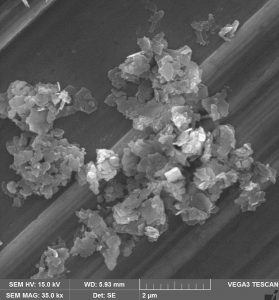
UFPR’s nanocontainers are structures of nanometric dimensions that appear in the form of overlapping two-dimensional sheets (lamellae), separated by a space of a few angstroms. It is in this interlamellar space that molybdate is stored. When a nanoreservoir comes into contact with corrosive environments, such as the sodium chloride (NaCl) solution used in the UFPR experiments, a negative ion exchange reaction occurs: molybdate anions leave the interlamellar space and chloride anions occupy these spaces. In this exchange, the molybdate is free to form a protective film on the exposed substrate surface, while the corrosive anions are “trapped” in the nanoreservoir.
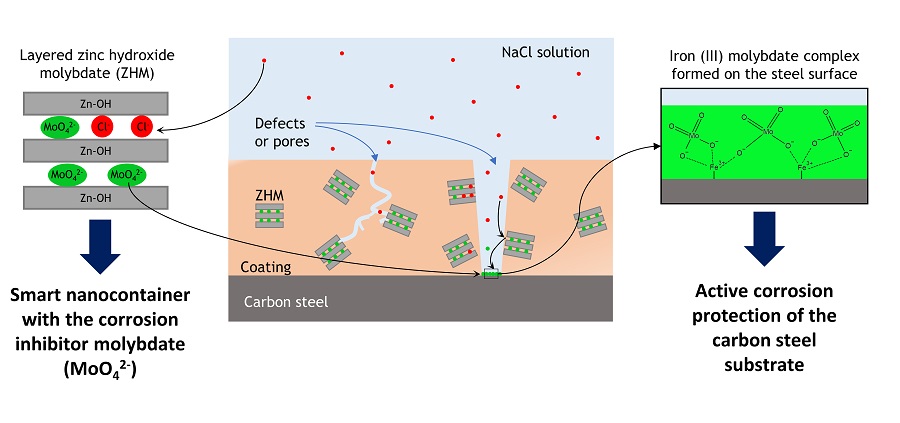
“The main contribution of the work is related to the active corrosion protection of steel. While traditional coatings provide only barrier protection, that is, passive protection, the intelligent coating developed in this work promotes active protection, releasing the molybdate corrosion inhibitor from the lamellar nanoreservoir on demand, through an anion exchange mechanism,” summarizes Débora Abrantes Nunes Leal, doctoral student of the Graduate Program in Materials Engineering and Science at UFPR and corresponding author of the article reporting the research, recently published in ACS Applied Materials & Interfaces. “In addition to releasing the inhibitor in a controlled manner, the lamellar nanoreservoir also “captures” the chloride anions, acting as a trap for these species and, therefore, also contributes to reducing the corrosive environment,” concludes the doctoral student.
Industrial scale use
Produced by means of a quick and simple process and using low-cost, abundant raw materials with low environmental impacts, such as zinc, UFPR’s nanocontainers have the potential for large-scale manufacturing process. When used as coatings additives, as in the UFPR research, nanocontainers could increase the useful life of steel structures found in atmospheres with high concentrations of corrosive compounds, such as, for example, marine atmospheres or close to chemical plants.
According to Débora, there is already a market, mainly in Europe, still incipient, of intelligent coatings to combat corrosion for the aeronautical and petrochemical industries. However, these coatings use as reservoirs of anticorrosive compounds, mainly polymeric microcapsules or double lamellar hydroxides, which are more complex to manufacture, costly and have a greater environmental impact than the lamellar hydroxyses used in UFPR’s nanocontainers . According to the authors of the article, these materials had never been used to store and release corrosion inhibitors before this work, neither in industry nor in the scientific literature.
All the work reported in the article of ACS Applied Materials and Interfaces was carried out by Débora Abrantes Nunes Leal within her still-in-progress doctoral thesis, which started in 2017. The research is guided by Professor Cláudia Marino (advisor), who is an expert in corrosion and protection of materials, and by Professor Fernando Wypych (co-advisor), whose expertise is the synthesis and characterization of lamellar materials. The work received funding from the Brazilian agencies Capes, CNPq and Finep.
Currently, the research on nanocontainers continues, and the authors indicate that they will soon present new results, including those related to the use of other corrosion inhibitors.

[Paper: Zinc-Layered Hydroxide Salt Intercalated with Molybdate Anions as a New Smart Nanocontainer for Active Corrosion Protection of Carbon Steel. Débora Abrantes Leal, Fernando Wypych, and Cláudia Eliana Bruno Marino. ACS Appl. Mater. Interfaces 2020, 12, 17, 19823–19833. https://doi.org/10.1021/acsami.0c02378.]
(Português) Processo seletivo para mestrado e doutorado em Física no PPGF/UFRN.
B-MRS Newsletter. Year 7, issue 5.
|
|||||||||||||||||||||||||
|
|||||||||||||||||||||||||
|