O Centro Técnico Científico da PUC-Rio(CTC/PUC-Rio) está com inscrições abertas para pós-graduação Stricto Sensu (Mestrado e Doutorado) em Engenharia Química, de Materiais e Processos Ambientais.
Inscrições até 24/11/2019 – Conceito 5 na CAPES
Candidatos interessados nos programas de mestrado e doutorado podem escolher entre três áreas de concentração: Engenharia Química (EQ), Materiais e Nanotecnologia (MN) e Processos Ambientais (PA), cada uma delas contemplando três Linhas de Pesquisa, a saber:
EQ: Modelagem, Otimização, Controle e Automação de Processos; Processos Químicos e Catálise; Processos Mínero-Metalúrgicos;
MN: Síntese, Processamento e Caracterização de Materiais; Desempenho e Integridade dos Materiais; Engenharia Microestrutural;
PA: Química Verde; Tratamento de Águas e Efluentes Industriais; Tratamento de Resíduos.
O Coordenador do Programa de Pós-graduação em Química da Universidade Federal de Santa Catarina (PPGQ-UFSC), nota máxima na avaliação CAPES, torna público que, no período de 25 de setembro a 18 de outubro de 2019, estão abertas as inscrições para o processo de seleção e admissão aos cursos de Mestrado e de Doutorado.
Estão abertas as inscrições para o ProcessoSeletivo 2020/1 ao Mestrado Acadêmico e ao Doutorado do Programa de Pós-Graduação em Engenharia da Nanotecnologia – PENt da COPPE/UFRJ.
O PENt é um Programa pioneiro no Brasil na área de Engenharia da Nanotecnologia, que deu início às suas atividades no ano de 2014.
Nesta oportunidade estão sendo oferecidas 20 vagas para o Mestrado Acadêmico (para entrada no período 2020/1) e um total de 20 vagas para o Doutorado (para entradas nos períodos 2020/1, 2020/2 e 2020/3).
O período de inscrição para ingresso no Mestrado Acadêmico no período 2020/1 é de 23/09/2019 a 22/11/2019. O período de inscrição para ingresso no Doutorado no período 2020/1 é de 23/09/2019 a 13/12/2019.
Por ocasião do XVIII Encontro da Sociedade Brasileira de Pesquisa em Materiais (SBPMat), que reuniu cerca de 1800 pesquisadores do Brasil e mais de uma dezena de outros países, de 22 a 26 de setembro de 2019, em Balneário Camboriú, Santa Catarina, a diretoria e o conselho da SBPMat vêm a público manifestar sua preocupação com os cortes e contingenciamentos de verbas para a educação e pesquisa no Brasil. Se persistirem os cortes nas universidades públicas e em órgãos de financiamento à pesquisa e pós-graduação, como a CAPES, CNPq e Finep, o País estará fadado ao retrocesso em seu processo de desenvolvimento. Ressaltamos que a necessidade de contenção de gastos públicos devido à crise econômica não justifica os cortes em ciência e educação, pois esses cortes são muito maiores – em porcentagem – do que em outras áreas do governo.
Como a história do progresso de nações mostra, a prosperidade e o bem-estar da população têm relação direta com a capacidade de um país de gerar e absorver conhecimento. É inacreditável que no Século XXI ainda seja necessário justificar investimentos em pesquisa e geração de conhecimento. Principalmente em uma era de viagens espaciais, longevidade sem precedentes para a humanidade, e tecnologias como as dos telefones celulares que permitem comunicação que há algumas décadas estava apenas em livros de ficção científica.
Gostaríamos de nos dirigir à sociedade brasileira que paga impostos para manter o sistema de ciência, tecnologia e inovação do País. Com tantas notícias falsas espalhadas atualmente, podem surgir dúvidas sobre as intenções da comunidade acadêmica e universitária. Pode-se perguntar se um manifesto como este não é apenas uma defesa corporativista de uma elite que vê seus interesses afetados pelas políticas adotadas com cortes e contingenciamentos. Essa é uma pergunta legítima, mas que pode ser respondida com firmeza pela comunidade da SBPMat. Fazer ciência e desenvolver novas tecnologias pressupõe a busca da verdade, de maneira que não podemos nos furtar de alertar a sociedade brasileira sobre as consequências das atuais políticas de ataques às universidades públicas e cortes de investimentos.
Mesmo que as pessoas não percebam no dia-a-dia, sua vida é altamente dependente da tecnologia: para ter energia e comunicação através de telefones celulares, para acesso a tratamentos médicos, disponibilidade de água limpa e comida a preços acessíveis. São muitos os exemplos de tecnologia brasileira que beneficiam a população e a economia brasileira, como naqueles mais óbvios em que o Brasil tem liderança mundial: exploração de petróleo em águas profundas, agronegócio e produção de aviões de médio porte. Por outro lado, a existência de laboratórios e pessoal treinado, fruto do investimento em ciência e tecnologia de muitas décadas, permitiu que o Brasil rapidamente desvendasse os mecanismos de ação do vírus Zika, causador da microcefalia em bebês; graças a este conhecimento, o mesmo vírus traz esperança de tratamento para tumores do cérebro ainda hoje sem chances de cura. Mencione-se, também, a necessidade de formação de profissionais capacitados que possam servir a população, só realizável com um sistema universitário pujante e que inclui pesquisa.
A comunidade acadêmica precisa ter a responsabilidade de não ser alarmista. Entretanto, ela também tem o dever de alertar o povo brasileiro sobre alguns dos efeitos que a destruição de nosso sistema de ciência, tecnologia e inovação trará – inevitável se as políticas de cortes persistirem. No mundo todo, o maior aporte de recursos para ciência e tecnologia é realizado pelo Estado; empresas em geral respondem pelo custeio de pesquisas mais aplicadas, construídas a partir do conhecimento básico adquirido em estudos mais fundamentais. É importante lembrar que a destruição desse sistema pode ser muito mais rápida do que as décadas necessárias para construí-lo.
Queremos encerrar este manifesto com uma nota de esperança. Em uma das palestras no XVIII Encontro da SBPMat, foi apresentada uma das conquistas que orgulha a ciência brasileira: o acelerador de partículas Sirius, instalado no Centro Nacional de Pesquisa em Energia e Materiais, em Campinas. Construído com 85% de tecnologia nacional, o Sirius está entre os mais avançados do mundo, e pode permitir geração de conhecimento essencial para muitas áreas estratégicas para a economia brasileira. A criação do Sirius é mais uma demonstração da capacidade da comunidade científica brasileira, que esperamos possa continuar seu trabalho. Isso só será possível, entretanto, se houver uma mudança nas políticas para educação e pesquisa no Brasil.
Na tarde de 25 de setembro, participantes do evento aderiram a um manifesto em favor da pesquisa e das universidades, o qual consistiu em uma foto em frente ao palco principal, com os telões exibindo a frase “Em Defesa da Ciência e da Universidade Pública”.
The Newsletter of the
Brazilian Materials
Research Society.
Special issue:
Get ready for the XVIII B-MRS Meeting!
Message from the Chair
Dear attendees,
It will be a great honor to receive you in Balneário Camboriú-SC for the 18th Brazil-MRS Meeting, in the period of September 22nd-26th, 2019.
There is a remarkable list of top international plenarists, and 23 symposia in all scientific themes in materials science with high level of confirmed invited speakers. More than 2500 submitted papers, representing institutions of different countries and almost all regions of Brazil. This is a record in the history of the meeting.
We dedicated ourselves to offer you the best conditions for a productive period of science discussions and knowledge exchange in order to promote scientific cooperation.
I am looking forward seeing you in Balneário Camboriú.
With kind regards,
Ivan H. Bechtold – Chair
Useful information
Airport transfer. Do you want to book a transfer from the international airport of Navegantes or Florianópolis to Balneário Camboriú? You can contact by WhatsApp the booking desk of Guarupa (a Brazilian transportation app): +55 47 9130-9001.
Event venues. Due to the high participation and to ensure everyone’s comfort, the sessions and activities will take place in two hotels, 300 meters apart: Hotel Sibara Flat & Conventions and Mercure Camboriu Hotel. The opening session of the event will be held at the Cristo Luz Complex, one of the main tourist attractions in the city. Know more about the venues.
Shuttle to the opening session. There will be free shuttle service between Sibara Hotel and Cristo Luz Complex on Sunday 22from 5 pm on. The complex is a 10-minute taxi/Uber ride from Sibara Hotel. It is recommended to arrive in advance.
Already registered participants. Participants who have already registered online can print their barcode to avoid queues. Access the event system with username and password, go to “Attendee” and “Print registration confirmation page”.
Onsite registration. Onsite registration remains open until the last day of the event at Sibara Hotel. B-MRS members have special discounts. You can become a member or renew your membership during the event’s registration and enjoy the special fees. See values.
Program. The program at a glance is available here. The presentation schedule, by symposium, is here. And the PDF file of the program book can be downloaded here. Changes in presentation times may still occur due to desistances. However, any changes will be updated on the online presentation schedule and app.
App of the event. The free app of the event is available at the official app stores of Android (Google Play) and Apple (App Store). Search “XVIII B-MRS Meeting” and download it to your smartphone. Features: schedule, maps, useful phones, personal schedule, QR code reader to access posters abstracts, and more.
Conference party. The party will take place on Wednesday 25, starting at 9 pm, at the lounge of the Green Valley Club, elected ‘The Most Prestigious International Club’ in 2013, 2015, 2018 and now 2019. The band of the party will be the “Brothers“. Tickets (limited) will be on sale for R$ 20 at the event secretariat from Monday 23.
Exhibitors fair. Visit the booths around the coffee break area, next to the secretariat, at Sibara Hotel!
Poster sessions. All symposia poster sessions will take place at Sibara Hotel, 17th floor, Adriatico room.
Students awards ceremony. The best students contributions presented during the meeting will receive prizes from B-MRS, ACS Publications journals and RSC journals. Prizes will only be awarded if the authors (students) are present at the ceremony, which will be held at the closing session of the event, on September 26 from 12:30 to 2 pm.
Memorial lecture. At Cristo Luz Complex (opening session).
On Sunday 22 in the opening session, atCristo Luz Complex, Prof. Yvonne Primerano Mascarenhas (USP, Brazil) will give the B-MRS annual Memorial Lecture. Prof. Yvonne, a pioneer who led the introduction and development in Brazil of X-rays crystallography, will talk about the origins and panorama of this technique in the country. See our interview with her.
Plenary Lectures. At Sibara Hotel, 4C floor.
On Monday 23 at 8:15 am, Prof. Stefano Baroni (SISSA, Italy) will talk about color expression in natural pigments, a basic science issue wit direct impact in the food industry, which he has been addressing using computational methods. Prof. Baroni is recognized for having made important contributions to the development of computational techniques for the study of materials at the nanoscale. See mini interview.
On Monday 23 at 4:45 pm, Prof. Norbert Koch (HU, Germany) will present promising structures for optoelectronic devices, which combine inorganic and organic semiconductors. Prof. Koch is the author of industry-impacting insights about the basic mechanisms that govern optoelectronic devices performance. See mini interview.
On Tuesday 24 at 8:15 am, Prof. Antônio José Roque da Silva (CNPEM, Brazil) will talk about Sirius, the new Brazilian Synchrotron Light Source whose project and construction he has been leading since 2009. Sirius will be the largest and most complex scientific infrastructure ever built in the country and one of the first fourth-generation synchrotron lightsources of the world.Know more about Sirius.
On Tuesday 24 at 4:45 pm, Prof. Maria-Pau Ginebra (UPC, Spain) will discuss a new generation of bone graft biomaterials, made through nature-inspired methods, that bring together the advantages of natural and artificial bones. Prof. Ginebra has created a spin-off company to transfer the knowledge on these materials to “real life”.See mini interview.
On Wednesday 25 at 8:15 am, Prof. Julia Greer (Caltech, USA), who is the author of seminal contributions to nanomechanics,will show a series of three-dimensional structures, based on innovatively engineered nanomaterials. Prof. Greer will share the synthesis, composition and amazing properties of her metamaterials.See mini interview.
On Wednesday 25 at 4:45 pm, Prof. Mingzhong Wu (CSU, USA) will talk about a promising and yet enigmatic group of materials, the topological insulators. Prof. Wu will report his experiments on systems consisting of magnetic and topological insulators interacting between them, with interesting scientific results and potential applications.See mini interview.
On Thursday 26 at 8:15 am, the plenary speaker will be Prof. Maurizio Prato (UNITS, Italy),an expert in adding organic molecules to the surface of carbon nanomaterials, opening up possibilities of applications in segments such as nanomedicine and energy. In the lecture, Prof. Prato will show fascinating results of using carbon nanomaterials for neuronal growth and clean energy generation. See mini interview.
On Thursday 26 at 11:30 am, Prof. Alan Taub (U-M, USA), will address the integrated efforts needed to develop affordable lightweight components for vehicles. Prof. Taub has made a notable career in industry, culminating in the Vice Presidency of General Motor´s Global R&D.
Other program highlights (free of charge for all event participants)
Sunday 22 from 1 to 5 pmat the 3rd floor of Sibara Hotel. Young Researchers School: How to Produce and Publish High Impact Papers. A tutorial by Prof. Valtencir Zucolotto (USP, Brazil) on high-impact research, writing and publication.
Tuesday 24, from 12:10 to 1:50 pm at Sibara Hotel, 3rd floor, Atlântico room.Material bonds: Brazilian-German exchanges in Materials Research. Representatives of German agencies will provide information on funding programmes and collaboration opportunities, and scientists working in the field of materials will share their experiences. Lunch boxes will be distributed on a first come, first served basis.
Tuesday 24 morning and afternoon at Sibara Hotel, 4C floor, Caspio room. Technical lectures. Companies in the field of scientific instrumentation will offer 13 technical lectures, 20 minutes each, on techniques and equipment for characterization of materials. See schedule.
Wednesday 25 from 12:10 to 1:50 pm at Sibara Hotel, 3rd floor, Persico room. Mastering the Art of Scientific Publication – ACS Publications’ Meet the Editors. A panel session about writing an effective paper, journal submission, review processes, and post-publication efforts with ACS editors. Lunch boxes will be distributed. Free registration in https://www.eventweb.com.br/xviiisbpmat/home-event/ (add/edit activities). Vacancies may have been filled.
Wednesday 25 from 12:10 to 1:50 pm at Sibara Hotel, 3rd floor, Atlântico room. Demonstration of ANSYS Granta’s software for materials research (CES Selector) and teaching (CES EduPack) with free software trial to all attendees. Lunch boxes will be distributed. Free registration in https://www.eventweb.com.br/xviiisbpmat/home-event/ (add/edit activities). Vacancies may have been filled.
A captivating group of materials whose existence has been experimentally proven a little over a decade ago will feature on the afternoon of September 25 at the XVIII B-MRS Meeting. These are topological insulators, which in broad lines can be described as materials that are insulating in their interior but can support flows of electrons on their surface. These materials have attracted the scientific community both for the challenges they pose to basic science and for their application possibilities in quantum computing and spintronics, two areas that should generate technologies for the very high performance devices we will use in the future.
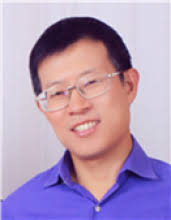
The lecturer will be Mingzhong Wu, Professor of Physics at Colorado State University (USA). Prof. Wu received his Ph.D. in Solid State Electronics from Huazhong University of Science and Technology (China) in 1999. In 2007 he joined the faculty of Colorado State University. Between 2012 and 2016 he was an Editor for IEEE Magnetics Letters. Currently he serves as an Editor for Physics Letters A, besides being on editorial boards of Journal of Applied Physics and Journal of Magnetism and Magnetic Materials. He has authored about 140 papers and 4 book chapters, and he has co-edited a book on magnetic insulators.
In his plenary lecture at the XVIII B-MRS Meeting, Professor Wu will talk about the experiments he conducted on a system consisting of a topological insulator layer interfacing with a magnetic insulator layer. Working with this system, Professor Wu could understand a little more about the nature of topological insulators, as well as explore applications related to the control of magnetic properties.
See our mini interview with this scientist.
B-MRS Newsletter: – We´d like to know more about your scientific work. Please choose your favorite contribution, briefly describe it, and share the references.
The main interests of my research group are with magnetization dynamics and spintronics. We have contributed to the development of the research field of insulator-based spintronics. We explored different approaches for using magnetic insulators to generate pure spin currents; demonstrated the use of spin currents to manipulate and control magnetization in magnetic insulator thin films; and developed unique processes for the growth and patterning of high-quality magnetic insulator thin films. Using spin waves in magnetic insulator thin films, we have observed experimentally a number of new nonlinear phenomena, such as soliton fractals and chaotic solitons. These observations contributed to the advance of “Nonlinear Dynamics” in general and the understanding of magnetization dynamics in magnetic thin films in particular. Some of our works are listed at: https://www.physics.colostate.edu/about/people/mingzhong-wu/
B-MRS Newsletter: – What does the word “topological” refer to in the case of the insulators you study?
The word “topological” refers to the topological distinction between topological insulators and ordinary insulators. Insulators can be characterized by a Z2 topological invariant. This invariant takes odd integers for topological insulators but takes even integers for ordinary insulators.
For more information on this speaker and the plenary talk he will deliver at the XVIII B-MRS Meeting, click on the speaker’s photo and the title of the lecture here https://www.sbpmat.org.br/18encontro/#lectures.
Panel session “Mastering the Art of Scientific Publication – ACS Publications’ Meet the Editors”
Description
While the electronic age has made the publication process easier and quicker, optimizing the structure of a scientific paper requires a certain degree of skill and proficiency. During this “ACS Publications’ Meet the Editors” event, editors from some of our journals will summarize the key steps involved in writing an effective paper, journal submission, review processes, and post-publication efforts.
Panelists
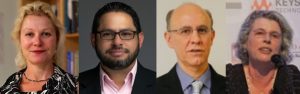
Julia R. Greer, Carlos Toro, Osvaldo Oliveira Jr and Mônica Cotta.
Julia R. Greer – Ruben F. and Donna Mettler Professor of Materials Science, Medical Engineering, and Mechanics/ California Institute of Technology. Associate Editor, Nano Letters.
Osvaldo N. Oliveira Jr. – Professor of the São Carlos Institute of Physics, University of São Paulo, Brazil. Executive Editor, ACS Applied Materials & Interfaces
Monica A. Cotta – Full Professor in Physics at University of Campinas, Brazil. Associate Editor, ACS Applied Nano Materials.
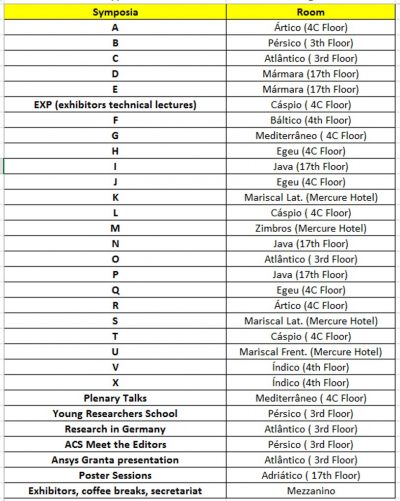
Due to the high participation in the XVIII B-MRS meeting (Balneário Camboriú, September 22 to 26), and to ensure everyone’s comfort, the sessions and activities will take place in two hotels, 300 meters apart: Hotal Sibara Flat & Conventions and Mercure Camboriu Hotel. Both venues are located in the center of the city, close to many hotels, restaurants and shops, and some meters from the sea.
In addition, the opening session of the event will be held at the Cristo Luz Complex, one of the main tourist attractions in the city, with impressive panoramic views.
Opening session (opening ceremony, memorial lecture and welcome cocktail):
Where? Cristo Luz Complex. Rua Indonésia, 800, Balneário Camboriú.
When? September 22 (Sunday), starting at 7:30 pm.
How to get? The complex is a 10-minute taxi/Uber ride from the Sibara Hotel. There will be free shuttle service between Sibara Hotel and “Complexo Cristo Luz” from 5:00 pm on. It is recommended to arrive in advance.
Oral sessions of symposia K, M, S and U: at the Mercure Camboriú Hotel. Avenida Atlântica, 2010, Balneário Camboriú.
All other program sessions and activities (oral sessions of all other symposia, all poster sessions, plenary lectures, technical lectures of exhibitors, pre-event tutorial, exhibitors fair, coffee breaks, secretariat, workshops and round tables): at Hotel Sibara. Avenida Brasil, 1500, Balneário Camboriú.
Conference Party
Where? Lounge of the Green Valley Club.
When? September 25 (Wednesday), starting at 9 pm.
How much? 20 reais. Tickets (limited) will be on sale at the event secretariat from September 23 (Monday).
After blood, bone is the most frequently implanted/ transplanted tissue, with about 2 million bone grafts performed each year worldwide – a number that tends to increase at the rate of population aging. A well-known case is that of the jaw graft to allow firmer dental implants. However, many other causes, such as tumors, severe fractures, congenital malformations or even infections, may cause a patient to need a graft, that is to say, an implant of a natural or synthetic piece of bone to support the natural growth of bone tissue.
In Barcelona, at the Universitat Politècnica de Catalunya (UPC), a research group has been successfully working on the development of innovative tissue regeneration biomaterials. Led by Professor Maria-Pau Ginebra, the multidisciplinary group consists of 30 researchers. After many published papers and patents obtained, Professor Ginebra decided to found, along with other members of the group, a spin-off company to bring the results of years of research into real life. Thus, in 2013, Mimetis Biomaterials was created, dedicated to nature-inspired bone regeneration solutions.
On the afternoon of September 24, Prof. Maria-Pau Ginebra will deliver a plenary lecture at the XVIII B-MRS Meeting. She will talk about a new generation of bone graft biomaterials, made through nature-inspired methods that allow control of the structure and composition of the material at the nano scale. The resulting biomaterials bring together the benefits of both natural and artificial bones, including the possibility of producing personalized grafts on 3D printers.
See our mini-interview with this Spanish scientist, Full Professor and Head of the Department of Materials Science and Metallurgy at UPC, President of Mimetis Biomaterials, and Member of the Editorial Board of Acta Biomaterialia, Journal of Tissue Engineering and the International Journal of Molecular Sciences.
B-MRS Newsletter: – You work in a research area that has a direct impact on society. What, in your opinion, is your scientific discovery with the greatest actual or potential impact? Please describe it very briefly.
One of the great challenges in the field of bone regeneration is the development of synthetic materials that are able to be degraded and transformed in newly formed bone. In this case, the synchronization between material degradation and new bone deposition is critical, and very difficult to achieve. We have demonstrated that this can be accomplished by using biomimetic processing routes, which allow tuning the nanostructure and composition of hydroxyapatite, mimicking more closely the mineral phase of bone. In this way the synthetic material can enter the natural bone remodeling cycle, allowing for this progressive transformation in new bone tissue.
B-MRS Newsletter: – Turning scientific knowledge into products is not an easy task. In your experience, what are the most important factors in getting a lab research to become a product on the market?
The transformation of the scientific achievements into real products is indeed a great challenge. This is particularly difficult in the biomedical field, where the scientists face a number of regulatory restrictions which were often overlooked during the previous stages of more “academic” research. In my experience, to be successful, you need the confluence of a good idea and the right people. Moreover, you need money. In summary, in my experience there are three main aspects that determine the success of the translation of a good idea to the market: 1) selecting a good team, with people mastering the different aspects of entrepreneurship, which we, as scientist, do not know; from regulation/legislation to marketing and financial aspects; 2) finding appropriate investors is always necessary; the innovation in the biomedical field is particularly expensive; 3) being willing to work really hard.
For more information on this speaker and the plenary talk she will deliver at the XVIII B-MRS Meeting, click on the speaker’s photo and the title of the lecture here https://www.sbpmat.org.br/18encontro/#lectures.
Many shades of blue, red and purple that we can see in the vegetable kingdom (for example, in grapes, raspberries, eggplants and flowers such as violets) are known to be generated by the presence of natural pigments called anthocyanins. However, what makes anthocyanin express in a plant a certain tone of this wide range? This intriguing basic science issue has applications of great interest to the food industry in its quest for healthier dyes from natural components.
A thorough answer will be presented in a plenary lecture of the XVIII B-MRS Meeting by Stefano Baroni, Full Professor of Condensed Matter Theoretical Physics at Scuola Internazionale Superiore di Studi Avanzati (SISSA) – an institution located in Trieste (Italy), dedicated to research and graduate studies in various areas of science. Baroni has been studying that issue, using, mainly, a computational method that considers phenomena occurring at the molecular level over several time scales.
Prof. Stefano Baroni is an internationally renowned Italian scientist who loves to invent and improve computational methods to unveil the properties of matter at the molecular scale and apply them to problems of fundamental and applicative interest. For example, Baroni is one of the principal creators of Density Functional Perturbation Theory (DFPT), a computational tool that allows the study of physical properties of materials that depend on responses to external perturbations. He is also the founder and one the main instigators of the Quantum ESPRESSO, project, one of the most popular open source softwares for quantum materials modeling and calculations at the nanoscale, and founding director of the Quantum ESPRESSO Foundation.
Stefano Baroni obtained a degree in Physics from the Università di Pisa (Italy) in 1978. After that, until 1984, he was a postdoctoral fellow at the École Polytechnique Fédérale de Lausanne (EPFL), in Switzerland. Later, he became Assistant Professor at the Department of Theoretical Physics at the Università degli Studi di Trieste until he joined SISSA in 1988. From 1994 to 1998, he was Director of CECAM, a European center for research in computational sciences and their applications, then based at the École Normale Supérieure de Lyon, in France. Thereafter, until 2003, he served as coordinator in Trieste of the Istitituto Nazione per la Fisica della Materia (INFM). From 2001 to 2008, he was Founding Director of the DEMOCRITOS national simulation center, now part of the Italian CNR. Baroni has been a visiting professor at many institutions around the world, including Université Pierre et Marie Curie (France), Princeton University (USA), University of Minnesota (USA), University of Sydney (Australia), University College London (UK).
See our mini interview with Prof. Stefano Baroni.
B-MRS Newsletter: – We´d like to know more about your scientific work. Please choose one or two of your favorite/ high-impact contributions, briefly describe them, and share the references.
For forty years my research has been motivated by the attempt to solve the fundamental equations that determine the properties of materials at the atomic scale, in the most realistic conditions practically accessible to computational science. While this effort, which I shared with many scientists more talented than me around the world, is having a tremendous impact in many and diverse technologies, as this Conference convincingly witnesses, my own motivation has been, how to say?, a bit “swotty”? Theorists like me strive to understand. Geniuses sometimes understand what they cannot teach or do not care to implement. Ordinary swots have to do, implement, and teach in order to convince themselves they have understood, and this is what I have been doing all my life, like a Renaissance craftsman. I am probably mostly known for density functional perturbation theory [https://doi.org/10.1103/RevModPhys.73.515], a technique that Paolo Giannozzi and I introduced in the late 80s [https://doi.org/10.1103/PhysRevLett.58.1861] and that is now considered the state of the art in the simulation of the vibrational properties of condensed matter. In the late 00s my colleagues and I generalised this technique to account for the dynamical phenomena that are probed in optical spectroscopies [https://doi.org/10.1103/PhysRevLett.96.113001, https://doi.org/10.1063/1.2899649]. This work provided the methodological motivation for me to enter the field of molecular spectroscopy, which eventually led me to study the color of flowers and fruits. The challenge to compute what others believe cannot be computed was also the motivation for me to enter the fascinating field of heat and charge transport in condensed matter, a senile passion I will have the privilege to report on in Symposium S of this conference on September 24 at 9:30 [https://doi.org/10.1038/nphys3509, https://doi.org/10.1038/s41598-017-15843-2, https://doi.org/10.1038/s41467-019-11572-4, https://doi.org/10.1103/PhysRevLett.122.255901, https://doi.org/10.1038/s41567-019-0562-0].
B-MRS Newsletter: – The subject of the talk aroused our curiosity. Could you tell us what led you to study these pigments? Does it have to do with industrial interest? With the search for fundamental answers? With the application of a new methodology?
As mentioned before, I was drawn to molecular spectroscopy while seeking useful applications for a new computational method that my collaborators and I had devised to deal with dynamical perturbations to quantum-mechanical systems. Ask around what would be the most important application of molecules absorbing light, and many would answer: “solar cells to produce clean, inexhaustible, energy”. So we went, and we were induced into the wrong thinking that efficient and inexpensive solar cells could be manufactured “using fruit juice” (i.e. using anthocyanins as the light-absorbing element of a photovoltaic device). It soon became clear that while the principle per se is not wrong (in fact, organic solar cells based on it are routinely assembled and used for educational purposes https://www.teachengineering.org/activities/view/uoh_organic_activity1, https://education.mrsec.wisc.edu/titanium-dioxide-raspberry-solar-cell/) the stability and efficiency of the resulting device are far too poor for industrial purposes. Meanwhile, our work attracted some attention, and I was invited to some important meetings on solar energy. On one occasion, I declined the invitation knowing that our work could not have a real impact in the field. The organisers flatteringly insisted, and I finally accepted under the condition that I would not talk of solar energy, but of the color of fruits and flowers, which had meanwhile started to arouse my curiosity. A few months later I was approached by a representative of a head-hunting company who, seeking an expert in the molecular simulation of natural dyes on behalf of a major multinational food manufacturer, had stumbled across the abstract of my talk. When I received the telephone call I thought it was a prank and I almost hung up on her. I resisted the impulse, and that was the beginning of an exciting five-years adventure in industrial research, which I never thought I would have lived and whose story I will tell in Balneário Camboriú …
For more information on this speaker and the plenary talk he will deliver at the XVIII B-MRS Meeting, click on the speaker’s photo and the title of the lecture here https://www.sbpmat.org.br/18encontro/#lectures.


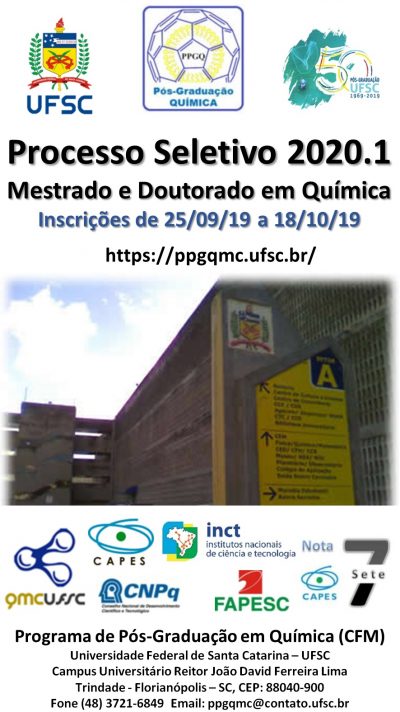 O Coordenador do Programa de Pós-graduação em Química da Universidade Federal de Santa Catarina (PPGQ-UFSC), nota máxima na avaliação CAPES, torna público que, no período de 25 de setembro a 18 de outubro de 2019, estão abertas as inscrições para o processo de seleção e admissão aos cursos de Mestrado e de Doutorado.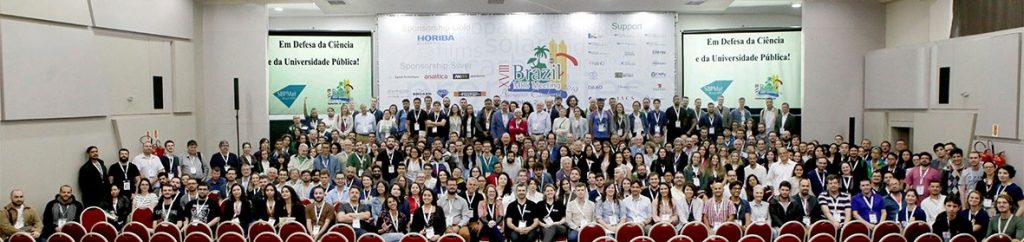
 Due to the high participation in the