Capes Doctoral Dissertation Award 2015: Interview with the author of the award-winning work in Materials area.

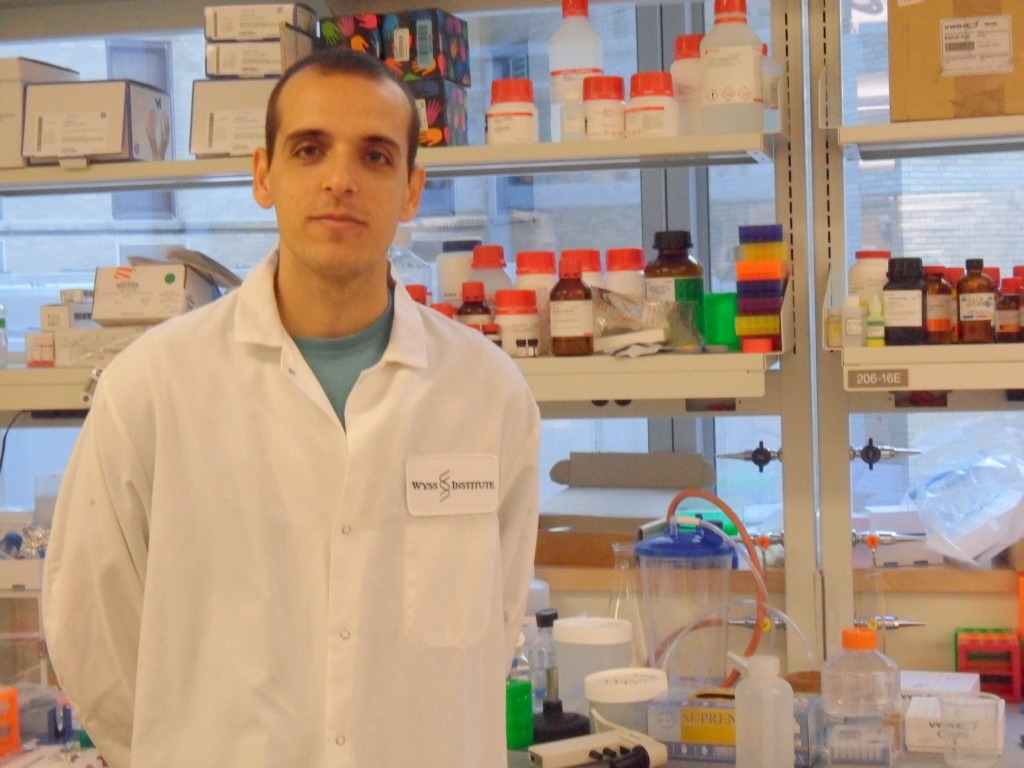
Edroaldo Lummertz da Rocha, winner of the Capes Dissertation Award in Materials field.

The scientific career of Edroaldo Lummertz da Rocha is permeated by two features of the area of Materials science and technology: interdisciplinarity and impact on people’s lives.

After graduating in Computer Science from Universidade do Extremo Sul Catarinense (UNESC), in the south of Brazil, Edroaldo got his master’s degree in Electrical Engineering at the Federal University of Santa Catarina (UFSC), with a study on the transport of phonons in fractal geometry. In 2010, he began a doctoratal program in Materials Science and Engineering, also at UFSC. With the advised of Professor Carlos Renato Rambo and Professor Luismar Marques Porto, Edroaldo worked on the interface among Materials Science, Computer Science and Biology to study the interaction between biological cells and bio and nanomaterials. In 2012, Edroaldo submitted, as first author, a scientific paper on simulations of interactions between nanoparticles and cell membranes. His paper was published in the journal Physical Chemistry Chemical Physics (DOI: 10.1039 / C2CP44035K) in 2013 and was featured on the front cover.

From January to December 2013, Edroaldo remained in the United States developing a part of his doctoral research at Harvard University (United States), more precisely in the Wyss Institute for Biologically Inspired Engineering, a multidisciplinary and multiinstitutional entity dedicated to the development of materials and devices inspired in nature, aimed at transforming medicine and building a more sustainable world. There he was advised by Professor Donald E. Ingber, founder and director of Wyss.
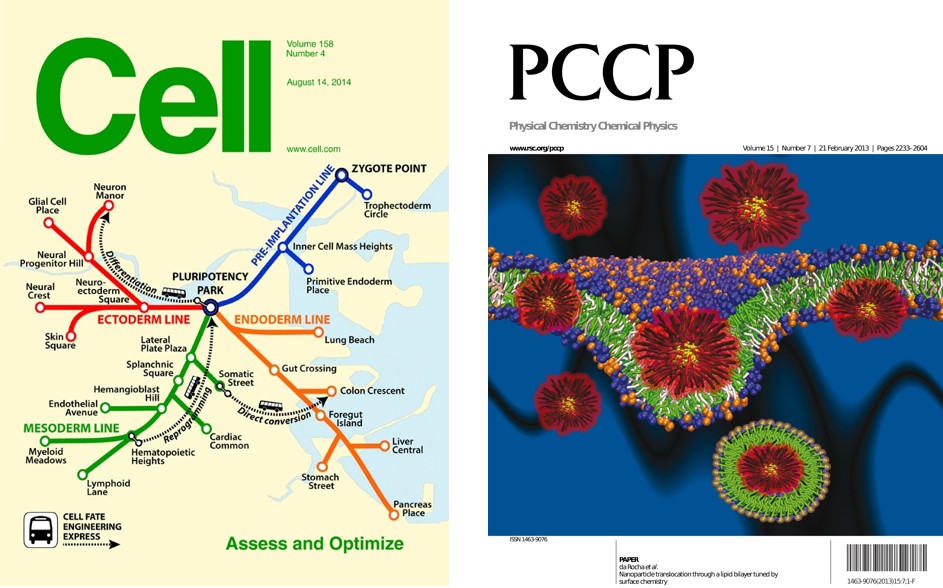
Two papers signed by Edroaldo became covers of prestigious journals.

A second journal cover (DOI:10.1016/j.cell.2014.07 .020) increased Edroaldo´s curriculum in 2014 as a result of his participation, along with researchers at Harvard University and other institutions in the United States, in a Cell Engineering field study.This time the distinction was in Cell, the prestigious journal of Life Sciences, whose impact factor is 32.242.

In September 2014, Edroaldo obtained his PhD degree by defending his dissertation entitled “Nanoparticle-cell interactions and biomaterial-cells induce global changes in gene expression programs“. A year latter, the work was distinguished as the best  dissertation defended in Brazil in 2014 by Capes, the government agency linked to the Brazilian Ministry of Education in charge of promoting high standards for post-graduate courses in Brazil. Edroaldo received the news of the award in the city of Rochester, in the United States, where he works in scientific activities as a postdoctoral fellow of the Mayo Clinic, an institution in the field of Medicine dedicated to research, education and patients´ care.

Interview with Edroaldo.

SBPMat Newsletter: – Could you tell us very briefly how did you become interested in science and in the Materials area, and what were the most important moments in your academic career so far?

Edroaldo Lummertz da Rocha: – My interest in science arose from the possibility of doing something important and helping people somehow. My interest in the Materials area arose due to the existence of a special class of materials, called nanomaterials, which can be used for the development of new therapies for a variety of diseases such as cancer, vascular and neurodegenerative diseases. However, the understanding of how nanomaterials interact with cells and biological tissues is extremely important for the development of safe and effective therapies.

The first most important event of my academic career was when Professor Carlos Renato Rambo, of the Federal University of Santa Catarina, agreed to be my advisor during my doctoral period. That’s where it all began. The second most important moment was when I had the opportunity to conduct part of my doctorate studies at the Wyss Institute at Harvard University, which significantly contributed to the development of my academic career.

Gene regulatory network made of data of gene expression from 16 kinds of human cells and tissues.

SBPMat Newsletter: – What, in your opinion, is the main contribution of your award-winning thesis?

Edroaldo Lummertz da Rocha: – The main contribution of my thesis was the development of computational approaches to systematically understand how cells interact with nanomaterials and respond to external stimuli. This can serve as a basis for future studies in the field of development of new drug delivery systems and lead to a better understanding of how gene expression programs change when nanomaterials interact with cells.

SBPMat Newsletter: – Which criteria guided you to make a quality research highlighted at national level (the award-winning thesis)? To what factors do you attribute this achievement?

Edroaldo Lummertz da Rocha:  – Dedication, discipline, creativity and a good team and co-workers are essential to progress in any area. Family support is essential, above all. From the point of view of the thesis, under the guidance of Professor Carlos Renato Rambo, I had the opportunity to work in a variety of projects and this contributed to the multidisciplinary nature of my thesis.

SBPMat Newsletter: – We invite you to leave a message for our readers who are conducting scientific research in the Materials area.

Edroaldo Lummertz da Rocha: – It is a long road, so you might as well enjoy the way. Being a scientist is something really rewarding, with new challenges and opportunities every day. The hope of discovering something important and providing a significant contribution is the driving force that guides my research. The effort is never in vain and there is always hope where there is perseverance.


More award-winners in the Materials field.

Several other works related to Materials Science and Engineering were awarded this year with the Capes Thesis Award, which was awarded to the best doctoral theses in 2014 in each of the 48 areas of knowledge recognized by Capes in postgraduate courses. The announcement of the winners was made on August 31 and the awards event will take place on December 10 in Brasilia city, the capital of Brazil. Here follow some examples related to Materials area:

Honorable Mention in the Materials area. Thiers Massami Uehara. Study of the interaction of nanomaterials with models of cell membranes and neural stem cells. Advisor: Valtencir Zucolotto. Postgraduate Program in Science and Engineering of Materials – USP/SC. Dissertation file: http://www.teses.usp.br/teses/disponiveis/18/18158/tde-27102014-134646/pt-br.php

Capes Award in Chemistry.  Rodrigo Villegas Salvatierra. Thin Films of Conjugated Polymer and Carbon Nanostructures obtained in Liquid-Liquid Interfaces: Synthesis, characterization and application in photovoltaic devices. Advisor: Aldo José Gorgatti Zarbin. Postgraduate Program in Chemistry – UFPR. Dissertation file:   http://dspace.c3sl.ufpr.br:8080/dspace/handle/1884/37915

Honorable mention in Chemistry.  Anderson dos Reis Albuquerque. Quantum-Chemical Study of the Ti(1-x)CexO2-δ in the Anatase Phase. Advisors: Ieda Maria Garcia dos Santos (DQ-UFPB) and Júlio Ricardo Sambrano (DM-UNESP Bauru). Postgraduate Program in Chemistry – UFPB. Thesis file: http://tede.biblioteca.ufpb.br/handle/tede/7154?locale=pt_BR. Report on CDMF website: http://www.nanotecnologia.com.br/trabalho-orientado-por-professor-do-cdmf-recebe-mencao-honrosa-no-premio-capes-2015/
Featured paper: Vibrations of manipulated nanotubes.

[Paper: Strain Discontinuity, Avalanche, and Memory in Carbon Nanotube Serpentine Systems. Muessnich, Lucas C. P. A. M.; Chacham, Helio; Soares, Jaqueline S.; Neto, Newton M.; Shadmi, Nitzan; Joselevich, Ernesto; Cancado, Luiz Gustavo; Jorio, Ado. Nano Lett. 2015, 15 (9), pp 5899–5904. DOI: 10.1021/acs.nanolett.5b01982]

Vibrations of manipulated nanotubes.

Scientists from Brazilian institutions, in collaboration with researchers from Israel, “manipulated” carbon nanotubes of 1 nm diameter deposited on quartz surfaces and analyzed strain and displacements produced by this nanointervention. The team identified some behavior patterns in the nanotubes – quartz system and formulated a mathematical model applicable to systems formed by one- and two-dimensional materials over various substrates. The results of the study were recently published in Nano Letters.

To perform the experiments, the Brazilian investigators used samples idealized and produced in the Weizmann Institute of Science (Israel), in which the nanotubes are serpentine-shaped (composed of parallel segments connected together by U-shaped curves).These samples offered a desirable complexity, fostered by both the nanotubes format and the anisotropic character of quartz, which makes adhesion of nanotubes to the substrate not the same at all points.

In order to “manipulate” the system, the researchers used the tip of an atomic force microscope (AFM) built in the laboratory, which allows to change the position of nanometric particles and even of atoms, and to measure in situ the optical spectrum of nanostructures. In each sample, the tip touched a point of the quartz substrate and pushed toward the nanotube, and then proceeded to the optical analysis.

Before and after nanomanipulation, the scientists analyzed a number of points in the nanotube using the technique of Raman spectroscopy, which provides information about the frequency in which the atoms vibrate in the area being studied. More specifically, researchers focused on the frequency of the “G band”, which is used to infer the strain measurements of a considered point, since changes in the frequency of the “G band” are proportional to changes in strain.

Thus, scientists were able to identify and analyze different behavior of the nanotubes after nanomanipulation; for example, the detachment of the substrate and the intense displacement of a full stretch of the nanotube that had received two manipulations at the same point.

In addition to performing the experimental work, the authors of the article in Nano Letters managed to condense the complexity of behaviors they observed in a mathematical model (an equation) capable of explaining them theoretically and predicting these phenomena in similar systems. “The paper proposes a relatively simple model to describe complex effects of nanostructures adhesion in support media,” says Ado Jório, professor in the Department of Physics of the Federal University of Minas Gerais (UFMG) signing the letter as corresponding author.

The research that led to the Nano Letters article was developed within the master’s, doctoral and postdoctoral work of three authors of the letter, in the context of the Brazilian Network for Research and Instrumentation in Optical Nano-Spectroscopy, a project funded by the National Council for Scientific and Technological Development (CNPq) and coordinated by Ado Jório. “This is the result of a broad scientific instrumentation project, which aims at reaching the level of manipulating nanostructures and measuring, accurately, the effect of this process at the nanoscale,” says Jório.

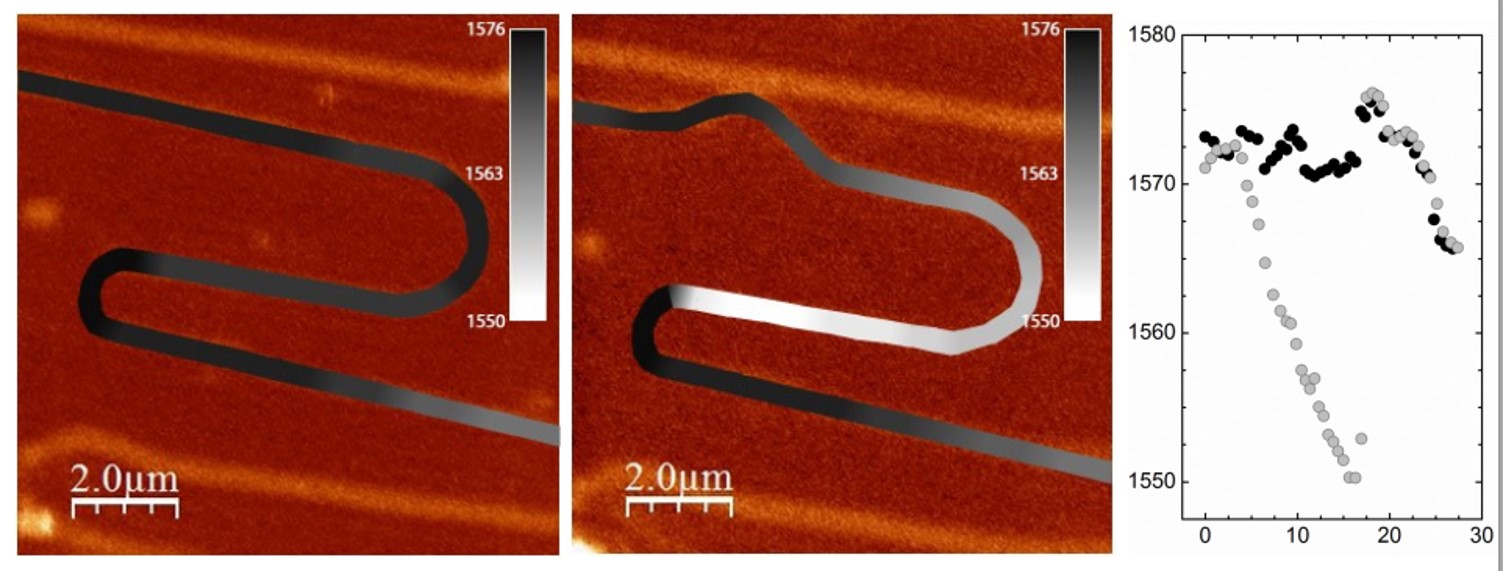
The figure shows one of the 34 serpentine-shaped nanotubes on crystalline quartz substrate studied by the authors of the article. To the left of the reader is the nanotube before manipulation. To the right, following the sequence, the same nanotube after the intervention, with the consequent evident strain. The central segment of the nanotube, where the nanomanipulation occurred, was colorized, the gray scale indicating the frequency of the G band in that place. Finally, farther to the right, the chart displays the frequency of G band measured by Raman spectroscopy in successive points of this nanotube (graphical representation of gray hues): the black circles refer to non-manipulated nanotube and the gray colored circles, to the manipulated ones.

Papers that received the Bernhard Gross Award at the XIII SBPMat Meeting (João Pessoa, 2014) were published in open access by IOP Publishing.

The special issue of IOP Conference Series dedicated to winners of the Bernhard Gross Award 2014 is already published on the web, with free and open access.

Through the Bernhard Gross Award, a prize for undergraduate and graduate students, the Brazilian Society for Research in Materials (SBPMat) annually distinguishes the best papers (one oral presentation and one poster, at the most) of each of the symposia of the society annual meetings. In 2014, the award highlighted twenty papers presented during the XIII SBPMat Meeting, which took place in the city of João Pessoa (PB) from September 28 to October 02, 2014.

The award-winning authors were invited by SBPMat to submit  to peer review their works in the form of scientific articles, aiming at publishing them in the IOP Conference Series, dedicated to the publication of papers presented at scientific meetings. Among the articles submitted, 8 were accepted for publication and comprise this special issue.

See the volume dedicated to the Bernhard Gross Award 2014: IOP Conference Series: Materials Science and Engineering, Volume 97, conference 1.

SBPMat newsletter. English edition. Year 2, issue 10. Special issue on the XIV SBPMat Meeting.


Brazilian Materials Research Society (SBPMat) newsletter

News update from Brazil for the Materials community

Special issue: XIV SBPMat Meeting 

Summary

The 14th edition of the annual meeting of the Brazilian materials research society (SBPMat), held in Rio de Janeiro (Brazil) from September 27 to October 1, 2015, featured internationality, interdisciplinarity and a massive and active participation of students. Internationality for its more than 300 attendants, speakers, exhibitors and organizers who came from 40 American, European and Asian countries. Interdisciplinarity in the broad spectrum of topics that were addressed within the technical sessions, invited speeches and plenary lectures, in which materials science and engineering met diverse other fields, such as neurosciences, electronics, medicine and computer science, among many others. Concerning the participation of students, not only they represented almost 50% of the attendants, but also they organized a symposium by themselves and exhibited enthusiasm and capability in scientific presentations and discussions. Another highlight of the meeting were the plenary lectures. The organization of the meeting brought seven world leader scientists on diverse research areas who captivated the public with issues on the frontier of human knowledge. Moreover, the XIV SBPMat Meeting set a new record on the number of participants (2,000) and symposia (26 symposia and 2 workshops). According to the organizers and attendants that we were able to hear, the meeting was a success! 

In numbers

2,000 attendees (20% more than the previous meeting): 950 undergraduate, master and doctoral students, and 1,050 Professors and other professionals.

85 % from Brazil, 15 % from abroad.

40 countries.

985 institutions.

– More than 2,300 works presented: about 1,800 posters, 350 oral presentations and 180 invited speeches.

7,613 authors.

26 symposia and 2 workshops.

7 plenary lectures.

17 rooms for simultaneous oral sessions.

32 stands in the exhibition.

35 prizes bestowed.

Reports

– Photoreport of the meeting on a Picasa web album. See here.

– Multimedia report of the meeting with some pictures, a video and embedded files of the plenary talks (on our site). See here. 

Awards

– 35 prizes were bestowed to participants of the meeting, mainly students, by SBPMat, E-MRS, IUMRS and Horiba. The awards distinguished the best posters and oral presentations presented at the meeting. See the list.

Statements

– Video: participants, organizers and exhibitors of the XIV SBPMat Meeting shared with us their impressions of the event. See the videos.

Cannot see this message? Click here.

To unsubscribe, click here