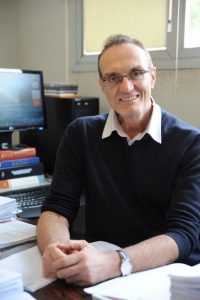
B-MRS member Victor Carlos Pandolfelli, professor in the Department of Materials Engineering at the Federal University of São Carlos (DEMa-UFSCar), was reelected as a member of the advisory board of the World Academy of Ceramics (WAC) to fulfill his second 4-year term (2018 to 2022). The board will include the Brazilian researcher, along with Professor Gary Messing (Penn State) and Dr. M. Singh (NASA), as representatives of the Americas.
In order to be part of the WAC advisory board, it is necessary to be a member of the Academy and be elected by vote of the members of the same region of the planet (in this case, the American continent). The names of the most voted must be endorsed by the presidency of the Academy. To be a member of the WAC, one must undergo a selection process that includes nomination by two effective members, evaluation of the application by a peer committee selected by the Academy, and final approval by at least ten of the twelve members of the advisory board.
According to Professor Pandolfelli, some of the activities he will hold in the council over the next four years are: reviewing the WAC admission rules, defining the members who will participate in the new candidate selection processes, defining the topic and speakers for technical presentations and awards in the scientific forum for members of the Academy.
The inauguration and first meeting of the new council will be held next June in Perugia (Italy).
If you can´t see this e-mail properly, click here.
Newsletter of the
Brazilian Materials
Research Society
Year 5, issue 4. May 8, 2018.
Featured Paper
A Brazilian scientific team reported in Nature Physics the first observation of a phonon with spin – something similar to a network of atoms vibrating and rotating. The discovery may have an important impact on spintronics. Know more.
From Idea to Innovation
To inaugurate this section of the newsletter, dedicated to telling the story of inventions that have become successful products, we propose a pun with you, reader: a riddle. Here’s the first clue. It is about a biomimetic product, metonymic, adored by children… and very practical. See here.
XVII B-MRS Meeting
(Natal, Brazil, September 16 to 20, 2018)
Join us, by the beach, and be part of this great gathering, where science and technology will meet nature to form the ideal learning and exchanging experience!
Acceptance of works. Until May 25, authors submitting abstracts will receive notification regarding acceptance, rejection, or need to modify abstracts.
Awards for students. Students’ extended abstracts can be submitted until June 18 to apply for the Bernhard Gross and ACS Publications awards. Know more.
Conference Party. The party will be held on the night of September 19, at the Imirá Plaza Hotel & Convention, and will be sponsored by ACS Publications scientific journals. Know more.
Symposia. See the list of symposia that will compose the event here.
Registration. Early fee registration is open until July 31. See registration feeshere.
Lodging, transfer and tours. See options of the event’s official tourist agency, Harabello, here.
Plenary lectures. Find out who are the 8 internationally renowned scientists who will deliver the plenary sessions and which are the themes of the lectures,here.
Memorial lecture. The Memorial Lecture “Joaquim da Costa Ribeiro” will be delivered at the opening session by Professor Fernando Galembeck.
Exhibitors and sponsors. 18 companies have already reserved their places in the exhibition and 13 names support the event throught other kinds of publicity. Companies interested in participating in the event with booths or sponsoring can contact Alexandre at comercial@sbpmat.org.br.
Organizers. The meeting chair is Professor Antonio E. Martinelli (Brazilian Federal University of Rio Grande do Norte, UFRN). Meet the organization committee.
Venue. The event will be held in the convention center of Hotel Praiamar, located a few meters from the famous beach of Ponta Negra.Know more.
City. A well-known destination for international tourists, Natal also offers a pleasant environment to discuss, interact and learn. Its nice weather (dry with an average temperature of around 25 °C in September), the welcoming people and very refined seafood and local gastronomy create an atmosphere of well-being that goes beyond the natural beauty of the city’s coastline. Watch this short video about Natal.
News from B-MRS Members
Antonio Martinelli (scientific director of B-MRS) and Fernando Lázaro Freire Jr (former president of B-MRS) were chosen as coordinators of the Materials and Astronomy/Physics areas at CAPES, the Brazilian federal agency for the improvement of graduate programs. Know more.
Video: In an interview with UFSCar Radio program, Prof. Edgar Zanotto (co-founder of B-MRS) talks about the importance of glass, from its role in the beginning of the scientific revolution to the use of bioactive glasses in the health area. The scientist also comments on the role of Brazilian groups in global research on glassy materials. Watch.
Video: In an interview with TV NBR, Prof. María del Pilar Hidalgo Falla talks about her work on nanocatalysts, nano-filters, nanosensors and alternative energy sources, and about the International Association of Advanced Materials award that she received in February at an event in Singapore. Watch.
Reading Tips
Method for super-fast material development, based on artificial intelligence + “experiment factory”, leads to the discovery of new metallic glasses (paper by Science Advances). Know more.
Scientists propose material that is quasicrystal and superfluid at the same time (paper from Physical Review Letters). Know more.
Two-dimensional channels: Brazilian research provides a detailed description of the mechanisms by which graphene oxide membranes separate water from alcohol (paper from Carbon).Know more.
Opportunities
Call of the M-ERA NET network (European Union) and FAPESP for transnational projects of research and innovation in Materials. Know more.
Events
6º Encontro Nacional de Engenharia Biomecânica (ENEBI 2018). Águas de Lindoia, SP (Brazil). 8 – 11 May, 2018. Site.
2a Escola de Pesquisadores do campus USP São Carlos. São Carlos, SP (Brazil). 9 – 10 May, 2018. Site.
8th International Symposium on Natural Polymers and Composites. São Pedro, SP (Brazil).27 – 30 May, 2018. Site.
Photonic Colloidal Nanostructures: Synthesis, Properties, and Applications (PCNSPA 2018). São Petersburgo (Russia). 4 – 6 June, 2018. Site.
7th International Congress on Ceramics (ICC7). Foz do Iguaçu, PR (Brazil). 17 – 21 June, 2018. Site.
IX Método Rietveld. Fortaleza, CE (Brazil). 16 – 20 July, 2018. Site.
International Conference on Electronic Materials 2018 (IUMRS-ICEM). Daejeon (South Korea). 19 – 24 August, 2018. Site.
Symposium “Nano-engineered coatings, surfaces and interfaces” no “XXVII International Materials Research Congress”. Cancun (Mexico). 19 – 24 August, 2018. Site.
8th International Conference on Optical, Optoelectronic and Photonic Materials and Applications (ICOOPMA2018). Maresias, SP (Brazil). 26 – 31 August, 2018.Site.
16th International Conference on Molecule-based Magnets (ICMM2018). Rio de Janeiro, RJ (Brazil). 1 – 5 September, 2018. Site.
XXXIX Congresso Brasileiro de Aplicações de Vácuo na Indústria e na Ciência (CBrAVIC). Joinville, SC (Brazil). 8 – 11 October, 2018.Site.
São Paulo School of Advanced Science on Colloids (SPSAS Colloids). Campinas, SP (Brazil). 28 October – 7 November, 2018.Site.
International Conference of Young Researchers on Advanced Materials (ICYRAM 2018). Adelaide (Australia). 4 – 8 November, 2018.Site.
6th Meeting on Self Assembly Structures In Solution and at Interfaces. São Pedro, SP (Brazil). 7 – 9 November, 2018. Site.
3rd International Brazilian Conference on Tribology (TriboBR 2018). Florianópolis, SC (Brazil). 3 – 5 December, 2018. Site.
Follow us on social media
You can suggest news, opportunities, events or reading tips in the Materials field to be covered by B-MRS Newsletter. Write to comunicacao@sbpmat.org.br.
Unsuscribe hereif you don´t want to receive our newsletters anymore.
Yesterday, April 30th, was the deadline for abstract submission to the 17th Brazil-MRS meeting, Natal, 2018. However, the organization received a number of messages from last minute authors experiencing system difficulty to send their contributions. Therefore, the system will remain open until May 4th to receive your abstract.
It is perhaps the best known among biomimetic products (products developed by humans to imitate living beings that have been “developed” by nature over many millions of years).
It is an invention that became innovation (entered the market) and after some time it was widely accepted by consumers. Its use spread on planet Earth (on land, water and air) and reached the Moon
It is an invention that was the seed of a multinational company that today markets thousands of products.
Have you guess it? Here’s another clue.
The word popularly used to designate this product actually corresponds to a trademark, not to the object itself. It is a case of metonymy.
Do you know what invention we’re talking about? Not yet? Then, carefully read the history of this invention.
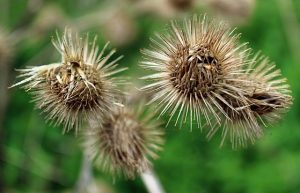
Fruits of a plant of the genus Arctium, similar to those that inspired the invention. Credits: https://en.wikipedia.org/wiki/Bur#/media/File:Burdock_Hooks.jpg
It all began in 1941 in the Swiss Alps. George de Mestral, a thirty-something Swiss electronics engineer, was back from a walk in the mountain with his dog, removing the burrs that had stuck to the dog’s hair and his clothing during the walk. These small spiked balls are the fruits of some plant families, and their ability to attach to animal hair is an advantage of these species as it helps to disperse the seeds that are inside the fruit.
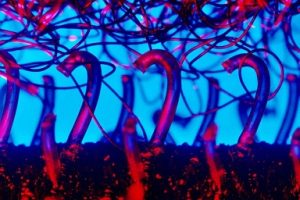
The story goes that at that moment Mestral wondered why the burrs stuck and decided to look at them with a microscope in his house. The engineer then noticed that the fixation occurred between two elements. On the one hand, tiny loops formed on the matted coat of the dog or on the surface of the tissues. On the other hand, the tips of the little thorns, which were shaped as a hook. These flexible little “hooks” were tangled in the loops and only loosened by pulling them out with some force. With a biomimetic look and inventive spirit (Mestral presented his first patent at age 12), he saw in this natural system of reversible fixation, a model to artificially develop a very useful product.
Have you guessed what the invention is? Whether yes or no, see how the rest of the story.
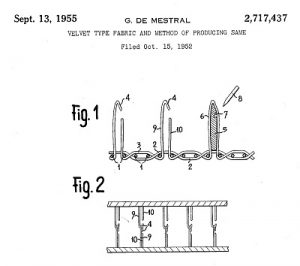
Figure included in patent US2717437A, representing the method for producing the fabric with hooks at the ends of the threads.
For some years, George de Mestral faced the challenge of creating a prototype of this system of tiny hooks and loops. The main problem was to develop a method which would allow manufacturing a strip of fabric that could push upward, perpendicularly, a considerable amount of flexible hooks.
It seems the process was not easy, and that Mestral had a hard time finding people to help him produce this fabric. However, in 1952, he filed a patent application with the United States patent office about such a fabric and how to fabricate it. In the document, Mestral presented a “velvet-like fabric,” as it was covered, like velvet, with a dense “forest” of upright wires. However, unlike velvet, in the new fabric the threads were made of nylon (a newly created material), and a good part of the threads had hook-like tips. The manufacturing process proposed in the patent was similar to traditional velvet, using a loom, but with a few additional tricks to shape the hooks at the ends of the nylon strands.
Granted in 1955, this seems to be the first in a series of patents by the Swiss engineer around the invention that is the answer of our guessing game.
Mestral then founded a company to manufacture and market the product. However, the manufacturing system he had proposed in the patent was not fully mechanized and did not allow it to be produced at an industrial scale. The finishing process to produce the hooks was manual… and quite time consuming. The engineer had to wait about 20 years from his “eureka!” for a loom capable of mass producing the fabric with the tiny hooks.
When coupling the fabric with the hooks with another fabric covered by a tangle of loops, Mestral obtained a reversible fixation product with a thousand and one utilities, and with potential to revolutionize the market of zippers and buttons.
At first, the system invented by Mestral did not look very attractive. But little by little he gained visibility (from newspaper columns to futuristic films) and was adopted by various segments. In the late 1960s, for example, the invention began to be used by sports shoes manufacturers, replacing shoelaces and stood out in the NASA space program “Apollo” as a system to attach small objects to the walls of the spacecraft, preventing them from floating.
Currently the product is incredibly widespread. It helps solve small day-to-day problems in offices, shops, residences, hospitals, laboratories, walkways, schools…
Need another clue to guess what the invention is? Here goes the last one:
In 1956, George de Mestral obtained the trademark registration for his company. The name invented by the Swiss is the combination of two words in French (predominant language in the region of Switzerland where he was born and died): “velours” (velvet) and “crochet” (hook).
We do not need to pronounce the name of this invention, do we? Mainly because it’s forbidden to use the term “Velcro ®,” as it is a registered trademark of this multinational company which markets this and other similar products, and is also the trademark used for all the company products, not just for “hook and loop fastener.” Go explain this to the children, who really like V________, especially in sports footwear…
Microscope image showing how the hooks are entangled in the loops in this invention. Credits: https://commons.wikimedia.org/wiki/File:Micrograph_of_hook_and_loop_fastener,(Velcro_like).jpg
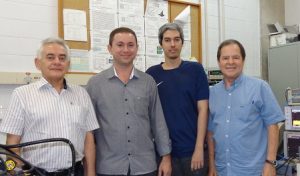
The 4 authors of the article. From the left: Antônio Azevedo da Costa (UFPE professor), José Holanda da Silva Júnior (who has just obtained his doctoral degree from UFPE), Daniel Souto Maior Pifano Ferreira (PhD student at UFPE) and Sergio Machado Rezende (Professor at UFPE).
A Brazilian scientific team announced in Nature Physics (impact factor 22,806), a remarkable novelty about the atomic and subatomic dimension of nature, object of Quantum Physics, in which tiny particles that also behave like waves move around without stopping.
The team, led by Professor Sergio Machado Rezende, was able to experimentally detect, for the first time in science history, phonons with spin – something like a collective vibration of interconnected atoms (phonon) spinning around an axis (spin). “Never had anybody observed a phonon with spin before these experiments,” contextualizes Prof. Rezende (Federal University of Pernambuco, UFPE).
The research was entirely carried out in the Department of Physics of UFPE, with funding from Brazilian research support agencies (CNPq, CAPES and FINEP and FACEPE).
The spin is a property of subatomic particles, and it is the origin of magnetic properties in materials. In a first approach to the concept, it can be represented as a rotational movement of the particle.
The discovery could have an important effect on the so-called “spintronics,” both from a fundamental (understanding of phenomena) and applied point of view. Just as electronics uses the electric charge of electrons to develop technology, the still incipient spintronics takes advantage of spin to encode and store data, transport, and decode them. That is why the evidence presented in the article of Nature Physics opens possibilities of employing phonons in the development of spintronic devices.
The research was developed within the PhD thesis of José Holanda da Silva Júnior, defended on April 20 of this year at UFPE, and guided by Professor Sergio Rezende (known for having held the position of Minister of Science and Technology in Brazil from 2005 to 2010).
The idea of the thesis work was to generate a spin wave (a collective excitement of spins) into a ferromagnetic material and convert it into an elastic wave (a collective vibration of a network of atoms). In quantum terms, the goal was to convert “magnons” into “phonons” – a transformation that can be achieved since in ferromagnetic materials the motion of spins can cause vibrations in the network of atoms.
The idea of the magnon-phonon conversion was well studied in the 1960s and 1970s, Rezende comments. However, at that time it was not possible to obtain clear experimental evidence of the conversion, since the materials available to make the experiments limited the observation of the effect. “Cylinders of ferromagnetic materials were used,” says Rezende. “The effect occurred, but it was inside the material and there was no way to test if it was actually occurring,” he adds. To obtain definitive evidence, it was necessary to use very thin layers of ferromagnetic material.
In the last 20 years, explains Rezende, technology has been developed to make thin films of various materials. As a result, the academic interest in magnon-phonon conversion has returned, generating numerous advances in the understanding of the phenomenon in the last decade.
In this new context, José Holanda, his advisor Prof. Rezende and collaborator Prof. Antônio Azevedo da Costa were able to manufacture a thin film of the most suitable ferromagnetic material to study the magnon-phonon conversion, the yttrium and iron grenade. With this thin film, the team prepared samples in the form of tapes of 2 x 12 square millimeters of surface and 8 micrometers of thickness, and used them to perform two types of major experiments.
The first consists, in broad lines, of applying microwave radiation to one of the two ends of the film, generating spin excitations in the material. Consequently, the spin is oriented around the magnetic field that is applied (phenomenon known as “precession”). This collective precession starts at one end of the sample and propagates as a real “spin wave” until it reaches the other end.
If the magnetic field applied to the sample is uniform, the spin wave attenuates itself and does not become an elastic wave. Therefore, the Pernambuco team used rare earth magnets (one at each end of the sample) to cause variations in the magnetic field along the film, following the spin wave displacement.
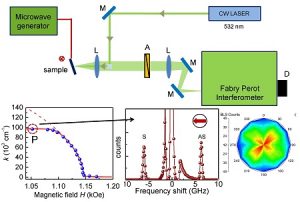
Illustration of Brioullin light scattering system by phonons generated by the conversion of magnons, and results of light polarization measurement.
The experiments with microwaves generated evidence that the magnon-phonon conversion was taking place, but the group considered it important to confirm, or not, the results through measurements of the so-called Brillouin scattering. In this experiment, laser light is applied at some point in the sample and the scattered light is analyzed. The result allows determining the nature of the excitation (in this case, magnon or phonon) that is interacting with light. “The great advantage of using a film instead of a massive material is that you can focus the laser at any position in the film and can vary the angle of incidence,” explains Rezende.
Through Brioullin scattering, the team not only could verify that the spin wave (magnon) subjected to a non-uniform magnetic field had actually converted into an elastic wave (phonons), but also they came upon a surprise: these phonons spread circularly polarized light. – evidence that they had spin. “We did not expect that the phonon produced by the conversion of the magnon also had a certain rotation motion, which is what we call spin,” says Rezende.
After making this discovery experimentally, the team made the corresponding theoretical calculations. “We confirmed that the theory actually predicted that the phonon had spin, but we did not know the theory before,” Professor Rezende reveals.
[Paper: Detecting the phonon spin in magnon–phonon conversion experiments. J. Holanda, D. S. Maior, A. Azevedo & S. M. Rezende. Nature Physics (2018) doi:10.1038/s41567-018-0079.]