Featured paper: Quantum dots with unique rules.

[Paper: Evidence of Band-Edge Hole Levels Inversion in Spherical CuInS2 Quantum Dots. Gabriel Nagamine, Henrique B. Nunciaroni, Hunter McDaniel, Alexander L. Efros, Carlos H. de Brito Cruz, and Lazaro A. Padilha. Nano Lett., 2018, 18 (10), pp 6353–6359. DOI: 10.1021/acs.nanolett.8b02707]

Quantum dots with unique rules
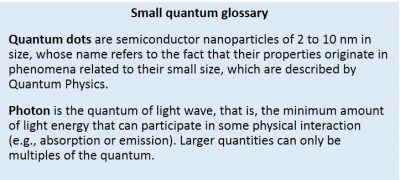
box englishA paper led by Brazilian researchers has revealed surprising news about the rules that determine the energy levels of electrons in quantum dots of copper and indium disulphide (CuInS2,) which stand out in the family of quantum dots for being non-toxic. The work was recently reported in Nano Letters (impact factor of 12.08).

The results of the study, confirmed by experimental and theoretical methods, showed a situation in the structure of energy bands that had never before been observed in other materials.
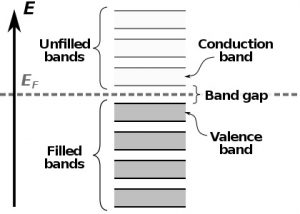
Diagrama simplicado da estrutura de bandas de um semiconductor. https://en.wikipedia.org/wiki/Valence_and_conduction_bands#/media/File:Semiconductor_band_structure_(lots_of_bands_2).svg
Simple diagram of semiconductor band structure. Credits

The band structure is a well-established scientific model that shows which energy states or levels the electrons can occupy in a given material. These states of energy are represented as allowed bands (those that the electrons can reach) and forbidden bands (those in which the electrons cannot be found).

In semiconductors, the energy bands that are allowed for an electron and that determine the properties of a material are the valence band and the conduction band. Both are separated by a band gap. For electrons to “jump” from the valence band to the conduction band, transposing the forbidden band in a process called transition, it is necessary they receive extra energy, which can occur when the material absorbs photons. When they lose energy, these electrons can once again occupy their places in the conduction band, and surplus energy can be emitted as photons (light). This light emission from the absorption of photons is known as photoluminescence.
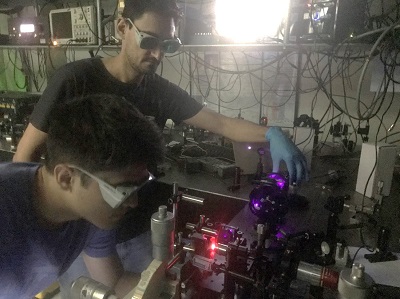
Foto dos estudantes Gabriel Nagamine (na frente) e Henrique Nunciaroni, os dois primeiros autores do paper, trabalhando no laboratório.
Photo of the students Gabriel Nagamine (front) and Henrique Nunciaroni, the first authors of the paper, working in the laboratory.

Researchers at the Gleb Wataghin Institute of Physics at UNICAMP (Campinas, SP, Brazil) discovered that the quantum dots they were studying did not follow the same transition rules as other semiconductor materials and nanomaterials. “Generally, in semiconductors, bulk or nanostructured, the states that form the top of the valence band and the bottom of the conduction band are such that a transition between these states by absorption of a photon is allowed,” contextualizes Lázaro Aurélio Padilha Junior, professor at UNICAMP and corresponding author of the article. “What we showed was that in the studied material (CuInS2 quantum dots), this transition is forbidden by absorbing one photon. The interaction with two photons is required for this transition to occur. As far as we know, this is the first semiconductor system that presents this inversion of states,” says Padilha.

The discovery, besides showing that the norms that govern the electron states in semiconductors are not valid for all the materials, can influence the applications of the quantum dots studied. According to Padilha, the conditions discovered favor the simultaneous emission of two photons in the material when the electrons return to the conduction band. “This could be attractive to lasers systems that emit light in two distinct colors at the same time, and with color adjustment over a wide spectral range,” says the professor. In addition, adds Gabriel Nagamine, the first author of the article, understanding the structure of material bands can improve the performance of existing applications such as luminescent solar concentrators – a technology that can be used both to generate electricity from sunlight and to increase the production of food in greenhouses. “All these applications come from the unique characteristics of the electronic bands of these materials,” says Nagamine.

History of a theoretically announced experimental result

The history of this discovery goes back to 2015, when Professor Padilha, who has worked with quantum dots since 2010, his master’s student Gabriel Nagamine and other members of the research group decided to devote their efforts in studying the quantum dots of CuInS2. “This material caught our attention because it did not have heavy metals in its composition, which made it interesting for applications in biology and medicine, such as fluorescent biological markers,” says Padilha. In fact, quantum dots, which were discovered in the 1980s and are now present in products such as TV screens, present very interesting properties to be used in the detection of diseases and other applications in the health area, but almost all of them are toxic due to their chemical composition.
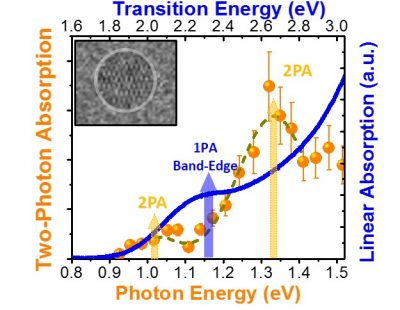
Esta figura mostra o espectro de absorção de dois fótons (pontos amarelos) e o espectro de absorção de um fóton (línea azul) em pontos quânticos de CuInS2 esféricos. As setas indicam os picos de absorção de dois fótons (setas amarelas) e de um fóton (seta azul). No canto superior esquerdo, há uma imagem de microscopia eletrônica de transmissão mostrando um dos pontos quânticos.
Two-photon (yellow dots) and one-photon (blue line) absortion spectra in spherical CuInS2 quantum dots. Arrows: absortion peaks of two photons (yellow) and one photon (blue). In the upper left corner, TEM image showing one of the quantum dots.

The UNICAMP team then collaborated with the company UbiQD, located in Los Álamos (USA) and specialized in the production of quantum dots, and which provided samples of spherical and pyramidal quantum dots. The characterization of the samples was performed partly in the company and also in the National Nanotechnology Laboratory (LNNano) of CNPEM, in the city of Campinas (SP, Brazil).

Initially, Padilha and his team set out to investigate how strong the absorption of two photons was in the chosen material, since this optical process allows to make three-dimensional images of the material, which can be very useful in its characterization and also in its application in several areas. To do this, in early 2016, the team performed the main experiments of the work at UNICAMP using a spectroscopy technique that allows detecting light emission from the absorption of two photons. “The first measurements revealed an absorption peak of two photons at smaller energies than those of linear absorption – a fact never previously observed experimentally,” Padilha says. “We believed it was a problem in our laser source and we repeated the experiment, achieving the same results,” he adds. These results, which are shown in the figure to the side, have arisen from the experiments performed with spherical quantum dots. In the pyramid-shaped quantum dot samples, the predominance of of two-photon absorption was not observed.

In May of the same year Padilha met with Dr. Alexander Efros (Naval Research Laboratory, USA) at a conference in South Korea. “He, who is one of the most respected theorists working on the electronic structure of semiconductor quantum dots, mentioned that he had made calculations that predicted a reversal in parity of states in these nanomaterials. We immediately noticed that I had proven his theory, “says Prof. Padilha. After that, they began working together and trying to understand other aspects of the problem, until they submitted the article to Nano Letters. The paper was accepted in less than two months.

The research that originated the paper is part of Gabriel Nagamine’s master’s thesis, defended in 2017 at UNICAMP, and received financial support from Brazilian research agencies (FAPESP and federal CNPq), the student support service (SAE) of UNICAMP and the Office of Naval Research (USA).


XVIII B-MRS Meeting: plenary lectures and memorial lecture.

XVIII B-MRS Meeting (Balneário Camboriú, SC, Brazil, September 22 – 26, 2019).

logo médioMemorial Lecture

Prof. Yvonne Primerano Mascarenhas

Instituto de Física de São Carlos – USP


Plenary Lectures

Prof. Julia Greer

California Institute of Technology – USA

Title: Materials by Design: Three-Dimensional Nano-Architected Meta-Materials

Prof. Stefano Baroni

Scuola Internazionale Superiore di Studi Avanzati – Italy

Title: Multi scale simulation of the color optical properties of natural dyes in solution

Prof. Alan Taub

University of Michigan – USA

Title: Challenges in Processing of Materials to Reduce Weight of Structural Components

Prof. Norbert Koch

Humboldt-Universität zu Berlin – Germany

Title: Hybrid inorganic/organic semiconductor structures for opto-electronics

Prof. Mingzhong Wu

Colorado State University – USA

Title: Spin Transfer in Topological Insulator/Magnetic Insulator Bi-Layered Structures

Prof. Maurizio Prato

Università degli Studi di Trieste – Italy

Title: Multifunctional Hybrid Carbon Interfaces

National award for B-MRS founding member.

Fernando Galembeck
Fernando Galembeck

Prof Fernando Galembeck (UNICAMP, SP, Brazil) is one of the scientists distinguished with the III Scientists and Entrepreneurs of the Year Award by the Nanocell Institute. Galembeck was selected in the category “Professor,” in the area “Nanotechnology”.

Professor Galembeck, who has a broad history of research, development and innovation in materials, is a founding member of B-MRS and was highlighted this year by the society with the Memorial Lecture “Joaquim da Costa Ribeiro”.

Postdoctoral fellowship in Physics.

Area of interest: Condensed Matter

FAPESP process number: 2017/02317-2

Project title: Synthesis and physical properties characterization of Halide Perovskites

Principal investigator: Prof. Gustavo Dalpian and Dr. Jose Antonio Souza

Institution: Federal University of ABC – Campus Santo André

Deadline for applications: December 30th, 2018. Expected starting date: February or March/2019.

Location: Avenida dos Estados, 5001, Bairro Bangu – Santo André, SP

E-mail for applications: (gustavo.dalpian@ufabc.edu.br); (joseantonio.souza@ufabc.edu.br)

Applications are invited for a post-doctoral position supported by the State of Sao Paulo Research Foundation (FAPESP-Brazil) in experimental condensed matter field. This fellowship is part of broader Thematic project “Interfaces in materials: electronic, magnetic, structural and transport properties” under the coordination by Prof. Adalberto Fazzio (LNNano, CNPEM – Campinas). The postdoctoral supervisor will be Prof. Dr. Gustavo Dalpian in collaboration with Prof. Dr. Jose Antonio Souza at the Federal University of ABC (UFABC), Santo André – São Paulo.

We intend to develop research on the synthesis and physical properties characterization of Halide Perovskites. Applicants are required to have good experimental knowledge on synthesis and/or physical properties characterization of halide perovskites in the form of nanostructures and/or thin films and/or heterostructures and/or quantum dots and/or bulk. The research will be developed at the Federal University of ABC – Campus Santo André.

The opportunity is open to both Brazilian and foreign candidates with a PhD degree, in Brazil or abroad, in areas related to the proposed subject. It is mandatory that the candidate has international experience, as well as publications in the areas related to the project in journals of relevant worldwide impact.

The following documents are required for application:

  1. Curriculum vitae, presenting the candidate’s academic experience and the list of published papers. The curriculum must be submitted in electronic format (pdf, Portable Document Format), where the articles must be identified by their DOI;
  2. Document proving that the candidate holds a PhD degree;
  3. At least two recommendation letters, in English, which should be sent directly to the email with the subject “Fellowship PD – Recommendation Letter”.

The implementation of the scholarship is conditioned to the approval of the candidate selected by FAPESP. If the decision is approved by FAPESP, the selected candidate will receive a scholarship in the amount of R$ 7,174.80/month and a technical reserve equivalent to 15% of the annual amount of the scholarship, destined to only carry-out expenses directly related to the research activity. More information on the scholarship can be found at: www.fapesp.br/bolsas/pd.

The candidate should send all the documentation to the electronic address cited above under the title “Fellowship PD – Application”. The deadline for submissions is 02/01/18. Only applications in which all the documents (including recommendation letters) are received by midnight 02/01/2018, Brasília time (UTC-3, Brazilian summer time) will be considered.

Member of B-MRS takes on the role of editor in the Journal of Alloys and Compounds.

Prof. Valmor Mastelaro

Professor Valmor Roberto Mastelaro (Institute of Physics of São Carlos, USP) was recently incorporated into the board of editors of the Journal of Alloys and Compounds of Elsevier.

Mastelaro, who has been a member of B-MRS since 2006, is currently the only Latin American researcher on the editorial board of the journal, which is made up of 44 people.

Call for the scholarship PNPD/CAPES with PPGFSC/UFSC – 2019/1.

The Graduate Program in Physics of  Federal University of  Santa Catarina – PPGFSC/UFSC, Florianópolis, announces the vacancy of 1 (one) postdoctoral scholarship from the Programa Nacional de Pós-doutorado da Coordenação de Aperfeiçoamento de Pessoal de Nível Superior  – PNPD/CAPES, to the period of 2 (two) years. It can be renewed annually at a maximum of 60 months.

The monthly amount of the scholarship is R$ 4.100.00 (four thousand one hundred reais) beyond the values destined to assets.

The candidate has to act in THEORETICAL or EXPERIMENTAL research lines at one of the following areas of research: Astrophysics, Atomic and Molecular Physics, Condensed Matter Physics and Statistical Mechanics, Mathematical Physics and Quantum Field Theory and Nuclear Physics and Hadrons.

The complete regulation of the Graduate Program (Programa Nacional de Pós-Doutorado – PNPD) is described at: Portaria nº 086, de 03 de julho de 2013.

To make your application: click here