Sorry, this entry is only available in Brazilian Portuguese.
Author: Verónica Savignano
From idea to innovation: nanotechnology-based raw materials spreading innovation.
In July 2019, Innoma is about to make the first sale of its first product, a nanotechnological input with antimicrobial properties that can enable innovations in the cosmetics, textile, paint, packaging and many other industries.
The origin of the startup dates back to 2015. At that time, Tiago Hilário Ferreira was a postdoctoral fellow who had accumulated more than 10 years of academic life in Minas Gerais state (Brazil), as well as an entrepreneurial experience of three years as a pizzeria owner. After studying Pharmacy, he had undertaken a master’s and a doctorate in materials science, during which he had researched the production and properties of nanometer-diameter cylinders composed of nitrogen and boron atoms, the boron nitride nanotubes. Finally, as a postdoctoral fellow he used this material to develop a system that could find tumors in the body and fight them efficiently.
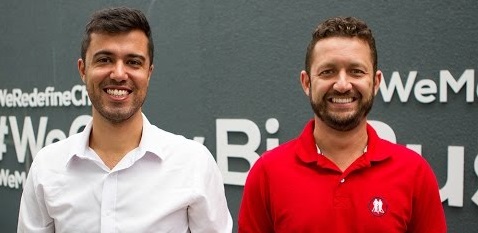
In 2015, that postdoctoral work was selected within a program of Minas Gerais government to be presented at an exhibition aimed at communicating to society in general the relationship between science “made in Minas Gerais” and the life of citizens. “At this time, I began to understand the need to bring scientific knowledge closer to society,” says Tiago. “I could really identify with this and based on that first contact I started to look for initiatives in this direction.” A little over a year later, in early 2017, Tiago created Innoma with materials engineer Diego Santos de Oliveira, who was pursuing his master’s degree with research on nanomaterials for health applications.
The initial impulse to create the startup, says Tiago, was the possibility of participating in two programs supporting the emergence and development of startups. Innoma was selected by both programs in 2017 for initial training called pre-acceleration. Initially, the partners’ idea was to produce, on an industrial scale, boron nitride nanoparticles for scientific research and for use in cancer therapies.
However, at the end of the pre-acceleration, the partners realized that they should prioritize projects with greater commercial viability, and opted for silver nanoparticles. These high-efficiency antimicrobials, which can be incorporated into many products, currently have the largest market in the world among nanomaterials, according to data reported by Innoma.
To develop the most suitable technology for nanoactive production, the partners relied on the knowledge acquired during their academic training and entered into a partnership with an university to use physical chemistry laboratories. The generated product was an aqueous dispersion of silver nanoparticles that, according to Tiago, stands out for its great stability and high concentration of the active.
After protecting the chemical route through filed patents, the startup outsourced the industrial production of the product. Thus, Innoma, which until now has been working with its own capital and with an internal team consisting only of the two founding partners, guarantees low operating costs and high production capacity. “We have partnered with a major chemical industry that has all the required certificates and registrations, as well as operational and technological structures capable of meeting the most stringent quality standards,” explains Tiago.
Currently, while marketing its first product, Innoma is working on upcoming releases: copper, zinc and gold based products that promise to benefit diverse segments of the Brazilian industry.
See our interview with Tiago Hilário Ferreira, the executive director at Innoma.

B-MRS Newsletter: What were the most important factors that enabled the creation and development of the startup?
Tiago Hilário: The learning acquired during the pre-acceleration process was very important for the beginning of the business model. Validations with potential customers have driven our efforts. The initial operation with the lowest possible fixed cost enabled our company to remain active during this pre-billing period.
B-MRS Newsletter: What were the main difficulties the startup has faced thus far?
Tiago Hilário: When starting a business from scratch, the difficulties are on a daily basis, the famous “kill one lion a day”. To date, the product development process and market suitability have been the most complicated steps.
B-MRS Newsletter: What do you think is the main contribution of the startup to society?
Tiago Hilário: We work to supply high efficiency nanocompounds to the domestic market, making it possible to use these materials in new products that until then had no commercial viability.
By doing this, and in accordance with the Brazilian government guidelines, we expect to promote increased human performance, its processes and products, quality of life and social justice.
B-MRS Newsletter: What is your goal/dream for the startup?
Tiago Hilário: The goal is for Innoma to establish itself as a company later this year, so that the partners can dedicate fully to the startup. Our dream is to be a national reference in this market.
B-MRS Newsletter: Leave a message for our newsletter readers and social media followers who are considering creating a startup.
Tiago Hilário: I have three tips for those who want to create a startup:
–The process is slow. It usually takes longer than expected and you need to be prepared for it.
– Too much money as well as too little money gets in the way. With a lot of resources, partners tend to run over validations and make wrong investments. With too little, the project becomes unachievable.
– The team is the most important. We tend to believe that the idea is the main thing, but a strong and motivated team is the factor that makes the biggest difference in the success of a startup.
B-MRS Public Notice.
The directory and board of the Brazilian Materials Research Society (B-MRS) are in solidarity with the Director of the Brazilian National Institute for Space Research (INPE), Prof. Ricardo Magnus Osório Galvão, with regard to the unsubstantiated claims by President Jair Bolsonaro. Had the President been careful to verify INPE’s work and Professor Ricardo Galvão contributions, he would not have made such an unfounded accusation.
Public agencies and their officials must serve the people and the Nation and are therefore subject to criticism and evaluation. However, it is inadmissible for a President of the Republic to make public accusations without the bare minimum of verification. It’s not just Professor Ricardo Galvão and INPE that the President offends, but all who work in favor of Brazil for knowledge generation.
(Português) Bolsa de pós-doutorado no CTNano – UFMG em projeto em parceria com a Petrobras em dispositivos de grafeno para sensoriamento de gases.
(Português) Seleção para o doutorado em Física da UFSC com oportunidade de bolsa.
Paper of B-MRS member is selected for collection of the Royal Society of Chemistry.

Professor Oswaldo Luiz Alves (IQ – Unicamp), a B-MRS member, is one of the corresponding authors of an article selected to compose a thematic collection of the Royal Society of Chemistry (RSC), commemorating the International Year of the Periodic Table. The collection, which can be accessed here, brings together 55 papers on low carbon dimensional systems and their applications, published between 2017 and 2019 in some RSC journals.
The paper signed by Professor Alves with seven other researchers from Brazil reports the toxicity and nanobiointeractions of a functionalized graphene oxide with respect to human blood components. The article was originally published in 2018 in the Journal of Materials Chemistry B and has just been featured in the commemorative collection, which is available in open access mode.
Article reference: Marcelo de Sousa, Carlos H. Z. Martins, Lidiane S. Franqui, Leandro C. Fonseca, Fabrício S. Delite, Evandro M. Lanzoni, Diego Stéfani T. Martinez and Oswaldo L. Alves. Covalent functionalization of graphene oxide with D-mannose: evaluating the hemolytic effect and protein corona formation. J. Mater. Chem. B, 2018,6, 2803-2812. DOI:10.1039/C7TB02997G. Available at: https://pubs.rsc.org/en/content/articlehtml/2018/tb/c7tb02997g?page=search (HTML)
(Português) Oportunidade de doutorado em membranas com bolsa CNPq na UFPR – ENCERRADA
XVIII B-MRS Meeting: registration and program.
Online registration for the XVIII B-MRS Meeting (Balneário Camboriú, September 22 to 26, 2019) is open.
Early registration (with descount) is open by August 2 August 9. Onsite registration at the event venue (Hotel Sibara) will be available throughout the meeting.
For participants of Brazilian institutions, B-MRS members benefit from additional discounts, and it is possible to become a B-MRS member or renew membership at the moment of meeting registration (online or onsite).
All registration fees are available on the meeting website: https://www.sbpmat.org.br/
B-MRS Newsletter. Year 6, issue 6.
|
|||||||||||||||||||||
|
|||||||||||||||||||||
|
Featured scientist: interview with Leonardo Mathias Leidens, winner of the national award for undergraduate research works.

When he answered the telephone on that May afternoon, Leonardo Mathias Leidens, 24 years old, thought it was a hoax. The president of CNPq (the Brazilian federal organization dedicated to the promotion of science and technology) was giving him the news that his undergraduate research (iniciação científica in Portuguese) had been chosen as the best in Brazil in the area of Exact, Earth and Engineering Sciences, in the sixteenth edition of the Prêmio Destaque na Iniciação Científica e Tecnológica.
However, in hindsight, if Leonardo had contained his excitement and looked back at that moment, he would have realized that the prize was in fact a likely consequence of a steady path through scientific knowledge, and a well-deserved recognition of his competency and dedication.
Leonardo was born in 1995 in Caxias do Sul, municipality of the Brazilian State of Rio Grande do Sul, of about 500 thousand inhabitants and an important industrial pole. After attending a public school in the city, always with excellent school performance, in 2013 Leonardo joined the undergraduate course in Chemical Engineering of the University of Caxias do Sul (UCS), a community university headquartered in Caxias do Sul, which has its campi in eight municipalities of the region.
In the first half of 2014, Leonardo found an opportunity to start doing science. He became a scientific initiation fellow, under the guidance of Professor Carlos A. Figueroa, leader in the UCS of a group of fundamental and applied research in Surface Science and Engineering, which would later receive the name of “Epipolé Group.” In this group, and always with the same advisor, Leonardo worked in several studies concerning the adhesion of amorphous carbon films as a scholarship holder of the university and then of the CNPq programs for undergraduate research. As a result of this work, Leonardo has today nine scientific papers (one of them as first author) published in international peer-reviewed journals, including some of the best journals in the area of surfaces and thin film.
In August 2016, Leonardo left the country for the first time to attend two semesters at the École Supérieure des Industries Chimiques (ENSIC), in the city of Nancy (France), after being selected as a fellow of BRAFITEC, a Brazilian federal program that supports the mobility of engineering students between institutions in Brazil and France. In this period, in addition to attend the courses, Leonardo presented, for the first time, a work in an international scientific event, the E-MRS 2017 Spring Meeting, held in the French city of Strasbourg.
After this enriching experience abroad, in mid-2017, Leonardo returned to Caxias do Sul and resumed his academic activities at UCS, including the undergraduate research in the Epipolé Group. In December 2018, he completed his bachelor’s degree in Chemical Engineering with a 3.96 average out of a maximum of 4 in all of the subjects studied. As a result, on graduation day, Leonardo was awarded the Academic Laurel by the Rector of UCS.
Due to his experience in more than four years as an undergraduate research fellow, Leonardo decided to pursue a doctorate without undertaking masters studies (Masters degree is the usual step before PhD in Brazil). Thus, earlier this year, he became a doctoral candidate of the Postgraduate Program in Materials Engineering and Science (PGMAT) of UCS, again under the guidance of Professor Figueroa.
On July 23, Leonardo will receive his CNPq award at the ceremony to be held in the city of Campo Grande (State of Mato Grosso do Sul) during the 71st Annual Meeting of the Brazilian Society for the Progress of Science (SBPC).
See our interview with Leonardo.
B-MRS Bulletin: Could you tell us briefly how and when you started and developed your interest in science/research? And your desire to become a scientist?
Leonardo Mathias Leidens: Curiosity has always been a perceivable characteristic of my personality. The will and concern to know the origin of “everything”, the whys and how things work led me to science, even if in a somewhat unconscious way. My parents always encouraged me to read and this was essential in the search for answers to my questions and in the development of creativity. More than that, as a child, I loved to work on simple experiments I learned on TV shows (unfortunately, the internet was not widely available in the 90s) or to create my own awkward experiments when I got a children’s chemistry kit (but with the simple instructions I would soon lose interest). Curiously, it took me quite a while to realize that combining all these things I did naturally and enjoyably could shape my career. It took a few years until, in high school, the penny dropped, and from there on I set out to achieve a new goal: to become a scientist. I entered the Chemical Engineering course with the intention of participating in Undergraduate Research activities and follow the academic career.
B-MRS Bulletin: Very briefly, what were the main competencies you have developed over the years as an undergraduate research fellow?
Leonardo Mathias Leidens: Basically, the greatest personal and professional development was the training in the “scientific method,” that is, the initial competency for training a scientist. Asking questions, seeking the state of the art and the answers already available for comparison with the presented reality and questioning/comparing the results became daily activities. In order to be able to develop all these research steps, training in complex equipment, data analysis and the proposal of ideas and projects were skills that I had to developed. In addition, throughout my scholarship I was able to improve languages, such as English (the language of science), as well as writing papers more meticulously and aptly for international journals, congresses, reports and projects.
B-MRS Bulletin: In your view, what were the most important factors that contributed to the achievement of the award-winning work?
Leonardo Mathias Leidens: Initially, it was the group’s trajectory, structure and experience in different approaches to minimize the adhesion problem of amorphous carbon films in ferrous alloys that allowed the work proposal and the result achieved, because with broad knowledge of the material system studied, it was possible to investigate in a meaningful way the problem and the positive modifications generated with the use of the hydrogen plasma. In my view, the success was the integration of basic science (the study of physicochemical mechanism of the treatment) with a real problem (to deposit the coatings under milder and efficient conditions on previously problematic substrates), which made the work complete and interesting in the scientific (knowledge generation) and industrial (applications with energy efficiency appeal) scopes.
B-MRS Bulletin: In another interview, you talk about being a scientist as a lifestyle, not just a profession. Tell us about that lifestyle that attracts you.
Leonardo Mathias Leidens: That expression has, fundamentally, two justifications. First, and as I said earlier, the scientific method was one of the most important learning aspects I have experienced over the years. It is applied not only in research but in various activities. Questioning and verifying everything (by tests and comparisons) are a scientist’s requirement, both inside and outside the laboratory. For example, in a society where never-ending information (of different qualities) is available, rigor becomes necessary to compare, select, and verify just how true or secure the sources are. On the other hand, science as a way of life means living science broadly. Integrating a diverse community, participating in projects and partnerships, and being able to make a difference in any area (no matter how small it looks) is much more than a profession. Finally, being part of a group of people who, with different backgrounds, stories and goals, come together and work for the generation of knowledge and advancement of humanity, even with so many difficulties, attracts me, encourages me and is a source of pride.
B-MRS Bulletin: You are currently in the first year of your doctorate. Have you thought about any project or career path after your PhD?
Leonardo Mathias Leidens: My advisor always suggests planning the next five years (at least)… It’s not always easy, especially in very unstable times. Regarding the doctorate, I would like to participate in a sandwich period at a university abroad because, having lived through this experience during my undergraduate studies, I realize the greater importance it would have in my scientific training as a doctor. Later, I intend to follow in the academic career, as researcher, in some institution here in Brazil or abroad.
B-MRS Bulletin: We invite you to leave some tips for our readers who are carrying out scientific initiation work in the area of Materials, answering the question “How to develop a national outstanding work.”
Leonardo Mathias Leidens: It’s not easy to directly suggest ways to produce a distinguished work because, to a certain extent, this is a consequence of a job well done and not the result of a “formula.” However, to reach the goal, I can say that one must take an active role in the research, proposing, without fear or apprehension, well-founded ideas for a problem of the area, even if at the beginning it is difficult and challenging for a undergraduate student. As we produce our own questions, we are encouraged to seek the answers and if they are not available, offer ways to obtain them Thus, with lots of work, dedication and scientific discussion, it is possible to transform a project into an outstanding work that can contribute to the advancement of a specific area and, more extensively, of society. However, one thing is fundamental: do not get absolutely discouraged when things do not go as planned. When we are on the frontier of knowledge, the result is not always the expected result – but this cannot curb the advance for further attempts.
With regards to me, as an undergraduate researcher in the Epipolé Group, I have always had the opportunity to participate actively in projects and discussions (and not only follow graduate students or do “mechanical” work, although these activities are also part of any undergraduate research grant and are important), even as a student of the initial undergraduate periods, and I enjoyed all these moments. This was instrumental in understanding how science is made and integrate with the group. Although greater responsibilities are created in these interactions, they were instrumental in the growth, encouragement and formation of a basis that allowed me to propose my own ideas, after a period of study and practice. For this, reading many scientific articles was also fundamental, besides being always abreast of the innovations of the area, but not forgetting to pay due attention to the scientific foundations, that is, the fundamental concepts.