

Sorry, this entry is only available in Brazilian Portuguese.
Author: Verónica Savignano
B-MRS member is the new director of CINE.
 Prof. Ana Flávia Nogueira (UNICAMP), B-MRS member, took on the position of general director of the Center for Innovation in New Energies (CINE) this December.
Founded in 2018 by the São Paulo Research Foundation (FAPESP) and the company Shell, CINE brings together research groups from UNICAMP, IPEN and USP and their collaborators to develop research on the frontier of knowledge and transfer technology to the industry in the area of new energies.
(Português) Homenagem de sócio SBPMat à Profa. Reiko Sato Turtelli.
B-MRS member is appointed editor of the Journal of Materials Science.

Prof. Andrea S. S. de Camargo (IFSC-USP), B-MRS member and scientific director, was appointed editor of the Journal of Materials Science (Springer), a well-established scientific journal within the international materials science community.
At the moment, the Brazilian scientist is the only representative of an institution from Latin America among the journal’s 25 editors.
Former B-MRS president is elected full member of the Brazilian Academy of Sciences.
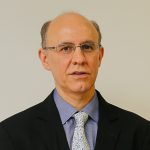 Professor Osvaldo Novais de Oliveira Junior (IFSC-USP), B-MRS member, was elected a full member of the Brazilian Academy of Sciences (ABC) in the area of Physical Sciences. The professor was president of B-MRS for two consecutive terms, from 2016 to 2020.
The election of the 21 new full members of ABC was held at an ordinary general meeting on December 3, 2020, based on nominations made by full members of ABC.
B-MRS Newsletter. Year 7, issue 11.
|
|||||||||||||||||||||||||
|
|||||||||||||||||||||||||
|
Biomimetic strategy for the synthesis of nanotubes that stimulate bone regeneration.
Experts say that, to date, there is nothing better than a natural bone to help regenerate another natural bone. In fact, despite the enormous advances in the area of biomaterials, there is still no synthetic material that works as well as autogenous bone graft (bone extracted from the patient himself) to encourage bone tissue regeneration – a process that occurs in our body regularly and spontaneously, but it is necessary to stimulate this through graft implantation when we experience noticeable bone loss due to trauma or disease. In this process, the basic unit of bone formation is the mineralized collagen fibril, a collagen cylinder formed by a group of cells called osteoblasts, which is filled and coated with calcium phosphates during the “biomineralization” process.
A study carried out by researchers from Brazil with collaborators from France took an important step in this context. Using a strategy inspired by nature, the scientific team produced, in the laboratory, a material that is very similar to mineralized collagen fibrils, in shape, size and structure. Collagen structures, which are expensive and difficult to handle proteins, were not used in this research. Instead, the researchers produced tubes (about 200 nm in diameter) which are very similar to fibrils, but composed of calcium phosphate crystals, the main inorganic component of bones, and strontium, an element used to treat osteoporosis, which helps reduce bone tissue loss and increase bone formation.
In in vitro tests, the material showed that it is not toxic to cells and that it generates the necessary conditions for bone tissue formation. In addition, it showed the ability to release strontium ions for long periods in controlled doses – an essential parameter for the long-term development of safe therapies, since in excess it can lead to the weakening of bones.
Strategy
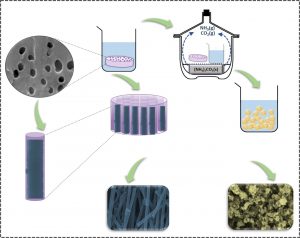
To produce the material having a cylindrical structure of controlled dimensions, the team employed a strategy that is used by several living organisms to generate teeth, shells and bones: physical confinement, which is nothing more than the use of a mold to induce a material to follow a specific morphology and size.
The mold used was a polycarbonate membrane, commercially available, which has cylindrical pores of 200 nm in diameter, similar in size to bone collagen fibrils. The membrane was submerged for twelve hours in a solution containing phosphate, calcium and strontium, which penetrated the pores. After drying the membrane in the presence of compounds that triggered mineralization, the polycarbonate was dissolved, allowing to separate and analyze the material that had formed inside the pores.
“By delimiting the physical environment in which the nucleation and growth processes of the mineral occur, we obtained nanotubes with highly controlled morphology, composition and size,” says Ana Paula Ramos, professor at the University of São Paulo (USP), campus Ribeirão Preto, and corresponding author of a recently published article reporting the study.
The same procedure, but without the use of molds, resulted in agglomerated spherical nanoparticles with very different characteristics from the collagen fibrils that were sought to emulate.
Surprise
The research was carried out within the PhD in Chemistry of Camila Bussola Tovani, which was carried out with funding from FAPESP, supervised by Professor Ana Paula Ramos, and defended this year at USP, campus Ribeirão Preto.
The initial idea of the project was to understand how strontium ions, used in the treatment of osteoporosis, acted on the bone mineralization mechanism. As this process, in the body, occurs in a situation of confinement, limited by the framework formed by the collagen fibrils, Camila and her advisor decided to use a mold to study how the calcium phosphate mineralization occurs in the presence of strontium ions.
“During the structural characterization, we found high similarity between the particles obtained and the mineralized collagen fibrils that form the bones, which encouraged us to conduct biological investigations”, says the professor. “What really surprised us, was the possibility of controlling particle properties such as mineral phase, morphology and size, by simply changing the medium in which precipitation occurred,” adds Ana Paula, who suggests that the same strategy can be applied to synthesize other inorganic particles for different applications in which the control of physicochemical properties is essential.
The nanotubes were produced and characterized in the Physical and Chemical Laboratory of Surfaces and Colloids, coordinated by Professor Ana Paula. Biological tests were carried out in other laboratories at USP campus in Ribeirão Preto, through collaborations with Professor Pietro Ciancaglini and Professor Sandra Fukada.
The study also benefited from two collaborations by Professor Ana Paula with researchers from France. The first, with the researcher Alexandre Gloter (Université Paris-Saclay), made it possible to investigate the formation mechanism and to characterize the nanotubes by advanced spectroscopy and microscopy techniques. The second, with researcher Nadine Nassif (Sorbonne Université), helped to understand the bone mineralization processes. “It is interesting that the initial contact with Dr. Alexandre Gloter took place in Brazil during TEM Summer School, organized at CNPEM by LNNano, and that the BEPE-FAPESP scholarship allowed Camila Tovani to stay at the Chimie de la Matiere Condensée laboratory at Sorbonne Université, under the supervision of Dr. Nadine Nassif for one year,” says Ana Paula Ramos. “The investment of Brazilian funding agencies in internationalization, both in bringing and sending researchers abroad, had an important impact on this research,” she concludes.
From the laboratory to the market
According to Professor Ana Paula, after conducting an investigation to validate the performance of nanotubes in animal models, the material will be able to be used to locally fill small bone defects. The nanotubes could also be incorporated into polymeric matrices that are used in orthopedic and cranio-maxillofacial surgery to replace, fill or repair bone defects caused by infections, injuries and neoplasms. In addition, the material could be incorporated into toothpaste formulations for the treatment of tooth hypersensitivity, since some toothpastes used for this purpose have strontium in their composition.
“The biggest challenge to make the particles as product is to find companies in the industry interested in the technology, which would allow us to develop formulations in the short term,” says the researcher.
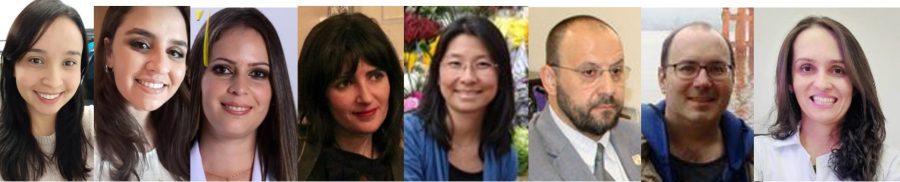
[Paper: Strontium Calcium Phosphate Nanotubes as Bioinspired Building Blocks for Bone Regeneration. Camila B. Tovani, Tamires M. Oliveira, Mariana P. R. Soares, Nadine Nassif, Sandra Y. Fukada, Pietro Ciancaglini, Alexandre Gloter, and Ana P. Ramos. ACS Appl. Mater. Interfaces 2020, 12, 39, 43422–43434. doi.org/10.1021/acsami.0c12434.]
Unpaid researchers: Thiago Marinho Duarte.
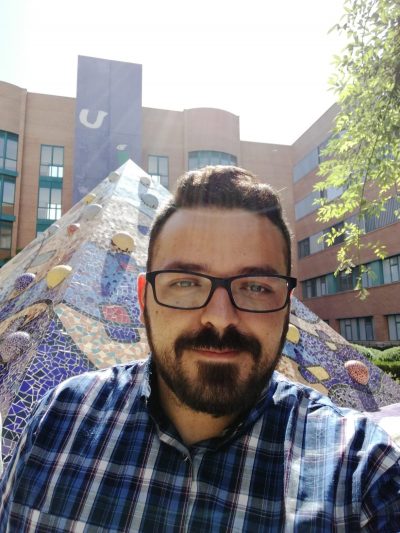
Thiago Marinho Duarte, 33, has a solid background to work in teaching and research. The Paraiban, born in Campina Grande, did a bachelor’s, master’s and doctorate in Chemistry, in addition to a specialization in teaching methodology in Chemistry and Biology. Thirteen years were dedicated to his scientific education.
However, since defending his doctorate in Chemistry at the Federal University of Paraíba (UFPB) in February this year, his plans to become a research professor have been put “in the freezer”. In order to pay the bills, he used the knowledge learned in his adolescence, in technical courses, and started to work as an electrician.
In September, he passed a selection process by the municipality of Conde, in the metropolitan region of João Pessoa, to work on the front to fight Covid-19, dealing with various issues, from analyzing water reports to raising awareness about the pandemic. In this way, he achieved financial stability for a few months (the contract ends at the end of December) while continuing to look for opportunities in order to return to his scientific career.
Usually, the step following the completion of a doctorate is a post-doctorate, which can be understood as a temporary job as a “junior scientist”. In Brazil, this phase of the career usually occurs in university research groups and is usually paid through scholarships, funded by government research agencies, either federal (such as CNPq or Capes) or state funded.
“I submitted research projects in two CNPq calls for selection of postdoctoral fellows,” says Thiago. “In both cases I was evaluated with a score close to the maximum (above 9.5), but I was informed that I would not receive the scholarship due to budget limitations,” he laments. In fact, the number of postdoctoral fellowships from federal agencies has been decreasing consistently since 2015, as previously shown by B-MRS.
In the middle of the pandemic, Thiago participated in four selective processes of higher education institutions in the states of Paraíba and Rio Grande do Norte for substitute lecturer – a temporary position that would allow him to remain in his professional area and get an income. But he was not selected. “The competition was very strong,” he says. In addition, he enrolled in a selective process for effective professor at the campus of the city of Areia at UFPB, but the selection has not yet been carried out due to the pandemic.
Thiago also considered entrepreneurship. He looked fondly at his undergraduate memories, when he began to produce and sell detergents, and thought that producing sanitizers would not be a bad idea for a chemist in a time of pandemic infectious disease. But this idea also ended up “in the freezer” given the difficulties Thiago faced to obtain bureaucratic information, necessary to start the initiative.
First university student in the family
“My first vocation was teaching,” says Thiago. In high school, he was good in courses in the Exact Sciences area. In the last year, after helping some colleagues understand a subject and pass the exam, he realized that he could dedicate himself to teaching. So, even without any family references (Thiago’s parents are salaried employees without higher education and he was the first person who attended college among all his relatives), he decided for a degree in Chemistry at the State University of Paraíba (UEPB).
After his graduation, in 2011, Thiago noticed that there were many selection processes in universities and federal institutes, and that they all required a master’s and/or doctorate degree. So he believed he should leave Campina Grande for postgraduate studies at UFPB, always in the Chemistry area.
That decision brought him many rewarding experiences, as well as personal and professional growth. In the master’s degree, Thiago was delighted to discover that the concepts learned in class became palpable in the laboratory, and that he could make his own contribution to the advancement of knowledge. In his PhD, he immersed in the world of computer simulations to study semiconductor materials that can be used for environmental remediation, which gave him the opportunity to go abroad for the first time to carry out part of the research at a Spanish university, with financial support from Capes.
“The contact with the real world of experiments and with the ideal world of simulations made me mature,” reflects Thiago. “And the experience abroad allowed me to grow as a person and as a researcher; it is something I recommend to everyone who has the opportunity,” he adds.
Currently, in addition to working on the front to fight Covid-19, Thiago is writing a research project to work in a group in the state of São Paulo. Once again, he will try to get a postdoctoral fellowship. In addition, Thiago is preparing to participate in another substitute-lecturer selection process, this time at the Federal University of Pernambuco (UFPE).
“I want to exhaust all possibilities in the country, but I don’t rule out going abroad,” says Thiago. “It is a pity that the government of Brazil has no interest in investing in knowledge and technology generation.”
B-MRS delivered a plaque in honor of Ricardo Rodrigues.
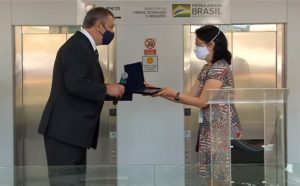
B-MRS participated in the ceremony in honor of the scientist and engineer Ricardo Rodrigues, held on the morning of November 9 in the Sirius building, organized by CNPEM. The emotional ceremony, which was broadcast live on YouTube, brought together some relatives and friends, who held demonstrations and presentations about Rodrigues’ extensive scientific career and personal aspects.
Representing the Board of B-MRS, Professor Daniel Mario Ugarte (UNICAMP), a member of the Society, handed a plaque to Rodrigues’ widow, Liu Lin, who is also a scientist. The B-MRS’s homage to Ricardo Rodrigues was conceived by members of B-MRS at the beginning of the year and would take place at the opening of the XIX B-MRS Meeting, which would be held in September this year in Foz do Iguaçu, but was postponed to 2021 due to the pandemic. The ceremony organized by CNPEM provided a new opportunity to perform the tribute.
Commemorative inscription in the plaque
“B-MRS homage to Antônio Ricardo Droher Rodrigues (1951 – 2020). The Brazilian Materials Research Society (B-MRS) pays homage to Ricardo Rodrigues’ fundamental contribution to the successful development and implementation of Brazilian synchrotron light sources (UVX and Sirius), which have placed Brazil at the forefront of materials research worldwide. November 2020.”
Ricardo Rodrigues
Ricardo Rodrigues was one of the main leaders responsible for the construction of the first synchrotron light source in the Southern Hemisphere, UVX, inaugurated in 1997. Starting in 2009, he led the engineering team that developed Sirius’ electron accelerators, the second light source synchrotron of Brazil. He passed away on January 3, 2020, at the age of 68.
The recording of the ceremony can be watched at https://www.youtube.com/watch?v=hrmTDdnyv9s.
B-MRS Newsletter. Year 7, issue 10.
|
||||||||||||||||||
|
||||||||||||||||||
|