

|
||||||||||||||||||
|
||||||||||||||||||
|
|
||||||||||||||||||
|
||||||||||||||||||
|
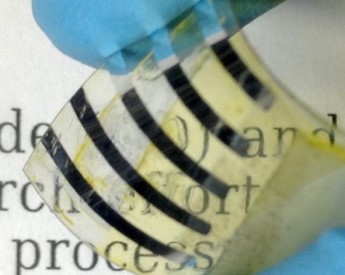
They are lightweight, thin and flexible. They can be manufactured on an industrial scale using simple, low-cost processes. Organic solar cells have several advantages and appeals, but still represent challenges to researchers, especially in the field of materials. These devices that transform sunlight into electricity owe their name to the use of organic materials (polymers or carbon-based molecules) in the active layer, responsible for absorbing light. But the other layers of the “sandwich” that constitute an organic solar cell are also very important, especially the electrodes, which are in charge of collecting the electrical charges produced by exposure to light.
In Brazil, three groups of researchers combined their skills and developed collaborative research that brought an important contribution for developing electrode materials for organic solar cells. The recently published work was coordinated by the researcher Maria Luiza M. Rocco, professor at the Institute of Chemistry at the Federal University of Rio de Janeiro (UFRJ).
Organic solar cells need electrodes that, in addition to being good conductors of electrical charges, are transparent to allow light to pass through the active layer, like windows. Unfortunately, there are few materials that combine good conductivity and transparency. One of them is indium tin oxide (ITO). Thin films of ITO deposited on glass substrate are, until now, the most used electrode in organic solar cells, in addition to being widely used in electronic screens and other devices on the market. “In the mid-term, this standard electrode will need to be replaced, and scientists are diligently trying to effectively replace it,” says Professor Maria Luiza. In fact, the ITO film production process is expensive, and indium is a scarce material in the earth’s crust. In addition, these electrodes are not fully flexible.
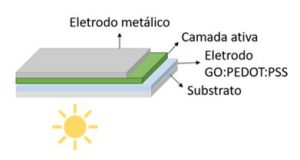
Thus far, the leading alternative to ITO is PEDOT:PSS, a polymer blend that allows the manufacture of conductive and transparent films. By combining this material with graphene oxide (GO), it is possible to obtain a composite material which conductivity not only is higher than that of pure polymer but also can be further increased by treating the material. In addition, GO:PEDOT:PSS films can adapt to the roll-to-roll system, that is the favorite for production of organic solar cells on an industrial scale. In this system, the different layers are printed or deposited on a flexible substrate (for example, plastic). The substrate is rolled up at the beginning of the production line, unrolled to receive the layers and rolled again at the end, with the material almost ready to be used as a solar panel.
Detailed analysis
In the work coordinated by Professor Maria Luiza, the researchers carried out a systematic study of different films, using spectroscopic techniques. They analized samples of pure PEDOT:PSS and of graphene oxide with different proportions of PEDOT:PSS (1, 5 and 10%). In addition, samples from each of these groups were treated by cooling them to -196 ° C (liquid nitrogen temperature) until reaching thermal equilibrium and then returned to room temperature.
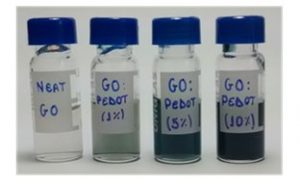
The objective was to understand the relationship between the structure and properties of each of the films, and to evaluate which of the combinations would allow greater electron mobility and, therefore, a better performance of the material as an electrode for organic solar cells.
Initially, graphene oxide was synthesized by the Materials Chemistry Group at the Federal University of Paraná (UFPR), led by Professor Aldo J. G. Zarbin. Then, members of the Laboratory of Nanostructured Devices, also from UFPR, developed the mixtures, prepared the films and studied the optical, electrical and heat treatment properties, under the coordination of Professor Lucimara S. Roman. Finally, the group of Professor Maria Luiza M. Rocco, from UFRJ, carried out spectroscopic studies at the Multi-User Photoelectron Spectroscopy Laboratory at UFRJ and at CNPEM’s National Synchrotron Light Laboratory (LNLS). The project had also participation of a representative from CSEM Brazil.
“The possibility of using synchrotron light was fundamental for understanding the electronic, morphological and transport properties of these new materials to be used as electrodes in optoelectronic devices,” states Professor Maria Luiza. Spectroscopic studies included differentiated analysis of the surface and bulk of the films, showing different characteristics in each region of the samples.
The study showed that cooled graphene oxide samples with PEDOT:PSS (5%) would better perform as solar cell electrodes. “The introduction of an insulating material (GO) in a conductor (PEDOT:PSS) increased the conductivity of the latter by two orders of magnitude,” reveals professor Maria Luiza. Cheaper than PEDOT, the graphene oxide used in the electrodes would lower the cost of the devices. The treatment carried out also helped to improve the conductivity of the material, by organizing the molecules so that it facilitates the displacement of electrons.
The study is part of Soheila Holakoei’s PhD research in Chemistry, defended at UFRJ in 2019, under the guidance of Professor Maria Luiza. The study received funding from LNLS-CNPEM and from Brazilian agencies Faperj (Rio de Janeiro), CNPq, CAPES and Finep.
Paper: Conformational and Electron Dynamics Changes Induced by Cooling Treatment on GO:PEDOT:PSS Transparent Electrodes. Soheila Holakoei, Amanda Garcez Veiga, Cássia Curan Turci, Matheus Felipe Fagundes das Neves, Luana Wouk, João Paulo V. Damasceno, Aldo J. G. Zarbin, Lucimara S. Roman, and Maria Luiza M. Rocco. The Journal of Physical Chemistry C. 2020 124(49), 26640-26647. DOI: 10.1021/acs.jpcc.0c07827
Contact: Prof. Maria Luiza M. Rocco – luiza@iq.ufrj.br.

Professor Gustavo M. Dalpian (UFABC) was appointed editor of the new scientific journal “Discover Materials” (Springer). Prof. Dalpian, a B-MRS member, is the chair of the XIX B-MRS Meeting + IUMRS ICEM 2021, to be held online this year.
The open-access “Discover Materials” journal was launched in 2020 by the editorial group Springer Nature, and covers all topics related to material research, from fundamentals to applications. Dalpian is part of the journal’s associate editors, along with three other scientists from Asia and Europe.
The year 2020 will undoubtedly be marked with sadness in our lives by the pandemic of Covid-19, which violently altered our daily lives, imposed tragic losses for many of us and gave more space to scientific negacionism, reinforcing the feeling of “nonsense” that we experience in today’s society.
However, at the same time, it was in 2020 that Science was once again a safe haven, pointing out alternatives and strategies to combat this terrible disease, while, in record time, decoding the virus genome and manufacturing vaccines with high efficacy. Brazilian researchers played an active part in building this knowledge chain, while resiliently fighting against threats to the country’s Science, Technology and Innovation (ST&I) structure. The materials research community could not abstain at such a critical moment and therefore quickly adapted research on biosensors, drug-carrying nanoparticles, materials with virucidal properties, etc. to combat SARS-CoV-2.
In 2020 B-MRS also had to reinvent itself. With the postponement of its annual meeting due to the health crisis, the virtual platform was our form of communication. And the community responded! With a strong presence in webinars, online events, and participating in awareness actions to maintain the country’s ST&I infrastructure as well as our most precious resource for the future, young PhDs and undergraduate and graduate students. The drive and motivation that students at our University Chapters show in their activities, brings us the certainty that there is a light at the end of the tunnel for Brazil.
And may 2021 come! We will be ready, equipped with the powerful resources of Science, to build a better year, with more health and decent living conditions for Brazilian citizens.
An excellent end of the year to everyone – as far as possible and observing all necessary care :).
B-MRS Board
Students can apply for joining the AMASE Master Programme, which provides Erasmus Mundus scholarships for carrying out a two-year international Master in Advanced Materials Science and Engineering. The application for the intake 2021 is now open.
The Joint European Master Programme in Advanced Materials Science and Engineering (AMASE) is aimed at students who have already obtained their Bachelor in Materials Science, Materials Engineering or other related Engineering Sciences, as well as Physics, Chemistry or other Natural Sciences. The programme is carried out by:
Within AMASE, students spend the first year at one of the partner universities and the third semester at a Second University. In the fourth (last) semester the student writes the Master’ thesis either at the Second or the Entrance University.
Through this exchange of cultures, the student gains vast advantages on the academic labour market, profits from personal growth and learns at least one new language. A particularity of the AMASE programme is that students have to study in two different languages by selecting the corresponding university (Spanish at UPC, French at UL, German at UdS and English at LTU, MUL and UPD). Language courses, as well as training in intercultural communication and complementary skills, are provided during the course.
Participation costs for the programme are 1.500 € per semester for EU-students and 4.500 € per semester for Non-EU students. Basic health and social insurance is included in the fees. To support students, the European Commission provides Erasmus Mundus Programme scholarships for especially gifted and motivated students. These scholarships consist of 1.000 € monthly allowance, a contribution for travel costs and installation (depending on the country of origin); and covering of participation costs.
Deadline for applying for Erasmus Mundus financial contribution is 15th of February 2021 (15th of January for students starting at LTU).
For more information please check our website www.amase-master.net or contact us at: office@eusmat.net.
If you are interested in our programme, you can apply for the scholarships and the study place through: https://amasemaster.net/application/SubmitAbstract.php
 Prof. Osvaldo Novais de Oliveira Junior (IFSC-USP), B-MRS member, was elected First Vice President of the International Union of Materials Research Societies (IUMRS).
The Brazilian scientist was chosen for the position unanimously, in an election held this December, involving materials research societies from around the world that participate in IUMRS.
He will hold the position of First Vice President for two years, from 2021 to 2022. At the end of his term, Oliveira Junior, who was the President of B-MRS from 2016 to 2020, will automatically assume the presidency of IUMRS.