Concurso na Unicamp para professor, na área de Química Inorgânica.

O Instituto de Química da Unicamp está com inscrições abertas para o Concurso Público de provas e títulos para provimento de um cargo de Professor Doutor, nível MS3.1, RTP, com opção preferencial pelo RDIDP, na área de Química Inorgânica, do Instituto de Química da
Unicamp.

Maiores informações sobre o concurso podem ser obtidas através do edital, disponível em
http://www.sg.unicamp.br/dca/concursos/abertos/concursos-para-professor-doutor/instituto-de-quimica

Boletim SBPMat – edição 11 – julho 2013.

Edição nº 11 – Julho de 2013
Saudações,

XII Encontro da SBPMat: avisos e lembretes

  • Já viu a programação no site do evento? Veja.
  • Dicas para chegar a Campos do Jordão de ônibus desde São Paulo e Rio de Janeiro. Aqui.

XII Encontro da SBPMat: entrevistas com palestrantes das plenárias

Pai do material termoelétrico mais eficiente até o momento, o professor Mercouri Kanatzidis (Northwestern University), nos contou de que trata e como desenvolveu sua original abordagem aos desafios de eficiência dos termoelétricos. O professor também comentou outros assuntos, como a viabilidade de se usar esses materiais para transformar em eletricidade o calor que se perde pelos canos de escapamento dos carros. Veja.
O professor Juan Manuel Andrés Bort (Universitat Jaume I, Spain) discorreu sobre o tema de sua palestra plenária, a combinação de teorias qualitativas, cálculo e técnicas experimentais no estudo de óxidos metálicos multifuncionais. Veja.

Artigos científicos em destaque

O paper com participação de brasileiros destacado nesta edição do boletim traz uma contribuição ao desenvolvimento de dispositivos bioeletrônicos. O artigo, publicado na Advanced Functional Materials, reporta o trabalho de uma equipe multinacional de cientistas que estudou as interações entre o ouro e a eumelanina – aquele pigmento presente em nossos cabelos, que interessa a Bioeletrônica por ser um material de características semicondutoras e biocompatíveis.

Veja a matéria de divulgação que preparamos para este boletim.

Dicas de leitura

Artigo de revisão
  • Materials Today publicou um artigo de revisão coassinado pelo palestrante do nosso XII Encontro Mercouri Kanatzidis sobre o tema de sua plenária, materiais termoelétricos de alto desempenho. Aqui.

Novidades do meio acadêmico

Brasil

  • Labs da Unicamp se unem no NanoBioss para estudar síntese de nanoestruturas e sua interação com sistemas biológicos (notícia da Agência Fapesp). Aqui.
  • Fibra de carbono brasileira de baixo custo, desenvolvida pelo Exército e a Petrobras usando piche de petróleo (notícia da Agência Brasil). Aqui.
  • Estudos com material bioativo implantável desenvolvido na UFSCar mostram seu potencial no reparo de tecidos ósseos (notícia da Agência Fapesp). Aqui.
Exterior
  • Avanços na compreensão da dissipação de calor em dispositivos de escala atômica (com base em paper da Nature). Aqui.
  • Eletrônica orgânica de alto desempenho: inovações em técnica de impressão de filmes finos semicondutores orgânicos (com base em paper da Nature Materials). Aqui.
  • Paineis solares coloridos: pesquisadores estudam materiais e processos para unir eficiência e design (notícia do Instituto Fraunhofer). Aqui.
  • Setup inovador permitiu ver ao vivo a formação de células solares de calcopirita e compreender a formação de defeitos (com base em paper da Advanced Energy Materials). Aqui.
  • Nanobastões de ouro revestidos com proteínas: possível plataforma para vacinas como a do vírus sincicial respiratório (com base em paper da Nanotechnology). Aqui.
  • Rumo a dispositivos fotônicos de MEH-PPV: medidas mais precisas sobre a capacidade desse polímero de amplificar luz (com base em paper da Applied Physics Letters). Aqui.
No mercado
  • Energia para o mundo via paineis solares nos desertos. Empecilhos: altos investimentos e alguns desafios técnicos (matéria da Scientific American). Aqui.
  • Materiais mais sustentáveis para a construção civil: cimento ecológico, telhas de celulose, concreto translúcido…(matéria da Globo Ciência). Aqui.

Oportunidades

Processos seletivos para pós-graduação

  • Curso “Estrutura, processamento e propriedades dos Materiais”, preparatório para o mestrado e doutorado em Materiais da UCS (RS). Aqui.
  • Seleção para mestrado e doutorado em Física e Química de Materiais na UFSJ (MG). Aqui.

Prêmios

  • Inscrições abertas para os prêmios Santander Universidades. Aqui.
  • Concurso de vídeos de até 60 segundos (Festival do Minuto) sobre o tema “Ciência”. Aqui.

Próximos eventos da área

  • MSSC2013 – Ab Initio Modeling in Solid State Chemistry. Featuring CRYSTAL13 and CRYSCOR13. Aqui.
  • 22 International Congress on X-ray Optics and Microanalysis. Aqui.
  • Euromat 2013 – European Congress and Exhibition on Advanced Materials and Processes. Aqui.
  • 8º Brazilian-German Workshop on Applied Surface Science. Aqui.
  • MSSC2013 London edition – Ab initio modelling in Solid State Chemistry (new users). Aqui.
  • 8th International Conference on High Temperature Ceramic Matrix Composites (HTCMC-8). Aqui.
  • Graphene Brazil 2013. Aqui.
  • Humboldt Kolleg 2013 – Sciences and technology in contemporary life: impacts and horizons. Aqui.
  • 4th International Congress on Alternative Energies and 1st International Meeting of the IPN Energy Network. Aqui.
  • XII Encontro da SBPMat. Aqui.
  • International Polysaccharide Conference (EPNOE 2013). Aqui.
  • III ENBRAER. Encontro Brasileiro de Espectroscopia Raman. Aqui.
  • “I Reunión Latinoamericana de Cristalografía”, ” IX Reunión Anual de la Asociación Argentina de Cristalografía” e eventos satélite. Aqui.
  • 6º Congresso Internacional de Electrocerâmica. Aqui.

Veja a agenda de eventos.

Nosso perfil no TwitterNossa página no Facebook
Para divulgar novidades, oportunidades, eventos ou dicas de leitura da área de Materiais, escreva para comunicacao@sbpmat.org.br.

Descadastre-se caso não queira receber mais e-mails.

Oportunidade de bolsa de pós-doutoramento em Engenharia de Materiais vinculada ao CEPID Centro de Desenvolvimento de Materiais Funcionais.

Nesse projeto pretende-se entender profundamente os processos envolvidos na sinterização ativada de nanocristais de óxidos metálicos pela visualização direta dos fenômenos durante sua ocorrência por microscopia eletrônica de transmissão in situ, em resolução atômica. Desse estudo, pretende-se desvendar os mecanismos da sinterização ativada pela observação direta dos fenômenos, com possíveis formulações de modelos quantitativos e qualitativos do processo.

O selecionado trabalhará no laboratório coordenado pelo Prof. Edson R. Leite no Departamento de Química da Universidade Federal de São Carlos na área de Química de Materiais. A vaga está aberta a brasileiros e estrangeiros altamente qualificados. O selecionado receberá Bolsa de Pós-Doutorado da FAPESP (no valor de R$ 5.908,80 mensais) e Reserva Técnica. A Reserva Técnica de Bolsa de PD equivale a 15% do valor anual da bolsa e tem o objetivo de atender a despesas relacionadas à atividade de pesquisa.

São desejáveis as seguintes competências para o candidato:

  • Ter título de doutor (adquirido nos últimos três anos) em física, química ou engenharia de materiais, com tese na área de microscopia eletrônica e/ou sinterização de nanomateriais.
  • Sólida experiência em microscopia eletrônica de transmissão (evidenciada por publicações). Práticas anteriores em experimentos de microscopia eletrônica in situ serão consideradas na seleção.
  • Experiência em processamento e síntese de nanocristais.
  • Ter publicações científicas e domínio da língua inglesa.

Os interessados devem enviar os seguintes documentos (em PDF), até 30 de agosto de 2013, para o email do Prof. Dr. Edson R. Leite (edson.leite@pq.cnpq.br):

  • Carta de motivação.
  • Resumo da tese de doutorado.
  • Curriculum Vitae Completo.

Duas referências para contato.

Chamada para bolsas de pós-doutorado da Dahlem Research School (Alemanha).

A Dahlem Research School, centro da Freie Universität Berlin para programas de excelência de doutorado e apoio para pós-doutorandos internacionais, estabeleceu um programa de bolsas de pesquisa, disponibilizando financiamento para que pesquisadores de pós-doutorado de destaque em todas as disciplinas possam realizar o seus próprios projetos de pesquisa na Freie Universität Berlin.

O programa é co-financiado pela Iniciativa de Excelência Alemã e pelo Programa Marie Curie da Comissão Europeia e tem como objetivo dar apoio a pós-doutorandos altamente qualificados com experiência de pesquisa internacional, além de integrá-los às redes de pesquisa da universidade na fase inicial de sua carreira.

Atualmente, são oferecidas 18 bolsas de pós-doutorado nas áreas de medicina, ciências naturais e exatas, ciências sociais e humanas e estudos regionais com uma duração de 18 meses.  Catálise é um dos temas de interesse.

A data-limite para a inscrição é o dia 15 de setembro de 2013.

Mais informações:

http://www.fu-berlin.de/pt/sites/brazil/cofund_point_regain2014.html.

Interviews with plenary lecturers of the XII SBPMat Meeting: Juan Andrés (Universitat Jaume I, Spain).

The combined use of theory and experiment is indispensable in modern nanoscience and nanotechnology. Frequently, theoretical, computational and experimental approaches are complementary in the understanding of structures and processes at the atomic level. Besides that, qualitative theories, high-level calculations and experimental techniques form a virtous cycle of knowledge generation in which advances in one of the approaches create new challenges for the others.

In his plenary lecture at the XII SBPMat Meeting, Professor Juan Manuel Andrés Bort (Universitat Jaume I, Spain) will present an overview of the results he obtained by combining theory and experimental work in the study of multifunctional metal oxides at the atomic level.

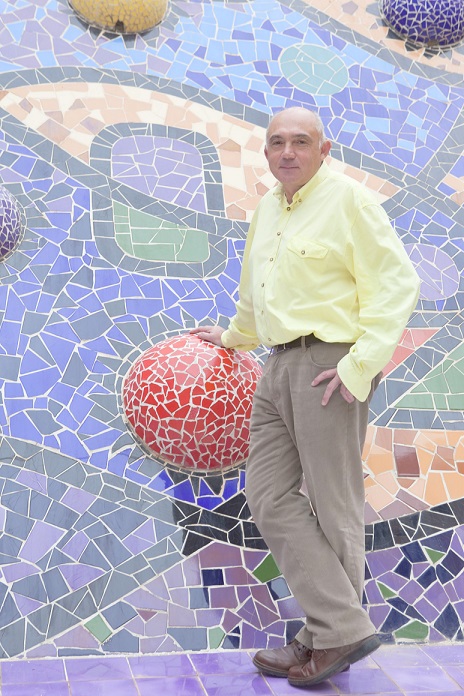
Professor Juan Andrés holds a Bachelor degree and a PhD in chemistry, both from University of Valencia (Spain). In 1984 he became full-time lecturer of that university. After that, he joined the Universitat Jaume I, where he holds a professorship in the area of physical chemistry since 1994 and is the director of the Laboratory of Theoretical and Computational Chemistry. He has been visiting professor at the Uppsala University (Sweden), the Pierre et Marie Curie University (France) and the Federal University of São Paulo at São Carlos (Brazil). Juan Andrés has published more than 330 scientific papers so far, with more than 6.000 citations, and 15 text books. He has given 25 invited talks in international meetings.

See below our interview with the lecturer.

SBPMat: – What are the main challenges you have faced in understanding the behaviour of multifunctional metal oxides within this “theory + experiment” approach?

Juan Andrés (J.A.):  – Theory and simulation can provide fundamental understanding of observed phenomena, and can be used to make predictions for systems that are difficult or impossible to study experimentally or behavior at very high temperature or pressure. In addition, theory and simulation can give detailed molecular level information that is difficult or impossible to determine from laboratory experiments. These methods also find important applications in determining the limits of well known macroscopic laws, which may break down for nanoscale systems.

Theory and experiment each have different strengths and limitations, but these are complementary to a large extent and there is much to be gained by constructing research programs that combine the two. For instance, the idea of the design of new materials such as multifunctional metal oxides, including nanostructures, with targeted chemical/physical properties has been attracting a lot of attention, especially because of potential industrial payoffs.

SBPMat: – In your opinion, what are the main challenges that science has to overcame yet for a better comprehension of the behaviour of these materials at the atomic level?

J.A.: – As scientific and chemical research becomes more complex and interdisciplinary, it becomes ever more challenging to communicate and explain the state of the art, new results and advances. In this context, the attitude adopted in the recent Nature Chemistry journal (vol. 1, April 2009) on the future of Chemistry is opened to be capable to show the deepest existential meanings in order to predict the future progress of this field. In particular, the note entitled: “Experiment and Theory in Harmony” (Nature Chemistry, 1, 8 (2009) by Mark A. Johnson at Yale University). This author discusses how the two sides of physical chemistry have necessarily developed together, and looks at how their synergy dictates the direction of contemporary research.

Physics-based simulations complement experiments in building, in a molecular-level, the understanding of chemistry: they can test hypothesis and interpret and analyse experimental data in terms of interactions at the atomic level. However, the connection among theory, simulations and experimental results are not always obvious, as the languages of these disciplines are different. This recognition motivated us to create a bridge between computational chemistry and experiment in a manner that will allow efficient exploitation of these approaches.

In this respect, the recent work of Chemistry Nobel prize: “Interaction between Experiments, Analytical Theories, and Computation” R. A. Marcus, J. Phys. Chem. C 2009, 113, 14598–14608/. In particular the following sentences of this paper can be remarked: “We all recognize that one of the main goals in research is to capture the physical essence of a phenomenon and use it not only to interpret but also to predict the results of new experiments. One view of theory, demonstrated in the present article, is that experiments are primary, often the source of new theory, and that the interaction of theory and experiment is paramount, each stimulating the other”. “Nevertheless, discerning basic theoretical problems in the wealth of available experimental and computational results can be a major hurdle and sometimes the development of the theory can be relatively rapid once the existence of an experimental puzzle is known. The writer continues to be impressed with this exciting interplay of experiment and theory and with many experimental puzzles that exist and that continue to arise in new experiments, when one keeps an eye out for them. For the theoretically oriented students it is perhaps a truism to add that the broader one’s background is in physics, chemistry and mathematics, and the more one is familiar with the new results and the potential and limitations of new techniques, the larger the range of interesting problems that one can address”.

SBPMat: – Modern experimental techniques, theoretical analysis, high-level calculation. According to your experience, is it good/ possible to gather all the necessary expertises and resources in your own research group or it´s better/ more feasible to collaborate with experts from other laboratories?

J.A.: – Predicting the physical/chemical properties of complex systems using first principle quantum mechanical approaches at microscopic level can be considered as the Holy Grail of theoretical and/or computational methods. Applied quantum mechanics holds a central position as a key technique that contributes to all aspects of chemistry, physics, biology, material science as well as nanoscience. The last few years have seen the continued development of methodology, computer hardware and algorithms that have resulted in an ever expanding range of complex systems and properties that are amenable to calculation.

One of the most remarkable successes of the present project will be to demonstrate that the improvements, developments of the methods and techniques of theoretical and computational chemistry (TCC), are now mature enough to model chemical and physical properties with good accuracy. Consequently experiments evolve to computational experiments, and theoretical calculations evolve to applied TCC, which can also be considered as computational experiments. At the outset of the 21st century, TCC has arrived at a position of central importance not only for theorists but also in the laboratories of most experimentalists and in many disciplines.

In the last years, new computational techniques and methods have been developed with successful and robust results in this field of study that has progressed to the point of being able to address important questions in the core areas of the chemical sciences, including questions lying on the interface among chemistry, physics, biology, and engineering. These interdisciplinary areas include biomolecular chemistry and the chemistry of materials. While the results obtained traditionally complement the information obtained by chemical experiments, it can, in many cases, predict not observed chemical phenomena.

In this respect, the methods and techniques of TCC have evolved into an important tool in almost all areas of chemistry and, as it were recently remarked by Truhlar /Truhlar, D. G. J. Am. Chem. Soc. 2008, 130, 16824./, “computations on complex systems are the current frontier of theoretical chemistry”. However, there is still a lot of work to do. As a matter of fact, modeling at the electronic level of systems with high configurational complexity is still challenging. In this case, the main problem is either practical and conceptual as the different observables to be modeled depend on processes occurring at different length, energy, and time scales. Computational tools typically employed for systems of such dimensions are classical simulations which, however, produce reliable results as far as transitions in quantum degrees of freedom do not take place. On the other hand, when the observables of interest explicitly involve quantum degrees of freedom, e.g., chemical reactions or spectral transitions, their modeling should be derived from statistical averages of genuine quantum states interacting with fluctuating perturbing environments. In the past years, our research group has been focusing its efforts in this direction, collaborating with experts from other laboratories, producing a theoretical-computational methodology whose main feature is to describe at electronic level a portion of a large molecular system maintaining the complexity of the overall system. Several applications, ranging from spectroscopic properties to chemical reactions, have been witnessing the rather good performance of the method.

Keeping in mind the objectives and topics that the lecture is going to cover, together with the collaborations with national and international research groups, including theoreticians and experimentalists, as well as the complementarities of the teams will allow us to improve, develop and complete some of the methods and techniques of TCC, in order to be applied in these research lines of outstanding interest.

SBPMat: – Feel free to leave any other comments about your plenary lecture to our readers.

J.A.: – The overall objective of the plenary lecture lies in taking advantage of the ability and experience in the use of the methods and techniques of TCC in order to carry out studies on structure, properties and chemical reactivity in micro- and nano-materials. Quantum mechanical calculations based on realistic model systems are changing the science of nanotechnology. These molecular simulations and modelling provide detailed, atomic-level insight into the fundamental mechanisms of nanomaterials, as well as practical applications to understand experimental data. For this purposes, new computational algorithms, theories and protocols will be developed, implemented and applied. Such advances will be exploited in designing new materials with properties suitable for use in a wide range of applications ranging from biomedicine to nanocatalysis, and this talk based on recent results obtained along the develop of the research project maintained with collaboration with “Centro Multidisciplinar para o Desenvolvimento de Materiais Cerâmicos (CMDMC). The groups at CMDMC involved in the project have a long experience of competitive scientific work with national and international collaborations. They try to promote basic and oriented research a of high scientific quality, almost in the frontier of knowledge, contributing to the development of new methods and techniques and the adjustment of the already ones to study relevant problems in the field of materials science and nanotechnology. We consider this project is in the current frontier of a multidisciplinary research where chemistry, physics, biology, materials science and the emerging field of nanotechnology converge.

See the abstract of Juan Andrés plenary lecture “Connecting theory with experiment: A survey to understand the behaviour of multifunctional metal oxides”.

See Professor Juan Andrés mini CV.

Artigo científico em destaque: Interação entre ouro e eumelanina – um material promissor para o desenvolvimento de dispositivos bioeletrônicos.

O artigo científico de membros da comunidade brasileira de pesquisa em Materiais em destaque neste mês é:

Julia Wünsche, Luis Cardenas, Federico Rosei, Fabio Cicoira, Reynald Gauvin, Carlos F. O. Graeff, Suzie Poulin, Alessandro Pezzella, Clara Santato. In Situ Formation of Dendrites in Eumelanin Thin Films between Gold Electrodes.  Advanced Functional Materials, 2013. Article first published online : 10 JUN 2013, DOI: 10.1002/adfm.201300715.

Texto de divulgação:

Interação entre ouro e eumelanina – um material promissor para o desenvolvimento de dispositivos bioeletrônicos

Olhos e ouvidos artificiais e dispositivos que realizem a interface entre o corpo humano e braços robóticos são algumas das aplicações que a Bioeletrônica promete. Ainda em estágio inicial, o desenvolvimento dessa área da pesquisa depende em boa parte do desenvolvimento de materiais que sejam semicondutores e biocompatíveis ao mesmo tempo. Um dos materiais mais promissores e mais estudados no contexto da Bioeletrônica é a eumelanina (um tipo de melanina determinante, por exemplo, na definição da cor dos cabelos dos seres humanos). A eumelanina começou a ser estudada sob a perspectiva da Ciência de Materiais na década de 1960, quando suas características semicondutoras foram descobertas. O problema é que a melanina, tanto a natural quanto a sintetizada por métodos tradicionais, não produz filmes finos de boa qualidade que viabilizem seu uso como material para dispositivos bioeletrônicos.

No ano 2004, no Brasil, mais precisamente na cidade de Ribeirão Preto (SP), na Universidade de São Paulo (USP), o grupo de pesquisa do professor Carlos Graeff desenvolveu uma forma de produzir melanina solúvel em dimetilsulfóxido (DMSO), o que possibilitou a produção de filmes finos de alta qualidade. A descoberta foi publicada no Journal of Non-Crystalline Solids (http://dx.doi.org/10.1016/j.jnoncrysol.2004.03.058). “A partir desta publicação e outras subsequentes recebemos o contato da professora Clara Santato, uma especialista na produção de dispositivos eletrônicos orgânicos da Escola Politécnica de Montréal (Canadá), para desenvolvermos um projeto comum”, relata o professor Graeff, atualmente professor da Universidade Estadual Paulista (Unesp) – campus de Bauru.

A colaboração então iniciada continuou ao longo dos anos e gerou uma pesquisa que demonstrou a existência de peculiares interações entre a eumelanina e o ouro. Os resultados desse trabalho foram publicados online no dia 10 de junho deste ano na prestigiada revista Advanced Functional Materials. O artigo agregou as competências em síntese de DMSO-melanina do professor Graeff, os recursos humanos e materiais para produção e caracterização de dispositivos eletrônicos a base de melanina do grupo da professora Santato e contribuições de outros grupos do Canadá e da Itália.

Dendritos
Dispositivos bioeletrônicos a base de filmes de eumelanina precisam, a princípio, de eletrodos para gerar uma corrente elétrica que flua através da eumelanina. Pensando nisso, os autores do artigo construíram um sistema composto por um substrato de dióxido de silício (SiO2) texturizado com partículas de ouro (os eletrodos) e, entre duas partículas do metal, depositaram o filme de eumelanina. Num contexto de 90% de umidade do ar e temperatura ambiente, aplicaram uma tensão de 1 volt, gerando um eletrodo positivo e outro negativo nas partículas de ouro e um fluxo de corrente elétrica entre elas.

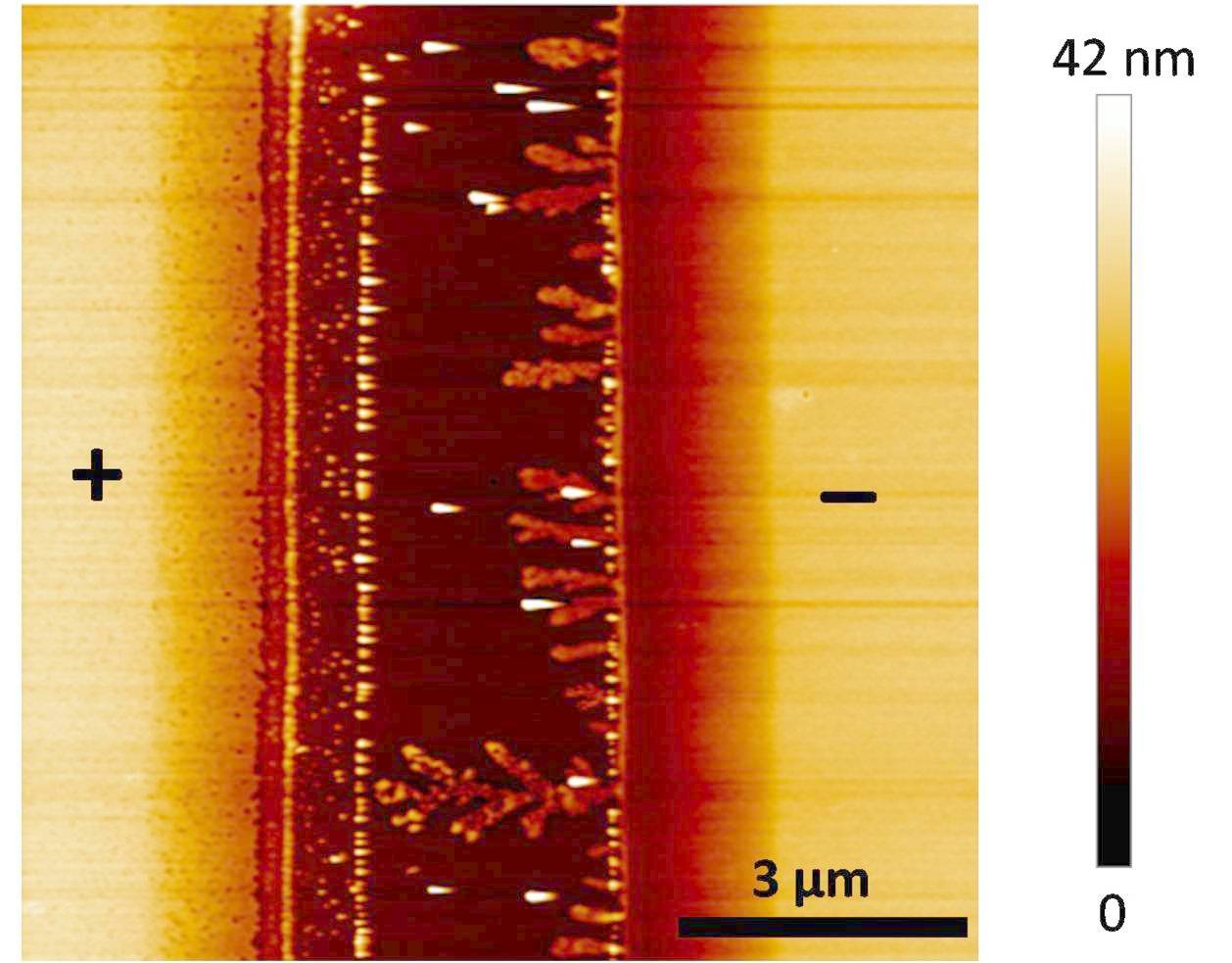
Com o auxílio de um microscópio de força atômica, o experimento permitiu a observação de uma paulatina formação de nanoestruturas sobre o filme. Inicialmente, essas nanoestruturas surgiram próximas ao eletrodo positivo em forma de nanoagregados, compostos basicamente por ouro e por algo de eumelanina. Ao aplicar tensão por mais alguns minutos, novos nanoagregados foram surgindo e se aproximando do eletrodo negativo, até chegar a ele. Nesse momento, começou a nucleação dos nanoagregados, a qual gerou estruturas em forma de dendritos (as ramificações dos neurônios) com alto conteúdo de ouro, surgidas a partir da região de contato com o eletrodo negativo. Enquanto a tensão continuou a ser aplicada, os dendritos continuaram a se formar, chegando a unir o eletrodo negativo ao positivo por meio de suas ramificações.

Além de terem formato parecido, as nanoestruturas dendríticas e os dendritos neuronais se assemelham no papel que desempenham, o de transmitir impulsos elétricos. De fato, os dendritos crescidos no filme de eumelanina demonstraram ser altamente condutores.

Esta imagem de microscopia de força atômica mostra o filme de DMSO-eumelanina hidratado, de 30 nm de espessura, após receber tensão de 1 V durante 3 horas:

A imagem permite ver que os nanoagregados de ouro e eumelanina se formam na região próxima ao eletrodo positivo, avançam pelo filme e se depositam nas proximidades do eletrodo negativo, levando, finalmente, à formação dos dendritos.

Processo Seletivo da Pós-graduação em Física e Química de Materiais da UFSJ (MG)

Já estão abertas as inscrições para o processo de seleção dos cursos de Mestrado e Doutorado em Física e Química de Materiais da Universidade Federal de São João del Rei (UFSJ).

Interessados devem comparecer, até o dia 2 de agosto, das 9h às 11h e das 14h às 17h, na Secretaria do Programa FQMat, Sala 2.19, Bloco A do Departamento de Ciências Naturais (DCNAT), Campus Dom Bosco – São João del-Rei. A taxa de inscrição é de R$ 75.

Confira o edital no link www.ufsj.edu.br/fqmat/processo_seletivo.php.

Mais informações pelo telefone (32) 3379-2535 ou pelo e-mail fqmat@ufsj.edu.br.

Interviews with plenary lecturers of the XII SBPMat Meeting: Mercouri G. Kanatzidis (Northwestern University – USA).

About two-thirds of all used energy is lost as waste heat. Bulk thermoelectrics (materials that can directly convert temperature differences to electric voltage and vice-versa) can improve this current situation by transforming some of the waste heat into useful electricity, but, in most cases their conversion efficiency is not sufficient to allow for commercial use. This efficiency is related to the ability of electrons to traverse the materials as they are excited by heat and to phonon scattering, and it is measured by the so-called ZT values (the higher a material’s ZT, the higher its conversion efficiency).

Efforts have been made to enhance the efficiency of thermoelectric materials, mainly by nanostructuring them. In his plenary talk at the XII SBPMat Meeting, professor Mercouri Kanatzidis (Northwestern University, USA) will present his panoscopic approach to highly efficient thermoelectrics. This approach considers not only the nanostructure of the material but also its mesoscale architecture. Using this strategy, professor Kanatzidis and his collaborators developed the top-performing thermoelectric system at any temperature, a lead telluride (PbTe) – based material. The achievement was published in the journal Nature in September 2012 (doi:10.1038/nature11439). The speaker will also address in his talk the substitution of tellurium by sulfur or selenium in thermoelectric materials for cost reduction.

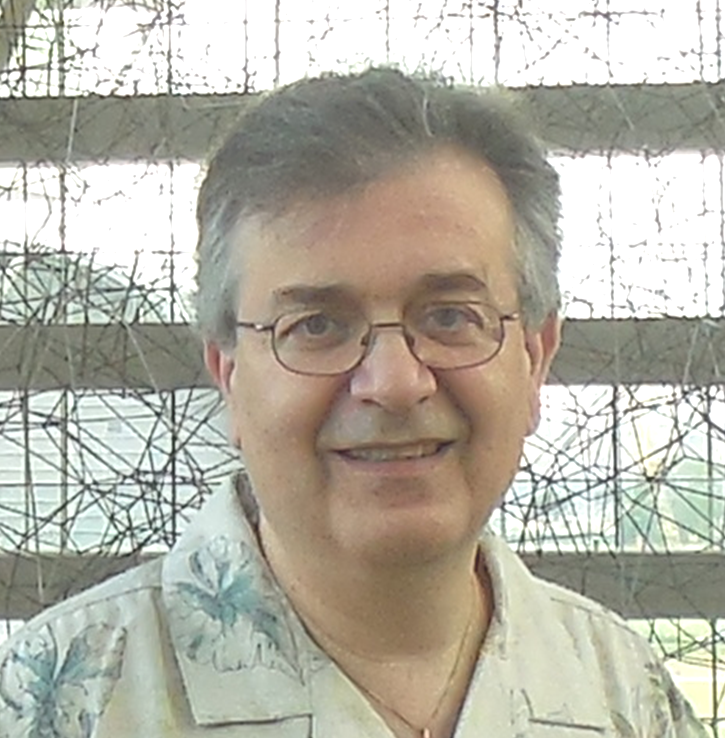
Professor Kanatzidis obtained his BSc from Aristotle University (Greece) and his PhD in chemistry from the University of Iowa. He was a University Distinguished Professor of Chemistry at the Michigan State University before moving to the Northwestern University, where he heads a research group focused in solid-state inorganic chemistry. Mercouri is also the editor-in-chief of the Journal of Solid State Chemistry and Senior Scientist at the Materials Science Division of the Argonne National Laboratory.

See below our interview with the lecturer.

SBPMat: – Could you exemplify some possible concrete applications of high-performance thermoelectric materials in daily life? In your opinion, how far is the real use of thermoelectric materials from the state-of-the-art?

Mercouri Kanatzidis (M.K.):  – Thermoelectric materials can be applied to internal combustion engines to help harvest exhaust heat and generate electricity that can be applied to the vehicle’s electrically driven devices. This will raise the overall efficiency of the vehicle. There is a staggering amount of energy in exhaust heat of a fossil fuel powered engine. Major auto companies in the US, Germany and Japan are actively developing this technology. Depending on the price of oil, government regulations and cost of the technology the implementation of thermoelectric materials in autos, trucks, etc may take anywhere from a couple of years to decades.

SBPMat: – Which are the thermoelectrics´ next challenges for materials science and engineering?

M.K.: – The current state of performance of thermoelectric materials is adequate for commercial applications. The next challenges lie in the fabrication of actually thermoelectric modules and devices that will pass the necessary testing before final application. Challenges such as long term stability, low cost assembly and fatigue testing need to be addressed.

SBPMat: – Can you share with us, very briefly, the story of the genesis of your panoscopic approach to highly efficient thermoelectric materials?

M.K.:  – About ten years ago we had a novel material composition which had two unlikely characteristics. It had a very high electrical conductivity and thermoelectric power combined with surprisingly low thermal conductivity. The thermal conductivity was lower than theory could explain. This material was first of its kind (referred to as LAST for lead, antimony, silver, tellurium) at that time to display a breakthrough ZT of 1.6, nearly double of the then state of the art. Because of this we delved deeply onto its “guts” using transmission electron microscopy in collaboration with Professors Polychroniadis and Frangis of the University of Thessaloniki in Greece. A few months after they received the samples they reported to us on their findings with a somewhat disappointing note saying that the materials were very complex and inhomogeneous on the nanoscale, therefore impure. In discussions I detected reluctance to deal with the material again. They did. In my lab however we immediately recognized that this very inhomogeneity and the nanoscale precipitates it contained was the root cause of the surprisingly very low thermal conductivity and the very high ZT. This was consistent with theoretical predictions emerging at the time that nanoscale precipitation in a matrix can result in great reduction in thermal conductivity. So we got very excited. We had discovered nanostructuring in thermoelectrics. After our paper appeared in Science in 2004, the thinking of the thermoelectrics community quickly shifted from pursuing single phase materials to focusing on more complex two-phase nanostructured materials. Now the great majority of activity in the community is in nanostructured materials.

The new paradigm led to additional breakthroughs such as how to design and synthesize nanostructured materials, and to higher ZT as well. The panoscopic approach was realized when we were challenged to create two-phase materials that did not degrade electronic transport through them. While matrix of a thermoelectric material with a small amount of a second phase in it can achieve unprecedented levels of low thermal conductivity, it nevertheless is an “impure system” and electrons transported through such a medium know this. Thus, in most cases the second phase degrades the electrical properties and higher ZTs are not realized.

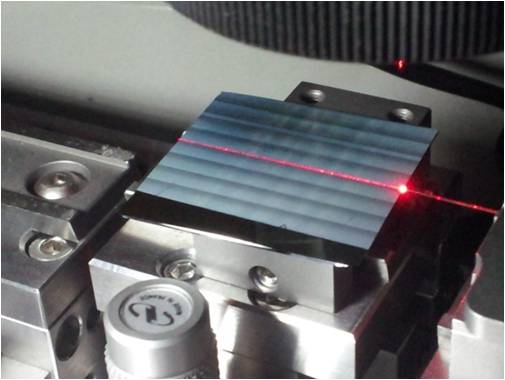
State of the art thermoelectric: (a) A mesoscaled granular composite of broad range of grain sizes to scatter long mean free path phonons. (b) Wwithin a single grain a ubiquitous nanostructuring is in place of a second phase that scatters short and intermediate mean free path phonons. The (a)/(b) combination results in a very low levels of thermal conductivity.

My group members Kanishka Biswas and Lidong Zhao and our collaborators Ctirad Uher and Vinayak Dravid noticed that when SrTe was added to p-type PbTe in as much as 2-4% concentration the hole carriers were behaving as if no SrTe was there. The explanation to this puzzle came from the recognition which was backed by theoretical calculations that the conduction bands in PbTe and SrTe were similar in energy and the holes as a result could traverse the SrTe nanoparticles with no scattering. This led to the concept to band alignment between matrix and second phase. The PbTe-SrTe material with its nanostructuring and band alignment was another material with ZT~1.7. As we realized that different ZT improving mechanisms could be integrated in a single system without the effect of one interfering with those of the other, we extended our approach to trying to integrate all possible mechanisms. We managed to properly introduce electronic band engineering for thermoelectric power enhancement and mesoscale engineering for further reduction on the thermal conductivity to reach the point we now are a record breaking ZT of 2.2. This is very exciting and bodes well for further breakthroughs in the near future.

SBPMat: – Feel free to leave any other comments about your plenary lecture for our readers.

M.K.: – My lecture will be aimed at reaching the broad but scientifically informed audience at the meeting to outline the current state and thinking in the field of thermoelectrics.

See the abstract of Mercouri Kanatzidis plenary lecture “Electrical power from heat: All-scale hierarchical thermoelectrics with and without earth-abundant materials”.

See Professor Kanatzidis biographical sketch.

Processo seletivo na USP para contratação de docente por prazo determinado, em Física da Matéria Condensada por prazo

Estão abertas, de 15 a 24 de julho de 2013, as inscrições ao Processo Seletivo para a contratação de 1 (um) docente, por prazo determinado, como Professor Contratado III (doutor), em Regime de Turno Parcial, em jornada de 12 (doze) horas semanais de trabalho, no Departamento de Física dos Materiais e Mecânica do Instituto de Física da Universidade de São Paulo, na seguinte área de conhecimento: Física da Matéria Condensada. A contratação vigorará até 31 de dezembro de 2013. O salário é de R$ 1.592,11.

O formulário de inscrição e o edital estão disponíveis no site http://web.if.usp.br/ataac/view/concurso. (Edital IF-53/13)

Informações adicionais poderão ser obtidas na Assistência Acadêmica do IFUSP. Telefones 3091-6020 / 3091-7000.