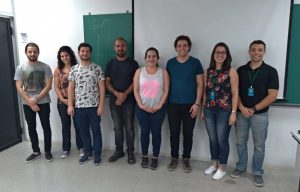

In 2004, three young chemistry graduates from the Brazilian Federal University of São Carlos (UFSCar) created a nanotechnology-based materials company. Today, Nanox has about 30 products developed, a technological platform consisting of seven patents (three worldwide, one in Europe, one in the United States) and over 200 clients, not only in Brazil, but also in 13 other countries.
Nanox’s business is to develop, produce and market nanotechnology-based materials whose properties (bactericidal, fungicidal, repellent, anti-sweat, antiallergic…) add value to a particular product (packaging, flooring, carpet, t-shirt…). Thus, Nanox provides its customers (companies in various segments) nanomaterials that can be easily incorporated into their products, which bring tangible benefits to end consumers.
Today Nanox’s flagship products are silver-based antimicrobial additives. The company has developed a series of such products within three broad lines: solution additives (liquid), powder additives (solid), and additives already mixed with polymeric materials.
As shown by the ratio between the number of products launched and the company’s years of existence (about 30 innovations in 15 years), innovation is part of everyday life at Nanox. Generally, the process is as follows. In its contacts with the market, the Nanox team identifies latent demands that can be met by applying the technologies that the company has mastered. The team then validates their innovation ideas with potential customers and begins to work on product development.
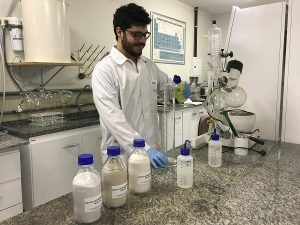
At its 500 m2 headquarters, located in the city of São Carlos (state of São Paulo, Brazil), Nanox has about 150 m2 of internal laboratories for research and development and quality control. There are three physicochemical laboratories, one for materials engineering and one for microbiology, in which the team performs bactericidal and fungicidal efficiency tests. The company has two researchers (one master’s and one doctor) dedicated to R&D activities, but, depending on the project and the development phase, the team may include up to five people. In addition, Nanox partners with external research laboratories to perform activities where there is no internal expertise and for those requiring expensive equipment such as electron microscopy or X-ray characterization of materials.
History and cases
It all started at a UFSCar research center supported by the São Paulo Research Foundation (Fapesp), the Multidisciplinary Center for the Development of Ceramic Materials (CMDMC), today the Center for the Development of Functional Materials (CDMF). There, under the guidance of Professor Elson Longo, friends André Luiz de Araujo (who worked at the company until 2011 and to date remains a shareholder), Daniel Tamassia Minozzi (current COO) and Luiz Gustavo Pagotto Simões (current CEO) were doing their undergraduate and master´s research.
In 2004, at the behest by the Brazilian home appliance company Multibrás to CMDMC, the trio saw an opportunity for entrepreneurship in the nanotechnology-based materials segment, which at that time had few products and very few companies in Brazil.
The project consisted of developing nanostructured films to protect metallic surfaces. To make it possible, Nanox obtained funding from Fapesp’s Pipe program, dedicated to supporting innovation research in small companies. This would be the first of seven fundings for Nanox from the Pipe program to support various phases of technology and product development, among other Brazilian public federal fundings.
In 2005, Nanox sold a product for the first time. It was a titanium dioxide nanoparticle film applied in the filters of hair dryer used in beauty salons, manufactured by the Brazilian company Taiff. The bactericidal and fungicidal effect of the nanomaterial guaranteed more salon hygiene and consumer health. The product earned Nanox a Brazilian award (Finep Innovation Award) in 2007, as well as widespread publicity and visibility.
In 2006, realizing that there was plenty of room for Nanox innovations in plastic products, the partners decided to start developing nanomaterials in the form of additives that could be incorporated into various polymers. Through partnerships with companies (Nanox customers), these innovations have reached end-consumers. An example is PVC films (those used in the home environment to pack cut fruits and other foods) with antibacterial shield. In 2014, the Brazilian company AlpFilm launched a line of films with additives from Nanox, whose antibacterial and antifungal effect allows conserving packaged foods longer by avoiding their degradation. Another Nanox case is a packaging that doubles the validity of fresh milk thanks to the antibacterial effect of the additive. The world’s first bactericidal milk bottle began to be used by the Brazilian agro-industry Agrindus in 2015, and was the headline for food and packaging industry websites and magazines in several countries.
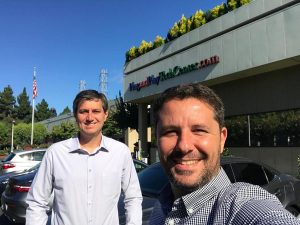
In 2009 there was another milestone in the history of Nanox. A presentation the company prepared for a General Electric team in Brazil ended up at the company’s Mexican branch and generated so much interest that, 15 days later, Nanox was undertaking its first export, which consisted of plastic additives to make refrigerator boxes in Mexico. From that moment on, Nanox began to look towards the foreign market, starting a strategy that includes investments in international fairs, representatives in several countries and training the team to deal with bureaucratic issues inherent to the export process and the introduction of products in different countries. This journey is currently reflected in exports that represent 12% of the company’s revenues, with recurring sales to Argentina, Chile, Colombia and Mexico; halfway toward the US market, and distributors in countries from Latin America, Eastern Europe and Asia. In addition, this year Nanox participated in a business acceleration program for Plug and Play Tech Center, a Silicon Valley-based innovation platform that has hosted companies such as Dropbox and PayPal. Nanox was one of 15 companies selected from 1,000 companies worldwide.
See our interview with Luiz Gustavo Pagotto Simões, PhD (2009) in Chemistry from UNESP, co-founder and current CEO of Nanox.
B-MRS Newsletter: What were the most important factors that allowed Nanox to develop in its various phases?
Gustavo Simões: It was a sum of factors. Financial resources, both public and venture capital – the latter from 2006 on, when the company became a Ltd., as well as the work of entrepreneurs and the team to validate products and bring them to market. We always use the resources of Fapesp and Finep to lower capital acquisition costs for development, especially at some crucial moments of the company. For example, at a time when we had a technology but its scale was too small, we got a Pipe phase 3 that allowed us to scale up production. The investor was also important; it improved the administrative and commercial structure of the company. The most important thing was to validate everything we thought could be a Nanox product, and you can’t do it without money or personnel. In addition, we must thank Professor Elson Longo, who accompanied Nanox in all its phases as a supporter, scientific advisor, partner, promoter…
B-MRS Newsletter: What were the main difficulties Nanox has faced thus far?
Gustavo Simões: In fact, trading nanotechnology in Brazil is not easy. At that time, many people said they wanted to have nanotechnology, but very few took a chance on this. We were very lucky to have some key partners like Taiff and IBBL. These companies decided, in a market as competitive as Brazil, to differentiate themselves and add a product like ours into their product. So the difficulty of getting customers has always been among the greatest issues. And also to survive this madness that is Brazil for entrepreneurship. The exchange rate variations, for example, have a direct impact on the company, and we have to get around such situations, this requires creativity and flexibility. It is rare to plan and get out what you have planned.
B-MRS Newsletter: Nanox is recognized worldwide and exports its products to various countries. Tell us a little about Nanox’s internationalization and what it is like for this Brazilian company to compete in foreign markets.
Gustavo Simões: Latin American markets are similar to Brazil’s market. They are less regulated, which increases the possibility of competition because there may always be a local player that competes with you. On the other hand, these markets are easier to access than the more regulated markets, such as the US, where you need multiple regulatory agency registrations and licenses, which require a number of expensive studies and tests. Not everyone is willing to do this. So, higher regulation creates a barrier to enter the market which decreases the number of competitors. We’re in the process of getting licenses to be able to sell our products in the United States, and we’ve already obtained some. In some products, we will only have three competitors in the United States.
In addition to this regulatory issue, other factors that hinder export are cultural issues, such as language. In Latin America, Brazil is the only Portuguese-speaking country. In Brazil there are also some bureaucracies, for example in banks, which hinder exports and may also make a business line not worth it. This has to change.
So, internationalization is quite expensive. You have to attend fairs abroad and have a team trained in the export bureaucracy and regulation of the markets you want to reach. However, I believe that in products like ours, more technology intensive and less labor intensive, Brazil is very competitive. We even have incentives to export. If you export, you do not pay some taxes and the product has a more competitive price abroad. Exports account for approximately 12% of Nanox’s revenues, but this percentage is expected to grow. After the last international fair in which we participated (in the plastics segment) we received orders from Iran, India, Pakistan…
B-MRS Newsletter: What do you think is Nanox’s main contribution to society?
Gustavo Simões: A contribution is the training of human resources, always with very good interaction here. A lot of people have worked here and today they are doing really well working in multinational companies. Moreover, I believe it’s important to share through media, lectures, etc. our experience from the point of view of entrepreneurship, to show that there is a different way of working, besides working in a private company or as a Professor. It is important to show that there is a possibility and that there are incentives and support in the country, perhaps not as many as we would like, but much more than in other places. In addition, the other contribution we make is our products for food safety and better quality of life. But, as Elson [Longo] says, if I can leave a line in the literature, that’s a lot; now, if I can motivate a person to undertake and run a project, this is very important.
B-MRS Newsletter: What is your goal/dream for Nanox?
Gustavo Simões: We want to consolidate internationalization, and we want to place ourselves as global players. We are making a very strong move, even though the dollar is crushing us because we are earning in reais [Brazilian currency] and spending in dollars. Over the next 5 years, we expect to have a larger international market share in revenues, so much that we have opened an office in the United States and are talking to investors to get funds over there.
B-MRS Newsletter: Leave a message for people who are considering entrepreneurship.
Gustavo Simões: I would say that entrepreneurship is worthwhile and necessary. I believe that the technical knowledge we receive in Brazil in our undergraduate courses, for example in Materials, leaves nothing to be desired elsewhere in the world. We have to convert knowledge into wealth, and there is only one way to do that – which is through entrepreneurship.
I think this issue of university-business interaction and spin-offs is the future for us to create a differentiated value-added economy in a country where we have a huge consumer market. If we can use all these financial and human resources, these extremely well-trained people, and generate products and services for the economy, I think it will be a very promising future.
 Forty-nine (49) proposals were submitted by the international scientific community within the XIX B-MRS Meeting + IUMRS ICEM symposium call. The number of submissions is one of the largest in the history of B-MRS events. “We received proposals from 18 different countries,” says Professor Gustavo Dalpian, chair of the event.