The special issue of IOP Conference Series dedicated to winners of the Bernhard Gross Award 2014 is already published on the web, with free and open access.
Through the Bernhard Gross Award, a prize for undergraduate and graduate students, the Brazilian Society for Research in Materials (SBPMat) annually distinguishes the best papers (one oral presentation and one poster, at the most) of each of the symposia of the society annual meetings. In 2014, the award highlighted twenty papers presented during the XIII SBPMat Meeting, which took place in the city of João Pessoa (PB) from September 28 to October 02, 2014.
The award-winning authors were invited by SBPMat to submit to peer review their works in the form of scientific articles, aiming at publishing them in the IOP Conference Series, dedicated to the publication of papers presented at scientific meetings. Among the articles submitted, 8 were accepted for publication and comprise this special issue.
Brazilian Materials Research Society (SBPMat) newsletter
News update from Brazil for the Materials community
Special issue: XIV SBPMat Meeting
Summary
The 14th edition of the annual meeting of the Brazilian materials research society (SBPMat), held in Rio de Janeiro (Brazil) from September 27 to October 1, 2015, featured internationality, interdisciplinarity and a massive and active participation of students. Internationality for its more than 300 attendants, speakers, exhibitors and organizers who came from 40 American, European and Asian countries. Interdisciplinarity in the broad spectrum of topics that were addressed within the technical sessions, invited speeches and plenary lectures, in which materials science and engineering met diverse other fields, such as neurosciences, electronics, medicine and computer science, among many others. Concerning the participation of students, not only they represented almost 50% of the attendants, but also they organized a symposium by themselves and exhibited enthusiasm and capability in scientific presentations and discussions. Another highlight of the meeting were the plenary lectures. The organization of the meeting brought seven world leader scientists on diverse research areas who captivated the public with issues on the frontier of human knowledge. Moreover, the XIV SBPMat Meeting set a new record on the number of participants (2,000) and symposia (26 symposia and 2 workshops). According to the organizers and attendants that we were able to hear, the meeting was a success!
In numbers
– 2,000 attendees (20% more than the previous meeting): 950 undergraduate, master and doctoral students, and 1,050 Professors and other professionals.
– 85 % from Brazil, 15 % from abroad.
– 40 countries.
– 985 institutions.
– More than 2,300 works presented: about 1,800 posters, 350 oral presentations and 180 invited speeches.
– 7,613 authors.
– 26 symposia and 2 workshops.
– 7 plenary lectures.
– 17 rooms for simultaneous oral sessions.
– 32 stands in the exhibition.
– 35 prizes bestowed.
Reports
– Photoreport of the meeting on a Picasa web album. See here.
– Multimedia report of the meeting with some pictures, a video and embedded files of the plenary talks (on our site). See here.
Awards
– 35 prizes were bestowed to participants of the meeting, mainly students, by SBPMat, E-MRS, IUMRS and Horiba. The awards distinguished the best posters and oral presentations presented at the meeting. See the list.
Statements
– Video: participants, organizers and exhibitors of the XIV SBPMat Meeting shared with us their impressions of the event. See the videos.
Rodrigo Martins (Portugal, E-MRS immediate past president and IUMRS officer). He highlights the talent of the chairs to bring the right persons to discuss the most advanced topics in materials science and technology. He says this is the best meeting ever organized in Brazil.
Marco Cremona and Fernando Lázaro Freire Junior (Brazil, meeting chairs). They emphasize the broad spectrum of material science topics that was covered in the plenary lectures. They highlight the big number of students in the event and the active scientific discussion of the poster sessions. Besides, they compare the total attendance of this year´s meeting (2,000 people) with the first edition of the event (300 participants), also held in Rio de Janeiro in 2002.
Ahmet Hikmet Ucisik (Turkey, researcher at Atilim University). In Brazil for the 4th time, being the first one in 2007, he has noticed progresses of the country in materials science and engineering and the enthusiasm of young people.
Beth Mayes and Susan Curtis (USA and UK, Institute of Physics – IOP). They feature the way that the poster sessions were designed and the good attendance of the sessions.
Daniel Bahro (Germany, KIT), winner of Horiba and Bernhard Gross prizes. Electrical engineer. PhD student. Attending a conference for the first time. He presented his research results on organic tandem solar cells and won the prize for the best oral presentation of the meeting. So many young and enthusiastic people in the SBPMat meeting impressed him.
Victor R. Jauja Cana (Peru, Universidad Nacional de Ingeniería), Bernhard Gross prize winner. He has just finished a graduation course in Chemistry. He searched on the web for a conference to attend to present his development of an electrochemical sensor, decided to come to the SBPMat meeting, got financial support, had an oral presentation and, eventually, won a Bernhard Gross prize.
Lucas Pintol Nishikawa (Brazil, USP), recipient of a Bernhard Gross prize.He is starting a master course in Materials Engineering. In the SBPMat Meeting, his first conference, he won a prize for the oral presentation of a research work on heat treatment in steels. He expresses his surprise over the size and internationality of the SBPMat meeting.
And the last words, with Prof. Roberto Mendonça Faria (Brazil, SBPMat president), who says he was very happy to see, in the event, SBPMat growing and young people participating. He also stresses the high quality of several works he saw.
For the best oral presentation and the best poster of the meeting.
Poster: Lucas Kling e Silva. “Magnetic characterization of steels AISI A 366, AISI S 235 and AISI 304 using Bitter tecnic ( Ferrofluid)”.
Oral: Daniel Bahro. “Understanding The External Quantum Efficiency of Organic Homo-Tandem Solar Cells Utilizing a Three-Terminal Device Architecture”.
———————————————————————————————————
IUMRS AWARD
For the 3 best posters of the meeting.
Gold prize: Leandro Merces (Laboratório Nacional de Nanotecnologia). “Fabrication and characterization of CuPc molecular junctions: investigation of the contact configuration”.
Silver prize: Edna Regina Spada (Instituto de Física de São Carlos). “Understanding light emission and reflection in spherical submicron mirrors arrays by confocal microscopy”.
Bronze prize: Nagyla Alves de Oliveira (Instituto de Química – UNESP). “Low-temperature down-conversion luminescence behavior of nanosized phosphors with potential application in optical devices”.
——————————————————————————————————
BERNHARD GROSS AWARD
A recognition of SBPMat to the best oral and poster contributions of each symposium presented at the annual meeting of the society. The choice is made by a committee selected by the coordinators of each symposium. Bernhard Gross was one of the pioneers of Materials research in Brazil.
Symposium A.
Oral: Guilherme Monteiro Torelly. “Probing the deposition of ultra-thin InAs layers on GaAs and their evolution towards the nucleation of 3D InAs islands”.
Poster: Raquel da Silva Brito. “Application of Natural Dyes of Brazilian Cerrado in the assembling Dye-sensitized solar cell”.
Symposium B.
Poster: Caio José Perecin. “Magnetite Nanoparticles Encapsulated with PCL and Poloxamer by Nano Spray Drying technique”.
Symposium C.
Poster: Aline Marques de Oliveira. “A Comparison Study on Nanomembranes for Oil Spill Clean-up Devices – The Tea-bag Like Configuration Case”.
Symposium D.
Oral: Victor Raúl Jauja Cana. “Development of electrochemical sensor of glassy carbon electrode modified with Hap-MWCNT composite by electrophoretic deposition for detection of trace cadmium”.
Poster: Rebecca Faggion Albers. “Synthesis and characterization of graphene and graphene/nanoparticles composites obtained from graphene oxide reduction direct by the modified polyol process”.
Poster: Rodrigo Morais Menezes dos Santos. “XAS/WAXS in situ study of LDH thermal decomposition and recovery”.
Symposium G.
Poster: Ramón Raudel Peña Garcia. “Thickness effects in the properties of hexagonal array of nanosized Ni hollow-spheres”.
Symposium K.
Oral: Bruno M. Serafim. “Electrospinning activation of highly porous PMMA microfibers for diagnostic applications”.
Poster: Fernanda Guerra Lima Medeiros Borsagli. “Effect of sugarcane bagasse composition in an array of pet in thermal morfology and mechanical evaluation for subsequent application as an insulator”.
Symposium M.
Oral: Lucas Pintol Nishikawa. “Quenching and Intercritical Tempering of Microalloyed Pipeline Steel”.
Poster: Lucas Kling e Silva. “Magnetic characterization of steels AISI A 366, AISI S 235 and AISI 304 using Bitter technic (Ferrofluid)”.
Symposium N.
Oral: Elaine Cavalcanti Rodrigues Vaz. “Spectroscopic Characterization of Functionalized CNT as Nano-antennas in Light Conversion Nanostructured Devices”.
Poster: Airton G. B. Junior. “Structural and optical properties optimization of Ba2SiO4:Eu3+(5%) red nanophosphor obtained via sol-gel route for white LED application”.
Symposium O.
Oral: Rafael dos Santos Carvalho. “Influence of intramolecular spin-orbit coupling on organic magnetoresistance effect”.
Poster: Bruno Rostirolla. “P3HT:PCBM based metal-insulator -semiconductor capacitors under visible light stimulation”.
Symposium Q.
Poster: Osmando Ferreira Lopes. “Controlled Synthesis of BiVO4 Photocatalysts: Evidence of the Role of Heterojunctions on their Photocatalytic Activity driven by Visible-Light”.
Symposium S.
Oral: Daniel Muniz Oliveira. “Obtainment and characterization of a new polymer formulation based on sodium alginate and fish scales suitable for extended release of herbicides”.
Poster: Marco Antonio Voinarovicz. “Chemical Solution for Recycling of Long Life Packaging”.
Symposium V.
Oral: Ronaldo José Farias Corrêa do Amaral. “Platelet-rich plasma modulates mesenchymal stromal cells chondrogenesis in collagen-hyaluronic acid scaffolds according to concentration”.
Poster: Andrei Sakai. “Tumorigenic cell membrane characterization trough nanostructured thin films: influence of the lipid composition upon biochemical signaling”.
Symposium W.
Poster: Isadora S. Deschamps. “Bioabsorbable scaffolds based on β-TCP and polymer used in oral implantology”.
Symposium X.
Oral: Maiara Emer. “Nanoparticle-bacteria interaction study based on surface functionalization of nanometric structures”.
Poster: Geovânia Cordeiro Assis. “Polystyrene Nano-foams impregnated with SnO2 nanoparticles by TIPS: Application in heterogeneous photocatalysis”.
Poster: Bruno Santos de Oliveira. “Enhancing Manufacturing Process of Template-Stripped Gold Pyramids for Near-Field Optical Microscopy”.
————————————————————————————————
E-MRS AWARD
For the best oral presentation and 2 best posters of symposium C.
Best oral presentation: Monique Gomes Teixeira (Universidade Federal de São João Del Rei). “Synthesis, characterization and photocatalytic application of ZnS nanocrystals”.
Best Poster, 1st position: José Antonio Souza (Universidade Federal do ABC). “ZnO microtubes decorated with nanowires”.
Best Poster, 2nd Position: Italo Odone Mazali (Universidade Estadual de Campinas). “Relation between the composition and the catalytic activity of the bimetallic noble metal nanoparticles with tunable compositions supported on organofunctionalized mesoporous silica”.
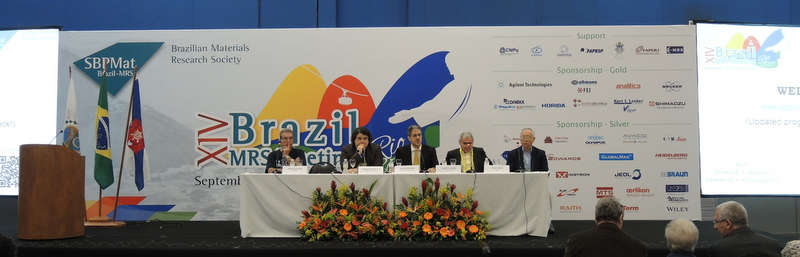
Sunday, September 27.By 6:45 pm. Hundreds of people enter the plenary room of the Convention Center “SulAmérica”, in Rio de Janeiro (Brazil) for the opening ceremony of the 14th annual meeting of the Brazil Materials Research Society, whose acronym in Portuguese is SBPMat. The opening table is composed by the chairmen of the event, Prof. Marco Cremona (Brazil) and Prof. Fernando Lázaro Freire Junior (Brazil), as well as the present SBPMat president, Prof. Roberto Mendonça Faria (Brazil), the immediate past president of the European Materials Research Society (E-MRS), Prof. Rodrigo Martins (Portugal), and the general secretary of the International Union of Materials Research Societies (IUMRS), Prof. Robert Chang (USA). Behind them, a big banner shows the logos of dozens of institutions and companies that gave financial support to the event.
At the opening table, from the readers´ left: Prof. Rodrigo Martins (Portugal, E-MRS immediate past president and IUMRS officer), Prof. Fernando Lázaro Freire Junior (Brazil, chair of the event), Prof. Marco Cremona (Brazil, chair of the event), Prof. Roberto Mendonça Faria (Brazil, SBPMat president), and Prof. Robert Chang (USA, IUMRS general secretary).
Near 1,000 attendants are present at the ceremony, which starts with the Brazilian national anthem. The chair Prof. Cremona welcomes the participants to the meeting. Prof. Robert Chang, who was president of MRS (Materials Research Society) in 1989 and founded IUMRS in 1991, convokes the participants of all countries to try to solve together the most important global challenges for materials research, related to health, food, environment, transport etc. Representing E-MRS, Prof. Martins, who presently takes care of Global Leadership and Service Award at IUMRS, emphasizes his desire of promoting international connections. Prof. Faria talks a little bit about Brazil, which, as well as other developing countries, is very rich in raw materials but needs to add value to its products by means of science and technology.
After the opening, Prof. Eloisa Biasotto Mano (Brazil) goes to the stage for the Memorial Lecture “Joaquim da Costa Ribeiro“, which is a distinction bestowed annually by SBPMat on a Brazilian researcher with outstanding career in the field of Materials. This 91-year-old scientist pursued international scientific education at a time when most women were illiterate in Brazil, and founded in the Federal University of Rio de Janeiro (UFRJ) the first research group in polymers in the country. This group later became the Institute of Macromolecules (IMA), which was directed by Eloisa until she retired. In the memorial lecture, she talks about macromolecular materials and, using a representation of a polyethylene molecule made by herself with wire, she shows how these kind of molecules behave in response to their big size. A group of Prof. Eloisa´s disciples (among them, the present director of IMA) assists her with the presentation, showing affection, gratitude and admiration for her . After the talk, many attendants of diverse ages make a queue to take a picture with this protagonist of the dawn of polymer science in Brazil. Eloisa, who is professor emeritus of UFRJ, poses for all the pictures she is ask to. At the end of the photo session, she accepts our microphone and leaves a message for the young people starting a carreer in science:
Right after the memorial lecture, in the same venue, the participants enjoy the welcome cocktail while meeting friends and collaborators. The cocktail is animated by live “chorinho” music, an instrumental Brazilian popular genre original from Rio de Janeiro.
———————————————————————————————————-
PLENARY LECTURES
Nader Engheta
Nader Engheta.
Monday, September 28.At 8:30 in the morning, the plenary room is full of attendants waiting to learn about metamaterials and the extreme behavior of waves interacting with them in the first plenary lecture of the event. The speaker is Nader Engheta, the H. Nedwill Ramsey Professor of Electrical and Systems Engineering at the University of Pennsylvania (United States). This Iranian-born scientist is a recognized world leader in research on metamaterials, and holds an H number of 69. Through experimental and theoretical research, Engheta and his collaborators have created such unconventional things as nanocircuits made of metamaterials that function as optical filters. Since the beginning of the talk, Engheta captivates the audience with some history of science and with a world of structures created by using particular composite metamaterials with particular sizes and geometries and arranged in particular ways with the aim of obtaining unconventional interaction with light and other waves.
In the afternoon, at 3:30, more than 400 people attend the second plenary lecture, which is about glass-ceramics (materials formed through controlled crystallization of certain glasses). The speaker is the Brazilian researcher Edgar Zanotto, Professor at the Federal University of São Carlos (UFSCar), in Brazil, where he founded and heads the Vitreous Materials Laboratory (LaMaV) that assembles a big international team. Zanotto, who is a world-renowned expert on glass-ceramics, presents in his lecture many useful applications of these materials, such as cooking hobs or artificial bones and teeth. He also mentions the scientists who, along 60 years of glass-ceramics history, contributed to the advancement of research on that topic. In spite of those contributions, the comprehension of some aspects of the formation of glass-ceramics is not complete, he says, but that is not a problem for glass-ceramics fabrication and applications. It´s just an opportunity for fundamental scientists.
Paul Ducheyne. Biomaterials. Merging Materials Science with Biology.
Paul Ducheyne.
Tuesday, September 29.8:30 am, time for the third plenary lecture of the event. The lecturer, Prof. Paul Ducheyne, also comes from University of Pennsylvania (USA), where he directs a multidisciplinary center for bioactive materials and tissue engineering research. An authority on biomaterials field, Ducheyne is the editor in chief of a six-volume book on biomaterials published in 2011. In the talk, he shows a series of biomaterial-made devices, grafts, scaffolds etc., most of them already being commercialized, that actively interact with the body, either by promoting tissue formation (for example, bone) or by releasing drugs for diverse treatments. Ducheyne presents their effects on solving health problems, numbers about their markets, and scientific recent advances that can make them even more effective.
Some hours later, at 3:30 pm, hundreds of participants cluster again, this time around Prof. Ulrike Diebold, whose research group at UT Wien (Austria) is devoted to the understanding of fundamental mechanisms and processes occurring in surfaces at the atomic scale. Prof. Diebold catches the audience attention from the beginning to the end by showing, through scanning tunneling microscopy images, how she spies the behavior of atoms on the surface of metal oxides – topic in which she is a worldwide leader researcher. In particular, she reveals two secrets of metal oxide surfaces: the first one about how oxygen adsorbs on titanium dioxide and the second one about how active single metal atoms are in oxidation process in magnetite.
Wednesday, September 30. In the plenary lecture of the morning, the audience is transported again to the social-impacting world of biomaterials by Prof. George Malliaras, Greek-born, working at École Nationale Supérieure des Mines de Saint-Étienne (France), where he heads the Department of Bioelectronics. Malliaras has an H index of 64. After many years working on organic electronics, he entered the new field of organic bioelectronics and obtained impacting results. His research is about electronic devices made of conducting polymers that match properties of living tissues. These devices are used for interfacing with human brain – a “natural electronic device”. The final purpose is to study brain activity or diagnose and even treat neurological diseases such as epilepsy. An example of device is a transistor that enables boosted in vivo recording of brain activity with low invasion. As suggestions for the materials community, Malliaras highlights the importance of collaboration with neuroscientists and physicians and the challenge of improving the understanding of electronic transport and structure.
Ichiro Takeuchi. Combinatorial Approach to Materials Discovery.
Ichiro Takeuchi.
In the talk of the afternoon, the speed of science progress accelerates following the beat of the combinatorial approach. Prof. Ichiro Takeuchi, from University of Maryland (USA), explains how his group manages to optimize materials and properties discovery. As well as in lottery one can buy a big number of tickets to have more chances to win a prize, in materials discovery scientists can produce a huge number of combinations of elements to obtain a compound with desirable properties. For example, for quaternary compounds, millions of combinations are possible, from which only 0,01 % are known. In Prof. Takeuchi´s lab, machines for thin film deposition used with masks work night and day to create patchwork-like samples containing libraries of similar compounds. Then, the libraries are characterized by rapid tools, giving information about the properties of several compounds at the same time. Coupled with appropriate theory and computational simulations, these high-throughput experiments become real materials discovery engines.
Claudia Draxl. On the Search of Novel Materials: Insight and Discovery though sharing of big data.
Claudia Draxl.
Thursday, October 1st,8:30 am. In the last plenary lecture of the event, Prof. Claudia Draxl (Humboldt University, Germany) publicly wonders how to make available the huge amount of data resulting from experiments around the world, high-throughput screening, computer clusters etc. Why to do that with scientific data? For confirmation, broad dissemination in society, sharing with distant collaborators and reuse with new purposes. With that aim, Prof. Draxl and collaborators from European countries are facing the development of a repository of materials raw data, called Novel Materials Discovery (NoMaD), which hosts, organizes and shares materials data on the web.
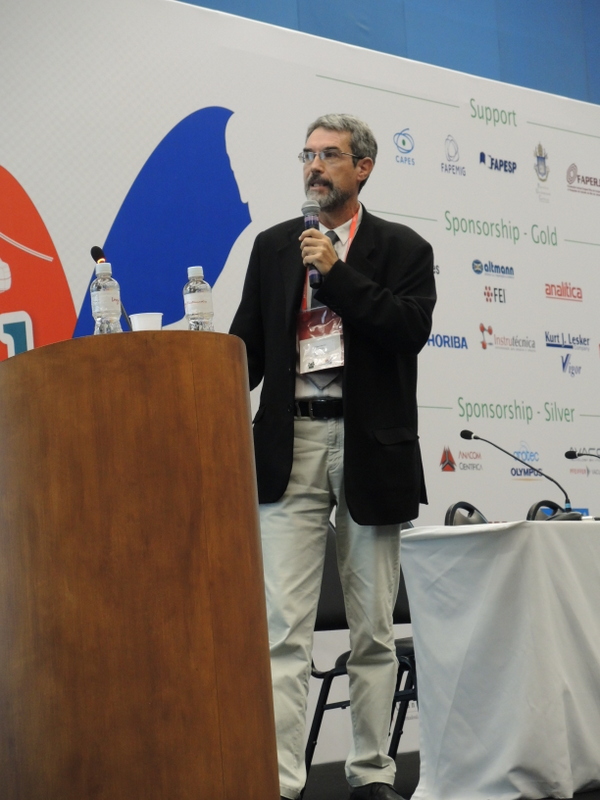
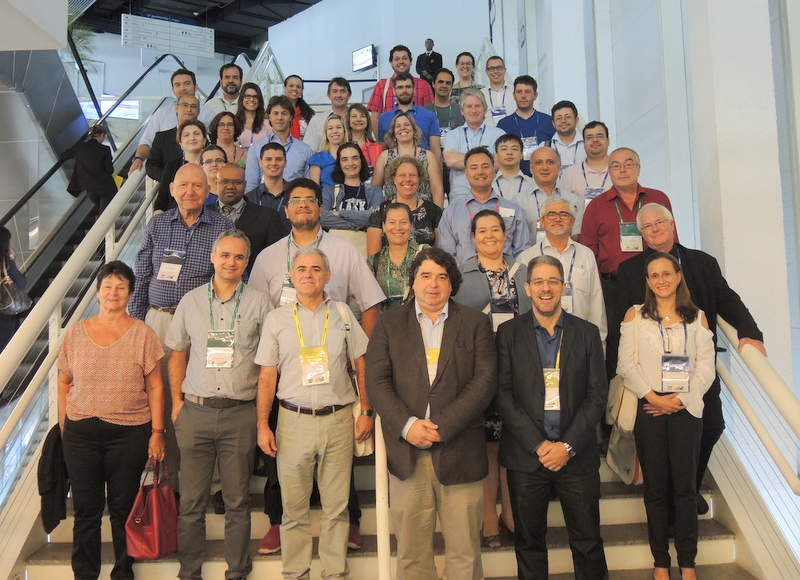
Some of the symposia coordinators with the meeting chairs and the SBPMat president.
The symposia at SBPMat annual meetings are selected from proposals that can be submitted to the event committee by any scientist from anywhere in the world. This edition of the event encompassed 26 symposia (including the satellite event “8th International Summit on Organic and Hybrid Solar Cells Stability”) and 2 workshops, and it registered symposia coordinators from Argentina, Denmark, England, France, Germany, Italy, Ireland, Japan, Portugal, Spain, Swiss, USA, and, of course, Brazil. Within the symposia, near 190 invited speeches and more than 2,000 technical works are presented and discussed in oral and posters sessions, on a wide range of subjects going from carbon nanostructures to biomaterials, from characterization techniques to computer simulation, from materials for sustainable development to safe use of nanomaterials.
While some symposia have been held year after year in the SBPMat meeting, the University Chapters symposium was a novelty of this year meeting. It was completely organized by students from diverse points of Brazil who are coordinators of the SBPMat University Chapters. The chapters are organized teams, affiliated with the society, composed of graduate and undergraduate students working in materials field. The members of these groups carry out diverse activities that complement their academic education. The students from the existing chapters, which were eight in number up to the moment of the meeting, faced the challenge of organizing a symposium – a task that is usually done by senior researchers.
In fact, students have not only active but also massive participation in the XIV SBPMat meeting. Almost half of the attendants (950 people) were master, doctoral and even undergraduate students doing research on materials field. In Brazil, the federal agency for research support, CNPq, has a program called “scientific initiation” that grants scholarships to undergraduate students to conduct research under the supervision of a Professor.
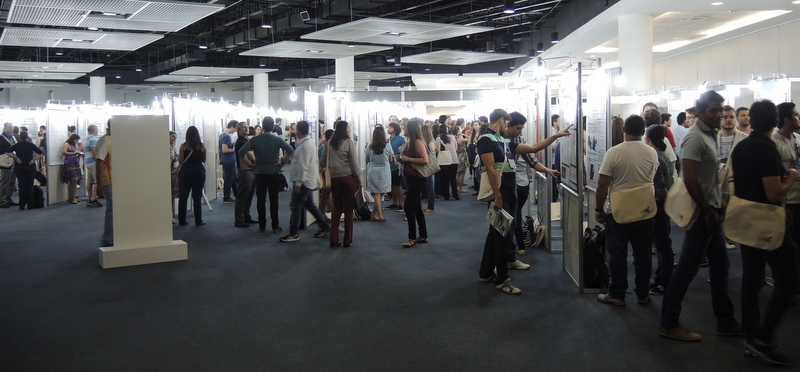
For the oral sessions of the symposia, all along the meeting, after the morning plenary session, and before and after the afternoon plenary talks, the attendants distributed themselves among 17 rooms. The poster sessions took place at the end of the afternoon from Monday to Wednesday and in the morning on Thursday. Walking through the long corridors of the poster sessions, one could see active scientific discussion, many times between a young author and a renowned researcher. One could also hear very positive comments about the original arrangement of the poster panels. The size of the poster session was impressive. In total, near 1,800 research works were presented in the posters.
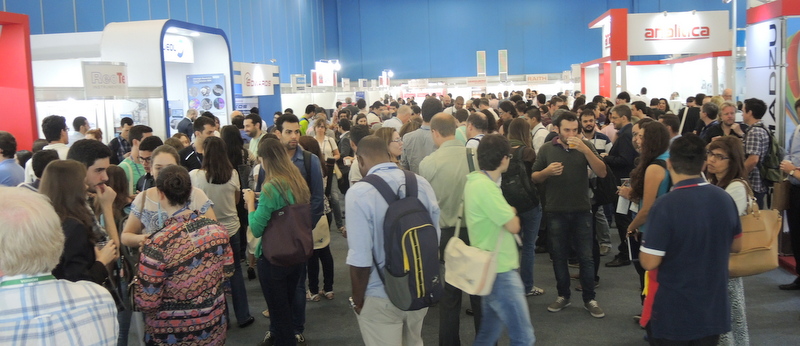
Twice a day from Monday to Wednesday, the attendants could take a break and have a coffee with cookies while visiting the exhibition of the event, which encompassed 32 stands showing a variety of scientific instruments, services, scientific journals, books and opportunities for the materials community. In addition, on Wednesday, the participants had the opportunity to attend four hours of technical talks given by some expositors about fabrication and characterization techniques.
On Thursday by 12:30 the closing ceremony started. In the closing panel, Prof. Soo Wohn Lee, from MRS Korea and conference chair of the IUMRS-ICAM 2015, joined the representatives of SBPMat, E-MRS and IUMRS.
In his final remarks, the meeting chair Prof. Cremona presented some photos of the past days and hours that made the public remember so nice and fruitful moments. He also presented the numbers of the event: 2,000 registered people from 985 institutions, among which 300 were foreign researchers from 40 countries. Finally, he announced that the next SBPMat annual meeting will be held in Campinas city (São Paulo state).
After the closing words, more than 20 prizes were given to young researchers within four different awards: the Bernhard Gross Award, a traditional SBPMat recognition for the best works of students, and the awards bestowed by IUMRS, E-MRS and Horiba.
Announcement of the students who won the Bernhard Gross Award.