
Sorry, this entry is only available in Brazilian Portuguese.
Author: Verónica Savignano
(Português) Processo seletivo para mestrado em Física de Materiais na UFOP.
(Português) Processo seletivo para mestrado e doutorado em Materiais na UNESP – Ilha Solteira.
Featured paper: Catalyzing hydrogen production.
[Paper: NiMo–NiCu Inexpensive Composite with High Activity for Hydrogen Evolution Reaction. Hugo L. S. Santos, Patricia G. Corradini, Marina Medina, Jeferson A. Dias, and Lucia H. Mascaro. ACS Appl. Mater. Interfaces. 2020, 12, 15, 17492–17501. https://doi.org/10.1021/acsami.0c00262]
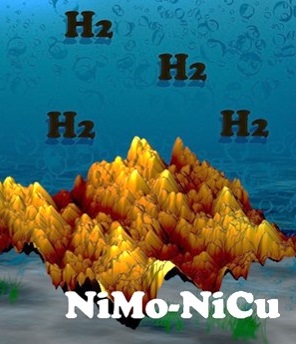
Hydrogen, whose combustion does not generate polluting emissions, is currently recognized as the most promising alternative to fossil fuels. However, there are still challenges in the sustainable production of this fuel, such as the development of a production process that is at the same time clean, economical and efficient.
Water electrolysis is one of the processes that can fit in these conditions. As the name implies, the process consists of the division of the water molecule, based on the action of an electric current. As a result, this simple reaction produces hydrogen gas and oxygen gas. However, to become a viable industrial process, water electrolysis needs catalysts that accelerate hydrogen production without significantly increasing its costs.
A work by a scientific team from the Brazilian Federal University of São Carlos (UFSCar), recently reported in an article in ACS Applied Materials & Interfaces, brings a contribution to overcome this challenge. “The main contribution of our work is to obtain a catalyst with significant performance improvement for the production of hydrogen from water electrolysis,” summarizes Lucia Helena Mascaro, professor at UFSCar and corresponding author of the paper.
The new catalyst is a film that can be deposited on the surface of the electrode used in the electrolysis process, which is why it is called an electrocatalyst. The electron transfer occurs in this negatively charged electrode, which causes hydrogen to detach from the water molecule.
While some electrocatalysts are made with noble metals, such as platinum, the Brazilian team looked for a material based on more abundant and economical elements, but which had good electrocatalytic activity and durability. The final option was for a metallic alloy composed of nickel (Ni), molybdenum (Mo) and copper (Cu), which presented two defined regions (phases), NiMo and NiCu, both with crystalline structures, composing a composite material.
“The NiMo-NiCu material showed excellent electrocatalytic activity, robustness, low toxicity, wide availability and economic viability for the hydrogen release reaction, called hydrogen evolution reaction. This material was easily obtained by electroplating, which is a simple, inexpensive and scalable technique, on a carbon steel substrate, without the need for any other treatment,” says Mascaro.
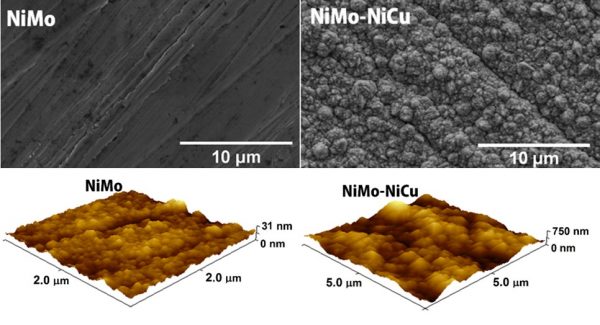
The main secret of the good performance of the film as an electrocatalyst is dependent on surface roughness, caused by the presence of copper. In relative terms, the NiMo-NiCua film presented roughness more than thirty times greater than the NiMo film, which is widely used to catalyze the release of hydrogen in water electrolysis.
In fact, the topography of a rough surface provides many more opportunities for the water molecule to come in contact with the catalyst and then the electron transfer that generates hydrogen release occurs. “The increase in the film’s roughness implies the formation of a greater amount of hydrogen for the same geometric area of the catalyst,” explains Professor Mascaro. “In addition, the NiMo-NiCu composite showed high stability during prolonged electrolysis,” she adds.
In search of the most suitable material
The genesis of the research dates back to 2012, when Professor Lucia Helena Mascaro and her team from at the Interdisciplinary Laboratory of Electrochemistry and Ceramics (LIEC) set out to find a material that would improve the efficiency of hydrogen production by water hydrolysis, and that could be produced through electrodeposition – a fast and viable process at an industrial scale, in which Professor Mascaro and her group have extensive expertise.
After developing some coatings with nickel and iron alloys, and making a thorough review of the scientific literature, the group came to the conclusion that a nickel, molybdenum and copper (Ni-Mo-Cu) alloy would be promising in terms of electrocatalytic activity and robustness, says the scientist. The UFSCar team then decided to add copper to the Ni-Mo alloy.
After defining the material, the team immersed in studying the conditions of the electroplating process. In fact, a key point for electrodeposition to generate the expected results is to correctly define the composition of the solution in which the process occurs. In this solution, also known as “electrodeposition bath,” the metals that will be deposited in the form of salts are found.
Thus, the team produced films with different concentrations of copper, characterized all of them and verified the performance of each one as an electrocatalyst in the release of hydrogen. At the end of the study, the researchers were able to safely determine which of the “recipe” had been the most successful.
The work was mainly carried out within Hugo Leandro Sousa Dos Santos’s master’s dissertation, supervised by Professor Mascaro and defended in 2018 in the Graduate Program in Chemistry at UFSCar. The research was funded by FAPESP, including through the Functional Materials Development Center (CMDF), CAPES and CNPq, and involved two UFSCar laboratories, LIEC and the Laboratory of Synthesis and Formulation Ceramic (LaFSCer), of the Materials Engineering Department.
(Português) Novos University Chapters da SBPMat na UFPR e UFCAT.
B-MRS live on materials research and COVID-19.
In several Brazilian universities, multidisciplinary scientific teams are currently working to deliver to society, in the shortest possible time, solutions to help combat COVID-19. Beyond generating publications, and even knowledge, the main objective of these works is to save lives.
The materials research community is actively participating in some of these challenges, which could generate important solutions such as rapid, reliable diagnostic tests and virucidal materials for ventilator valves, as well as personal protective equipment (PPEs) produced in Brazil.
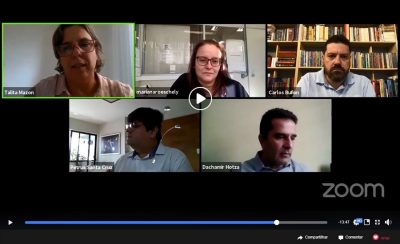
In the early afternoon of May 7, in its first live transmission, B-MRS brought together four researchers who are working on these challenges. These scientists told an audience of about 100 how they organized to respond to this emergency situation, and what may be the social impact of their projects. The reports showed the importance of continuous investment in research and collaboration between individuals and institutions.
The discussion was mediated by Carlos César Bof Bufon, researcher and head of the Devices Division at the Brazilian Nanotechnology Laboratory (LNNano/CNPEM). Bufon is part of the organizing committee of the next annual B-MRS event, the XIX B-MRS Meeting.
The online discussion panel, broadcasted on B-MRS’s Zoom platform and Facebook, was held within the Brazilian Virtual March for Science, an event promoted by Brazilian Society for the Progress of Science (SBPC) with the aim of calling attention to the importance of science.
National tests for COVID-19 diagnosis and detection of antibodies.
The scientists Mariana Roesch Ely (professor at the University of Caxias do Sul, UCS) and Talita Mazon (researcher at CTI Renato Archer) talked about their respective works to develop sensors for COVID-19 diagnostic tests, which they are carrying out with the support of specialists in the Chemistry, Electronics, Informatics, Physics, Materials, Biology and Health areas.
Both sensors are point-of-care instruments. This expression designates miniaturized devices that allow performing tests anywhere, without the need for laboratories or other equipment, and receiving the result within a few minutes.
According to the researchers, the sensors they are developing will be able to detect those infected with COVID-19 within the first day of infection – a characteristic that none of the diagnostic techniques currently used in the country allows. Finally, they said that the new sensors will provide more accurate results (with fewer false negatives or positives) than many of the rapid tests that are currently available on the market.
In both works, the development of the sensors is quite advanced. However, the two scientists concur in stating that 6 months is a reasonable time for a product to be ready, tested with respect to the RT-PCR method (the most reliable at the moment) and viable at an industrial scale.
In her statement, Professor Mariana said that since 2012 she has been working on developing sensors based on magnetoelastic technology, initially aimed at the detection of bacteria and yeasts. When Brazil experienced the outbreak of the Zika virus in 2015, the scientist and her entire research network directed their work towards this virus, gaining experience in detecting this type of organisms, which are much smaller than bacteria. According to Professor Mariana Roesch Ely, the magnetoelastic sensor would be able to detect both the viral particle (from the beginning of the infection) and the antibodies produced by the person who is or has been infected. Thus, it could be an important tool to define measures and protocols in all phases of the pandemic, including the resumption of face-to-face economic activities.
Researcher Talita Mazon said that she has worked five years on integrating ceramic and biological materials to develop point-of-care sensors, which, in her view, are well adapted to the Brazilian reality, given that a large part of the population lives far away from laboratories and hospitals. With the experience accumulated during that time, the scientist was able to finalize in 2019, together with a multidisciplinary team, an electrochemical sensor that detects the Zika virus accurately and within a few minutes. She is currently adapting this platform to detect Sars-COV-2 (the virus that causes the COVID-19 disease).
Thinking about the possibility of producing the sensor without the need for imported inputs, mainly at an industrial scale, the researcher looked for local partners and adapted the sensor to the biological inputs that could be produced in Brazil. In addition, she is establishing a partnership with the public microelectronics company CEITEC, located in the state of Rio Grande do Sul, whose installed capacity would allow it to manufacture the chips for all the sensors needed to test the Brazilian population in the next phases of the pandemic. “We have to join forces to develop solutions that can actually be met by the country’s industrial capacity,” said Professor Talita Mazon.
Virucidal materials for masks and respirators
In the panel, Dachamir Hotza, professor at the Federal University of Santa Catarina (UFSC), told of the individual and group efforts carried out to bring responses to society during the COVID-19 pandemic. In one of these works, the researcher and his collaborators are carrying out the physical and biochemical characterization of masks used in hospitals in order to define precisely when the masks lose their functionality and need to be replaced. In addition, working with other institutions and a regional company he previously collaborated with, the researcher is advancing in the development of fabrics with virucidal activity. One difficulty that has not yet been overcome, said the researcher, was accessing a laboratory that has the appropriate level of biosafety procedures to perform tests with the new coronavirus.
Active materials in the elimination of the Sars-COV-2 virus were also addressed by Professor Petrus Santa Cruz, from the Federal University of Pernambuco (UFPE). The scientist told how he accumulated knowledge generated over decades, available in articles and patents from his research group, for his work related to fighting the pandemic. One example relates to an emergency action aimed at providing the public health system with respirator valves that could be used in patients infected with COVID-19 in a phase prior to intubation, given situations of high occupancy rates of ICU beds and mechanical ventilators. Professor Petrus’ interdisciplinary team, which includes software experts, was able to overcome the challenge of manufacturing these valves on 3D printers with the necessary surface roughness to prevent the bacterial adherence (initially bacteria and, probably, also viruses). In addition, the group is working to give this and other materials an active role in eliminating the virus, using nanotechnology to break through the wall that protects the viral RNA.
Continuous investments for fast results
The four panelists highlighted that the capacity of science to quickly respond to society in times of emergency is the result of many years of efforts and investments. “There is no on/off button for science, because it is made up of the accumulation of knowledge,” said Professor Petrus.
On the other hand, with successive cuts to the CTI budget, many Brazilian researchers have developed strategies to circumvent the difficulties and continue working. It is a characteristic of the Brazilian scientist to adapt to adverse situations, commented Professor Dachamir.
The panelists’ statements showed that a combination of expertise and persistence, on the one hand, and creativity and reinvention, on the other, is part of the method they are applying in their work related to fighting the pandemic.
Another aspect the scientists highlighted as fundamental to the success of emergency projects was the work in multidisciplinary collaborative networks, including with companies that could produce solutions at an industrial scale. “This is the time to intersect everyone’s expertise to give a quick response to society,” said Professor Mariana Roesch Ely.
Founding member of B-MRS among the most cited and downloaded authors in the Journal of Non-Crystalline Solids.

Professor Edgar D. Zanotto (DEMa – UFSCar) is highlighted in the report of the most downloaded and most cited articles in 2019 from the Journal of Non-Crystalline Solids (JNCS). The founding member of B-MRS is co-author of 3 of the 10 most downloaded articles in 2019, among more than 27,000 papers in the journal. In addition, 2 articles signed by Zanotto are among the 5 most cited articles in 2019.
Founded in 1968, JNCS is a prestigious Elsevier journal in the field of vitreous materials science.
More information: http://www.ppgcem.ufscar.br/pt-br/artigos-de-professores-e-alunos-do-ppgcem-em-destaque-no-journal-of-non-crystalline-solids