
Sorry, this entry is only available in Brazilian Portuguese.
Category: News
B-MRS Newsletter. Year 8 , issue 3.
|
||||||||||||||||||||
|
||||||||||||||||||||
|
Featured scientist: Interview with Prof. Cid Bartolomeu de Araújo (UFPE).
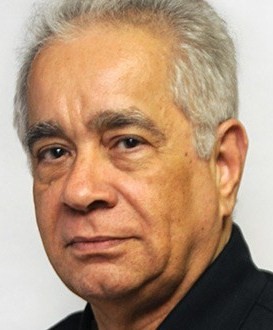
Cid Bartolomeu de Araújo was born in Recife, the capital of the Brazilian state of Pernambuco, in 1945. When he was in high school, he was very fond of Physics. However, he was not able to choose this undergraduate course because it was not yet offered in Pernambuco in the 1960s.
He graduated with an Electrical Engineering degree from the Federal University of Pernambuco (UFPE) in 1968. After the B.S. degree, he received a master’s degree in Physics from the Pontifical Catholic University of Rio de Janeiro (PUC-Rio). After that, he became an adjunct professor at UFPE, where he actively participated in the creation and development of the Physics Department. At the same time, he started his doctorate, again at PUC-Rio, and in 1975 he obtained a PhD diploma in physics.
Throughout 1976 and 1977, he held a postdoctoral position at Harvard University (USA), in the research group of Nicolaas Bloembergen, who, at that time, had one of the best laboratories in the world in Nonlinear Optics (area of knowledge dedicated to the study of phenomena that occur when high intensity light interacts with matter). In 1981 Bloembergen was awarded the Nobel Prize in Physics.
Back in Brazil in 1978, Professor Araújo created the Laboratory of Nonlinear Optics, which placed UFPE on the world map in this research area. Since then, Cid de Araújo has contributed to the advancement of scientific progress and development of human resources. He produced around 350 articles published in international scientific journals and supervised almost 100 masters and doctoral students and postdocs. His scientific production has more than 9,300 citations, according to Google Scholar. In 2020, Professor Araújo, whose h-index is 48, was listed among the 100,000 most influential scientists in the world in the ranking published in the journal Plos Biology.
Currently Professor Emeritus at UFPE, Cid de Araújo was Full Professor at the university from 1989 until 2013. He was a Visiting Professor at the Université d´Angers (France) and a Visiting Researcher at the State University of Campinas, École Polytechnique (France), Université Paris-Nord (France) and IBM Thomas J. Watson Research Center (USA).
Araújo is a Full Member of the Brazil and Pernambuco Academies of Sciences, and a Fellow of the Optical Society of America (OSA) and TWAS (The World Academy of Sciences). He is a member of the Brazilian National Order of Scientific Merit – Grand Cross and Commander. In 2003, he received the Galileo Galilei award, bestowed annually by the International Commission for Optics (ICO) in recognition of outstanding contributions in the field of Optics, achieved in comparatively unfavorable circumstances. Professor Araújo is the only Brazilian out of 27 scientists who have received the medal so far.
In 2020, B-MRS granted Cid de Araújo the Memorial Lecture “Joaquim da Costa Ribeiro” – a tribute granted annually since 2011 to notable scientists from Brazilian institutions. Thus, Professor Araújo will deliver a lecture at the opening of the XIX B-MRS Meeting + IUMRS ICEM, which will be held virtually from August 30 to September 3 this year. At the event, he will talk about plasmonic nanocomposites (fundamentals, synthesis, linear and non-linear optical properties and applications), a research topic that has engaged the scientist and his group in recent times.
Read our interview with Cid de Araújo.
B-MRS newsletter: Tell us what led you to become a scientist and, in particular, to participate in the field of optical properties of materials.
Cid de Araújo: I don’t have an objective answer to this question… It certainly wasn’t family influence. My mother was a “housewife” and my father was a businessman. He wanted me to become a businessman just like him. He almost convinced me, but the school’s influence was greater. I liked Physics and Mathematics when I was in high school. I also liked History and used to read biographies of famous scientists (physicists, astronomers, mathematicians…). When I took the entrance exam, I chose the Electrical Engineering course because among the possible alternatives in Recife, in 1964, it was the one that seemed to have a larger scientific component than the other engineering courses. During the first two years of the course, I understood that I really liked Physics. From the fifth semester onwards, I decided that I should be in a Physics course; I did not like the subjects of the professional Engineering course. But there was no Physics course in Recife. Fortunately, other colleagues were also attracted to Physics and together with some Physics professors from the School of Engineering, we began to informally study the subjects that constitute the core of the bachelor’s degree in Physics. At the same time, I continued the EE course that I concluded in December 1968.
My fondness for Solid State Physics (currently called Condensed Matter Physics) grew during the undergraduate Electrical Engineering course as a result of reading scientific articles about electrical and magnetic properties of materials.
After completing the course, thanks to previous contacts with two professors from PUC-Rio (Alceu Pinho and Erasmo Ferreira), I traveled to Rio de Janeiro, in January 1969, to enroll in the postgraduate program in physics. In the master’s degree course, I performed experiments that combined microwaves and light to study properties of ferromagnetic crystals. A resulting article was published in Solid State Communications (in 1972) and the co-authors were Sergio Costa Ribeiro and Sergio Machado Rezende. As the article was written when I was already hired in Recife, the article included my UFPE address, and this was the first article in Physics of the Solid State with an UFPE address in the literature. Later, in the doctoral project, I developed works where I explored analogies between nonlinear processes of ferromagnetic magnons and the theory of lasers and optical parametric amplifiers. In the post doctorate program, I started working in Nonlinear Optics with applications in Material Physics (some liquids and semiconductors). The decision for postdoctoral fellow at Harvard University, with Nicolaas Bloembergen, was motivated by the fact that he was one of the pioneers of nonlinear magnetic resonance, and in addition, he was one of the pioneers of Nonlinear Optics.
B-MRS newsletter: From the point of view of scientific discoveries, reflected in the publication of articles or patent applications, from your viewpoint, what are your main contributions and why do you consider them the most relevant? In other words, which are your favorite and why do you like them so much?
Cid de Araújo: I am an experimental physicist, but my doctoral thesis resulted in the publication of five theoretical articles. Infrastructure problems in Recife contributed to this theoretical work. We were building laboratories from empty rooms. I was very happy with these articles because they were published in good scientific journals and so I was able to complete the doctoral thesis, which was presented at PUC-Rio in 1975. These are not the most important publications in my curriculum, but they represent a relevant contribution in the history of the Department of Physics-UFPE.
Upon returning from the postdoctoral studies in January 1978, until today, I always worked with several collaborators (students and fellow professors). So, in 1978, while setting up the Nonlinear Optics Laboratory, I began to interact strongly in another laboratory with a professor at DF-UFPE, Erivaldo Montarroyos, who was completing his doctorate using the Raman Scattering technique to study antiferromagnetic materials. The sequence of works that resulted from this project was important for developing the area at UFPE. I also interacted with other students who later entered this research line; the experimental works were carried out exclusively in Recife from 1978 to 1985. At that time in Recife, Experimental Physics was an adventure. In the same period, together with my colleague José Rios Leite, in 1980, we published in Chemical Physics Letters a theoretical article with the prediction of a new effect of Non-Linear Optics: the simultaneous absorption of two photons by a pair of interacting atoms. At that time, it was not possible to carry out the experimental work in the existing laboratories. The effect was observed for the first time in 2002 by a Swiss-German group that, utilizing modern techniques for preparing nanomaterials and nano-optic techniques, observed the phenomenon using an organic solid (para-terphenyl) doped with terrylene molecules (an organic dye). The article appeared on the cover of the journal Science [vol. 298; issue 5592 (2002)]. It was encouraging to know that the effect we had foreseen was observed 22 years after our proposal and that our theoretical article received the due credits. Later, in 2012, this same effect was observed in sodium vapor and published in Physical Review Letters [108, 253004 (2012)] by the group of Vanderlei Bagnato, in São Carlos. In other words: it is a basic phenomenon that can be observed not only in condensed matter but also in atomic vapor and other systems not yet studied. There are some proposals in the literature to study the effect under different situations.
A set of works that I really like is related to the observation, understanding and applications of optical phenomena in plasmonic composites (glasses and colloids with metallic nanoparticles). These are more recent works where we explored the contribution of superficial plasmons in silver (or gold) nanoparticles and their application in studies related to luminescence, using random lasers, with the propagation of space solitons and other phenomena of optics instability influenced by plasmons. We have published several articles in this area and a review of some published works can be seen in Advances in Optics and Photonics 9 (2017) 720-774. This research continues in the present time and we continue to place much effort in this area with recent publications.
B-MRS newsletter: From the point of view of developing researchers, creating laboratories and other aspects of a researcher’s career, what are your most impacting achievements and/or the ones that gave you the greatest satisfaction?
Cid de Araújo: From an institutional perspective, I believe I carried out very important work together with the colleagues when we put together the first research group in Physics in Recife, in 1971. Also in 1971, we implemented the bachelor’s degree in Physics. This group included Ivon Fittipaldi, Mauricio Coutinho, Marco Moura and Sergio Rezende. My colleague José Rios Leite, who participated in the initial project, joined the DF only after completing his doctorate at MIT in 1977. We were conducting research, teaching and administrative work, in order to establish a new research center in Physics. Fortunately, we were successful, and we gradually incorporated new professors who helped consolidate the project. Between 1973 and 2013 I took on several administrative positions: Head of the DF-UFPE, Physics Undergraduate Coordination, Physics Postgraduate Coordination, Postgraduate Coordination in Materials Science, and Direction of the Exact and Nature Sciences Center, which in addition to the DF brought together the Departments of Fundamental Chemistry, Mathematics, Statistics and Informatics.
From the research perspective, I had the opportunity to set up one of the first Non-Linear Optics laboratories in the country. This laboratory has been in operation since 1978, and has remained active since the beginning, contributing to the education of undergraduate and graduate students. To date, there have been about 40 undergraduate students, 44 master’s students, 27 doctoral students, and 20 post-doctoral students. These former students currently work in several Brazilian states, some at DF-UFPE, and some abroad (Canada, USA, Colombia, Peru, Uruguay, China and India) as research leaders.
In the 43 years of the Laboratory, we have been able to introduce in the Country several experimental research techniques in Nonlinear and Photonic Optics, new scientific topics and we have contributed to significant advance in this area.
Currently, the Physics Department of UFPE is completing 50 years of research and teaching activities in PG. The performance of DF radiated to several States, especially the Northeast and Northern regions of the country. I am extremely pleased for the opportunity to participate in this story.
Until now, I have been contributing to the physics community by participating in the research commissions of funding agencies (from Brazil and abroad), coordinating research projects and scientific events at the national and international level. I hope to continue doing research for several more years.
B-MRS newsletter: Now we invite you to leave a message for our readers who are starting their scientific careers.
Cid de Araújo: I believe that a career choice should be based on the attraction the professional activity exerts on the individual, and this is particularly true with regard to scientific activity. However, this is not enough. In addition to the attraction for the profession, solid education is required in the specific content of the field and in the fundamentals. The ability to work as a team, the ability to impart knowledge, general culture and the ability to interact with people are very important requirements. Scientific work requires considerable effort and a lot of dedication, but intellectual challenges serve as a permanent stimulus.
Featured Paper: Band structure engineering using the geometry of rolled-up tubes.
[Text by Christoph Deneke, Leonarde do Nascimento Rodrigues and Angelo Malachias, co-authors of the research, with editorial changes by B-MRS Newsletter.]
Changing material properties like the optical ones or the ability to conduct current by straining the material has a long tradition in semiconductor technology. Therefore, researchers have used this mechanism to control fundamental properties of different materials and discover new possibilities for technological application. In this regard, thin, nanometer thick membranes of semiconductor materials are especially well suited as they become extremely compliant and flexible due to being thin. Until now, such engineering was done by applying an external strain to ultra-thin membranes successfully changing fundamental properties like the band structure (the energy level distribution of the electrons inside the material).
A team of researchers from Brazilian universities demonstrated now that they can fundamentally change the optical properties of a semiconductor namomembrane, if they integrated it into a curved system, or in a tubular structure (rolled-up microtube). For this, the authors used a well established technology of releasing a strained layer system, which then self-assembles into a three-dimensional structure, in this case a rolled-up tube.
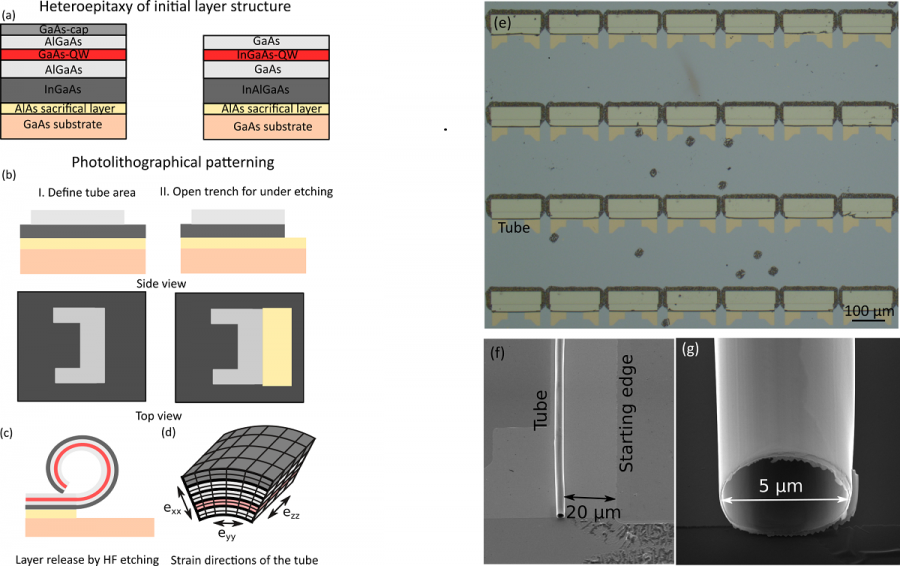
The way the nanostructures are made is illustrated in the image above. Initially, the team growth first a single crystal compromised of different materials. In following steps, they defined a U-shaped pattern on the surface of the structure by carrying out photolitography – the same kind of technology used to make computer chips. For the last step, that is responsible to form the final geometry in the form of a tube, they selectively removed a sacrificial layer previously introduced below the layers of interest. The schematics on the left of Fig. 1(a-d) represent the different steps of the tube fabrication. The optical microscopy image on the right together with the electron microscopy images (Fig. 1 f-g) depict the obtained structures.
“I am working since 2001 with these kind of systems. We already know that the properties of embedded quantum light sources change by the rolling-up. But until now, we used materials that were less affected by the geometrical change” tells Prof. Ch. Deneke from Unicamp. His long-time collaborator Prof. A. Malachias adds, “By using InGaAs instead of GaAs, we were able to achieve a complete change of the electronic structure of the material and the quantum light source integrated into the tube wall. The control of the band structure shown in the work is of great technological interest in the field of optical devices.” To investigate these changes, the team carried out optical measurements at Unicamp together with Prof. O. Couto Jr. and Prof. F. Iikawa. When using optical spectroscopy techniques to measure the polarization of light (the vibration plane of the light), the authors discovered that the optical response pointed to fundamental changes of the light source.
The image below shows the spectrum obtained by a reference structure (in its planar form) and in its new rolled-up form.
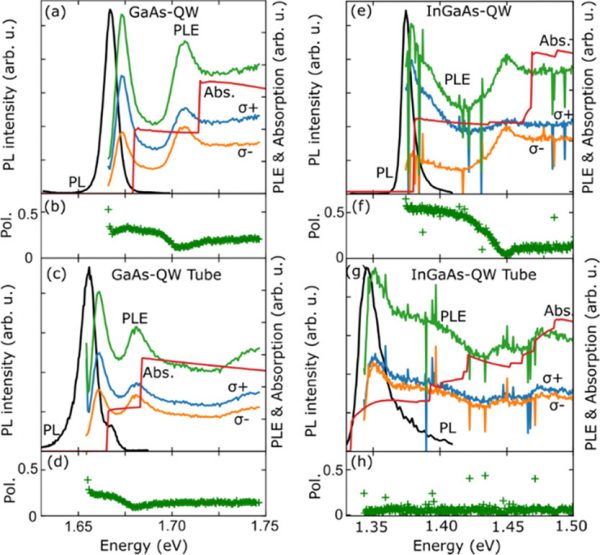
“With the vanishing of any polarization of the rolled-up layers, which included an InGaAs layer, we understood that the electronic structure and the optical properties had undergone fundamental changes. And we achieved this without relying on the application of an external force to control the expansion and compression of the material. The self-formation of these tubular structures is an elegant way to induce a hybrid state of compression and expansion, which in turn induces new effects”, explains Prof. L. N. Rodrigues, who worked in his postdoc together with Prof. Ch. Deneke on the system. Theoretical calculations show that the effect can be expected for all kind of curved systems made into tubes based on the used material system.
InGaAs and GaAs quantum light sources are already used. Basically, all lasers used in fiber communication are based on this material class, building the backbone of the internet communication unbeknownst to most people. Taking this into account, the light sources manufactured with the mentioned material, whose properties can be altered and controlled, are of great interest for the next generation of technology development, which includes, for example, quantum information or quantum computing. The fact that these tube-shaped semiconductor structures can be transformed into a light-emitting device (laser), together with the ability to alter and control physical properties without the need for any external voltage source, provide modern engineering that points in the direction of potential applications regarding light emitters and other fields of science. Furthermore, the results are also transferable to other semiconductor materials. Most important, this could be a model to modify Si (the most important material of the IT technology) in a similar way.
The work was largely supported by Brazilian agencies FAPESP and CNPq. The samples were grown and processed at LNNano / CNPEM, Campinas. X-ray diffraction measurements were carried out at the National Synchrotron Light Laboratory LNLS / CNPEM, Campinas. The optical spectroscopy measurements were performed at the GPO of the Physics Institute “Gleb Wataghin“ of Unicamp, Campinas.
Paper: Rolled-Up Quantum Wells Comprised of Nanolayered InGaAs/GaAs Heterostructures as Optical Materials for Quantum Information Technology. Leonarde N. Rodrigues, Diego Scolfaro, Lucas da Conceição, Angelo Malachias, Odilon D. D. Couto Jr., Fernando Iikawa, Christoph Deneke. ACS Applied Nano Materials 2021, DOI: 10.1021/acsanm.1c00354. Disponível na modalidade de acesso aberto em https://pubs.acs.org/doi/10.1021/acsanm.1c00354.
Corresponding author: Prof Chistoph Deneke (UNICAMP) – cdeneke@ifi.unicamp.br.
Virtual XIX B-MRS Meeting + IURMS ICEM: abstract submission is open.
 Abstract submission is open until April 25th for oral and poster presentation at the XIX B-MRS Meeting + IURMS ICEM 2021, which will be held in virtual format from August 30 to September 3 this year. Registrations to participate in the event are also open with early registration fees until July 30th.
The event brings together the 19th edition of the annual meeting of the Brazilian Materials Research Society (SBPMat/B-MRS) and the 17th edition of the international biennial conference on electronic materials organized by the International Union of Materials Research Societies (IUMRS).
Interdisciplinary and international, the event is dedicated to the presentation and discussion, in English, of scientific and technological advances achieved in the field of materials. In the last editions, the B-MRS Meeting has brought together about 1,500 participants from different parts of Brazil and dozens of other countries.
Thematic symposia
Abstracts can be submitted within the 24 thematic symposia, covering a wide range of research topics, from materials design to applications, including synthesis, manufacture, modification and characterization of materials. The symposia encompass many types of materials: conductive polymers, hydrogels, hybrid materials and nanocomposites, nanomaterials, metal oxides, electroceramics, biomaterials, superconductors and quantum materials, among others. Concerning the applications, the symposia include advances in materials for energy harvesting, storage and conversion, for oil and gas indystry, for decontamination, health, electronics and photonics, among others. Advances in the field of toxicology and regulation of nanomaterials and nanoregulation will also be discussed. Finally, the event will feature a symposium organized by the B-MRS University Chapters on research, entrepreneurship and the future.
The symposia of the XIX B-MRS Meeting are coordinated by researchers from different parts of Brazil, as well as Argentina, Canada, Denmark, France, Germany, India, Israel, Japan, Norway, Portugal, Sweden, United Kingdom, USA and Uruguay . The general coordinator of the event is Professor Gustavo Martini Dalpian, from the Brazilian Federal University of ABC (UFABC).
Each symposium comprises oral and poster sessions, as well as invited lectures by internationally renowned researchers. The event also features seven plenary lectures by internationally renowned scientists: Prof Alex Zunger (University of Colorado Boulder, USA), Prof Edson Leite (LNNano, Brazil), Prof Hideo Hosono (Tokyo Institute of Technology, Japan), Prof John Rogers (Northwestern University, USA ), Prof Luisa Torsi (Università degli Studi di Bari “A. Moro”, Italy), Prof Tao Deng (Shanghai Jiaotong University, China), Prof Thuc-Quyen Nguyen (University of California Santa Barbara, USA). The traditional Memorial Lecture Joaquim da Costa Ribeiro will be given by Prof Cid Bartolomeu de Araújo (UFPE).
Awards
The best works of each symposium presented by undergraduate or graduate students will be distinguished at the end of the event with awards from B-MRS (the Bernhard Gross Award). In addition, ACS Publications will award cash prizes, of R$ 2,000 each, to the five best posters and five best oral presentations of the entire event. To apply for the awards, authors must submit an extended abstract in addition to the conventional one, after being notified of the acceptance of the work at the event.
Event website: https://www.sbpmat.org.br/19encontro/
XIX B-MRS Meeting + IURMS ICEM 2021. Abstract submission is open!
Dear Colleagues
We are very happy to announce that the abstract submission for the XIX B-MRS Meeting + IUMRS ICEM 2021 is open. Submissions can be done until April 25.
The event, organized by the Brazilian Materials Research Society (B-MRS) and the International Union of Materials Research Societies (IUMRS), will be held in a virtual format (online) from August 30 to September 3, 2021.
We invite you and your collaborators to submit your abstracts for oral or poster presentation within any of the 24 symposia of the event, covering areas ranging from Biomaterials to Electronic Structure Calculations. These symposia are organized by researchers from Brazil and many other countries, such as Argentina, Canada, Denmark, France, Germany, India, Israel, Japan, Norway, Portugal, Sweden, UK, Uruguay and the USA.
Besides these exciting symposia, that will count with invited speakers and oral and poster presentations, we will also have seven Plenary speakers:
-Alex Zunger (University of Colorado Boulder, USA)
-Edson Leite (LNNano, Brazil)
-Hideo Hosono (Tokyo Institute of Technology, Japan)
-John Rogers (Northwestern University, USA)
-Luisa Torsi (Università degli Studi di Bari “A. Moro”, Italy)
-Tao Deng (Shanghai Jiaotong University, China)
-Thuc-Quyen Nguyen (University of California Santa Barbara, USA).
The Memorial Lecture will be delivered by Cid Bartolomeu de Araújo (UFPE, Brazil).
The B-MRS Meeting is the largest conference in the area of Materials Science in Latin America, and we believe that the online meeting will bring the possibility to even larger participation.
It will be our great pleasure to welcome you all to the virtual XIX B-MRS and 2021 IUMRS- ICEM.
Stay well and take care,
Gustavo Dalpian
Conference Chair
B-MRS Newsletter. Year 8, issue 2.
|
||||||||||||||||||||||
|
||||||||||||||||||||||
|
Featured paper: Nonlinear interactions with a two-dimensional material.
When the light beam emitted by a laser pointer hits a glass window a few millimeters thick, some of the light is refracted, which means that the speed of the light wave changed when it entered the glass. This change can be easily quantified: the refractive index for air and glass is approximately 1.00029 and 1.5. The refraction phenomenon is well known; it is usually taught in High School Physics and fits in the theory of Linear Optics.
The light emitted by the laser pointer has low power, a few thousandths of a watt. However, when the laser power is very high (tens or thousands of watts), other phenomena occur in the interaction between the light and the material, which are called “non-linear.” One makes the glass act like a convex or concave lens. The magnitude of this effect depends not only on the characteristics of the light beam, but also on the material, and can be quantified by the non-linear refractive index.
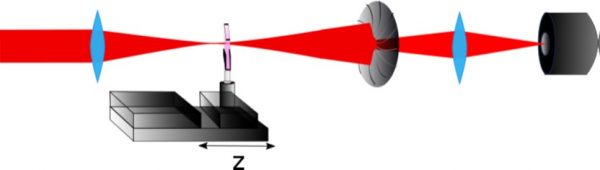
A multidisciplinary team that included researchers from the Brazilian Federal University of Pernambuco (UFPE), the Brazilian Mackenzie Presbyterian University and the United States Air Force Research Laboratory (AFRL) was able to determine, for the first time, the non-linear refractive coefficient of ZrTe2 (zirconium telluride) – a two-dimensional material, still little studied, from the family of transition metal dichalcogenides (TMDs). The study was recently reported in an article published in Applied Physics Letters.
TMDs have unique electrical and optical properties that depend on their thickness, which can reach the subnanometer scale. In fact, extremely thin, transparent and flexible layers can be produced with these metals, which, of course, have aroused much interest for several applications. Important detail: for several of these applications, such as those related to medical imaging, the most important properties are those of the Non-Linear Optics universe.
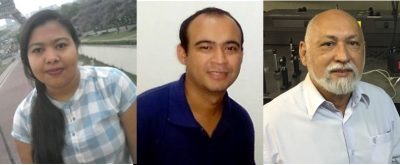
In this context, Professor Anderson Stevens Leonidas Gomes (UFPE) has been working on, for about three years, a research line focused on the study of the nonlinear properties of TMDs, carried out in collaboration with researchers from AFRL. “They prepare the material and we perform the nonlinear optical characterization,” says the scientist. “The role of Melissa Maldonado, who completed a doctorate and is now a postdoctoral fellow under my supervision, was and is critical, since she has mastered the characterization techniques and was the main researcher responsible for the work in this line of research,” he adds.
Several materials from the family of two-dimensional TMDs have been studied by the group. In the work published in Applied Physics Letters, AFRL researchers prepared zirconium telluride nanoflakes of about 1 nm thick and 50 to 100 nm long, using a method based on laminating the surface of thicker nanoparticles. The samples traveled from the state of Ohio to São Paulo and arrived at Mackenzie, where part of the characterization was carried out. Finally, the samples were sent to UFPE, where their nonlinear optical properties were probed using a laser emitting extremely short and strong pulses, which interacted with the zirconium telluride nanoflakes. After performing a series of mathematical calculations, Professor Gomes and his group were able to determine the material’s nonlinear refractive coefficient. Through computer simulations, the authors were also able to understand the origin of the phenomenon and, therefore, create possibilities to control it.
“The main scientific contribution of this study is to measure, unequivocally and appropriately, one of the optical coefficients that indicate the magnitude of the material’s optical non-linearity,” says Professor Anderson Gomes, who is the corresponding author of the article. “This coefficient is important to define which photonic applications can be explored in this material,” he adds.
The study received financial support from the Brazilian federal agencies CNPq and Capes, the INCT-Nanocarbono, the Foundation for the Support of Science and Technology of the State of Pernambuco (FACEPE) and the US agency AFOSR. The authors used computational resources from the Advanced High Performance Computing Center (NACAD) at COPPE/UFRJ (Brazil).
Paper: Femtosecond nonlinear refraction of 2D semi-metallic redox exfoliated ZrTe2 at 800nm. Melissa Maldonado, Manoel L. da Silva Neto, Pilar G. Vianna, Henrique B. Ribeiro, Cid B. de Araujo, Christiano J. S. de Matos, Leandro Seixas, Ali M. Jawaid, Robert Busch, Allyson J. Ritter, Richard A. Vaia, and Anderson S. L. Gomes. Appl. Phys. Lett. 118, 011101 (2021); doi: 10.1063/5.0031649
Contact: Prof Anderson Gomes (UFPE) – anderson.lgomes@ufpe.br
Online XIX B-MRS Meeting + IUMRS ICEM 2021. Message from the chairman.
Dear Colleagues
We are happy to announce that we’ve just released the list of symposia that will be held at the XIX B-MRS and IUMRS-ICEM 2021. A total of 24 symposia were selected, covering areas ranging from Biomaterials to Electronic Structure Calculations.
Besides these exciting symposia, that will count with invited speakers and oral and poster presentations, we will also have seven Plenary speakers:
-Alex Zunger (University of Colorado Boulder, USA)-Edson Leite (LNNano, Brazil)
-Hideo Hosono (Tokyo Institute of Technology, Japan)
-John Rogers (Northwestern University, USA)
-Luisa Torsi (Università degli Studi di Bari “A. Moro”, Italy)
-Tao Deng (Shanghai Jiaotong University, China)
-Thuc-Quyen Nguyen (University of California Santa Barbara, USA).
The Memorial Lecture will be delivered by Cid Bartolomeu de Araújo (UFPE, Brazil).
Owing to the uncertainties brought to us by the COVID pandemic, this year our conferences will be held online, from August 30th until September 3rd. The B-MRS is the largest conference in the area of Materials Science in Latin America, and we believe that the online meeting will bring the possibility to even larger participation.
It will be our great pleasure to welcome you all to the virtual XIX B-MRS and 2021 ICEM meetings next August/September ONLINE.
Stay well and take care,
Gustavo Dalpian
Conference Chair
B-MRS Newsletter. Year 8, issue 1.
|
||||||||||||||||||
|
||||||||||||||||||
|