Tribute to Aldo F. Craievich from Daniel M. Ugarte.

About Aldo Craievich: homage, reflections and memories.
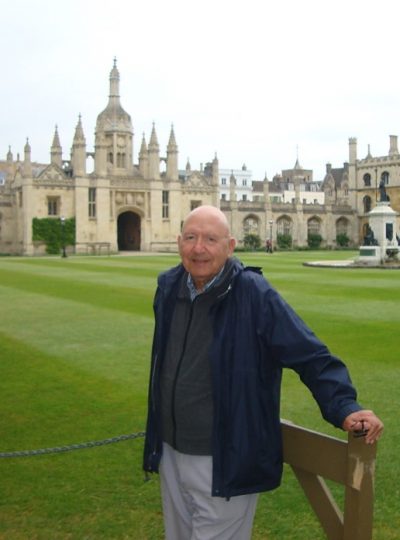
Prof. Aldo Craievich visiting the University of Cambridge in the United Kingdom. (Photo from Prof. Daniel Ugarte's personal archive)
Prof. Aldo Craievich visiting the University of Cambridge in the United Kingdom. (Photo from Prof. Daniel Ugarte’s personal archive)

On April 24, 2023, Prof. Aldo Felix Craievich died in São Paulo, two months after his 84th birthday.

Aldo was born in the province of Santa Fe in Argentina and graduated in physics at the Instituto Balseiro in Bariloche in 1964. He later carried out his doctoral work in France under the supervision of André Guinier, a world famous researcher in the area of X-ray diffraction. In 1973, he moved to Brazil and held positions at several universities and research institutes such as the Institute of Physics and Chemistry of São Carlos (IFQSC-USP), the Brazilian Center for Research in Physics (CBPF) and the Institute of Physics at USP in São Paulo city.

There are abundant sources where it is possible to obtain detailed biographical data on Aldo – without a doubt, one of the most outstanding researchers in materials science in Brazil. But probably, Aldo will always be remembered for his contribution to the construction of the National Synchrotron Light Laboratory (LNLS) in Campinas, where he worked in the initial gestation of the project and later as Scientific Director during the construction of the first UVX storage ring. Aldo assumed responsibility for the design and construction of beamlines and, above all, the training of users for the future Brazilian source of synchrotron light.

I met Aldo personally when I moved from Switzerland to Brazil in 1993 to join the team at the incipient LNLS. The leadership of the laboratory consisted of three directors: Cylon Gonçalves da Silva, Ricardo Rodrigues and Aldo. A short conversation with them about the project to build a synchrotron with national technology starting from scratch was inspiring. What a progressive and courageous vision! I had the privilege of observing how they associated competence and originality, always looking for creative solutions adapted to the low resources and real possibilities in the Brazilian context. In addition to the material aspects, the project required the construction of a specialized technical-scientific human resources team. It is important that the new generations of professionals visualize and understand the Herculean task that was to develop and build everything, everything. An analogy would be building a skyscraper when you have to learn how to make every brick, every steel bar, every little piece. What a challenge they faced, and what a complete triumvirate! Ricardo, the creativity, engineering and physics of accelerators. Aldo, the application of synchrotron radiation, science and the training of human resources. And Cylon, weaving together different aspects like accelerator science and technology with science policy and organizing a management system for a big science laboratory. Wow, what a trio! I can tell my advisees, students, children and grandchildren, that I worked closely with them during the construction of the LNLS.!! And I didn’t bother much…

Despite his position as Director, Aldo had the humility to try to convince each researcher or student of the great opportunities that LNLS offered. He organized numerous schools in Brazil, Latin America and ICTP-Trieste, where he received students from all areas, physics, chemistry, engineering, biology, medicine, etc. This effort on an international scale is clearly reflected in the various awards he has received in other countries and in Mercosur. Perhaps the greatest recognition received by Aldo was his entry into the Brazilian Academy of Sciences in 2015, at almost 80 years old. On a very personal level, I ask myself every day: why did Aldo have to wait so long? Almost 20 years since the start of operation of the UVX, the first synchrotron in the southern hemisphere. Well… in the end justice was served, better late than never. My biggest sadness is that Aldo’s partner in the project, Ricardo Rodrigues, responsible for the design (accelerator physics) and construction (engineering, electronics, materials, etc.) of the UVX and the new synchrotron, Sirius, left in 2020 without receiving this honor. The history of Latin America shows a social and economic development with many paradoxes, such as, for example, strong urbanization without industrialization. The formation of the scientific and technological community in the country was not exempt from these peculiarities. Therefore, it is important to evolve to give more value to applied works, to the construction of real and operational equipment of small, medium or huge size, to the creation of instrumentation, sometimes advanced and sometimes just practical and cheap solutions. Innovation and industrialization, so sought after and mentioned today, will thank us. As Aldo described well in his words: “there is no division between basic and applied research, the real dichotomy is good or bad quality research”.

For us, in the Argentine community, Aldo was “el cracho”, the nickname by which he has been known since his beginnings in physics and the exact sciences. Cracho is a synonym for energy, positive energy, endless energy, energy that is contagious and makes progress, energy that transmits optimism, energy that motivates, energy that sets an example, energy that moves mountains, energy against winds and seas . The deep knowledge, the long, objective and sincere conversation, the culture, the willingness to help, to encourage people to face challenges, the example of science, humanity and ethics. This is the image I have of Aldo. I was blessed to work closely with him at the beginning of my career as a young independent scientist at LNLS. How much I learned! He was a mentor, a friend, an example, a role model.

Daniel M. Ugarte
Professor
Gleb Wataghin Institute of Physics
Unicamp
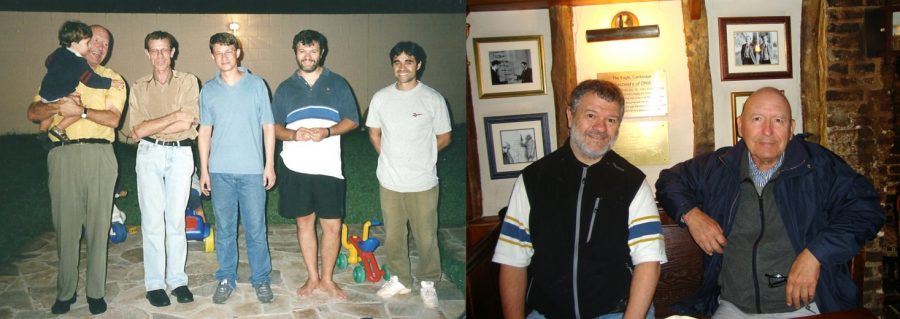
On the left, in the Ugarte family home, Aldo Craievich with a son of the hosts on his lap, next to Ricardo Rodrigues, Varlei Rodrigues, Daniel Ugarte himself and Gilberto Medeiros. Right, Ugarte and Craievich at The Eagle pub in Cambridge, where James Watson and Francis Crick matured the structure of DNA (the famous double helix) and announced it for the first time. The discovery of the double helix was based on X-ray diffraction images, a technique greatly appreciated by Craievich, who helped to disseminate it in Latin America.
On the left, in the Ugarte family home, Aldo Craievich next to Ricardo Rodrigues, Varlei Rodrigues, Daniel Ugarte himself and Gilberto Medeiros. Right, Ugarte and Craievich at The Eagle pub in Cambridge, where James Watson and Francis Crick matured the structure of DNA and announced it for the first time. The discovery of the double helix was based on X-ray diffraction, a technique greatly appreciated by Craievich, who helped to disseminate it in Latin America.

Aldo Felix Craievich: note of condolences.

It is with deep regret that B-MRS informs the death of its founding member Aldo Felix Craievich, senior professor at USP, which occurred in the early hours of today, April 24, 2023, at the age of 84.

Craievich was a pioneer in glass research in Brazil and one of the protagonists in the history of the National Synchrotron Light Laboratory (LNLS). In addition, he dedicated himself to training users of synchrotron light, mainly in Latin America.

In 2016, B-MRS distinguished him with the Memorial Lecture “Joaquim da Costa Ribeiro” in recognition of his trajectory.

The Executive Board of B-MRS deeply regrets the departure of this Argentine scientist, who had lived in Brazil since 1973, and would like to remember him as a member who made great contributions to our community.

Call for symposia and suggestions of plenary speakers for the XXI B-MRS Meeting (Maceió, October 1st to 5th, 2023).

logo2023The call for symposium proposals to compose the XXI B-MRS Meeting is open until December 3rd this year. The event will be held from October 1st to 5th, 2023 in Maceió (Alagoas, Brazil), chaired by Professors Carlos Jacinto da Silva and Mario Roberto Meneghetti, from the Federal University of Alagoas (UFAL).
Proposals can be submitted by teams of researchers (Ph.D.), preferably of international composition, wishing to organize a symposium within the event on a research topic in the field of Materials Science and Technology – from the design, synthesis and characterization of materials to their applications in the most diverse segments. The list of approved final symposia will be published on December 16 this year.

To submit a symposium proposal, simply fill out, in English, the online form available at http://sbpmat.org.br/proposed_symposium/ .

In addition, the event’s organizing committee invites the community to send suggestions of plenary speakers (internationally renowned scientists who can give a motivational lecture on advances made over time in a particular research topic, as well as the challenges and perspectives for the future). The plenary lectures should interest a wide audience, with different levels of training and thematic specialties.

Suggestions for the plenary lectures must be submitted by November 20th of this year through this Google form.

XXI B-MRS Meeting website: https://www.sbpmat.org.br/21encontro/ .

Featured article: Catalysts for the sustainable production of hydrogen peroxide.

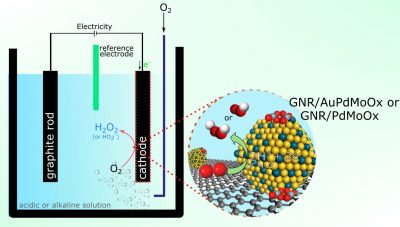
This schematic figure shows an electrochemical hydrogen peroxide generator and, in detail, the catalyst developed by the Brazilian team.

Hydrogen peroxide (H2O2) is a compound widely used, especially as a bleach or antiseptic in the production of pulp and paper, in cleaning, pharmacy and beauty products and in the treatment of wastewater, among other applications. With a large and growing market, the production of hydrogen peroxide has the challenge of becoming more sustainable, using methods that are environmentally friendly and allow the compound to be obtained in the same place where it will be used, reducing risks, costs and the environmental impact of transport. In this scenario, producing hydrogen peroxide in electrochemical generators using basically water, air and electricity is a promising path, which some companies are already treading. However, the success of this process largely depends on having efficient, stable and low-cost catalysts.

In a recently published scientific article, a team made up of researchers from the Brazilian Federal University of Mato Grosso do Sul (UFMS), Federal University of Grande Dourados (UFGD), and the São Carlos Institute of Chemistry (IQSC-USP) made a contribution in this regard. They developed catalysts based on graphene nanoribbons and metallic nanoparticles and studied in detail their performance in the electrochemical production of hydrogen peroxide. In addition to showing that these catalysts significantly improve reaction efficiency, equating to the best conventional catalysts in some aspects, the study advanced the understanding of fundamental phenomena that open possibilities to continue optimizing the electrocatalytic production of hydrogen peroxide.

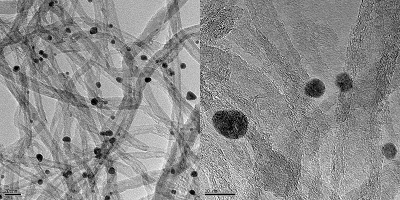
Transmission electron microscopy images of the catalyst material. It is possible to observe the nanoparticles (in this case, palladium oxide and molybdenum) anchored in the graphene nanoribbons.
Transmission electron microscopy images of the catalyst material. It is possible to observe the nanoparticles (in this case, palladium oxide and molybdenum) anchored on the graphene nanoribbons.

“We proposed the synthesis of catalysts with a low content of noble metal (≤6.4% by mass), with high catalytic efficiency and high durability for the electrochemical production of H2O2”, says Professor Gilberto Maia (UFMS), co-author of the article. Indeed, noble metals such as gold and palladium are known for their catalytic properties but have the disadvantage of cost. “Our catalysts were built from oxides of molybdenum, gold and palladium, which together form nanoparticles anchored on the surface of graphene nanoribbons”, describes Maia.

The team tested the efficiency of the catalysts in terms of generating hydrogen peroxide through the two-electron oxygen reduction reaction (ORR-2e– ), in which one molecule of oxygen, two hydrogen cations and two electrons form one molecule of hydrogen peroxide. Mainly, the researchers tested, with very positive results, the activity of the catalyst (its ability to increase the rate of reaction), its selectivity (its ability to direct the reaction towards a certain product, in this case, hydrogen peroxide) and its stability (the ability to maintain its properties over time).

“The results we obtained showed that the improved catalytic activity for ORR-2e–  was promoted by a combination of factors including geometry, palladium content, interparticle distance and active site blocking effects, while the electrochemical stability of the catalysts may have been enhanced by the presence of molybdenum”, says Professor Maia.

The work was developed within a collaboration between researchers from the Institute of Chemistry at UFMS and the Environmental Electrochemistry Research Group at IQSC-USP, who have been working together on the synthesis, characterization and application of electrocatalytic materials. According to the authors, the main idea and the first combinations of synthesis emerged as an offshoot of the doctoral thesis by Guilherme Fortunato, which was supervised by Professor Gilberto Maia and was defended in UFMS in 2019. The work continued and finalized within the postdoctoral research of Fortunato, carried out at IQSC under the supervision of Professor Marcos Lanza.

The research was funded by Brazilian federal and state agencies Capes, CNPq, FAPESP and FUNDECT-MS.

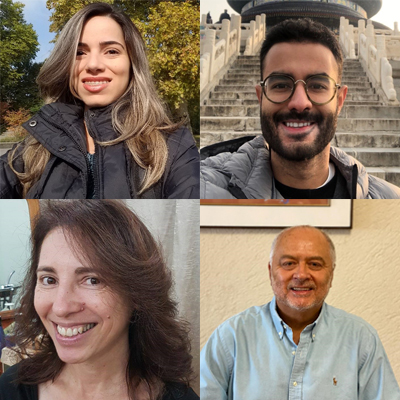
Some of the authors of the article. From left: Guilherme V. Fortunato, Leticia B. Siqueira, Eduardo S. F. Cardoso, Marcos R. V. Lanza and Gilberto Maia.

Paper reference: Using Palladium and Gold Palladium Nanoparticles Decorated with Molybdenum Oxide for Versatile Hydrogen Peroxide Electroproduction on Graphene Nanoribbons. Guilherme V. Fortunato, Leticia S. Bezerra, Eduardo S. F. Cardoso, Matheus S. Kronka, Alexsandro J. Santos, Anderson S. Greco, Jorge L. R. Júnior, Marcos R. V. Lanza, and Gilberto Maia. ACS Applied Materials & Interfaces 2022 14 (5), 6777-6793. DOI: 10.1021/acsami.1c22362.

Corresponding authors contact: g.fortunato@usp.br and gilberto.maia@ufms.br.

Featured article: Earth and bamboo for more sustainable mortars.

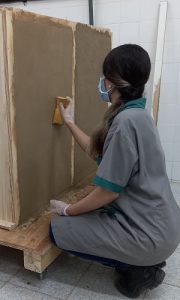
Aplicação da argamassa de terra e bambu.
Application of earth and bamboo mortar.

Like other sectors of the economy, civil construction faces an important challenge: to progressively reduce greenhouse gas emissions and become increasingly sustainable. In this sense, there are efforts in the scientific community to develop construction materials that have a positive environmental impact at all stages of the building process, starting with the extraction of raw materials, going through the use of the buildings and reaching the recycling of waste at the end of the life cycle of the product. To this end, one of the strategies being explored is the incorporation of natural raw materials, such as raw earth and biomass, into construction materials.

In an article recently published in the journal Construction and Building Materials, a Brazilian scientific team reports the development and study of mortars based on raw earth and plant biomass residues (bamboo particles) with potential for use as internal wall plaster. In addition to analyzing the properties of these mortars, the authors evaluated their environmental impact, mainly in relation to the carbon dioxide emissions involved in their preparation, use and disposal.

“The main contribution of this work is to show the feasibility of producing mortars based on locally available natural resources (raw earth and plant biomass – bamboo) in the construction of a portfolio of low carbon and low energy consumption constructive solutions”, says Romildo Dias Toledo Filho, professor of the Civil Engineering Program at Coppe, the postgraduation and research institute in Engineering at the Federal University of Rio de Janeiro (UFRJ), who led the work.

To produce the mortars, the scientific team used raw earth, bamboo particles, hydrated lime, Portland cement and natural sand, among other ingredients. Bamboo particles were obtained from waste from the furniture sector in the state of Rio de Janeiro and processed to obtain fibers of a few hundred micrometers in diameter and up to 2 cm in length.

Four types of mortar were produced: one without bamboo and the others with different proportions of particles (3, 6 and 9% of the total volume). In addition to studying its physical, mechanical and thermal properties, the authors quantified the greenhouse gas emissions involved in the mortar’s life cycle. Using well-established methodologies, the researchers evaluated the developed earth mortars and compared them with conventional mortars. The study considered the entire life cycle of the material.

The research showed good results for earth and bamboo mortars and explained the weight of each factor in the carbon emissions involved in the process, pointing out ways to reduce them even more. Earth mortars, especially those with a higher proportion of bamboo, presented lower emissions than conventional mortars due to the carbon stock of bamboo. In fact, vegetal biomass extract carbon dioxide from the atmosphere through photosynthesis and use it to grow. When this biomass is incorporated into a mortar, the carbon remains stored and its emission is avoided. This environmental gain is enhanced when residues from biomass processing are used as a source of raw material, as occurred in this work.

In addition, density, thermal conductivity and resistance tests showed that earth mortars with bamboo, especially the one containing 6% biomass, can perform very well as plaster for internal walls of buildings, as they have adequate adhesion and resistance, and improve the energy efficiency of the environments. “Earth mortars that incorporate plant biomass present the peculiarity of open porosity, and this characteristic gives them the potential to act as a coating and passive material for hygrothermal regulation of the internal microclimate of the environments, making them more salubrious, providing better conditions of health to the occupants and reducing energy consumption for artificial air conditioning”, explains Professor Romildo.

The work was developed within the PhD in Civil Engineering of Rayane de Lima Moura Paiva, with funding from CNPq and FAPERJ and guidance from Professor Romildo and Professor Lucas Rosse Caldas. The study is part of a research line on earth and biomass mortars that is underway at Coppe’s Sustainable Materials Center in partnership with a group from ETH Zürich (Switzerland).

The authors of the article: Rayane de Lima Moura Paiva, Lucas Rossi Caldas, Adriana Paiva de Souza Martins and Romildo Dias Toledo Filho.

Scientific article reference: Potentiality of earth-based mortar containing bamboo particles for GHG emissions reduction. Rayane de Lima Moura Paiva, Lucas Rosse Caldas, Adriana Paiva de Souza Martins, Romildo Dias Toledo Filho. Construction and Building Materials. Volume 317, 24 January 2022, 125971. https://doi.org/10.1016/j.conbuildmat.2021.125971

Author contact: Prof. Romildo Dias Toledo Filho – toledo@coc.ufrj.br

B-MRS members are speakers at the opening of the International Year of Glass (UN).

zanotto e andreaTwo B-MRS members are part of the group of 30 speakers from different countries and sectors (industry, academia, media, museums, art) who will speak at the Opening Ceremony of the International Year of Glass (2022), established by the United Nations (UN).
Professor Edgar Zanotto (UFSCar), founding member of B-MRS, will give a lecture on glass education. Professor Andrea S. S. de Camargo (IFSC-USP), current Scientific Director of the Society,  will speak about glass science in Brazil.

The free event will take place on February 10 and 11 at the Palace of Nations (Geneva, Switzerland) and will be broadcast live at this link https://media.un.org/en/webtv/.

More information about the event: https://iyog2022oc.org/

End of Year message.

In the year 2021, the pandemic continued to dominate our lives, but the vaccines that science provided us in record time are playing their part. Little by little, we are leaving our virtual life, resuming face-to-face activities to incorporate this new reality.

Unfortunately, our event this year still had to be virtual. Despite that, it was possible to feel the presence of each one of you on the screen!! With each work presented, with each question asked by a student, we felt reassured that science is still well represented in our country! This gives us hope for the future – much-needed hope in the face of the enormous challenges that lie ahead.

Carl Sagan said that we have to know the past to understand the present. And past and present show us that education and science are the main basis for a future with decent living conditions and social well-being. We hope that in 2022 we will continue to fight together for these values, resisting the denialism that still tries to remain present in our society. And that we can finally share our experiences – and our science – in Foz de Iguaçu!

We wish you an excellent end of the year to all, observing all the necessary sanitary care.😊

B-MRS Executive Board

Featured paper: Optimizing nanotubes for green hydrogen production.

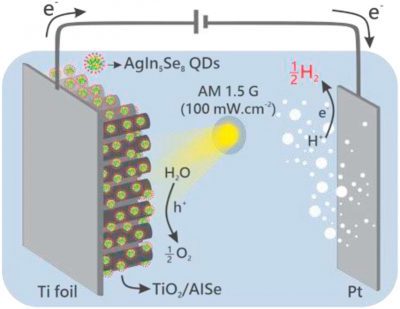
Hydrogen generation in a photoelectrochemical cell with the photoanode developed by the Pernambuco team.

A work carried out in institutions from the state of Pernambuco (Brazil) contributes to the development of nanomaterials with the potential to overcome an important energy challenge: the generation of hydrogen through sustainable processes. In fact, the hydrogen molecule is considered a clean fuel because its use, or “burning”, does not emit greenhouse gases. However, the production of this molecule is responsible for emitting hundreds of tons of carbon dioxide per year.

Fortunately, more sustainable ways to produce molecular hydrogen are being explored by scientists around the world. The “greenest” of all are the photoelectrochemical processes, which consist of breaking down the water molecule (H2O) using electricity from photovoltaic conversion (the transformation of photons into electrons). These processes are carried out in photoelectrochemical cells – simple and low-cost systems basically composed of a photoanode, where sunlight is absorbed, thus generating a current of electrons, and a cathode, on whose surface the hydrogen detaches from the water molecule by the action of the electricity generated in the photoanode. In this context, it is essential to develop materials for the photoanode that are efficient and durable, and which can be produced using low-cost and environmentally friendly processes.

In an article recently published in the Journal of Power Sources (impact factor 9.1270), scientists from the Center for Strategic Technologies of the Northeast (CETENE) and the Federal University of Pernambuco (UFPE) report a simple and clean method to produce nanocomposites capable of generating an electrical current from sunlight. The work also presents good results in the application of the material as a photoanode for hydrogen production.

Challenge: increase photoanode sensitivity

Titanium dioxide (TiO2) is the most used material in photoanodes. Unlike other semiconductors, it is non-toxic and does not degrade easily in contact with light and water. However, this material has a limitation that affects its efficiency: it can only absorb ultraviolet light, not taking advantage of other radiations present in sunlight. For this reason, scientific efforts have been made to expand the sensitivity of TiO2. This was exactly the objective of the CETENE and UFPE team at the beginning of the collaborative work. The strategy they adopted was to integrate semiconductor nanocrystals (quantum dots) to TiO2 nanotubes and, in this way, obtain a material that is more sensitive to sunlight thanks to the synergistic action of both semiconductors.

The researchers started by sensitizing the nanotubes with bismuth sulfide (Bi2S3) nanocrystals, says Denilson V. Freitas, who now works as a researcher at CETENE and has participated in this research line since the beginning, when he was doing his doctorate in Chemistry at UFPE. In the experiments, the scientists noticed that the method of preparing the nanocomposite significantly impacted its photoelectrochemical performance, and reported these results in an article published in 2018 in ACS Applied Energy Materials (impact factor 6.024). “We found that the best photoelectrochemical results were for the linker-assisted method when compared to the hydrothermal method,” says Denilson. Thus, the first method was chosen. In

linker-assisted sensitization, TiO2 nanotubes, supported on titanium sheets, are submerged in a solution containing the chosen nanocrystals. Both materials interact and, at the end of the process, the quantum dots are adsorbed on the surface of the nanotubes.

The second phase of the research was carried out within the Master’s Degree project in Materials Science by Danilo A.P. Velásquez, carried out at UFPE. This time, the scientific team used silver, indium and selenium nanocrystals (AgIn5Se8) with the main objective of determining what would be the optimal submersion time of the nanotubes in the solution, as the researchers had noticed that high concentrations of nanocrystals on the surface of the nanotubes affected in a negative way the performance of the nanocomposite. For this, they performed a series of experiments varying the submersion time between 1 hour and 48 hours.

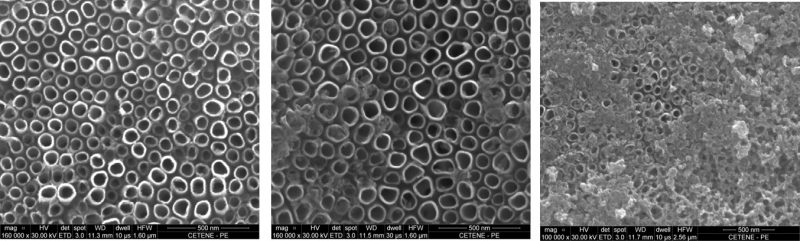
Titanium dioxide nanotubes without quantum dots (left), sensitized with quantum dots for 2 hours (center) and for 72 hours (right).

In addition to observing through electron microscopy techniques the concentration of nanocrystals obtained in each case, the researchers checked the performance of each sample. The results showed that the photoletrochemical performance of nanotubes improved with increasing sensitization time up to 24 hours of immersion, when the obtained nanocomposite generated a photocurrent 2.4 times greater than that of pure nanotubes. Furthermore, the optimized nanotubes also improved their performance in hydrogen production, which was 3.1 times greater than that of the material without quantum dots. The experiments also demonstrated that, after 24 hours of immersion, the concentration of nanocrystals became excessive and impaired the functionality of the nanocomposite. “The work showed that the temporal optimization of the sensitization of nanotubes is an important step in the production of more efficient systems,” summarizes Denilson.

The research was carried out by researchers and students linked to postgraduate programs in Chemistry and Materials Science at UFPE, coordinated by professor Marcelo Navarro, and to CETENE, led by researcher and director of the center Giovanna Machado. The acquisition of images of nanotubes sensitized by high resolution transmission electron microscopy were performed at SENAI-MG. The works were funded by Brazilian research funding agencies CNPq, FACEPE, CAPES and Finep.

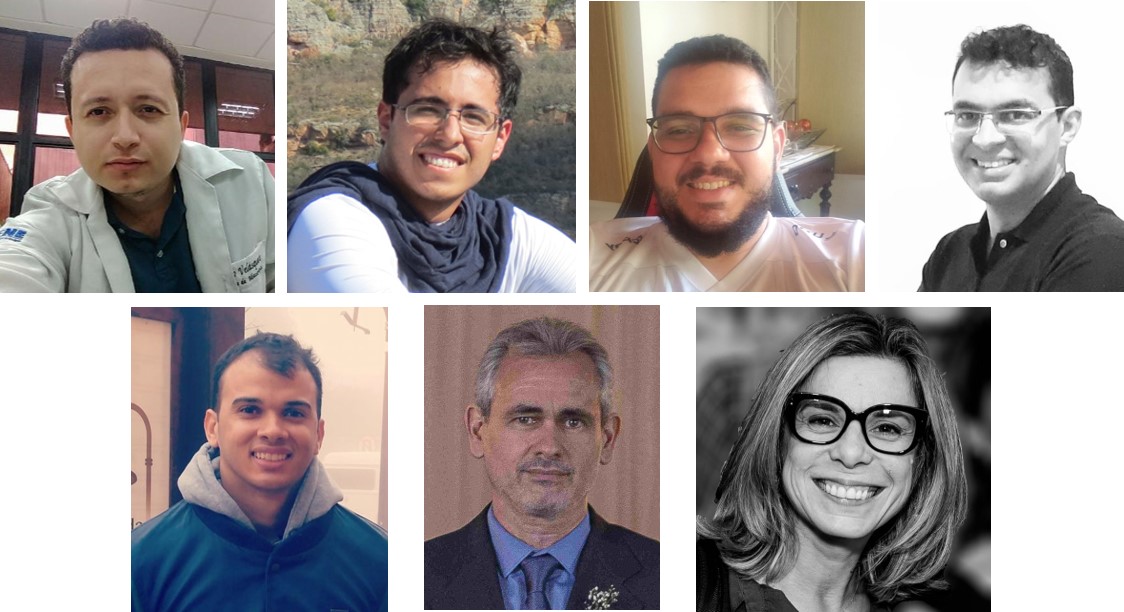
Os autores do paper. A partir da esquerda: Danilo A. P. Velásquez, Felipe L. N. Sousa, Thiago A. S. Soares, Anderson J. Caires, Denilson V. Freitas, Marcelo Navarro e Giovanna Machado.
The authors of the paper. From the left: Danilo A. P. Velásquez, Felipe L. N. Sousa, Thiago A. S. Soares, Anderson J. Caires, Denilson V. Freitas, Marcelo Navarro e Giovanna Machado.


Scientific article reference: Boosting the performance of TiO2 nanotubes with ecofriendly AgIn5Se8 quantum dots for photoelectrochemical hydrogen generation. Danilo A. P.Velásquez, Felipe L. N.Sousa, Thiago A. S. Soares, Anderson J. Caires, Denilson V. Freitas, Marcelo Navarro, Giovanna Machado. Journal of Power Sources. Volume 506, 15 September 2021, 230165. https://doi.org/10.1016/j.jpowsour.2021.230165.

Contact of the corresponding author: Giovanna Machado – giovanna.machado@cetene.gov.br.