

Sorry, this entry is only available in Brazilian Portuguese.
Author: Verónica Savignano
Students awards of the B-MRS Meeting: applications by July 14th.
 The best undergraduate and graduate student contributions presented at the XVIII B-MRS Meeting (Balneário Camboriú, Brazil, September 22-26, 2019) will receive awards from B-MRS and ACS Publications, the scholarly publisher of the American Chemical Society.
To compete for awards, the author (student) must submit, by July 14, an extended abstract additional to the conventional abstract. Prizes will only be awarded for works presented by students at the symposia of the event, and only if the authors (students) are present at the ceremony, which will be held at the closing session of the event, on September 26.
B-MRS will award up to 46 contributions within the Bernhard Gross Award, that annually distinguishes the best student work from each symposium (up to 1 oral and 1 poster per symposium). To elect the winners, the committee will consider the quality of the extended abstract and presentation, as well as the scientific contribution of the work.
Among the winners of the Bernhard Gross Award, the top five oral and five best posters will receive a cash prize (US $ 500.00) and a certificate from ACS Publications.
See more information about the awards, and instructions and template for elaborating the extended abstract: https://www.sbpmat.org.br/18encontro/#authors
(Português) Eleições na SBPMat: comissão eleitoral recebe candidaturas para Diretoria e Conselho até 1º de julho.
International Union of Materials Research Society (IUMRS) endorses UNESCO´s International Year of the Periodic Table.
[IUMRS News Release]
The Periodic Table of Chemical Elements Underlies All of Our Modern Materials
Seminal work of Dmitri Mendeleev one hundred and fifty years ago revealed systematic interrelationships of all the chemical elements known and predicted at the time, and, remarkably, of those subsequently discovered.Those elements are the stuff of which everything and everyone we see is made. The phenomenal natural evolution of our world, including of life itself, assembles the necessary major and often crucial minor elemental ingredients required for Nature’s grand design. Mendeleev’s Periodic Table of the Chemical Elements and its legacy gave us the tools and understanding to invent and design well beyond what Nature has provided.
Whereas empirical uses of materials date to the Bronze and Iron Ages, our electronics, pharmaceuticals, and skyscrapers owe their existence to invention informed by knowledge of the properties of the elements and of the likely properties of myriad compounds and alloys that they form. Such research and invention continue apace in the laboratories of universities and companies with no end in sight. The community of materials researchers depends on, and fully participates in, this exciting progress. The International Union of Materials Research Societies (IUMRS) therefore enthusiastically endorses UNESCO’s declaration of 2019 as the “International Year of the Periodic Table of Chemical Elements (IYPT2019). See https://www.iypt2019.org.
According to IUMRS President Professor Y.F. HAN, “The thousands of researchers affiliated with our membership, who devote their careers to uncovering the next great innovation enabled by advanced materials, all rely on their early training which included Mendeleev’s Table and which emains invaluable in formulating the next new approach to solving problems and making new discoveries in the laboratory. It is therefore entirely appropriate for IUMRS to recognise this sesquicentennial anniversary on their behalf.”
IUMRS Head Office: Room 2112, No. 62 Zizhuyuan Road, Haidian, Beijing, China.
For more information about this topic, contact Dr. Fenfen Liang at +86 10 6872 2032, fax to 86-10-6872-2033, or email to liangff_cmrs@163.com.
Alternative contact: IUMRS Chief Advocacy Officer at cao@iumrs.net
(Português) Eloisa Biasotto Mano: nota de pesar.
(Português) Oportunidade para estágio Pós-Doutoral: Programa de Desenvolvimento Científico e Tecnológico Regional no Estado de Mato Grosso do Sul.
(Português) Mestrado no PPGEPM da Unicamp – Limeira.
B-MRS Newsletter. Year 6, issue 5.
|
||||||||||||||||||||||||||
|
||||||||||||||||||||||||||
|
Featured paper: Disclosing structural disorder in nanomaterials.
[Paper: Decreasing Nanocrystal Structural Disorder by Ligand Exchange: An Experimental and Theoretical Analysis. Gabriel R. Schleder, Gustavo M. Azevedo, Içamira C. Nogueira, Querem H. F. Rebelo, Jefferson Bettini, Adalberto Fazzio, Edson R. Leite. J. Phys. Chem. Lett. 2019 10 1471-1476. https://doi.org/10.1021/acs.jpclett.9b00439]
Disclosing structural disorder in nanomaterials
It is known that it is very important to know and control the structure of a material (how its atoms are arranged in three-dimensional space) as it is largely responsible for the properties of the material and therefore for its applications. For example: regions of disorder in crystalline materials (whose atoms, ideally, are ordered in regular patterns) change some expected behaviors for these materials. Unfortunately, knowing the structure of some materials in detail can be a difficult task – particularly when it comes to nanomaterials.
Concentrating various skills and experimental and theoretical resources, a Brazilian team developed a method to establish the degree and location of disorder in the structure of crystalline and non-crystalline nanomaterials, interfaces and surfaces. The method, which is based on the combination of an experimental technique (transmission electron microscopy), a data analysis method (pair distribution function) and computational simulations, is already available to the scientific community at the Brazilian National Nanotechnology Laboratory (LNNano), and should help develop better performing materials.
In addition to developing the technique, the team applied it in the study of structural disorder in nanocrystals, which are basic elements of nanotechnology and are used for example, in solar cells and electronic devices. Although by definition they have ordered structures, these crystals of nanometric dimension can exhibit, in practice, regions with structural disorder.
In order to carry out the study, the scientists produced faceted nanocrystals of about 3.2 nm in diameter, formed by a core of zirconium dioxide (ZrO2), inorganic material, and a shell made up of organic substances known as ligands, whose atoms form chemical bonds with atoms that are on the surface of the inorganic nucleus. Ligands have the important role of stabilizing the nanocrystals, thus preventing them from aggregating.
The team produced a first series of nanoparticles with ligands containing an aromatic ring and analyzed it using the developed method. The samples were then subjected to a process known as ligand exchange in which chemical reactions occur in the material in the presence of a solvent at a temperature above its boiling point. In these reactions, some connections break down and new connections occur. As a result of the ligand exchange, the team was able to produce nanoparticles with shells containing oleic acid, which were also analyzed using the developed method.
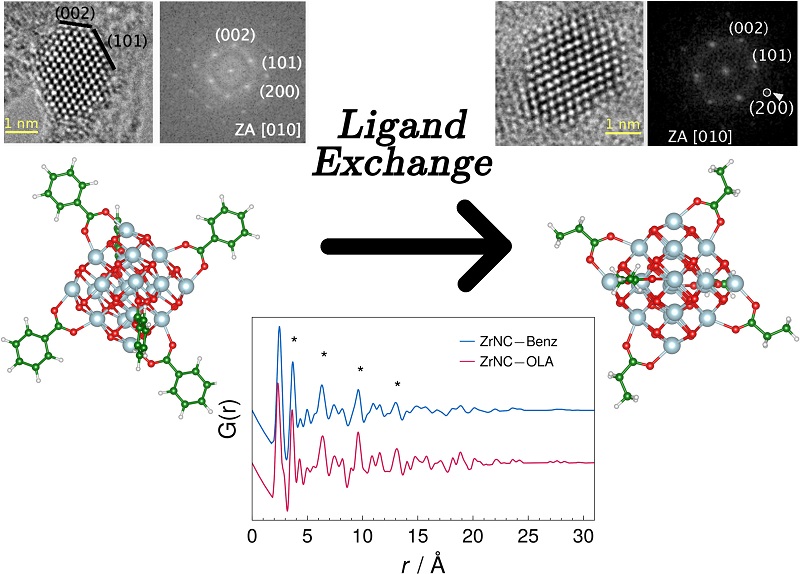
The scientists concluded that, unlike the ideal nanocrystal of zirconium dioxide, the two types of nanocrystals analyzed had a degree of structural disorder located on the surface of the nucleus. In addition, in the second group of nanoparticles, the disorder was significantly lower. The researchers interpreted this reduction as a result of the high temperature of the ligand exchange process, which altered the tensions of the network of atoms.
“In our work, we were able to directly assess the degree and location of disorder in the nanocrystals, which until then was not technically feasible,” says Gabriel Schleder, PhD candidate in the Graduate Program in Nanosciences and Advanced Materials of the Brazilian Federal University of the ABC (UFABC).
By better understanding structural disorder and its causes, the researchers were able to point out a way to control it. “Any property that significantly depends on surface-located structural disorder could be in principle controlled by this kind of ligand exchange process,” says Schleder. “Mechanical properties, photoluminescence, electronic transport and catalytic properties are some of them,” he adds.
The research was reported in a recently published article in The Journal of Physical Chemistry Letters (impact factor = 8,709).
Overcoming the challenge through collaborations
The initial idea of the study appeared in a meeting held at the end of 2017 at the National Center for Research in Energy and Materials (CNPEM), located in the city of Campinas, São Paulo. At the meeting, a group of reserachers discussed the implementation in Sirius (the next Brazilian synchrotron light source) of a technique that allows locally analyzing structural issues such as disorder and defects, called pair distribution function (PDF). The technique describes the distances between pairs of atoms by means of a mathematical function. To apply it, the specialist generally uses the results of X-ray diffraction measurements – an experimental technique that provides information about the structure of materials. However, in order to implement the analysis by PDF, the X-ray beam focused on the sample must be of very high energy – higher than that provided by the current Brazilian synchrotron light source.
During the meeting at CNPEM, Professor Gustavo de Medeiros Azevedo, researcher at the National Laboratory of Synchrotron Light (LNLS), and Professor Edson Leite, LNNano’s scientific director, decided to begin applying PDF using electron diffraction results, a specialty of LNNano’s researcher Jefferson Bettini. The electron beams would be generated by the transmission electron microscope (TEM) of LNNano. In fact, this instrument allows the control of the electron beam so that it focuses a small area of the sample, allowing the desired local analysis of the structure. Besides that, when switching from the “diffraction mode” to the “image mode”, the microscope would made possible to choose precisely the area of the sample to be analyzed.
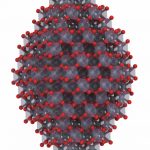
The development team also involved professors Içamira Costa Nogueira, from the Federal University of Amazonas (UFAM) and Querem Hapuque Felix Rebelo, from the Federal University of the West of Pará (UFOPA), who contributed with the synthesis of nanocrystals that would be studied and with the development of the analysis methodology.
During the development of the technique, another challenge had to be faced. To interpret the PDF results, it would be necessary to have a simulation of an ideal nanocrystal – a nanocrystal model without structural disorganization that could be used as a reference.
New skills were then incorporated into the team, which was then joined by Professor Adalberto Fazzio, director general of LNNano and leader of a UFABC research group dedicated to computational techniques applied to materials, and his doctoral student Gabriel Schleder. Based on the Density Functional Theory (DFT), a computational modeling method in the field of Quantum Physics, the researchers were able to simulate the ideal nanocrystal that served as the analysis model.
“Something very positive we perceived is that the main results arose from the process of interaction, discussion and exchange of information mainly between theory/computational simulation and experiments. Without this, we certainly would not have good final conclusions,” says Schleder.

Featured scientist: Prof. Norbert Koch (Humboldt-Universität zu Berlin, Germany).
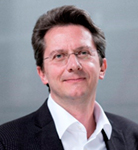
While a large part of humanity benefits from the advantages of solar cells, LEDs and other optoelectronic devices, some scientists are striving to find materials and structures that enable new developments in optoelectronic technologies.
Norbert Koch (Professor at the Humboldt-Universität zu Berlin, and research group leader in that university and at the Helmholtz-Zentrum Berlin) belongs to the latter group of qualified people.
Prof. Koch studied technical physics at the Technische Universität Graz (Austria), where he also did his doctoral studies in solid-state physics. He spent two years as postdoc at Princeton University (USA). In 2003, he started setting up a research group at the Humboldt-Universität zu Berlin, where he was appointed as professor in 2009. His scientific production has more than 16,300 citations and his h-index is 66 (Google Scholar).
This scientist will be in September in Balneário Camboriú (Brazil), giving a plenary lecture at the XVIII B-MRS Meeting. In the talk, he will speak about very promising structures in the field of optoelectronics, which are based on a combination of organic and inorganic materials.
See our mini interview with Professor Norbert Koch.
B-MRS Newsletter: – We´d like to know more about your scientific work. Please choose one or two of your favorite contributions, briefly describe them, and share the references.
All modern optoelectronic devices are complex multilayer structures. To arrive at the desired function, e.g., light emission or energy conversion, with the highest possible efficiency, an optimized alignment of the electronic energy levels is key. For novel and emerging materials, such as organic and 2-dimensional semiconductors, this cannot be achieved readily because the fundamental underlying mechanisms, which govern the level alignment, are not properly understood. Consequently, my research is geared towards unraveling this understanding, and to devise means of optimizing interfacial energy levels. For instance, for a long time it was believed that the level alignment with organic semiconductors is substantially different from what was known for traditional inorganic semiconductors like silicon. The concerted effort of many groups worldwide has finally provided the insight that the established mechanisms do hold, but peculiarities of the organic compounds have to be considered appropriately. It turned out that the energy and density distribution of electronic states of the organic semiconductor critically determines the level alignment, at interfaces towards electrodes [Nat. Commun. 5, 4174 (2014)] and at semiconductor heterostructures [Sci. Adv. 1, e1501127 (2015)]. With this understanding at hand, device engineers can now minimize electrical losses at contacts and precisely tune the energy level offset at heterojunctions.
B-MRS Newsletter: – In your plenary talk at the B-MRS Meeting, you will talk about hybrid (organic / inorganic) structures for optoelectronics. Could you give examples of such structures and their present and/or future applications? Why this type of structure is relevant for developing optoelectronic devices?
The idea to combine inorganic and organic semiconductors is based on the notion to take advantage of the beneficial properties of each component while compensating their respective weaknesses. For instance, inorganic semiconductors typically exhibit high charge carrier mobility and organic ones stand out by very strong light-matter coupling. In a hybrid light emitting diode (LED), one can imagine to electrically pump the inorganic semiconductor at highest levels, and upon energy transfer the desired light is emitted by the organic semiconductor. This could result in LEDs with high brilliance at virtually any color that also feature ultrahigh modulation bandwidth.
For more information on this speaker and the plenary talk he will deliver at the XVIII B-MRS Meeting, click on the speaker’s photo and the title of the lecture here https://www.sbpmat.org.br/18encontro/#lectures.