|
|||||||||||||||||||||||||||||||||||||||||
|
|||||||||||||||||||||||||||||||||||||||||
|
|
|||||||||||||||||||||||||||||||||||||||||
|
|||||||||||||||||||||||||||||||||||||||||
|

Like other sectors of the economy, civil construction faces an important challenge: to progressively reduce greenhouse gas emissions and become increasingly sustainable. In this sense, there are efforts in the scientific community to develop construction materials that have a positive environmental impact at all stages of the building process, starting with the extraction of raw materials, going through the use of the buildings and reaching the recycling of waste at the end of the life cycle of the product. To this end, one of the strategies being explored is the incorporation of natural raw materials, such as raw earth and biomass, into construction materials.
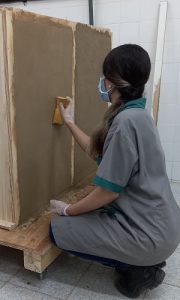
In an article recently published in the journal Construction and Building Materials, a Brazilian scientific team reports the development and study of mortars based on raw earth and plant biomass residues (bamboo particles) with potential for use as internal wall plaster. In addition to analyzing the properties of these mortars, the authors evaluated their environmental impact, mainly in relation to the carbon dioxide emissions involved in their preparation, use and disposal.
“The main contribution of this work is to show the feasibility of producing mortars based on locally available natural resources (raw earth and plant biomass – bamboo) in the construction of a portfolio of low carbon and low energy consumption constructive solutions”, says Romildo Dias Toledo Filho, professor of the Civil Engineering Program at Coppe, the postgraduation and research institute in Engineering at the Federal University of Rio de Janeiro (UFRJ), who led the work.
To produce the mortars, the scientific team used raw earth, bamboo particles, hydrated lime, Portland cement and natural sand, among other ingredients. Bamboo particles were obtained from waste from the furniture sector in the state of Rio de Janeiro and processed to obtain fibers of a few hundred micrometers in diameter and up to 2 cm in length.
Four types of mortar were produced: one without bamboo and the others with different proportions of particles (3, 6 and 9% of the total volume). In addition to studying its physical, mechanical and thermal properties, the authors quantified the greenhouse gas emissions involved in the mortar’s life cycle. Using well-established methodologies, the researchers evaluated the developed earth mortars and compared them with conventional mortars. The study considered the entire life cycle of the material.
The research showed good results for earth and bamboo mortars and explained the weight of each factor in the carbon emissions involved in the process, pointing out ways to reduce them even more. Earth mortars, especially those with a higher proportion of bamboo, presented lower emissions than conventional mortars due to the carbon stock of bamboo. In fact, vegetal biomass extract carbon dioxide from the atmosphere through photosynthesis and use it to grow. When this biomass is incorporated into a mortar, the carbon remains stored and its emission is avoided. This environmental gain is enhanced when residues from biomass processing are used as a source of raw material, as occurred in this work.
In addition, density, thermal conductivity and resistance tests showed that earth mortars with bamboo, especially the one containing 6% biomass, can perform very well as plaster for internal walls of buildings, as they have adequate adhesion and resistance, and improve the energy efficiency of the environments. “Earth mortars that incorporate plant biomass present the peculiarity of open porosity, and this characteristic gives them the potential to act as a coating and passive material for hygrothermal regulation of the internal microclimate of the environments, making them more salubrious, providing better conditions of health to the occupants and reducing energy consumption for artificial air conditioning”, explains Professor Romildo.
The work was developed within the PhD in Civil Engineering of Rayane de Lima Moura Paiva, with funding from CNPq and FAPERJ and guidance from Professor Romildo and Professor Lucas Rosse Caldas. The study is part of a research line on earth and biomass mortars that is underway at Coppe’s Sustainable Materials Center in partnership with a group from ETH Zürich (Switzerland).

Scientific article reference: Potentiality of earth-based mortar containing bamboo particles for GHG emissions reduction. Rayane de Lima Moura Paiva, Lucas Rosse Caldas, Adriana Paiva de Souza Martins, Romildo Dias Toledo Filho. Construction and Building Materials. Volume 317, 24 January 2022, 125971. https://doi.org/10.1016/j.conbuildmat.2021.125971
Author contact: Prof. Romildo Dias Toledo Filho – toledo@coc.ufrj.br
Prof. Ana Flavia Nogueira (UNICAMP), B-MRS member, became associate editor of two important journals of the Royal Society of Chemistry: Materials Advances and Journal of Materials Chemistry C.
At B-MRS, the scientist was elected a member of the Deliberative Council, with a term of office from 2022 to 2026.
Two B-MRS members are part of the group of 30 speakers from different countries and sectors (industry, academia, media, museums, art) who will speak at the Opening Ceremony of the International Year of Glass (2022), established by the United Nations (UN).
Professor Edgar Zanotto (UFSCar), founding member of B-MRS, will give a lecture on glass education. Professor Andrea S. S. de Camargo (IFSC-USP), current Scientific Director of the Society, will speak about glass science in Brazil.
The free event will take place on February 10 and 11 at the Palace of Nations (Geneva, Switzerland) and will be broadcast live at this link https://media.un.org/en/webtv/.
More information about the event: https://iyog2022oc.org/
|
|||||||||||||||||||||||||||||||||||||||||||||||||
|
|||||||||||||||||||||||||||||||||||||||||||||||||
|
Ricardo D. Rodrigues (1951-2020). Exceptional human being and true polymath.

Antonio Ricardo Droher Rodrigues (Ricardo to his colleagues and friends) passed away two years ago, on January 3, 2020. Ricardo led the projects and construction of the two synchrotron light sources built at the Brazilian National Synchrotron Light Laboratory (LNLS), an entity now belonging to the National Center for Research in Energy and Materials (CNPEM), Campinas – São Paulo state, Brazil.
Ricardo graduated as a Civil Engineer in 1974 at the Federal University of Paraná, Curitiba-UFPR, began his scientific activities in 1974 in the X-Ray Optics Group of the Physics Department at UFPR and performed his doctorate in Physics from 1976 to 1979 at King’s College, University of London, UK. In his thesis work “X-ray optics for synchrotron radiation” Ricardo proposed and characterized nearly parallel double-crystal X-ray monochromators for suppression of harmonic components, which are now used in many synchrotron light laboratories around the world. In 1977 he carried out the tests of these monochromators in Hasylab (Hamburg), thus being the first Brazilian to use a synchrotron light source.
Soon after his return to Brazil in 1981, Ricardo actively participated in the Synchrotron Radiation Project (PRS/CNPq) developed at the Brazilian Center for Research in Physics (CBPF), Rio de Janeiro, from 1980 to 1985. The PRS was the precursor project that led to the creation of LNLS in 1986. As part of the PRS activities, a group of Brazilian scientists led by Ricardo did a three-month stay at Stanford Synchrotron Radiation Lightsource (SSRL), in Stanford, USA, during which they developed a conceptual project of a 2-3 GeV synchrotron light source, which later was the initial LNLS project.
Shortly after the LNLS was created in 1986 in Campinas, Ricardo was appointed Project Manager. During a total period of 10 years, he implemented the initial basic infrastructure, trained the young technicians and engineers of his team and developed the various actions that led to the construction and successful operation of the first light source of LNLS – with an electron energy of 1.37 GeV – called UVX. The construction of the UVX source was completed in 1996 and opened to external users from Brazil and abroad in July 1997, thus providing scientists from numerous areas of science with a modern instrumentation that only exists today in few countries in the world. At that time, UVX was the only synchrotron light source in the Southern Hemisphere and even today the LNLS is the only National Laboratory in Latin America equipped with asynchrotron light source. Ricardo’s qualities of clear leadership, extreme dedication and unquestionable competence, both scientific and technical, were of fundamental importance for the successful development of the first Brazilian synchrotron light source. In addition to Ricardo’s decisive role in the construction of the first LNLS light source, he also actively participated in the development of new scientific instrumentation for several beamlines. The UVX source operated satisfactorily and was extensively used for 22 years, until 2019, by more than 6,000 researchers, mainly Brazilians and also from other countries.
In 2001, with the UVX synchrotron source already working routinely, Ricardo decided to move away from LNLS and created the company Skedio Technologies in Campinas, where he started the production of precision industrial instrumentation and also devices of artistic interest. He remained at this company until 2009, when he received and accepted an invitation from the LNLS board to return to this institution and face the second major challenge of his professional career: the design and construction of the second Brazilian synchrotron light source (Sirius).
In 2009 Ricardo assumed the role of Sirius Project Leader with the mission of designing and building a fourth-generation 3 GeV synchrotron light source with light emission qualities much superior to those of the UVX source. At that time, the only synchrotron source in the world with this exceptional quality was in the design phase in Sweden. The construction of this modern source presented numerous engineering challenges, many of them without precedent in Brazil and abroad. However, Ricardo and his team overcame these problems by applying in many cases local solutions. Thus, the first X-ray beam produced by the 3 GeV Sirius source was emitted in December 2019. Sirius is the third state-of-the-art (fourth-generation) synchrotron light source now operating in the world, after the existing ones in Lund (Sweden) and Grenoble (France). In this way Ricardo as Sirius Project Leader achieved the ambitious goals of the project and thus won the second great challenge of his career.
Ricardo demonstrated a clear leadership capacity, extreme seriousness and recognized competence both as a physicist in the area of X-ray optics and in different areas of engineering: civil, mechanical and electrical-electronic, with emphasis on the subareas of electrical circuits, magnetics and electronics.This multi-faceted competence allowed him to efficiently act on all relevant technical aspects associated with the construction of both LNLS light sources and demonstrated his leadership respected by all his team. Notably, Ricardo was not only a respected leader, an excellent physicist and a competent engineer in several specialties, he also demonstrated artistic sensitivity and competence as a sculptor and painter. This shows that Ricardo possessed all the typical characteristics of a true polymath. That is to say, his multifaceted competences were not merely those exhibited by “generalists”, but the ones demonstrated by rare and distinguished human beings who have deep knowledge in the different areas in which they work.
Ricardo’s work was unanimously recognized by the LNLS team and user researchers who knew him. He also received formal honors from the Brazilian Society of Crystallography in 2000 and from LNLS/CNPEM on the occasion of the celebration of the 30th anniversary of the LNLS, in 2017. In 2010, he received a distinction from the Presidency of the Republic of Brazil that designated him Commander of the National Order of Scientific Merit.
I had the privilege of following Ricardo’s work for over more than 40 years. Our first meeting was at the XI Congress of the International Union of Crystallography (IUCr) held in Warsaw in August 1978, during which we talked about the new scientific possibilities opened up by the availability of synchrotron light sources, which were still in their infancy in the world at that time. From 1981 to 1986 my interaction with Ricardo was mainly at CBPF, in Rio de Janeiro, during the development of the Synchrotron Radiation Project, from 1987 to 2000 at LNLS, in Campinas, during the construction of the UVX source, from 2000 to 2009 at the company Skedio Technologies, and finally, from 2009 to 2019, again at LNLS. Our last conversation was during the last week of December 2019, in which he told me – serenely and with contained satisfaction – that the electron beam in Sirius reached its nominal 3 GeV energy and the first experiments by users were carried out. Sadly, Ricardo passed away on January 3, 2020, just a few days after having won the second big challenge of his professional life.
Two years have passed since Ricardo’s death. We physically lost an exceptional human being, a distinguished master, a brilliant physicist and engineer, and a sensitive fine artist. Ricardo’s legacies for Brazilian science are the modern Sirius synchrotron light source open to users from all areas of science from Brazil and abroad, the competent team of engineers and technicians from the LNLS that he formed and the large community of LNLS
users who benefited from the results of his work. His example of life and unique personality continue and will continue to live in the memory of all those who have had the privilege of knowing him and had followed his fruitful work. Ricardo’s death mourned Brazilian science and engineering.
After his death, LNLS/CNPEM honored Ricardo by naming its annual school on applications of synchrotron light as Ricardo Rodrigues School of Synchrotron Light, and organized, on November 9, 2020, a Ceremony of Tribute to Ricardo Rodrigues. In this ceremony, family, friends and colleagues presented emotional testimonies with memories and personal visions about Ricardo’s life. In the final part, B-MRS honored Ricardo by delivering a plaque engraved with the words: The Brazilian Society for Materials Research (SBPMat) honors Ricardo Rodrigues’ fundamental contribution to the successful development and implementation of Brazilian synchrotron light sources UVX and Sirius, which put Brazil at the forefront of materials research. All the testimonies presented (in Portuguese) at the Tribute Ceremony were recorded and can be accessed through the link https://www.youtube.com/watch?v=hrmTDdnyv9s
Aldo F. Craievich
Senior Professor
Institute of Physics
University of São Paulo
|
||||||||||||||||||||||||||
|
||||||||||||||||||||||||||
|
In the year 2021, the pandemic continued to dominate our lives, but the vaccines that science provided us in record time are playing their part. Little by little, we are leaving our virtual life, resuming face-to-face activities to incorporate this new reality.
Unfortunately, our event this year still had to be virtual. Despite that, it was possible to feel the presence of each one of you on the screen!! With each work presented, with each question asked by a student, we felt reassured that science is still well represented in our country! This gives us hope for the future – much-needed hope in the face of the enormous challenges that lie ahead.
Carl Sagan said that we have to know the past to understand the present. And past and present show us that education and science are the main basis for a future with decent living conditions and social well-being. We hope that in 2022 we will continue to fight together for these values, resisting the denialism that still tries to remain present in our society. And that we can finally share our experiences – and our science – in Foz de Iguaçu!
We wish you an excellent end of the year to all, observing all the necessary sanitary care.😊
B-MRS Executive Board
|
|||||||||||||||||||||||||||
|
|||||||||||||||||||||||||||
|