B-MRS Newsletter. Year 10, issue 7.


capa-ingles

Year 10, issue 7. August 7th, 2023.

Elections at SBPMat

ELEIÇOES

B-MRS members will elect, in October this year, the next Executive Board and six members of the Council. The calendar for the electoral process was released. All active members can run for the Board or the Council. Know more.

Papers by the community

Imagem2

In this article, a scientific team from Unesp and USP makes a contribution to the development of implants that integrate better into the body. The authors studied in detail the possibility of adding bisphosphonates (organic molecules used in the treatment of bone diseases) to materials for dental implant coatings: titanium dioxide (a material with good adhesion to metals such as titanium) and hydroxyapatite (a compound with excellent biocompatibility). Bisphosphonates could make implants more bioactive by increasing their ability to induce bone growth. This work takes a first step in this direction, as it shows how the adsorption of these molecules on films occurs and how this affects surface properties. Check out the paper in Surfaces and Interfaces.

Imagem1

Micro and nanofibers that are both flexible and conductive are the subject of this review article signed by a team from UFBA, Embrapa Instrumentação and UFSCar. The authors address recent advances in the development of these materials produced by electrospinning, and their application in flexible electronic devices, from batteries to sensors, increasingly present in health and environmental monitoring. Check out the review in the Chemical Engineering Journal.

Imagem4

Researchers from Unicamp and CNPEM, together with a collaborator from Canada, investigated the modulation of acidity in catalysts and its impact on the hydrodeoxygenation reaction – one of the main processes used to add value to biomass derivatives in the production of biofuels. The results contribute to the development of more active, selective and stable catalysts that can be used to produce fuels and raw materials for industry from biomass. Access the paper in Applied Catalysis B: Environmental.

Imagem3

A team from UFABC developed a portable device that allows detecting the rabies virus in less than 1 minute. The work presents a new alternative to the current methods of diagnosing the disease, which require a laboratory structure and expensive reagents to be carried out. The authors produced different graphene derivatives from natural Brazilian graphite and tested their performance as biosensor electrodes. Reduced graphene oxide films showed the best performance in tests with respiratory secretions from bats. Functionalized with cDNA, the electrodes detected and quantified the RNA of the virus in the samples. The device is promising for diagnosing diseases in hard-to-reach places, as well as for field research. Access the scientific article in Biosensors and Bioelectronics.

If you are the author of a high-impact article in the Materials area and you wish to share it with our community, contact us.

Awards

Imagem5

Registrations for the JALCOM Award will close on the 15th of August. This award from B-MRS and the Journal of Alloys and Compounds (Elsevier) is devoted to researchers from Brazilian institutions with significant contributions in certain topics in the areas of Materials and Energy. Know more.

University Chapters

Imagem5

B-MRS launched a call to fund outreach projects of its University Chapters within the theme “Materials and Sustainable Development”. Application is open until the 31st of August. Know more.

XXI B-MRS Meeting
Maceió (AL), October 1st to 5th, 2023

maceio

Early Registration. The period for registration with discount in all categories ends on August 10th. See prices and register here.

Short Courses. On October 1st (Sunday), starting at 10:00 am, the program features 3 free short courses for XXI B-MRS Meeting attendees, on the themes: research in microfluidics, writing and publishing scientific articles and use of advanced materials in forensic science. To participate, it is necessary to register through the event system until August 31st, by clicking on “add/edit activities”.

Short Program: it is available on the website. See here.

Plenary Lectures. This edition of the event will have 6 plenary lectures given by distinguished scientists from France, Germany, India, Italy, Portugal and Spain. Learn more about the plenary sessions on the website.

Memorial Lecture. At the opening of the event, the traditional Memorial Lecture Joaquim da Costa Ribeiro will be given by Prof. Gilberto Fernandes de Sá (UFPE).

Lectureship Award José Arana Varela. Prof. Fernando Lázaro Freire Junior (PUC-Rio) will receive this distinction from B-MRS and will deliver a plenary lecture at the event.

Symposia. The event comprises 24 thematic symposia covering design, synthesis, characterization, processing and applications of various materials, from traditional alloys to bio-based polymers. More than 100 researchers from 15 countries organize our symposia.

Venue. The venue for the event will be the Ruth Cardoso Cultural and Exhibition Center, in the city of Maceió. Know more.

Chairmen. The general coordinators of the event are Professors at the Federal University of Alagoas (UFAL): Carlos Jacinto da Silva, from the Institute of Physics, and Mario Roberto Meneghetti, from the Institute of Chemistry and Biotechnology.

Opportunities

– Research internship at IBM Research for PhD students in the field of molecular modeling. Know more.

– Joint call for (self) nominations from Applied Materials & Interfaces and ACS Applied Nano Materials to compose a collection of articles by authors from South America. Deadline: August 31. Know more.

– Jalcom Award, award from SBPMat and the Journal of Alloys and Compounds (Elsevier) for researchers from Brazilian institutions with contributions in topics of Materials and Energy, applications are open until August 15th. Know more.

– Waterloo Institute for Nanotechnology (WIN) Award, University of Waterloo (Canada), for emerging leader in nanoscience and nanotechnology aligned with WIN themes: smart and functional materials, connected devices, next-generation energy systems, therapeutics and theranostics. Registration until September 15th. Know more.

– Call for papers from the ACS Applied Nano Materials journal for the special issue “Women in Nano”, dedicated to articles by women working on nanomaterials with a focus on applications. Deadline for submission is August 31. Know more.

– Call for articles from the Journal of Materials Chemistry A, B and C (RSC) for the thematic collection on “functional framework materials”. Submissions by September 1st. Know more.

– Call for articles for thematic collection on injectable hydrogels in the RSC Journal of Materials Chemistry B and Biomaterials Science. Submissions by September 10th. Know more.

Upcoming events

– IV Brazilian Nanocellulose Summit. Sao Carlos (SP). August 9th to 11th, 2023. Website.

1st Brazilian Symposium on Nanotechnology Engineering at PENt-COPPE/UFRJ. Online. August 28th to 30th, 2023. Website.

Chip in Rio (International Congress in Microelectronics and Microtechnologies). Rio de Janeiro. August 28 to September 1, 2023. Website.

XXI B-MRS Meeting. Maceio (AL). October 1st to 5th, 2023. Website.

4th International Brazilian Conference on Tribology (TriboBR). Victoria (ES). November 26th to 30th, 2023. Website.

XLVI Congresso Internacional de Químicos Teóricos de Expressão Latina (Quitel 2023). Montevideo (Uruguay). November 26th to 30th, 2023. Website.

– IEEE International Magnetics Conference (INTERMAG 2024). Rio de Janeiro – (RJ). May 5th to 10th, 2024. Website.

– 50th International Conference on Metallurgical Coatings and Thin Films (ICMCTF 2024). San Diego (USA). May 19th to 24th, 2024. Website.

Follow us on social networks

rodape-ingels

Unsubscribe if you don´t want to receive our newsletters anymore.

B-MRS Newsletter. Year 10, issue 6.


capa-ingles

Year 10, issue 6. July 5th, 2023.

Featured paper

destaque

Through a simple hydration and drying process, researchers from UFABC (Brazil) have converted three-dimensional perovskites into low-dimensional perovskites, thus modifying their optoelectronic properties. The discovery brings a new perspective on the interaction of water with these materials, whose degradation in contact with humidity is known. The work was reported in Journal of Materials Chemistry C. Read our news story.

Awards

jalcom award

This new award from B-MRS and the Journal of Alloys and Compounds (Elsevier) will distinguish both Advanced and Early Career researchers from Brazilian institutions with significant contributions in certain topics in the areas of Materials and Energy. Applications are open until August 15. Know more.

XXI B-MRS Meeting
Maceió (AL), October 1 to 5, 2023

maceio

Short program: it is available on the website. See here.

Status of revised abstracts. On July 7th (new deadline), the authors of abstracts that were submitted after review will receive the final status notification: whether it was approved for presentation or rejected.

Student Awards. Work submitted by students and approved for presentation can now apply for the Student Awards, until July 23 (new deadline). There are awards from B-MRS (Bernhard Gross Award), ACS Publications and the Royal Society of Chemistry. Know more.

Registration. Registration is open, with special prices for students and researchers from Brazilian institutions and other Latin American countries. Early registration, with special discount, ends on August 10. See the fees.

Plenary Lectures. This edition of the event will have 6 plenary lectures given by distinguished scientists from France, Germany, India, Italy, Portugal and Spain. Learn more about the plenary sessions on the website.

Memorial Lecture. At the opening of the event, the traditional Memorial Lecture Joaquim da Costa Ribeiro will be given by Prof. Gilberto Fernandes de Sá (UFPE).

Lectureship Award José Arana Varela. Prof. Fernando Lázaro Freire Junior (PUC-Rio) will receive this distinction from B-MRS and will deliver a plenary lecture at the event.

Symposia. The event comprises 24 thematic symposia covering design, synthesis, characterization, processing and applications of various materials, from traditional alloys to bio-based polymers. More than 100 researchers from 15 countries organize our symposia.

Venue. The venue for the event will be the Ruth Cardoso Cultural and Exhibition Center, in the city of Maceió Know more.

Chairmen. The general coordinators of the event are Professors at the Federal University of Alagoas (UFAL): Carlos Jacinto da Silva, from the Institute of Physics, and Mario Roberto Meneghetti, from the Institute of Chemistry and Biotechnology.

Reading tips

Nature cover: Scientists make the first X-ray characterization of an individual atom. The advance, which makes it possible to determine what an atom is made of, should have a major impact on Materials Science and Technology, in addition to areas such as Medicine and Environment. Know more.

Science: Scientists increase elastomer resistance 9 times without impairing its elasticity. New material could reduce huge microplastic pollution generated by tire wear. Know more.

Opportunities

– Applications are open until August 15th to the Jalcom Award, an award from B-MRS and the Journal of Alloys and Compounds (Elsevier) for researchers from Brazilian institutions with contributions on Materials and Energy topics. Know more.

Award from the Waterloo Institute for Nanotechnology (WIN, Canada) for emerging leader in nanoscience and nanotechnology aligned with WIN themes: smart and functional materials, connected devices, next-generation energy systems, therapeutics and theranostics. Applications until September 15th. Know more.

– Call for papers from the ACS Applied Nano Materials journal for the special issue “Women in Nano“, dedicated to articles by women working on nanomaterials with a focus on applications. The deadline for submission is August 31st. Know more.

– Call for articles from the Journal of Materials Chemistry A, B and C (RSC) for the thematic collection on functional framework materials. Submissions by September 1st. Know more.

– Call for articles for thematic collection on injectable hydrogels in the RSC Journal of Materials Chemistry B and Biomaterials Science. Submissions by September 10th. Know more.

To follow the opportunities in the area, enter the B-MRS group on Linkedin.

Upcoming events

Escuela Virtual de Caracterización de Materiales de la SMMATER – 3ª edición. Online. February 20th to August 2nd, 2023. Website.

41st International Conference on Vacuum Ultraviolet and X-ray Physics (VUVX 2023). Campinas, (SP). July 3 to 7, 2023. Website.

– IV Brazilian Nanocellulose Summit. Sao Carlos (SP). August 9th to 11th, 2023. Website.

– 1º Simpósio Brasileiro de Engenharia da Nanotecnologia do PENt-COPPE/UFRJ. Online. August 28th to 30th, 2023. Website.

– Chip in Rio (International Congress in Microelectronics and Microtechnologies). Rio de Janeiro. August 28 to September 1, 2023. Website.

– XXI B-MRS Meeting. Maceio (AL). October 1st to 5th, 2023. Website.

– 4th International Brazilian Conference on Tribology (TriboBR). Vitória(ES). November 26th to 30th, 2023. Website.

– XLVI Congresso Internacional de Químicos Teóricos de Expressão Latina (Quitel 2023). Montevideo (Uruguay). November 26th to 30th, 2023. Website.

Follow us on social media

rodape-ingels

Unsubscribe here if you don´t want to receive our newsletters anymore.

Featured paper: Hydrating perovskites for a dimensional conversion.

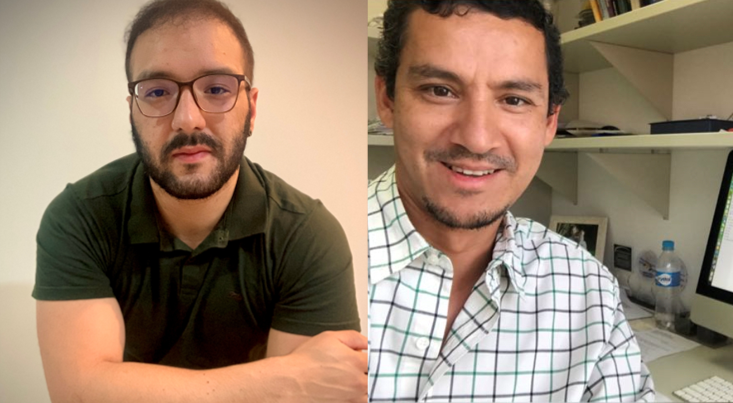
The authors of the article: postdoc André Luiz Martins de Freitas and professor Jose Antonio Souza (UFABC).
The authors of the article: postdoc André Luiz Martins de Freitas and Professor Jose Antonio Souza (UFABC).

Perovskites are very promising semiconductor materials for use in solar cells and other optoelectronic devices, but they have a limitation that impairs the useful life of their applications, their low stability. In this context, humidity can be considered the enemy of perovskites, as it is one of the main factors that accelerate the degradation of these materials.

Now, a discovery by researchers from the Brazilian Federal University of ABC (UFABC) brings a very different perspective on the interaction of water with perovskites. With a process based on the simple hydration of three-dimensional perovskite structures, the scientists were able to generate two-dimensional (sheet) and one-dimensional (wire) structures, which, in addition to being more stable than 3D structures, have different properties.

“In controlled amounts, the presence of water can be extremely beneficial for the synthesis of new structures in perovskites”, says André L. M. Freitas, postdoctoral fellow and author, together with Prof. José A. Souza, of the paper that reports this work in the Journal of Materials Chemistry C.

The authors produced micrometric cubes of MAPbBr3, a hybrid material (organic – inorganic) from the perovskite family, which is usually used in the academic environment in solar cells and LEDs. In this material, the inorganic part forms an octahedron, where the central atom (Pb) is surrounded by six halides (Br). “The octahedrons are extremely important in these materials, as they are directly responsible for the physical properties of the material”, explains the postdoc.

To generate the wires, the microcubes were placed in water. To produce the sheets, an organic molecule was added to water. In contact with the liquid, almost instantly, the material lost its crystalline structure, forming what the UFABC duo called an intermediate phase. “We faced a great challenge when analyzing this phase, as the process occurs quickly and many times we had to repeat the experiments to properly characterize it”, says Freitas.

Subsequently, when subjecting the material to drying, the water molecules were expelled from the structure and an interesting conversion took place: the material once again had a perovskite structure, but with a morphology and dimension different from the original ones. “That was one of our main contributions; we were able to control the recrystallization process and obtain different structures and dimensions”, says Freitas.
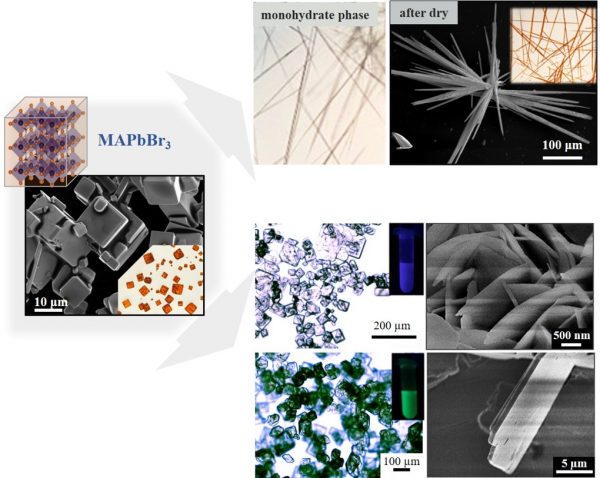
Optical microscopy and SEM images of MAPbBr3 microcubes and evolution of the dissociation/recrystallization process using different strategies to obtain different morphologies. Above right: Transformation of MAPbBr3 microcubes into colorless needles (intermediate 1D structure) after interaction with water, while complete drying results in orange colored microthreads (MAPbBr3 phase). Bottom right: morphology resulting from the incorporation of the organic molecule butylamine during MAPbBr3 recrystallization, showing the formation of lamellar morphologies (2D). The different observed colorations and emissions are characteristic of 2D structures with different numbers of octahedral layers confined between organic spacers.
Optical microscopy and SEM images of MAPbBr3 microcubes and evolution of the dissociation/recrystallization process using different strategies to obtain different morphologies. Above right: Transformation of MAPbBr3 microcubes into colorless needles (intermediate 1D structure) after interaction with water, while complete drying results in orange colored microwires (MAPbBr3 phase). Bottom right: morphology resulting from the incorporation of the organic molecule butylamine during MAPbBr3 recrystallization, showing the formation of lamellar morphologies (2D). The different observed colorations and emissions are characteristic of 2D structures with different numbers of octahedral layers confined between organic spacers.

In the formation of the wires, the process inhibited the growth of the crystalline structure in two directions. In the case of the sheets, the organic molecule added to the water acted as a barrier to the growth of the material in one direction, as if it was a spacer between the layers of octahedra, giving rise to a new structure of the 2D perovskite family. Especially in the 2D structures, this confinement, which occurred on a very small scale, restricted the movement of electrons, resulting in very pronounced quantum effects which modified the electrical and optical properties of the material.

“Our observation revealed that dissolved or degraded material can recrystallize into interesting structures”, summarizes Freitas. According to the authors, by exploring the hydration process of perovskites, the work brings new perspectives to advance the understanding of the degradation and recrystallization of these materials, as well as to understand optical properties such as those involving the dynamics of the exciton (the electron – hole pair generated from the excitation of light in the semiconductor).

The work presents a simple, scalable and sustainable process to produce low-dimensional perovskites with controlled properties. The results could impact both application development and the study of the fundamentals of these versatile materials.

The research received financial support from Brazilian agencies FAPESP and CNPq.


Scientific paper reference: Water-induced dimensionality conversion from 3D perovskites to microwires and 2D hybrid halide perovskites. Andre L. M. Freitas and Jose A. Souza. J. Mater. chem. C, 2023, 11, 6651. https://doi.org/10.1039/D3TC00593C.

Authors contact: joseantonio.souza@ufabc.edu.brandre_luizmf@yahoo.com.br.

B-MRS Newsletter. Year 10, issue 5.


cabeçalho

Year 10, issue 5. June 2nd, 2023.

New Award

jalcom award

B-MRS and the Journal of Alloys and Compounds (Elsevier) launched the JALCOM Award for researchers from Brazilian institutions with significant contributions in certain topics in the fields of Materials and Energy. The award will distinguish 1 advanced career researcher and 2 early career researchers. Applications are open until August 15th. Learn more.

Papers by the community

paper guilherme

In this work, a scientific team from UNESP developed a low-cost material, based on cellulose microfibers, capable of removing toxic dyes present in effluents from the textile industry. The material, which is recyclable, was produced within the circular economy concept from an agro-industrial residue widely available in Brazil, sugarcane bagasse. Go to the paper in Bioresource Technology.

paper cafe

Researchers from IFSC-USP and UFES, along with scientists from Colombia, have developed a low-cost, portable biosensor capable of detecting ochratoxin with high sensitivity and selectivity. Ochratoxin is a toxic and potentially carcinogenic substance produced by fungi, often found in coffee beans. A patent application for this development is in progress at the USP Innovation Agency. Go to the paper in Talanta.

paper joao vitor

Scientists from UFSCar and USP presented a new route, based on the “flash-sintering” technique, for obtaining glass-ceramics (materials with high resistance to impacts, obtained by crystallizing common glasses). The team obtained glass-ceramics in much shorter times and lower temperatures than conventional methods: 20 seconds in an oven at 500 °C, instead of a few hours at 950 °C. A patent application for the process has already been submitted in Brazil. Go to the paper in Acta Materialia.

paper gustavo

A team from five Brazilian and one French institutions developed a technique to characterize chiral organic materials, which can mimic the properties of the chiral molecules that exist in nature, and also can form metamaterials that interact exotically with light. Called Photoluminescent Ellipsometric Circular Dichroism (PECD), the technique makes it possible to distinguish the electronic transitions that are related to the chiral centers of molecules, and it can be combined with Ellipsometric Raman Spectroscopy (ERS). Go to the paper in Spectrochimica Acta Part A.

If you are the author of an impactful article in the Materials area and wish to share it with our community, contact us.

XXI B-MRS Meeting
Maceió (AL, Brazil), October 1 to 5, 2023

maceio

We received nearly 2,500 abstracts!

Abstract status notification. On the 6th of June, the authors of the submitted abstracts will receive their notifications: approved for presentation, rejected or needing modification.

Student Awards. Contributions submitted by students and approved for presentation will be eligible for student awards until July 17. Learn more.

Registration. Registration is open, with special prices for students and researchers from Brazilian institutions and other Latin American countries. Besides that, early registration discount ends on August 10th. See the fees.

Plenary Lectures. This edition of the event will have 6 plenary lectures, given by distinguished scientists from France, Germany, India, Italy, Portugal and Spain. Learn more about the plenary sessions on the website.

Memorial Lecture. At the opening of the event, the traditional Memorial Lecture Joaquim da Costa Ribeiro will be given by Prof. Gilberto Fernandes de Sá (UFPE).

Lectureship Award José Arana Varela. Prof. Fernando Lázaro Freire Junior (PUC-Rio) will receive this distinction from B-MRS and will deliver a plenary lecture at the event.

Symposia. The event comprises 24 thematic symposia covering design, synthesis, characterization, processing and applications of various materials, from traditional alloys to bio-based polymers. More than 100 researchers from 15 countries organize our symposia.

Venue. The venue for the event will be the Ruth Cardoso Cultural and Exhibition Center, in the city of Maceió. Learn more.

Chairmen. The general coordinators of the event are Professors at the Federal University of Alagoas (UFAL): Carlos Jacinto da Silva, from the Institute of Physics, and Mario Roberto Meneghetti, from the Institute of Chemistry and Biotechnology.

Advocacy

– B-MRS subscribed to a SBPC’s letter to federal deputies and senators, expressing concern about the fall of Brazilian universities in a world ranking of higher education institutions, caused by cuts in funding for research and education. Read the letter.

– B-MRS also signed a letter from SBPC expressing indignation at the approval in the Parliament of proposals that withdraw essencial organs from the Ministry of the Environment and Climate Change and from the Ministry of Indigenous Peoples. Read the letter.

Opportunities

– ACS Applied Nano Materials is calling for papers for its special issue “Women in Nano”, dedicated to articles by women working in nanomaterials with a focus on applications. The deadline for submission is August 31st. Prof. Monica Cotta, B-MRS President, is among the organizers. Learn more.

Upcoming events

Escuela Virtual de Caracterización de Materiales de la SMMATER – 3ª edición. Online. February 20 – August 2, 2023. Site.

41st International Conference on Vacuum Ultraviolet and X-ray Physics (VUVX 2023). Campinas (SP, Brazil). July 3 – 7, 2023. Site.

– IV Brazilian Nanocellulose Summit. São Carlos (SP, Brazil). August 9 – 11, 2023. Site.

– 1º Simpósio Brasileiro de Engenharia da Nanotecnologia do PENt-COPPE/UFRJ. Online. August, 28 – 30, 2023. Site.

– Chip in Rio (International Congress in Microelectronics and Microtechnologies). Rio de Janeiro (RJ, Brazil). August 28 – September 1st, 2023. Site.

– XXI B-MRS Meeting. Maceió (AL, Brazil). October 1st – 5, 2023. Site.

– 4th International Brazilian Conference on Tribology (TriboBR). Vitoria (ES, Brazil). November 26 – 30, 2023. Site.

– XLVI Congresso Internacional de Químicos Teóricos de Expressão Latina (Quitel 2023). Montevidéu (Uruguai). November 26 – 30, 2023. Site.

Follow us on social media

rodape

Unsubscribe if you don´t want to receive our newsletters anymore.

B-MRS Newsletter. Year 10, issue 4.


capa-ingles

Year 10, issue 4. May 5th, 2023.

Featured paper

destaque news

After developing a method based on NMR experiments and computational simulations, a team of researchers from CeRTEV (São Carlos, SP, Brazil) was able to carry out the first observation of the changes that occur in the structure of a glass during relaxation and nucleation, two processes that occur at the nanoscale in all glasses and that impact their properties. The advances are crucial for the development of high-performance glass-ceramics. The work was reported in Acta Materialia. Know more.

Community

Imagem1

Prof. Aldo Craievich (USP) passed away on April 24 at the age of 84. Craievich was one of the founding members of B-MRS and made great contributions to our community. He was a pioneer in glass research in Brazil and one of the protagonists in the history of the National Synchrotron Lab. Also, he dedicated himself to training synchrotron light users and was instrumental in setting up several X-ray characterization laboratories.

  • Read the tribute to Aldo Craievich written by the B-MRS member Daniel Ugarte (Unicamp), who considers him a friend, mentor and role model. Here.
  • Access the interview that Craievich gave to the B-MRS Newsletter in 2015. Here.

XXI B-MRS Meeting
Maceió (AL), October 1st to 5th, 2023

maceio

Plenary lectures. This edition of the event will have 6 plenary lectures, given by distinguished scientists from France, Germany, India, Italy, Portugal and Spain, in addition to the Memorial Lecture “Joaquim da Costa Ribeiro”, with Prof. Gilberto Fernandes de Sá (UFPE), and the Lectureship Award” José Arana Varela”, with Prof. Fernando Lázaro Freire Junior (PUC-Rio). Learn more about the plenary sessions on the website.

Symposia. The event comprises 24 thematic symposia covering design, synthesis, characterization, processing and applications of various materials, from traditional alloys to bio-based polymers. More than 100 researchers from 15 countries organize our symposia. See the list and description of the symposia.

Student awards. Contributions submitted by students and approved for presentation will be eligible for student awards until July 17. Know more.

Registration. Registration is open, with special prices for students and researchers from Brazilian institutions and other Latin American countries. See the values.

Venue. The venue for the event will be the Ruth Cardoso Cultural and Exhibition Center, in the city of Maceió. Know more.

Chairmen. The general coordinators of the event are professors from the Federal University of Alagoas (UFAL): Prof. Carlos Jacinto da Silva, from the Institute of Physics, and Mario Roberto Meneghetti, from the Institute of Chemistry and Biotechnology.

Papers by the community

Imagem2

Researchers from Unicamp and LNLS and collaborators show in this review article that a set of recent research has taken perovskite solar cells closer to commercialization. The advances, many of them carried out in Brazil, are based on in situ and operando experiments carried out with synchrotron light. Access the review, which is on the cover of a very high impact factor journal.

Members

Imagem3

Prof. Edgar Zanotto (UFSCar) received an award from the Brazilian Council of State Research Foundations (CONFAP) for his contributions to converting research into development and well-being of Brazilian populations. He won the fisrt place in the Featured Researcher category of the Exact Sciences area.

Advocacy

– B-MRS sent the second letter to CAPES, this time to the current president, Prof. Mercedes Bustamante, expressing concern about the loss of access to journals of the Royal Society of Chemistry (RSC) on the CAPES Portal. Read the letter.

– The General Coordination of Social Communication of CAPES sent a message to B-MRS in response to the publication of the letter. Look here.

– B-MRS joined dozens of scientific and civil society entities to propose the creation of an annual day of struggle against dictatorship and celebration of democracy. Know more.

Reading tips

– Using computer simulations and tunneling microscopy, scientists studied catalysis processes on the atomic scale and concluded that, contrary to the established assumption, the bonds between metal atoms of catalysts do not remain intact during the reactions they catalyze. This new understanding could help reduce the enormous amounts of energy involved in catalysis processes widely used in industry. (Science) Know more

– A scientific team led by Professor Sir Andre Geim has discovered a new property of graphene: under ambient conditions, the material has the highest magnetoresistance of any system ever studied. (Nature) Know more

Opportunities

– M-ERA . NET Call 2023 for ambitious transnational RTD projects addressing materials research and innovation including materials for batteries and low carbon energy technologies. Deadline for the pre-proposal stage is May16. Learn more.

– The call for nominations for the VinFuture Prize, which distinguishes scientific research and technological innovations that have had a high social impact, is open until May 15th. The prize has special categories for developing countries, innovative women and emerging areas. Learn more.

– ACS Applied Nano Materials is calling for papers for its special issue “Women in Nano”, dedicated to articles by women working in nanomaterials with a focus on applications. The deadline for submission is August 31st. Prof. Monica Cotta, B-MRS President, is among the organizers. Learn more.

– Postdoc in composite metamaterials for aeronautical application at the Federal Institute of Maranhão. Learn more.

Upcoming events

Escuela Virtual de Caracterización de Materiales de la SMMATER – 3ª edición. Online. February 20th to August 2nd, 2023. Website.

49ª International Conference on Metallurgical Coatings and Thin Films (ICMCTF). San Diego (USA). May 21 to 26, 2023. Website.

41st International Conference on Vacuum Ultraviolet and X-ray Physics (VUVX 2023). Campinas (SP, Brazil). July 3 to 7, 2023. Website.

– IV Brazilian Nanocellulose Summit. Sao Carlos (SP, Brazil). August 9th to 11th, 2023. Website.

– Chip in Rio (International Congress in Microelectronics and Microtechnologies). Rio de Janeiro (Brazil). August 28 to September 1, 2023. Website.

XXI B-MRS Meeting. Maceio (AL, Brazil). October 1st to 5th, 2023. Website.

4th International Brazilian Conference on Tribology (TriboBR). Victoria (ES, Brazil). November 26th to 30th, 2023. Website.

XLVI Congresso Internacional de Químicos Teóricos de Expressão Latina (Quitel 2023). Montevideo (Uruguay). November 26th to 30th, 2023. Website.

Follow us on social media

rodape-ingels

Unsubscribe if you don´t want to receive our newsletters anymore.


Featured paper: Secrets of glass structural relaxation finally revealed.

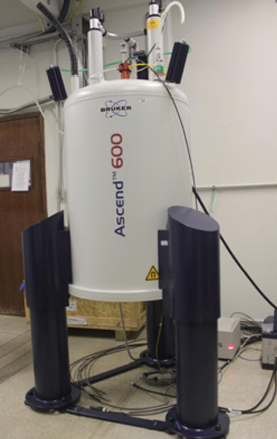
NMR spectrometer installed at IFSC-USP.

A team of researchers from CeRTEV (one of the largest academic centers for glass research in the world, located in São Carlos, SP, Brazil) has carried out the first experimental observation of the changes that occur in the structure of a glass during relaxation and nucleation, two processes that occur at the nanometer scale in all glasses and that impact their properties.

It is worth remembering that glasses are amorphous materials: their atoms do not appear in an organized and periodic arrangement. Furthermore, they are out of thermodynamic equilibrium and therefore tend to seek stability. In that search, the structure of the glasses undergoes rearrangements, which tend to either make it more fluid (relaxation), or to form the first crystals (nucleation) to, finally, crystallize.

In addition to occurring spontaneously (at the end of almost infinite human times at room temperature), the relaxation and crystallization of glasses can be greatly accelerated by heating the material, which is the method used to produce glass-ceramics. Much more resistant to impacts than common glasses, glass-ceramics have crystalline regions dispersed in the amorphous matrix. Due to their unique properties, they are used in applications such as bulletproof windows and dental restorations.

Understanding the structural changes of glasses during relaxation and nucleation is an old scientific problem, whose resolution was limited by the absence of adequate instrumentation. Therefore, in order to carry out this study, the CeRTEV researchers needed to develop a method. The challenge was finally overcome using experiments based on the nuclear magnetic resonance (NMR) technique combined with computer simulations.

“Our research and the resulting technique offer a valuable tool for monitoring and understanding the relaxation process in many glasses, as well as the early stages of crystal nucleation that occur during heat treatments,” says Henrik Bradtmüller, corresponding author of the article that reports this research in Acta Materialia. “These findings are crucial for the design and production control of technologically advanced glass-ceramics with high performance ”, adds the young German scientist, who has been working as a postdoctoral fellow at UFSCar, with a scholarship of the São Paulo Research Foundation (FAPESP), since 2020.

The discovery

The joint work of highly specialized scientists was one of the keys to achieving success in this research. In fact, the work team added the broad experience of two senior researchers: Professor Edgar Dutra Zanotto (UFSCar) in the area of nucleation and crystallization in glasses, and Professor Hellmut Eckert (IFSC-USP) in the development and refinement of the new NMR technique. Also fundamental were the contributions of postdoctoral fellow Anuraag Gaddam (IFSC-USP), also a FAPESP fellow, who carried out the computational simulations, and Henrik Bradtmüller, who developed and applied the NMR strategies that made the observations possible.
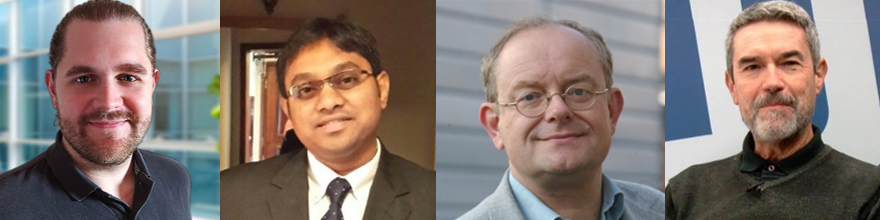
The authors of the paper. From left: Henrik Bradtmüller, Anuraag Gaddam, Hellmut Eckert and Edgar D. Zanotto.

“Through the use of molecular dynamics simulations, we were able to predict the structural changes that occur during glass relaxation,” says Bradtmüller. “In the present contribution we could observe these changes for the first time through sensitive NMR experiments”, he adds. The NMR technique makes it possible to analyze, on the atomic scale, the structure of solid materials, including amorphous structures.

To carry out the experiments, the team chose lithium disilicate (Li2Si2O5), a glass-ceramic widely used, mainly in dental prostheses. The researchers heated it over periods that varied between 15 minutes and 60 days, at 435 °C, a temperature lower than that of the glass transition of this material, in which the atoms gain mobility and the glass begins to become more fluid, without, however, melting.

The samples taken at different times of heating were analyzed using the developed NMR experiments. The results showed, for the first time, what happens to the structure of lithium disilicate during relaxation and nucleation. “The distribution of the network building blocks of this glass (-Si-O-Si-) stays mostly unchanged”, reports Professor Zanotto, who is director of CeRTEV. “In contrast, the network modifier cations (Li+), which are very mobile within the material at annealing temperatures, continously approach a structural configuration that resembles the crystalline state.” Given enough heating time, explains the professor, the first crystal nuclei appear, followed by many others, until the entire material is crystallized.

From now on, the authors of the work hope that the new methodology will be used to study many other vitreous materials and that this detailed understanding of fundamental phenomena will allow adjusting the properties of glass-ceramics to improve their performance and expand their range of applications.

This research was funded by FAPESP.
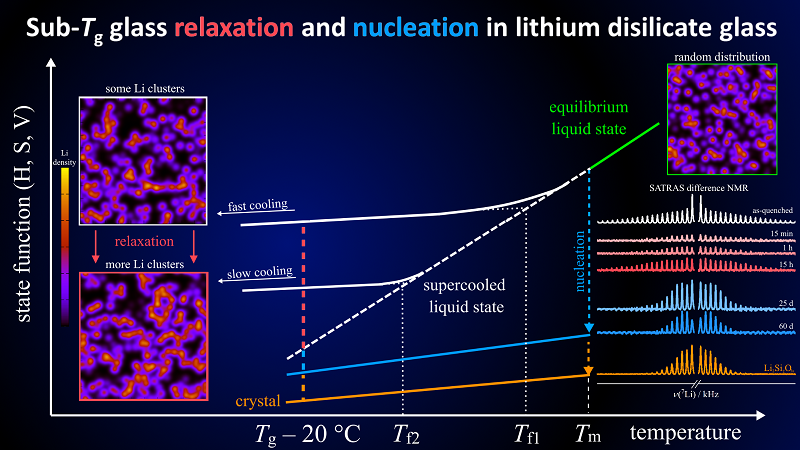
 Center: State functions Enthalpy (H), Entropy (S), and molar Volume (V) as a function of temperature, highlighting the differences between liquid, crystal and glass. Left and top right: Slices of molecular dynamics “boxes”, highlighting the distribution of Li + ions (orange colored) in the simulated glass. Bottom right: NMR spectra showing the differences between glass as-prepared by melt-quenching, glass after relaxation following annealing for variable times at a temperature 20°C below the glass transition temperature, glass containing crystal nuclei, and fully crystallized glass.
Center: State functions Enthalpy (H), Entropy (S), and molar Volume (V) as a function of temperature, highlighting the differences between liquid, crystal and glass. Left and top right: Slices of molecular dynamics “boxes”, highlighting the distribution of Li + ions (orange colored) in the simulated glass. Bottom right: NMR spectra showing the differences between glass as-prepared by melt-quenching, glass after relaxation following annealing for variable times at a temperature 20°C below the glass transition temperature, glass containing crystal nuclei, and fully crystallized glass.

Paper reference: Structural rearrangements during sub-Tg relaxation and nucleation in lithium disilicate glass revealed by a solid-state NMR and MD strategy. Henrik Bradtmüller, Anuraag Gaddam, Hellmut Eckert, Edgar D. Zanotto. Acta Materialia. Volume 240, November 2022, 118318. https://doi.org/10.1016/j.actamat.2022.118318

Author contact: Edgar Dutra Zanotto – dedz@ufscar.br