

Check out the comments from some of the organizers regarding their symposia, workshops, and short courses, as well as the remarks from the general chairs about the event.
About the meeting
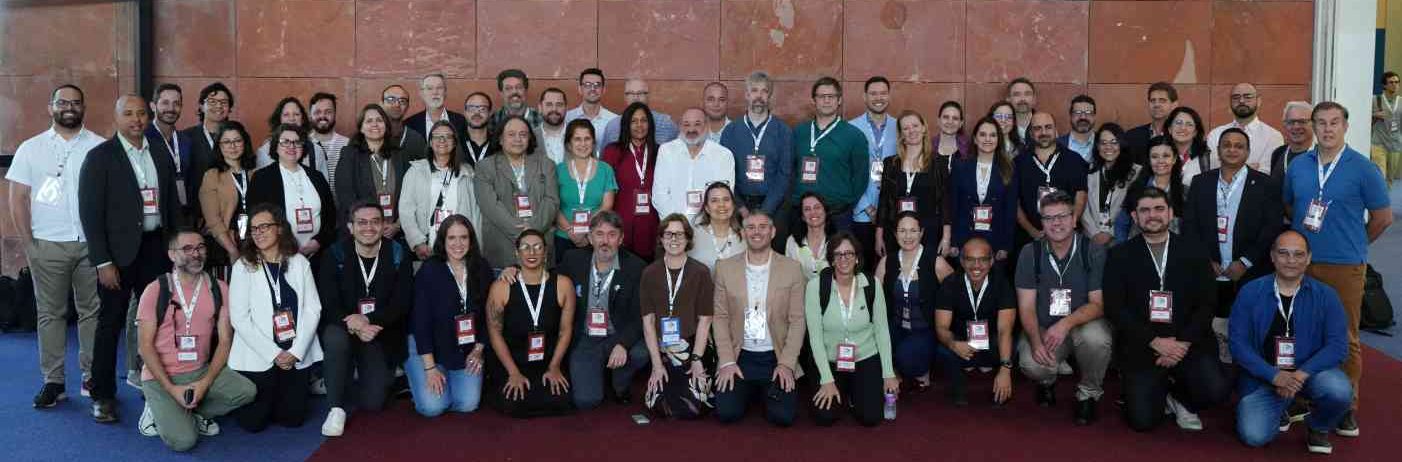
Gregório Couto Faria (IFSC-USP), chair: For me, leading the XXIV B-MRS Meeting went far beyond the challenge of organizing a large scientific event: it was an opportunity to help create a space where a community I deeply admire could come together, exchange ideas, and share experiences. During those days in Curitiba, I saw ideas take shape, new collaborations emerge, and people from different generations and backgrounds share their enthusiasm for materials science. I came away not only with the satisfaction of having helped bring the meeting to life, but also with deep gratitude to everyone who made it possible, and with the joy of having shared the experience with Paula and so many others who are deeply committed to our community.
Paula Cristina Rodrigues (UTFPR), chair: One of the most special moments of the XXIV B-MRS Meeting was welcoming students from public school science clubs and experiencing their enthusiasm as they shared their projects with our community. For me, this exchange between researchers of different generations highlighted the importance of bringing the scientific community closer to schools as well as creating opportunities for young people to see themselves as key players in the construction of knowledge and to envision a future in science.
About the symposia
Symposium D – Frontiers in Advanced Photonic Materials and Nanostructures: From Synthesis to Optical Functionality
Luciana Reyes Pires Kassab (Fatec São Paulo), organizer: The symposium brought together researchers from different areas of materials science, physics, and chemistry to discuss recent advances in photonic materials and nanostructures. The works presented (oral and poster sessions) highlighted innovative approaches to the synthesis and characterization of emerging materials, with particular emphasis on luminescent materials and novel photonic sources. It was inspiring to see the excitement in the eyes of undergraduate students as they presented their work during the poster session. The symposium provided a stimulating environment for scientific exchange and collaboration, fostering new perspectives on the development of advanced photonic materials and devices for next-generation technologies.
Symposium G – High-Entropy Materials: Microstructure, properties and new perspectives
Ricardo Floriano (Unicamp) and Francisco Gil Coury (UFSCar), organizers: Symposium G was a very successful and dynamic forum for discussing recent advances in high-entropy and multicomponent materials. The symposium featured a strong scientific program, with several renowned invited speakers from Brazil and abroad, together with high-quality oral and poster contributions covering topics from fundamental aspects of alloy design and phase stability to structural, functional, energy, and other advanced applications. The excellent attendance and active participation of the audience promoted stimulating discussions and valuable scientific exchanges throughout the sessions. We were particularly pleased with the strong participation of young researchers and students, highlighting the vitality and continued growth of the high-entropy materials community.
Symposium L – Clay Minerals as Strategic Functional Materials for Sustainable Technologies
Raphaela de Oliveira (CNPEM), organizer: It was the first attempt in the last decade of B-MRS Meetings to bring together such a diverse community in terms of research fields and academic backgrounds around the topic of clay minerals, but in the end, we must cooperate since we all share the same central question: understanding how clay mineral properties affect our system behavior. In this sense, it is fruitful to learn from different points of view how intercalation processes, functionalization, and differences in surface charge are key aspects for tuning clay mineral properties for technological applications, ranging from cement to catalysts, membranes, 2D devices, water purification, and many others. Also, it is worth highlighting our efforts to promote gender equality, with 3 out of 4 invited speakers being women, two working at Brazilian institutions and one from Copenhagen, as well as an almost 1:1 balance among oral contributions. By fostering this multidisciplinary exchange, the symposium takes an important step toward strengthening collaborative networks aimed at accelerating the optimization of clay-based systems for applications that address global sustainability needs.
Symposium M – Advanced Materials for Na- and Li-Based Batteries: From Fundamentals to Device Integration
Ana Candida Martins Rodrigues (UFSCar), organizer: The symposium brought together a large part of the community working on battery technology in Brazil, even revealing groups I hadn’t known about before. Researchers working across various fronts participated—some linked to industry and others dedicated to modeling. The sessions consistently drew good audiences; in fact, in one session the room was full, with attendees left standing.
Symposium N – Frontiers in Computational Surface Science: Reactivity, Interfaces, and Material Design
Miguel San-Miguel (Unicamp), organizer: Our symposium N at the B-MRS Meeting in Curitiba attracted many experimental researchers interested in how atomistic simulations can support their work. Their participation sparked engaging discussions on how simulations can help interpret experimental results, clarify underlying mechanisms, and guide further experiments.
About the workshop
Workshop on Science Communication and Outreach
Ingrid Távora Weber (UnB), organizer: The 1st B-MRS Workshop on Science Communication and Outreach, held during the B-MRS Meeting 2026, was a source of great satisfaction. It is highly rewarding to follow the evolution of these activities within the Society: we began with a roundtable in 2024; moved on to a roundtable and the inaugural edition of a video award in 2025; and reached 2026 with a workshop that featured two oral sessions, two invited talks, a poster session, and the second edition of the video award. I was particularly pleased with the level of participation, the audience turnout for the sessions, and the quality and creativity of the work presented. There was a rich exchange of experiences, including inspiring accounts—such as the one shared by Prof. Cazé from UNESP (Presidente Prudente). Another significant aspect was the strengthening of the University Chapters, which enhanced their visibility and interaction with the community. I truly hope this agenda is here to stay and that we can continue to grow in the coming years, further cementing science communication and outreach as an increasingly integral part of B-MRS’s activities.
About the short courses
Functional Materials for Energy, Electronics, Healthcare, and Intelligent Surfaces: Processing Technologies and Applications
Daniela Gomes (NOVA, Portugal), organizer: This short course highlighted the interdisciplinary nature of Functional Materials for Energy, Electronics, Healthcare, and Intelligent Surfaces. It provided an overview of processing methodologies for the development of sustainable and functional materials, ranging from physical vapor deposition and lithography to solution-based synthesis and ink formulation for maskless printing. These processing approaches were discussed in the context of emerging applications, including energy storage, photocatalysis, bioelectronics, and memristive devices, highlighting how materials processing and design can enable next-generation technologies across multiple fields.
Introduction and Perspectives of High Entropy Alloys and Materials
Francisco Gil Coury and Isabela Dainezi (UFSCar), organizers: One of the main goals of our short course was to show how much the field of high-entropy alloys has evolved over the past two decades. We discussed the transition from early, simplified alloy design concepts toward a more realistic understanding of thermodynamics, microstructural complexity, and the mechanisms governing material properties. It was a great opportunity to share recent developments and discuss the challenges and opportunities that lie ahead in this rapidly evolving field.
Modelagem computacional aplicada à remediação ambiental
Ihosvany Camps (UNIFAL-MG), organizer: The course’s standout feature is its use of accessible computational tools to explore carbon nanomaterials for greenhouse gas detection and capture. Simulations under realistic conditions provide a valuable link between molecular insights and practical environmental applications.
Single crystal growth and their technological applications
Manuel Henrique Lente (Unifesp), organizer: The short course on single-crystal growth and its applications, held during the B-MRS Meeting, proved highly productive. The students participated very actively, posing a number of interesting questions throughout the course. It was possible to present the core concepts involved in single-crystal growth and to demonstrate how these materials are utilized in a wide array of high-tech devices. Beyond imparting technical knowledge, the short course also aimed to promote this field of research and development—an area that has experienced a significant decline in our country over the last few years—and to encourage young scientists to pursue it.
Young Researchers’ School
Valtencir Zucolotto (IFSC-USP), organizer: The Young Researchers’ School attracted more than 60 participants, highlighting the strong interest in developing scientific writing and publishing skills. The short course featured a lecture by Prof. Dr. Valtencir Zucolotto on scientific writing and a session led by Ana Claudia Garcia, Elsevier, on scientific publishing. Key topics included strategies for writing high-impact scientific papers, developing competitive research projects, navigating the peer-review and publication processes, and using artificial intelligence ethically and effectively in scientific communication. The strong participation reinforced the importance of these skills in enhancing research quality, visibility, and international impact.