

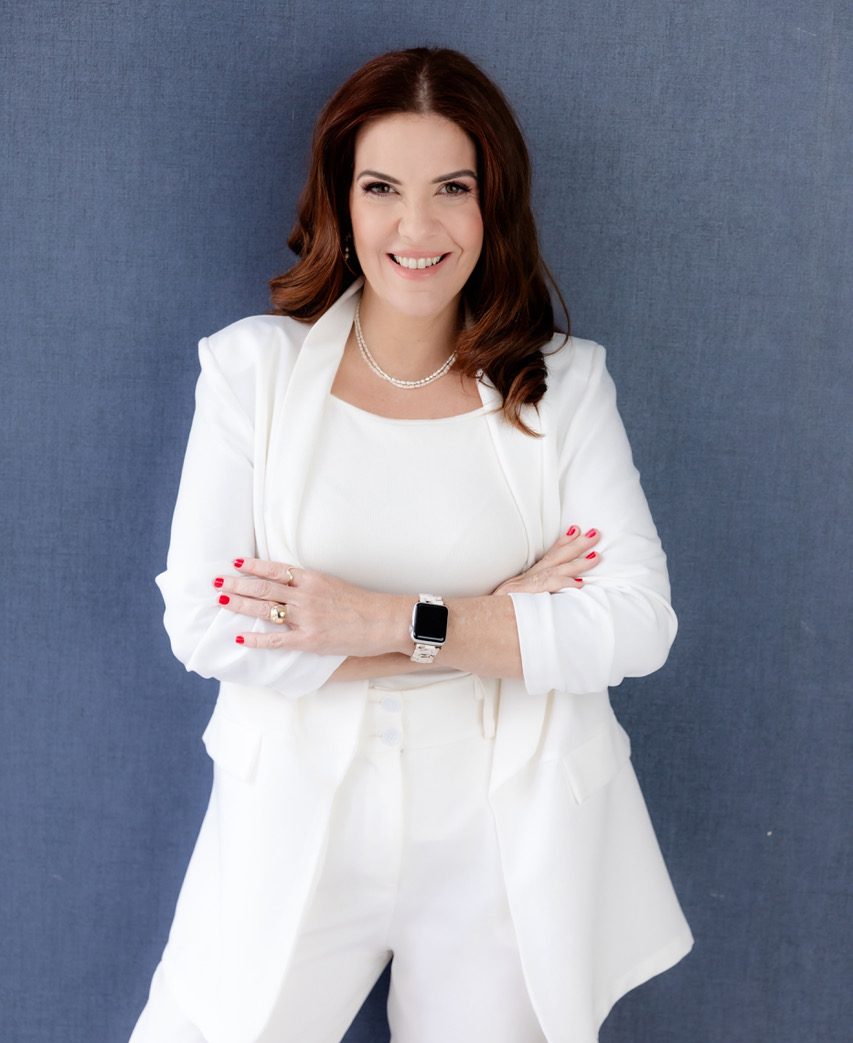
 During her undergraduate studies, Ana Flávia Nogueira had the opportunity to see a device generating electricity from sunlight. She was fascinated by the phenomenon, and shortly thereafter—during her master’s program—she began working on disruptive research involving solar cells. This marked the beginning of a scientific career characterized by extensive exploration into materials for emerging photovoltaic technologies.
Thirty years have passed since then, and today Professor Ana Flavia is an internationally recognized authority in the field; she has authored pioneering scientific papers with hundreds of citations and has published in some of the most high-impact journals in the fields of Materials Science and Energy.
Born in Bragança Paulista, São Paulo state, in 1973, she earned her Bachelor’s degree in Chemistry from the University of São Paulo (USP) in 1996 and obtained her Master’s and PhD degrees in Chemistry from the State University of Campinas (Unicamp) in 1998 and 2001, respectively.
She conducted postdoctoral research at Imperial College London (UK) between 2001 and 2002 and at USP in 2003 and 2004. In 2004, she became a professor at Unicamp’s Institute of Chemistry, where, the following year, she established the Nanotechnology and Solar Energy Laboratory (LNES)—a facility she continues to coordinate to this day. Over the past 22 years, she has supervised more than 70 research projects at the undergraduate, master’s, doctoral, and postdoctoral levels.
In 2016, she served as one of the chairs for the XV B-MRS Meeting, held in Campinas, São Paulo.
From 2017 to 2018, she was a visiting researcher at Stanford University (USA). In 2020, she received the Brazilian Women in Chemistry and Related Sciences Award—sponsored by the American Chemical Society (ACS) and the Brazilian Chemical Society (SBQ)—in the “Leadership in Academia” category. In 2022, she was elected a member of the Brazilian Academy of Sciences (ABC) in the field of Chemical Sciences and a Fellow of the Royal Society of Chemistry.
In 2025, she was appointed to the steering committee of the Energy Sector Fund (CT-Energ)—linked to Brazil’s Ministry of Science, Technology, and Innovation—as a representative of the scientific community. Later that year, Ana Flávia received the “Zeferino Vaz” Academic Recognition Award from Unicamp in acknowledgment of her outstanding contributions to teaching, research, and outreach at the Institute of Chemistry.
Currently, in addition to her roles as a professor and researcher at Unicamp, Ana Flávia serves as director of the Center for Innovation on New Energies (CINE), a research center established by the São Paulo Research Foundation (Fapesp) and Shell in 2018. CINE brings together over 250 researchers from eleven institutions to work on projects aimed at advancing sustainable technologies for renewable energy generation and storage. She also serves as an associate editor for three prestigious journals: Journal of Materials Chemistry C and Materials Advances (both published by the Royal Society of Chemistry) and Materials Today Chemistry (published by Elsevier).
This year, B-MRS selected her to receive the José Arana Varela Award, which honors outstanding researchers working in Brazil. As part of this recognition, Professor Ana Flávia will deliver a plenary lecture on perovskite solar cells on September 30th at the XXIV B-MRS Meeting.
Learn more about Ana Flávia and her fruitful, inspiring career in this interview she gave to the B-MRS Newsletter.
Tell us what led you to become a scientist.
I’d say I was always a very curious child—at least according to my mother. I was curious about everything. My mother tells stories about how, whenever a letter arrived at the house, I’d open it right away out of sheer curiosity. And I was always asking “why.” So, I think it was natural for me to want to know more about things, to want to investigate. So, at high school, I decided I wanted to study Chemistry at university. I attended a school run by nuns, and my Chemistry teacher was a Spanish nun. She was very funny, and she’s the one who made me fall in love with physical chemistry. Since she spoke with a thick accent and didn’t have great teaching skills, I had to study on my own. I’d grasp the material, and then the next day, I’d explain the content to my classmates. That’s how—when I was 16 or 17—I decided I wanted to pursue Chemistry.
Did you see yourself as a future researcher back then?
At that point, I didn’t plan on doing a master’s, a PhD, or a postdoc. I always enjoyed studying, but nothing in my life was really planned out. At that time, we just let life take its course; we did the things we liked, and opportunities would just pop up… So, after high school, I passed the entrance exams for USP, UNESP, and Unicamp, but I chose USP—I wanted to be in São Paulo. A graduate course was a somewhat natural path because, right at the end of my first year at the university, I started doing undergraduate research with Professor Viktoria Klara Lakatos Osório, who had been one of the Chemistry Institute’s most brilliant students. She knew so much Chemistry. I continued doing research in Viktoria’s lab until I graduated. Given my personality, I was always chatting with everyone in the hallway, asking what they were working on, and so on. And I practically “lived” in the graduate students’ room. It was funny, because they used to say I couldn’t sit there—that I’d only get a desk once I was a grad student—but I was friends there and spent all my time in that room. So, I think seeing their work and getting exposure to graduate studies so early on—right in my first year—made a real difference. I fell in love with research, and moving on to a master’s program felt like the natural next step.
How did you get started working with solar cells?
I really liked seeing practical applications; I didn’t want to do fundamental research. I was always asking myself: “Why am I studying this?” “What is the application?” “Why is this important?” Sometimes you get lucky, right? And one day, while I was at the IQ-USP [Institute of Chemistry at USP], I saw Professor Carlo Bignozzi from the University of Ferrara in Italy—who collaborated with Professor Neyde Yukie Murakami Iha—showing off a large prototype of a dye-sensitized TiO2 cell (what we called a “dye-TiO2 cell”). It was a sunny day, and Carlo placed the cell on a bench in the sun and occasionally covered it with a sheet of paper. We could see on the voltmeter that the cell was generating electricity from sunlight. That fascinated me—the conversion of light energy into electricity. Plus, it was a research topic that involved a lot of inorganic chemistry, a field I really enjoyed. So, I decided I wanted to study materials science for my master’s degree. However, USP didn’t have a strong materials program at the time; the leading materials chemists were based in São Carlos or at Unicamp. I remember talking to Professor Henrique Toma from IQ-USP who mentioned that at Unicamp I would find several people working in solid-state chemistry and materials science—professors like Marco-Aurélio de Paoli, Fernando Galembeck, and Oswaldo Alves. I thought it would be a good idea to experience a different university and city. Later, at a Brazilian Chemical Society (SBQ) meeting where I was presenting my undergraduate research, I ran into Professor Marco-Aurélio de Paoli himself. I introduced myself and mentioned I was considering a master’s at Unicamp. He then told me about a project involving dye-sensitized TiO2 cells—the very same type of cell I had seen Professor Carlo Bignozzi holding in the corridors of IQ-USP. Marco was on a six-month sabbatical in Germany at the time, studying these cells. So, when he returned to Unicamp, he needed someone to start the solar cell project, and I was selected for the master’s program. It was perfect! I came to Unicamp to pursue my master’s under Professor Marco-Aurélio, and we maintained a collaboration with Professor Neyde. It was a whole new world; just us at Unicamp and Neyde in São Paulo were working on dye-sensitized cells. Marco had a large group—nearly 30 people—but I was working alone on my specific research topic, and the subject was new to him as well. So, the master’s degree was a challenge for me. The PhD, however, was easier. My entire master’s and PhD work focused on producing a polymer electrolyte for dye-sensitized TiO2 cells. We published the first paper in the literature on this topic. Consequently, my articles—from both my master’s and PhD—are highly cited and have had an international impact. During my PhD, I missed having the chance to discuss ideas and collaborate with other researchers. That´s why I undertook a research internship at Imperial College with Professor James Durrant, which opened many doors for me. Once again, my tendency to talk to everyone helped me quickly build a network—something I consider a crucial aspect of my career. Thanks to the high-quality, widely cited papers we produced, Professor James invited me back to London for a postdoctoral position. I returned, but I wanted to do something different and learn new things; stability and repetition simply don’t appeal to me—that’s a key part of my personality. I told him I wanted to work on solar energy, but not on dye-sensitized TiO2 cells. James was starting a project on organic solar cells with Professor Niyazi Serdar Sariciftci from Austria, and I ended up spearheading that project. In fact, I am credited with being the first person to assemble an organic solar cell at Imperial College. That was back in 2002. I learned a great deal from that project, but after a year, I decided to return home for personal reasons and because there were many university job openings in Brazil. I could have stayed at Imperial College and lived in London, but I have no regrets; I make more of a difference here. So, I returned to Brazil and went back to USP—specifically to Professor Henrique Toma’s laboratory—to work on dye-sensitized TiO2 solar cells again, but from a different perspective. The lab had a host of fantastic molecules—which we called supramolecules—and the idea was to test them in solar cells. This also resulted in numerous publications—about seven papers. Soon after, a faculty opening came up at Unicamp, and I have been a faculty member at the Unicamp Institute of Chemistry since 2004.
Have you always worked with solar cells?
I am currently working on my fourth emerging photovoltaic cell technology: I’ve worked with dye-sensitized TiO2 cells, organic cells, hybrid organic-inorganic cells, and now perovskite cells. As I mentioned, I enjoy doing different things. That’s why I’ve also done a lot of work with nanocomposites, carbon nanotubes, hydrogen generation, cadmium sulfide and selenide chalcogenide quantum dots, and perovskite quantum dots. Let’s see what Ana Flávia comes up with next!
What are your favorite scientific discoveries from your entire career?
I think my favorite is the first discovery I made—during my master’s and PhD studies—which was the first solid-state TiO2 cell. I believe that was the major breakthrough. There was also a really cool discovery from my postdoc involving organic cells. At the time, everyone knew that electron transfer from the polymer to the fullerene was extremely fast—on the order of femtoseconds—but no one knew about the reverse reaction, which we call recombination. And the recombination process is just as important as the charge injection process. No one had any idea it was possible to measure that, but we did so during my postdoc. So, that was a very interesting discovery: determining how long it took for the electron to return from the fullerene to the polymer. Furthermore, I really like the work we’ve been doing more recently studying perovskites using in situ and operando techniques, both with and without synchrotron radiation. I think this is the work that makes my group stand out in the scientific community today. It all started during my sabbatical with Professor Michael Toney at the Stanford synchrotron (SLAC), where we used available synchrotron radiation techniques to gain a better understanding of perovskites. We discovered a great deal through fundamental research: how perovskite forms from solution and the stages of film crystallization. I think we made a significant contribution in that regard.
What were the main challenges you faced in developing your career? Were they related to being a woman?
Well, I think I’ve always worked hard because I’m passionate about what I do. And since I was always working hard, I never really had time to sit around complaining. I had to work—I enjoy what I do—and I think I’ve always managed to handle a lot of tasks. Plus, I’ve never been a perfectionist, which I think helped me because it allowed me to get a lot done. When you want to make something perfect, I think you expend a huge amount of energy. But regarding the difficulties, I’m not sure if the biggest ones stemmed from being a woman or from being a young researcher bringing new research to Brazil. No one was researching organic solar cells back then. I was the first person to assemble an organic solar cell at Imperial College. Our work is highly cited. I brought a wealth of experience from there, but when I arrived here, people—funding agencies and colleagues alike—didn’t know what organic solar cell research was. At the time, it was disruptive. And the question arose: is she actually capable of doing this? I remember my first grant proposal to Fapesp wasn’t approved. To conduct the research, I needed a glovebox to assemble the cells inside, but the funding was denied. Unfortunately, the reviewers failed to see how groundbreaking that research was for Brazil. My biggest challenge was really at the beginning with the funding agencies—which are essentially made up of our own colleagues, since they’re the ones evaluating our projects. They didn’t have the insight to say, “Wow, this is disruptive research; she’s asking for this piece of equipment—let’s give it to her.” Because of that, I couldn’t move forward with the organic cell research—we couldn’t compete with the efficiency levels being achieved abroad—so the idea of working with hybrid cells came up. Instead of using fullerene as an electron acceptor, I decided to work with inorganic nanoparticles. I love making inorganic nanoparticles. Besides, these cells already had low efficiency, so it wouldn’t be a problem to publish results showing a cell with 2% efficiency—since that was what everyone else was achieving at the time. So, the research took a different direction than originally planned. Whether these difficulties arose because I was young, because I was a woman, because I was returning from abroad with new ideas, or because people didn’t know me… I can’t say for sure. Another factor was entering the physics community. I work extensively in physics and have great colleagues in the field today, but it was difficult at the start. I think physicists respect me much more now than they used to. Finally, now that I am in a leadership position at CINE, I can say with certainty that women face far more scrutiny than men when making decisions, so things take much longer to happen—especially in our academic environment, which is predominantly male.
And how did you overcome those challenges to advance your career?
I think I just kept moving forward with my career and didn’t let myself get shaken. That might be a key point. I never let comments, difficulties, or rejections get me down. For instance, I had to scrap a research project that could have been groundbreaking in Brazil, but I immediately found something else to take its place. I think if I had wasted energy fighting the situation, I wouldn’t have achieved the same results. I try one path; if that doesn’t work, I quickly try another, because I don’t have time to waste. I don’t stay idle for long. I think that’s what kept me motivated.
Tell us how you managed to publish articles in high-impact journals.
I think that for that, it’s important to always look for opportunities and think a bit outside the box. You have to spot something others aren’t doing, think differently, and look in a direction no one else is looking. At first, it might seem impossible, but we have to test our hypotheses. For example, in the perovskite study we conducted using synchrotron radiation, I saw an opportunity to use Sirius—a wonderful laboratory located just ten minutes from my office. I believe we need to stay very attentive to new trends and emerging developments, and consider whether they offer opportunities for our research. I’ve always sought to do something new rather than sticking to incremental research—a type of work that never really appealed to me.
You frequently champion and defend research conducted in Latin America—for instance, through your stance in debates or by organizing events and special journal issues focused on the region. What motivates you to take this approach?
You know, I always bring up this perspective because I believe we have excellent research groups in Latin America, yet we lack visibility abroad. I am particularly concerned about journal editors-in-chief who are unfamiliar with the research being conducted in Latin America—and I’m not talking about when I started my career 30 years ago, but about the present day. Currently, Latin America—and Brazil specifically—hosts research groups producing work just as competitive as that coming out of Europe, the United States, or Asia. Here in the country, we have Sirius; with this fantastic machine, we can conduct experiments that are possible only here. Just think of the opportunity that represents! So, while we conduct top-tier research, we lack visibility. That is why we need to bring foreigners—such as journal editors-in-chief—here to see our reality firsthand. I’m really in a “Latin America-focused” phase right now. In fact, I came up with the idea of launching a LATAM edition of MATSUS, a conference that already takes place in Europe twice a year. MATSUS focuses on materials and sustainability, and we have many groups in the region doing incredible work in materials science. So, we are holding the first MATSUS-LATAM edition in Cartagena, Colombia, in early February. Furthermore, I’ve partnered with groups in Chile and Colombia to host graduate students who want to learn how to fabricate perovskite cells, as my group is currently a Latin American leader in emerging photovoltaics. For my colleagues in Latin America, it is far easier and less expensive to send a student here to fabricate a device than to send them to Europe or the United States. LNES is there for everyone to use; it isn’t just for my own students.
We’ve seen you working to bridge the gap between academia and industry—participating as a speaker, panelist, and event organizer for business audiences, and actively encouraging university-industry partnerships. What led you to pursue this direction?
I think this direction has been part of my career for a long time, largely because my research has always been applied in nature. One of the first projects I undertook after joining Unicamp was with an energy distribution company. Then, in 2008, we founded the startup Tezca, which focused on dye-sensitized TiO2 flexible solar cells. Later came the Dense Energy Carriers project, which would become one of the core divisions of CINE, in partnership with Shell. Subsequently, we established a partnership with Itaú at CINE. So, public-private partnerships have played a crucial role in my career; they provided the additional funding needed to purchase state-of-the-art equipment and hire researchers, while also opening new doors. I believe there should be an increasing number of public-private partnerships in science—with each party respecting its own boundaries, of course. I think it is possible to have that conversation, to sit down at the table, and to find common ground.
Finally, we’d like you to leave a message for our younger readers who are starting a career as scientists in Brazil or are considering that path.
Well, I always say that a research career in Brazil is never going to be easy—but it isn’t easy anywhere. Abroad, for instance, the competition for grants is incredibly fierce. I believe researchers really have to love what they do, because there are moments when you genuinely want to give up. You also have to think differently; even if an idea seems absurd, you have to investigate it. To those just starting out, I’d say we need more disruptive research, to think a bit outside the box. The research landscape in Brazil today is vastly different from when I began my graduate studies. Conditions aren’t ideal, and they vary greatly from state to state. Yet, research conditions in the country today are still far better than they were thirty years ago. Finally, I’d say you have to know how to make lemonade out of lemons. If something goes wrong, don’t dwell on it; turn the problem into an opportunity, find something positive in the difficulties, and strike out in a new direction.