Postdoc and PhD positions to develop Perovskite Solar Cells at UFABC (SP, Brazil)

Postdoc

We are seeking a researcher interested in developing new materials and deposition techniques for preparing perovskite solar cells (PSCs). The researcher must hold PhD in Nanoscience and Advanced Materials, Chemistry, or Materials Science. Experience in solar cell preparation and photovoltaic characterization is essential for this position. Other skills, such as the use of SEM, XRD, etc., are welcome.

How to apply: send your CV Lattes (https://lattes.cnpq.br/) link and a brief letter describing your expertise and how you think to contribute to the development of PSCs to andre.polo@ufabc.edu.br. Having a recommendation letter from your previous supervisor(s) for the last 24 months is also mandatory. This letter should be sent directly from the supervisor to andre.polo@ufabc.edu.br.

Foreigner candidates: due to the scholarship requirements, this opportunity is limited to candidates already residing in Brazil and possessing the necessary Brazilian documentation.

Ph.D. candidate

We are seeking a Ph.D. candidate interested in understanding and developing new materials for charge carrier transport layers for PSCs. The candidate must have previous experience (undergraduate internship or MSc) in experimental science and will be enrolled in the UFABC – Nanoscience and Advanced Materials Graduate program. Candidates must have graduated in Chemistry, Physics, or Materials Science.

How to apply: send your CV Lattes (https://lattes.cnpq.br/) link and your undergraduate/graduate curriculum to andre.polo@ufabc.edu.br. It is also mandatory to send a recommendation letter from your previous supervisor(s). This letter should be sent directly from the supervisor to andre.polo@ufabc.edu.br.

Foreigner candidates: due to the scholarship requirements, this opportunity is limited to candidates already residing in Brazil and possessing the necessary Brazilian documentation.

Call for symposia for the XXIII B-MRS Meeting (Salvador, September 28 to October 2, 2025) is open until November 4th.

The call for thematic symposia is now open as part of the XXIII B-MRS Meeting program. The meeting will take place at the Salvador Convention Center, in Salvador, Bahia (Brazil), from September 28 to October 2, 2025. The chairs of the event are Luiza Amim Mercante (UFBA) and Daniel Souza Corrêa (Embrapa Instrumentação).

Proposals must be submitted by researchers with a PhD degree by November 4, 2024, using the form available at https://sbpmat.org.br/proposed_symposium/.

The program committee of the XXIII B-MRS Meeting will evaluate the proposals. The preliminary list of approved symposia will be available on November 29, 2024.

Due to the growing interest in participating in the B-MRS Meetings, the number of submitted proposals far exceeds the symposia that can be accommodated in the scientific program. The program committee will therefore give priority to proposals of exceptional interest to the materials science community.

Each symposium will receive four (4) registration fee waivers. In addition, for every 100 abstracts submitted, the symposium will receive one (1) additional waiver.

We recommend that at least two of the co-organizers rotate for symposia with previous editions. A diverse international group of four (4) co-organizers, with gender equality, is considered the best choice. Including interdisciplinary research and industrial involvement is highly encouraged for symposia. Furthermore, we suggest caution with excessive number of invited speakers, so that oral sessions are available for presentations by members of our community. Likewise, gender and geographic balance of invited speakers is strongly encouraged.

Nota de apoio à Fapesp.

Rio de Janeiro, 09 de maio de 2024

NOTA DE APOIO À FAPESP

A Sociedade Brasileira de Pesquisa em Materiais (SBPMat) manifesta preocupação com a proposta de corte de 30% no orçamento da Fundação de Amparo à Pesquisa do Estado de São Paulo (FAPESP) para o ano de 2025.

As instituições de ensino e pesquisa do estado de São Paulo são responsáveis por grande parte do conhecimento científico gerado no Brasil, em especial na área de materiais, e contribuem com a formação qualificada de pesquisadores para atuarem na academia, no mercado de trabalho e para empreender.

A FAPESP tem um papel central no financiamento destas atividades e a redução de 30% dos recursos comprometerá significativamente este processo, sendo um retrocesso não apenas para o desenvolvimento científico e tecnológico do país, mas para a sociedade em geral por ele beneficiado.

O engajamento de todos os setores da sociedade é fundamental para alertar os parlamentares da Assembleia Legislativa de São Paulo, a fim de impedir que isso aconteça.

 Ivan H Bechtold

Presidente da Sociedade Brasileira de Pesquisa em Materiais – SBPMat

B-MRS invites the community to suggest plenary speakers for the 2025 event.

The organizing committee of the XXIII B-MRS Meeting, which will be held in Salvador (Bahia, Brazil) from October 28 to November 2, 2025, invites the scientific community to send suggestions for speakers for the plenary sessions.

Plenary lectures should interest a broad audience, with different levels of training and thematic specialties. Scientists are expected to be renowned researchers at an international level, capable of giving a motivational talk that addresses the advances achieved over time in their research topic, in addition to discussing challenges and prospects for the future.

The XXIII B-MRS Meeting is chaired by Luiza Amim Mercante, from the Federal University of Bahia (UFBA) and Daniel Souza Correa, from Embrapa Instrumentação (São Carlos/SP).

Suggestions must be sent by May 20th this year through this Google form.


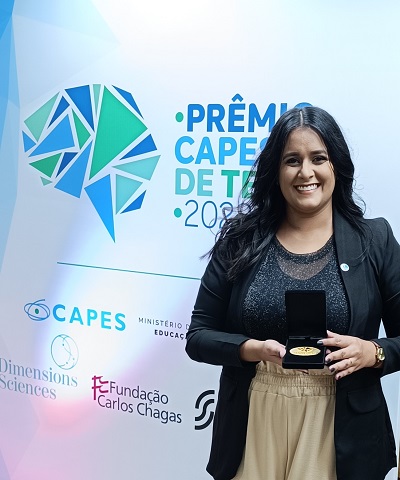
Featured scientist: Interview with Ana Elisa Ferreira de Oliveira, winner of the Capes Prize for Doctoral Dissertations in the Materials area.

“Science is alive, dynamic, exciting and enriching, and being part of its advancement is a great privilege”, says Ana Elisa Ferreira de Oliveira, winner of the 2023 Capes Prize for Doctoral Dissertation in the area of Materials.

The award distinguished the 49 best doctoral dissertations, one per area of knowledge, defended in Brazilian postgraduate programs in 2022. In addition, 98 honorable mentions were awarded. More than 1,400 works applied for this edition of the Capes Award, whose ceremony was held in Brasília on December 14th.

In her research work, Ana Elisa developed two electrochemical sensors, one made of graphite and the other made of carbon nanotubes, capable of detecting in real time a breast cancer biomarker (the CA 15-3 protein) in biological samples (blood serum and saliva). This protein appears at higher than normal levels in most women with breast cancer after the initial phase of the disease – which is why it can be used to monitor these patients’ response to treatments, as well as to screen for metastasis and detect recurrence of cancer.

The sensors developed in Ana Elisa’s doctorate were produced on paper substrate on which electrodes were printed using conductive inks using simple methods, such as screen printing and handwriting. To detect the CA 15-3 biomarker, the sensors were modified with antibodies to this protein.

The research was carried out under the guidance of Professor Arnaldo César Pereira within the Postgraduate Program in Physics and Chemistry of Materials at the Federal University São João del-Rei (FQMat – UFSJ), in the state of Minas Gerais. However, the work is the result of ten years of scientific training in the area of sensors, from undergraduate research to PhD, always at UFSJ and with the same supervisor.

In this interview for the B-MRS Newsletter, this young scientist, born in Barbacena (interior of Minas Gerais), talks about the sensors and the difficulties and joys of the path she took to complete the best Brazilian Materials dissertation defended in 2022.

B-MRS Newsletter: Tell us a little about your scientific background.

Ana Elisa Ferreira de Oliveira: My academic career began when I entered the Federal University of São João del-Rei (UFSJ) in 2011. I did two “scientific initiations” (undergraduate research) guided by Prof. Dr. Arnaldo, both in the sensor development area. That was the introduction to my career as a researcher. From there, I understood the importance of scientific research and was sure of my desire to continue my studies in postgraduate studies. In 2015, I completed my master’s degree in the Physics and Chemistry of Materials Program at UFSJ, and started my PhD in 2017, in the same program.

When I was writing my doctoral project, I really wanted something in the health area, so I chose the development of sensors to determine biomarkers. But I had to decide what the sensor would determine, which disease. Today breast cancer is the most common type of tumor in women in most parts of the world. Women over 50 are most affected by this type of cancer. Statistically, about one in eight women is diagnosed with breast cancer in her lifetime. Therefore, I decided that in my doctorate I would focus on the application of sensors to determine breast cancer biomarkers.

During my years of research, I published 19 papers in different journals. Between graduation, master’s and doctorate, it was ten years at UFSJ. A decade of lots of study, learning, challenges and personal evolution. I am eternally grateful for the role my university played in my professional journey.

B-MRS Newsletter: What were the biggest challenges you faced in carrying out the award-winning thesis?

Ana Elisa Ferreira de Oliveira: The path during my doctorate was not easy. But, definitely, the main difficulty was the surprise of a global pandemic that at that time had taken the lives of millions around the world. Adapting to a new reality and having the laboratory interrupted for months was challenging. When I finally returned, making up for lost time was extremely tiring. I spent morning, afternoon and night in the laboratory, and often left without results. This was very stressful. However, with a lot of effort and dedication I managed to meet this challenge. And receiving this award just confirms that it was worth it!

The award was a big surprise. I am feeling extremely honored to have my doctoral work recognized by receiving such an important award. It’s an indescribable feeling. I celebrate this victory with everyone who, indirectly or directly, helped me make my dream come true.

B-MRS Newsletter: What are the advantages of the sensors developed in relation to other disease detection techniques?

Ana Elisa Ferreira de Oliveira: Electrochemical sensors have some advantages over conventional techniques: high selectivity and sensitivity, low production cost of the devices, they do not require much maintenance for their use and conservation, the analysis can be done in real time and specialized technicians may not be necessary.

In addition to having a quick response and often without the need for pre-treatment, printed electrodes can be manufactured on a large scale, allowing low-cost production. They are disposable, eliminating the need for cleaning. Consequently, printed sensors are known as low-cost, miniaturized, disposable, and high-sensitivity devices. Printed electrodes can replace the conventional three-electrode system (working, reference, and counter) using conductive inks and a substrate.

B-MRS Newsletter:  You assembled the sensor prototypes. What steps would be necessary for these devices to be used outside the laboratory?

Ana Elisa Ferreira de Oliveira: The results of the work suggest the possibility of using printed electrochemical sensors as an alternative for determining CA 15-3 in biological samples. However, there are many more studies that can and should be carried out on these proposed sensors in order for them to become commercial.

They can be further optimized by trying to increase sensitivity and lower the limit of detection and quantification. Another possibility is the modification of printed sensors to determine other biomarkers, not only for cancer, but for other diseases such as cardiovascular diseases.

Electrochemical sensors can also be designed for point-of-care (POC) analysis due to their fast analytical response, possibility of miniaturization and simple operation. POC testing is usually performed in close proximity to the patient, allowing for instant availability of results to make immediate, informed decisions about patient care.

Therefore, some experimental optimizations could be performed on the proposed sensors to reduce analysis time and allow the use of portable potentiostats. Printed electrochemical sensors have great potential in health monitoring and, fortunately, many works are being generated in the literature involving different materials for these purposes. The results of this dissertation corroborate this idea and present a possibility of developing sensitive devices for CA 15-3.

B-MRS Newsletter: Leave a message for our readers who are doing their undergraduate, master’s or doctoral research.

Ana Elisa Ferreira de Oliveira: There is a sentence attributed to Marie Curie that says “Throughout my life, new discoveries about nature have made me happy like a child”. That’s how I felt throughout my academic career. And that’s how I still feel when reading a good article, when developing a project or when I read about new research. Science is alive, dynamic, exciting and enriching. Being part of the advancement of science, even if only in a very small way, is a great privilege.

B-MRS Newsletter: If you would like to make any other comments, feel free.

Ana Elisa Ferreira de Oliveira: I would like to give special thanks to some people who were by my side during this journey. To my parents, sister and nephews for their constant support and encouragement. To my husband Lucas for being by my side at all times. To Mayra, my faithful laboratory companion, for her help and partnership. To Prof. Dr. Lucas Franco Ferreira for the partnership and collaboration. To my colleagues in the research group (Polymer and Electroanalytical Research Group – GPPE), I would like to thank you for your support, collaboration, companionship, pleasant conversations and moments of joy. And in particular, I would like to thank my advisor Prof. Dr. Arnaldo César Pereira for the opportunity granted. He welcomed me as a student nine years ago, and since then we have gone through undergraduate research, master’s degree and now the dreamed doctorate. Thank you for your guidance, conversations and partnership, for trusting in my work and for your constant encouragement. It is difficult to describe in words your importance in my professional journey.


The JALCOM Award

The Journal of Alloys and Compounds (JALCOM) from Elsevier in cooperation with the Brazilian Materials Research Society (B-MRS) is pleased to invite researchers from Brazilian institutions to apply for The JALCOM Award.

The Journal of Alloys and Compounds is an international peer-reviewed medium that disseminates original work for the advance of the science of materials comprising compounds and alloys. Its great strength lies in the diversity of disciplines that the journal encompasses, drawing together results from materials science, physical metallurgy, solid-state chemistry, and condensed matter physics.


Awards

Achievement JALCOM Award. This JALCOM Award will be given to an Advanced Career Researcher (Researcher or Professor) who received his/her Ph.D. for at least 10 years.

Rising Star JALCOM Award. Two Rising Star JALCOM Awards will be given to Early Career Researchers who received their Ph.D. degree within the last 10 years.

For both awards, we will consider researchers who have contributed to the following fields that JALCOM covers:

  • Energy conversion and storage
  • Hydrogen production and storage materials
  • Solar photocatalysis applications
  • High entropy alloys
  • Batteries and battery materials
  • Metastable materials
  • Magnetocaloric materials
  • Sensors


How to apply

To apply for the Awards, interested researchers must submit the following documents, in English:

  1. A letter of up to 2 pages highlighting the main contributions to one or more fields of interest listed above.
  2. Submissions must also include a brief CV containing information considered important for the awards.
  3. Equity criteria: To promote equality between men and women in academic activities, we highly encourage female scientists to apply for the awards, and detailed information on each advent of offspring must be included in the proposal submission, in a separate document, called “Equity Document”.

Participants should send the documents to jalcomawards@sbpmat.org.br.

Deadline: the deadline for the nomination is August 15th, 2023.


Prizes

1) Advanced Career Researchers: An award certificate, and a cash prize of US$1,000.00.

2) Early Career Researchers:   An award certificate, and a cash prize of US$500.00 for each award.


Winners

A selection committee will be assembled to nominate the awards winners.

The award winners will be announced at the XXI B-MRS meeting closing ceremony. The presence of the winner at the meeting is not mandatory for receiving the prize.

Researchers do not need to have published in JALCOM  to be nominated. However, they may be invited to contribute with a research/perspective/review paper to the journal.


If you have any questions, please contact us at jalcomawards@sbpmat.org.br.


Postdoc in composite metamaterials for aeronautical application at the Federal Institute of Maranhão.

Professor Edson Miranda Jr. (http://lattes.cnpq.br/9782653543954493) has 1 (one) position open for a postdoctoral position in the area of DYNAMICS
AND VIBRATION OF COMPOSITE METAMATERIALS FOR AERONAUTICAL APPLICATION, in the Department of Mechanical and Materials of the Federal Institute of Maranhão (for the simulation part, it is not necessary to be full-time in São Luís-MA).

The position is to work in a project funded by CNPq, specifically with experiments and modelling of dynamical systems, wave propagation, and passive vibration control applied to aeronautical engines. The researcher will have the opportunity to collaborate with outstanding research groups, mainly, in
Brazil and Italy.

The candidate should have a doctorate degree in Mechanical Engineering or related areas.

Knowledge and experience on finite element modelling, wave propagation, periodic systems, mechanical vibration, composite materials, and signal processing are desired.

Knowledge of MATLAB and good English are mandatory.

Knowledge of COMSOL software, plane wave expansion (PWE) approach, and composite material manufacturing are differentials.

The scholarship is of R$ 4.500,00 (SET-C) from now (april/2023) until 11/17/2025 (the end of the project).

The interested should send the following documents to edson.jansen@ifma.edu. The documents are:

1) A detailed CV with research experience and average graduate degree results.

2) A motivation letter detailing how your research profile and interest relate to the project.

3) A recommendation letter from researcher or professor.

An online interview shall be scheduled after the evaluation of the documents.