B-MRS Newsletter. Year 9, issue 7.


20Anos_260px

Newsletter of the
Brazilian Materials
Research Society

Year 9, issue 7. August 1st, 2022.

Featured paper

Researchers from IFSC-USP and UNIFESP are co-authors of this review article on Langmuir and Langmuir-Blodgett films. In addition to addressing concepts and commenting on the promising applications of the films in molecular machines, organic electronics and tissue engineering, the authors report the history of these materials, including the contributions of two women: Agnes Pockels, an amateur and self-taught scientist whose discoveries were made in her kitchen sink, and Katherine Blodgett, who was the first woman to earn a doctorate in physics from the University of Cambridge and to be hired as a scientist at General Electric. Access the paper in Chemical Reviews: https://doi.org/10.1021/acs.chemrev.1c00754.

langmuir 2

A team from USP (IFSC and ICB-II) proposed a possible strategy for the treatment of Covid-19, based on the repositioning of a drug combined with the use of nanotechnology. The solution consists of encapsulating a drug, currently used to treat patients with multiple sclerosis, inside a polymeric nanocapsule capable of releasing the medication into cells infected with SARS-CoV-2. Tests with cells showed that the encapsulated drug has less toxicity than the free one and, at the same time, its antiviral activity against SARS-CoV-2 is almost 70 times higher than that of the drug without encapsulation. Access the article on ACS Applied Bio Materials:
https://doi.org/10.1021/acsabm.2c00349.

nanocapsulas

Looking for natural materials that can provide low-cost two-dimensional insulating layers, a team from UFMG, UFOP, Mackenzie, LNLS and UNICAMP investigated the structure and properties of clinochlore – an abundant lamellar mineral. The authors demonstrated that the presence of impurities between the lamellae affects the optoelectronic properties of the material in both its macroscopic and two-dimensional versions. The article points out the potential application of this material in nanodevices production. Access the paper on Applied Surface Science:
https://doi.org/10.1021/acsabm.2c00349.

clinocloro

Lives & Webinars

A live held for the Brazilian National Science and Researcher Day (on July 8th) brought together three researchers from the Southeast, North and Northeast regions of the country who showed the importance of research in sustainable development. The recording of the panel is available at the B-MRS YouTube.

Professor Hidembergue Ordozgoith from Frota (UFAM) showed how the development of new materials based on the sustainable use of Amazonian biodiversity can contribute to a new economic cycle in the North region, with an impact on segments such as food, agriculture and construction.

Professor Simoni Margareti Plentz Meneghetti (Ufal) presented through several examples the fundamental importance of catalysts to make industrial processes more sustainable, to take advantage of renewable raw materials such as biomass, to enable the use of clean and renewable energy and even to recycle various materials.

Researcher Cauê Ribeiro de Oliveira (EMBRAPA) has shown that developing fertilizers is, in fact, developing materials. In order to achieve the maximum possible efficiency and the necessary properties with the least negative environmental impact and reduced cost, it is necessary to modify the fertilizers with other materials and to use systems that allow them to be released gradually in a controlled manner.

diadaciencia

XX B-MRS Meeting

20meeting_imagemtopo_2

  • Early registration period is open until August 10th.

  • Program: the program at a glance is available on the website.
  • Student awards: Prizes will only be awarded to winners who are present at the ceremony on the last day of the event.
  • Venue: the “venue” tab of the event’s website contains information about reservations at the Rafain hotel and other nearby hotels.
  • Memorial Lecture: Prof. Roberto Mendonça Faria (IFSC-USP).
  • Plenary Speakers: Christine Kranz (Ulm University), Daniel Mario Ugarte (UNICAMP), Gustavo Rivas (Univ. Córdoba), Natalie Stingelin (Georgia Tech Univ.), Sanjay Sampath (State Univ. of New York at Stony Brook), Pulickel Ajayan (Rice Univ.), Stuart Parkin (Univ Martin-Luther de Halle-Wittemberg).
  • Support and sponsorship: 20 companies have already confirmed sponsorship and participation in the exhibition of this edition of the event, which also has 40 institutinal supporters among journals, companies and other organizations. Entities interested in participating in the expo or in other forms of dissemination and support can contact Alexandre Alves at comercial@sbpmat.org.br.

For more information and registration, visit the event website.

Reading tips

– Computational study shows superconducting behavior of two-dimensional material Mo2N at relatively high temperatures and ambient pressure (Nanoscale cover). Saiba mais.

– Study with the participation of researchers from USP and Inpe shows that it is possible to control phonons by means of a magnetic field (Physical Review Letters). Know more.

– Researchers manage to produce well-aligned boron nitride nanotube fibers, starting from the liquid crystal of this material. The advance opens up the possibility of applying these nanotubes, which are good electrical insulators (Nature Communications). Know more.

– Video by researchers from CeRTEV (DEMa – UFSCar) with theatrical representation of the phenomenon of glass transition wins the second place in the international competition Glorious Glass Demo for the dissemination of science and technology of glass, promoted by ACerS. Know more and see the video.

Opportunities

– CNPq call for cooperative projects Brazil – Argentina in Nanotechnology. Applications until August 22nd. Brasil Link. Argentina Link.

– Vacancy for researcher in the field of Organic Electronics and Bioelectronics at the University of Coimbra (Portugal). Applications until August 8th. Know more.

– Vacancy at LNLS – CNPEM for researcher of the Jatobá do Sirius beamline (X-ray diffraction – PDF). Know more.

– Vacancy at LNNano-CNPEM as a researcher in data science and nanostructure theory. Know more.

– Researcher vacancy at LNNano-CNPEM in LT-STM applied to materials for quantum technologies.Know more.

– Selection of post-doc and doctoral scholarships for FAPESP thematic project in the area of colloids at UNICAMP, UFABC, CNPEM and UFSCar. Applications until August 31st. Know more.

Events

– Course: Fundamentals of Transmission Electron Microscopy. IFGW-UNICAMP + online (to confirm). Second half of 2022. More information.

– IUMRS-ICAM2021 + IMRC2022. Online + Cancun (Mexico). August 14th to 19th, 2022. Website.

– Machine Learning School for Materials @Ilum. Hybrid event. September 5th to 7th, 2022. Website.

– XVIII International Small Angle Scattering Conference. Online + Campinas, SP (Brazil). 11 to 16 September 2022. Website.

– 18th International Conference on Plasma Surface Engineering (PSE 2022). Trade Fair Erfurt (Germany). September 12 to 15, 2022. Website.

XX B-MRS Meeting. Foz do Iguaçu (Brazil). 25th to 29th of September 2022. Website.

– 22nd International Magnetic Measurement Workshop (IMMW22). Online. September 26 to 30, 2022. Website.

– 7th Meeting on Self Assembly Structures in Solution and at Interfaces (AUTOORG 2022). Bento Gonçalves (RS). November 2nd to 4th, 2022. Website.

– V Workshop de Química Inorgânica. Manaus (AM) + online. November 9th to 11th, 2022. Website.

– 11th International Conference of the African Materials Research Society (AMRS2022 ). Dakar (Senegal). December 12 to 15, 2022. Website.

41st International Conference on Vacuum Ultraviolet and X-ray Physics (VUVX 2023). Campinas (SP). 3rd to 7th of July 2023. Website.

Follow us on social media

Comments and suggestions: comunicacao@sbpmat.org.br.
Unsubscribe here if you don´t want to receive our newsletters anymore.


B-MRS Newsletter. Year 9, issue 6.


20Anos_260px

Newsletter of the
Brazilian Materials
Research Society

Year 9, issue 6. July 5th, 2022.

Featured paper

imagem destaque

A team of researchers from Brazilian institutions exfoliated two-dimensional layers of phlogopite (a mineral abundant in Brazil) and showed that this new insulating material is promising for composing ultrathin optoelectronic devices, replacing high-cost synthetic materials (2D Materials). Know more

Lives & Webinars

imagem painel

SBPMat will participate in the celebration of the Brazilian Science and Researchers Day, promoted by SBPC, with a panel discussion on materials for a more sustainable world. The event will be held on July 8 at 4:30 pm (São Paulo time) in the B-MRS channel on YouTube. More information coming soon on all B-MRS media.

Members

imagem luciana

Prof. Luciana Kassab (Faculty of Technology of São Paulo / CEETEPS), a B-MRS member, was interviewed by the magazine of the former OSA (The Optical Society), which was renamed OPTICA, while Senior Member of the society. See the interview.

XX B-MRS Meeting

20meeting_imagemtopo_2

  • Submission of extended abstracts to apply for the student awards: open until August 1st. The extended abstracts template is available on the “submission” tab of the website. Prizes will only be awarded to winners who are present at the ceremony on the last day of the event.
  • Final abstract notification: 11th of July.
  • Accomodation. The “venue” tab of the event’s website contains information about reservations at the Rafain hotel and other nearby hotels.
  • Memorial Lecture: Prof. Roberto Mendonça Faria (IFSC-USP).
  • Plenary Speakers: Christine Kranz (Ulm University), Daniel Mario Ugarte (UNICAMP), Gustavo Rivas (Univ. Córdoba), Natalie Stingelin (Georgia Tech Univ.), Olle Inganas (Linkoping Univ.), Pulickel Ajayan (Rice Univ.), Stuart Parkin (Univ Martin-Luther de Halle-Wittemberg).
  • Registration. Early registration until August 5th.
  • Support and sponsorship: 17 companies have already confirmed sponsorship and participation in the exhibition of this edition of the event. 18 companies and journals support the meeting. Entities interested in participating in the expo or in other forms of dissemination and support can contact Alexandre Alves at comercial@sbpmat.org.br.

For more information, extended abstract submission and registration, visit the event website.

Opportunities

– LNLS– CNPEM: researcher of the Jatobá beamline (X-ray diffraction – PDF) of the Sirius Brazilian synchrotron light source. Know more.

– LNNano-CNPEM: researcher in data science and nanostructure theory. Know more.

– LNNano-CNPEM: LT-STM applied to materials for quantum technologies. Know more.

– Post-doc in perovskite solar cells at UNESP. Registration until July 15th. Know more.

– Selection for post-doc and doctoral scholarships for a FAPESP thematic project in the area of colloids at UNICAMP, UFABC, CNPEM and UFSCar. Applications until August 31st. Know more.

Events

– Webinar “Bio-based polymers”. Online. July 5th at 3 pm. Organização: ACS Publications in partnership with SBPMat, ABPol and IUMRS. Free registration.

– International Conference on the Science and Technology of Synthetic Metals (ICSM). Glasgow (Scotland). 17th to 22nd of July 2022. Website.

– 4th Workshop on Coated Tools & Multifunctional Thin Films. Campinas, SP (Brazil). 20th to 23rd of July 2022. Website.

– XII Course of the Rietveld Method. Fortaleza, CE (Brazil). 25th to 29th of July 2022. Website.

– Course: Fundamentals of Transmission Electron Microscopy. IFGW-UNICAMP + online (to be confirmed). Second half of 2022. Learn more.

– IUMRS-ICAM2021 + IMRC2022. Online + Cancun (Mexico). August 14th to 19th, 2022. Website.

– Machine Learning School for Materials @Ilum. Hybrid event. 5th to 7th of September 2022. Website.

– XVIII International Small Angle Scattering Conference. Online + Campinas, SP (Brazil). 11 to 16 September 2022. Website.

– 18th International Conference on Plasma Surface Engineering (PSE 2022). Trade Fair Erfurt (Germany). September 12th to 15th, 2022. Website.

XX B-MRS Meeting. Foz do Iguaçu (Brazil). 25th to 29th of September 2022. Website.

– 7th Meeting on Self Assembly Structures in Solution and at Interfaces (AUTOORG 2022). Bento Gonçalves (RS). 2 to 4 November 2022. Website.

– 11th International Conference of the African Materials Research Society (AMRS2022 ). Dakar (Senegal). December 12 to 15, 2022. Website.

41st International Conference on Vacuum Ultraviolet and X-ray Physics (VUVX 2023). Campinas, (SP). 3rd to 7th of July 2023. Website.

Follow us on social media

Comments and suggestions: comunicacao@sbpmat.org.br.
Unsubscribe here if you don´t want to receive our newsletters anymore.

Featured article: New natural insulator for ultrathin devices.

A team of researchers from Brazilian institutions took the first steps towards the use of phlogopite, a mineral abundant in Brazil, as a natural source of ultrathin insulating layers that could be used in optoelectronic devices of the future. “Our work presents the insertion of this natural mineral in materials research and its possible use in different areas of nanotechnology”, says scientist Alisson R. Cadore, corresponding author of the article recently published in the journal 2D Materials.

The work is part of the search for two-dimensional materials (one or a few atoms thick) at low cost. In this search, the scientific community has investigated the so-called “lamellar materials”, which are formed by stacked ultrathin layers, joined together by the so-called “van der Waals forces”. Because they are relatively weak, these physical forces allow the lamellae separation to be performed using several methods. One of the best-known examples of this group is graphite, which is the source of graphene. Another example is that of micas, a family of minerals that includes phlogopite, which had never been studied in its two-dimensional form before the work of the Brazilian team.

In this work, the researchers used macroscopic phlogopite crystals mined in Itabira (state of Minas Gerais, Brazil) to generate two-dimensional layers by mechanical exfoliation. This extremely simple technique gained fame for having led to the first successful production of graphene, which earned Andre Geim and Konstantin Novoselov the Nobel Prize in Physics in 2010. In this method, a common adhesive tape is used to separate flakes from the material, by sticking them to the tape. The procedure is repeated until reaching the thinnest possible layer, the monolayer.

Using this method, the authors of the paper obtained monolayers and few-layers flakes of phlogopite. With them, they carried out a robust characterization that involved several experimental techniques in laboratories at Universidade Presbiteriana Mackenzie (UPM), at the National Laboratory of Synchrotron Light (LNLS) and at the Federal University of Minas Gerais (UFMG). Some results were confirmed with computer simulations carried out by the authors of the Federal University of Lavras (UFLA).
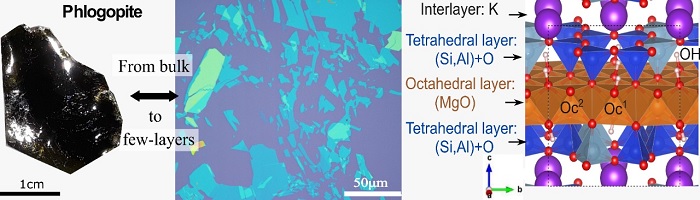
Natural macroscopic crystal of phlogopite; optical microscopy image of phlogopite flakes exfoliated with different thicknesses; representation of the crystal structure of a phlogopite monolayer calculated by computer simulations.

“In this work, we theoretically and experimentally identified the chemical and structural composition of phlogopite and demonstrated that this natural and abundant insulator can be exfoliated to the limit of a single layer, maintaining its physical characteristics”, summarizes Cadore, who is currently a researcher at the National Laboratory of Nanotechnology (LNNano), but carried out the work at UPM, where he was a Professor. One of the main findings of the study was the fact that the ultrathin phlogopite is stable when subjected to thermal processing, as well as when exposed to the environment (the samples were left for 13 months in ambient conditions without showing degradation).

In addition, the work compared the characteristics of phlogopite with those of the synthetic insulator most used as a substrate in nanodevices, hexagonal boron nitride. For this, the Brazilian team developed a collaboration with the National Institute of Materials Science (NIMS, Japan), where the material with the best physical properties is produced. The Japanese group supplied the synthetic crystals.

According to the authors, given that two-dimensional phlogopite is an excellent electrical and thermal insulator, in addition to being naturally abundant and easy to extract, it can be used as a low-cost material in devices that are still little explored at the nano scale, such as transistors, capacitors and photodetectors. These applications become even more promising given the possibility of using two-dimensional phlogopite in structures with unique properties called “van der Waals heterostructures”, which are formed by stacking ultrathin layers of different materials, joined by van der Waals forces. Therefore, the authors of the article assembled phlogopite and tungsten disulfide heterostructures and studied some of their properties. “We emphasize that two-dimensional phlogopite is a stable insulator under ambient conditions and can be easily combined with other 2D materials, creating ultrathin hybrid heterostructures, which expands the application of this nanomaterial in new future optoelectronic devices”, says Cadore.
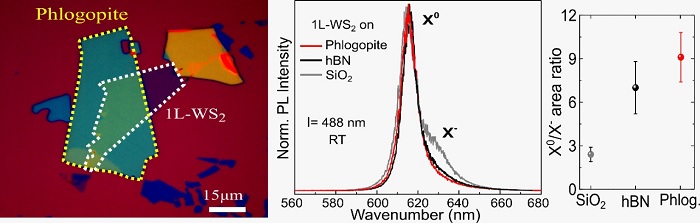
Optical microscopy image of a van der Waals heterostructure containing a monolayer of tungsten disulfide over a few layers of phlogopite. Analysis of optical properties of 2D heterostructures.

Carried out as part of Raphaela de Oliveira’s doctorate, the work on the two-dimensional phlogopite is part of a research line begun in the Physics Department at UFMG. “Our studies have always involved different national and international researchers in obtaining and characterizing different natural 2D materials and their application in nanodevices and nanophotonics”, says Cadore, whose PhD in Physics at UFMG was on two-dimensional graphene heterostructures. The objective of these works is to find materials with the ideal characteristics for these applications, in order to replace the synthetic materials, which are expensive.

The work developed with phlogopite was inspired by studies carried out with soapstone, started at UFMG in 2015. Studies with this mineral continued at LNLS – CNPEM conducted by researcher Ingrid Barcelos, who also completed her PhD in Physics at UFMG with research on van der Waals heterostructures. In 2021, Ingrid won, for her work with soapstone, one of the For Women in Science awards, granted by L’Oréal Brasil in partnership with UNESCO and the Brazilian Academy of Sciences (ABC).

Some of the main authors of the article. From left: Alisson R. Cadore, Raphaela de Oliveira, Raphael Longuinhos, Ingrid D. Barcelos and Christiano J. S. de Matos.

The research on two-dimensional phlogopite was funded by CAPES, CNPq, Mackenzie Research and Innovation Fund, FAPESP, FAPEMIG and the L’OREAL-UNESCO-ABC Award for Women in Science.


Paper reference: Exploring the structural and optoelectronic properties of natural insulating phlogopite in van der Waals heterostructures. Alisson R Cadore, Raphaela de Oliveira, Raphael Longuinhos, Verônica de C Teixeira, Danilo A Nagaoka, Vinicius T Alvarenga, Jenaina Ribeiro-Soares, Kenji Watanabe, Takashi Taniguchi, Roberto M Paniago, Angelo Malachias, Klaus Krambrock, Ingrid D Barcelos and Christiano JS de Matos. 2022 2D Mater. 9 035007. https://doi.org/10.1088/2053-1583/ac6cf4.

Corresponding author contact: alissoncadore@gmail.com

Postdoctoral Research Scientist in perovskite solar cells

The group of Prof. Carlos F. O. Graeff at Faculty of Sciences from São Paulo State University (UNESP), in Bauru (Brazil), is looking for 1 postdoctoral research scientist. The application deadline for the positions is 15/07/2022. The candidates are expected to design, produce and characterize perovskite solar cells (PSCs).

About the Project

The present project aims on comprehending the degradation mechanisms involved in PSCs, and on finding solutions to overcome the stability issues of these devices. Based on this premise, several chemical and physical aspects will be investigated which includes; synthesis of different perovskite light harvester materials, analysis of interfacial and defects phenomena, search for optimal electron and hole transport layers materials, use of promising novel techniques for materials and devices characterization and novel device configurations. These investigations will converge to the primary objective of this work which consists of proposing more stable and more efficient PSCs.

Key project aims

I. To optimize perovskite compositions in order to minimize defects during crystallization and thin-film deposition steps.
II. To design novel electron and hole transport layers as alternatives for the currently low stable used materials.
III. To characterize the structure, morphology and optical properties of nanomaterials as active components in PSCs;
IV. To study defects and their effects on PSCs by using advanced spectroscopic and electrical techniques such as photothermal deflection spectroscopy (PDS) and photo-CELIV.

Requirements and how to apply

– Ph.D. in Physics, Materials Science & Engineering, Chemistry, or related areas.
– Experience in fabrication and characterization of perovskite solar cells is necessary.
– Experience on a variety of film deposition methods (blade-coating, roll-to-roll, etc) will be positively evaluated.
– Previous experience with the characterization techniques PDS or CELIV is a plus.
– English knowledge (fluent in writing and speech).

Each selected candidate will receive a Post-Doctoral fellowship from the São Paulo Research Foundation (FAPESP) in the amount of R$ 8.479,20 monthly and a research contingency fund, equivalent to 10% of the annual value of the fellowship which should be spent in items directly related to the research activity

Candidates should contact Prof. Carlos F. O. Graeff (carlos.graeff@unesp.br) with a brief statement of research interest/cover letter, a CV, and contact information of 2-3 references. Students in their final year of Ph.D. training are encouraged to apply.

B-MRS Newsletter. Year 9, issue 5.


20Anos_260px

Newsletter of the
Brazilian Materials
Research Society

Year 9, issue 5. June 3rd, 2022.

Featured paper

junho_artigo destaque

A Brazilian scientific team developed a high-sensitivity and low-cost biosensor, based on nanotubes of a conducting polymer, capable of detecting Covid-19 antibodies in about 30 minutes from the interaction with a few drops of blood (Materials Today Chemistry). Know more.

Lives & Webinars

minicurso raman

WORKSHOP IN PORTUGUESE
Minicurso
“Evolução da Espectroscopia Raman: Inovadores métodos de escaneamento de amostras, quimiometria por inteligência artificial, microgeoprocessamento de imagens e correlações colocalizadas com Microscopia Eletrônica de Varredura e MicroFluorescência de Raios X.”
Quando: 14 de junho das 9:00 às 12:00.
Onde: online.

minicurso 2_fluorescencia

WORKSHOP IN PORTUGUESE
Minicurso
“Espectroscopia de Fluorescência – Análise de Absorbância e Transmitância Simultâneas – Tecnologia A-TEEM para Caracterização Química Molecular.”
Quando: 21 de junho das 9:00 às 12:00.
Onde: online.

More information and free registration: https://www.sbpmat.org.br/pt/lives-webinars/

XX B-MRS Meeting

20meeting_imagemtopo_2

The event received over 1,500 abstracts!

  • Abstract status notification: June 10th.
  • Submission of revised Abstract: June 24th.
  • Final abstract notification: July 1st.
  • Submission for Student Awards: July 1st to August 1st.
  • Request for resources from FAPESP: Researchers from the State of São Paulo (BR) might be eligible for financial support from FAPESP. More information here.
  • Venue: Hotel Rafain Palace, Foz do Iguaçu (Brazil).
  • Memorial Lecture: Prof. Roberto Mendonça Faria (IFSC-USP).
  • Plenary Speakers: Christine Kranz (Ulm University), Prof. Daniel Mario Ugarte (UNICAMP), Prof. Gustavo Grivas (Univ. Cordoba), Prof. Natalie Stingelin (Georgia Tech Univ.), Prof. Olle Inganas (Linkoping Univ.), Prof. Pulickel Ajayan (Rice Univ.), Prof. Stuart Parkin (Univ Martin-Luther de Halle-Wittemberg).
  • Registration: early registration fee until August 5th.
  • Support and sponsorship: 16 companies have already confirmed sponsorship and participation in the exhibition. If your company is interested in participating, please contact Alexandre Alves at comercial@sbpmat.org.br.

For more information, abstract submission and registration, visit the event website.

Community

faria

Today June 03 at 15:00 (São Paulo time), Prof. Roberto Mendonça Faria, former B-MRS president, will be honored with a symposium in celebration of his 70th birthday. Event will be held at IFSC-USP and broadcast on YouTube. Know more.

Advocacy

– B-MRS subscribed a note against the federal government’s intention to cut more than BRL 2.9 billion from the Ministry of Science, Technology and Innovations. Know more.

– B-MRS endorsed the manifesto that warns of the negative impacts of the lag in the value of scholarships paid to researchers in the country. Know more.

Reading tips

– Scientists create a method that allows, for the first time, to synthesize new materials and structures and analyze them in situ under pressures of about 1 terapascal – equivalent to more than 3 times the pressure of the center of the Earth (Nature). Know more.

– Brazilian researchers develop electrodes that allow monitoring the health of plants, applying wearable sensor technology to precision agriculture (ACS Applied Materials and Interfaces). Know more.

Innovation. Company dedicated to the development of “green” materials launches flame retardant paint based on graphite and cellulose crystals. Innovation emerged from basic research carried out in master’s work and has already received several awards. Know more.

Opportunities

– Call of the European consortium M-ERANET together with FAPESP for transnational R&D projects in materials. Submission of proposals until June 15th. Know more

Events

– International Conference on the Science and Technology of Synthetic Metals (ICSM). Glasgow (Scotland). 17 to 22 of July 2022. Website.

– 4th Workshop on Coated Tools & Multifunctional Thin Films. Campinas, SP (Brazil). 20 to 23 of July 2022. Website.

– IUMRS-ICAM2021 + IMRC2022. Online + Cancun (Mexico). August 14 to 19 2022. Website

– Machine Learning School for Materials @Ilum. Hybrid event. 5 to 7 of September 2022. Website.

– XVIII International Small Angle Scattering Conference. Online + Campinas, SP (Brazil). 11 to 16 September 2022. Website.

– 18th International Conference on Plasma Surface Engineering (PSE 2022). Trade Fair Erfurt (Germany). September 12 to 15, 2022. Website.

XX B-MRS Meeting. Foz do Iguaçu (Brazil). 25 to 29 of September 2022. Website.

– 7th Meeting on Self Assembly Structures in Solution and at Interfaces (AUTOORG 2022). Bento Gonçalves, RS (Brazil). 2 to 4 November 2022. Website.

– 11th International Conference of the African Materials Research Society (AMRS2022 ). Dakar (Senegal). December 12 to 15, 2022. Website.

41st International Conference on Vacuum Ultraviolet and X-ray Physics (VUVX 2023). Campinas, SP (Brazil). 3 to 7 of July 2023. Website.

Follow us on social media

Comments and suggestions: comunicacao@sbpmat.org.br.
Unsubscribe here if you don´t want to receive our newsletters anymore.

Featured article: Biosensor of conducting polymer and nanoparticles in the fight against the pandemic.
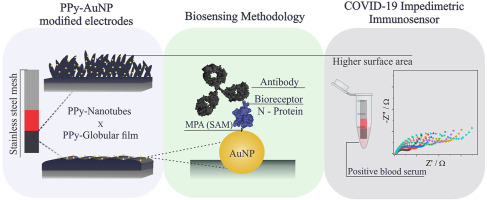
Left: representation of biosensor electrodes coated with nanotubular or granulated polypyrrole and gold nanoparticles. Center: SARS-CoV-2 protein immobilized on the nanoparticle and interacting with the antibody. Right: Device detecting antibodies in a blood sample.
Left: representation of biosensor electrodes coated with nanotubular or granulated polypyrrole and gold nanoparticles. Center: SARS-CoV-2 protein immobilized on the nanoparticle and interacting with the antibody. Right: device detecting antibodies in a blood sample.

A team of researchers from the Brazilian Federal University of Paraná (UFPR) has developed a low-cost biosensor capable of detecting Covid-19 antibodies in about 30 minutes and with high sensitivity. The system has shown promise for producing handheld, disposable devices that could be used to diagnose coronavirus infection or to confirm antibody production after vaccination using just a few drops of blood.

Biosensors are systems that have a biological element (in this case, the N protein of the SARS-CoV-2 virus) responsible for chemically interacting with what you want to detect (in this case, the specific antibody for that antigen). When the interaction takes place, the chemical reaction is transformed in the device into an interpretable signal.

The biosensor developed at UFPR is based on a stainless steel mesh coated with a hybrid material which is formed by a polymer that conducts electricity (polypyrrole) and gold nanoparticles. In these nanoparticles, virus proteins are immobilized, so that antibodies from blood samples, if any, come into contact with their antigens, spontaneously react with them and become detectable.

Facing the pandemic

The idea of the research emerged at the beginning of the Covid-19 pandemic, when society needed to have systems for the detection of the virus and the antibodies generated by the infection. At that moment, Professors Dênio Souto and Marcio Vidotti, from UFPR, decided to gather their expertises in sensors and related topics and be part of the global efforts.

“We already knew from the beginning that the urgency and multidisciplinary nature of the subject would increase our challenge”, says Bruna M. Hryniewicz, first author of the article that reports this research in the journal Materials Today Chemistry. Bruna took part in the research during her PhD, still in progress, under the guidance of Professor Vidotti, both from the Research Group on Macromolecules and Interfaces at UFPR.

A detection system was built based on the doctoral thesis of Ana Leticia Soares, which has just been defended by UFPR. With the guidance of professors Marcio Vidotti and Luis Fernando Marches, the work resulted in a platform formed by a conductive polymer modified with gold nanoparticles that showed promising responses when joined to several pairs of antigens and antibodies.

More sensitivity and selectivity
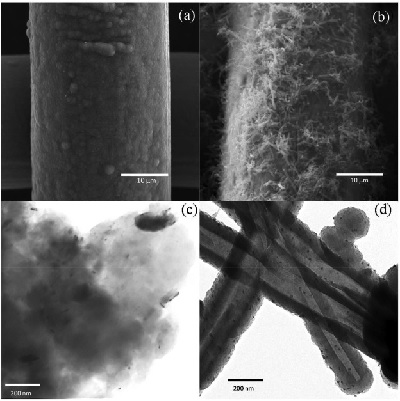
Electron microscopy images show the materials developed for the biosensor: granulated polypyrrole (left) and nanotubular (right) with gold nanoparticles.

Starting from this platform, the team investigated some issues that could improve the sensitivity and selectivity of the biosensor – parameters that allow reducing the amount of false positives and negatives in the detection results, even in small amounts of sample.

In this sense, the authors synthesized and characterized two polypyrrole morphologies to produce the hybrid material, the globular and the nanotubular, and found that the polymeric nanotube biosensor had a sensitivity eight times higher to detect antibodies than the globular polypyrrole system.

Another important point was the choice of the method of immobilization of the N protein in the nanoparticles. The researchers chose to promote a covalent bond (chemical bond based on the sharing of electron pairs between the atoms involved), which brings more stability and sensitivity to the system. In fact, this methodology positions the antigen in an orientation in which the sites of interaction with the antibody are available – an interaction that is further encouraged by the favorable chemical environment provided by polypyrrole. “All these characteristics allow the biosensor to present satisfactory sensitivity and selectivity responses”, says Jaqueline Volpe, also the first author of the article, who participated in the research during her master’s degree, under the guidance of Professor Dênio Souto, both from the Spectrometry, Sensors and Biosensors.

In addition to the participation of professors, post-docs and students from the Graduate Program in Chemistry at UFPR, the collaboration of researchers and physicians from UFPR and Hospital Erasto Gaertner, in Curitiba, was fundamental in the research. These collaborators quickly provided the SARS-CoV-2 N protein. They also obtained blood samples from people with and without Covid-19 who had had PCR tests (the diagnostic methodology considered the most accurate), which were used to test the performance of the biosensor.

“Taking into account that the work was carried out during the height of the pandemic, the challenges were numerous, from access to laboratories, to the exploration of a highly relevant topic, which generates greater pressure in the development of research”, comments Larissa Bach Toledo, co-author of the article.
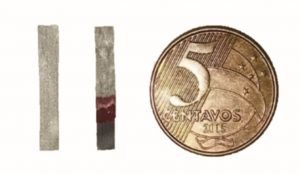
Biosensor appearance and size: Steel mesh before and after biosensor construction, next to a coin for reference.
Biosensor appearance and size: steel mesh before and after biosensor construction, next to a coin for reference.

According to the authors, the biosensor developed is promising for use on a large scale in the diagnosis of infected people and in the monitoring of antibodies due to the simple and scalable method of manufacturing the electrodes (batch synthesis), added to the low cost of the stainless steel matrix, and the high sensitivity of the system. However, to produce it commercially, it would be necessary to do many more validation tests with real samples, as well as transforming the system into a simple, miniaturized and easy to use device, in which the detection results could be interpreted by anyone.

This research was funded by the German foundation Alexander von Humboldt, UFPR through Proind 2020 and the Brazilian agencies CAPES and CNPq. The work also received support from INCTBio, of which Professor Marcio Vidotti is a member.
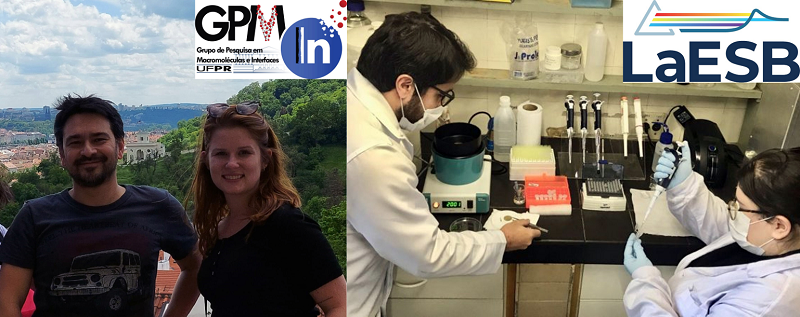
Article authors. On the left, Prof. Marcio Vidotti and Bruna M. Hryniewicz. On the right, Prof. Denio Souto and Jaqueline Volpe.

Reference of the paper: Development of polypyrrole (nano)structures decorated with gold nanoparticles toward immunosensing for COVID-19 serological diagnosis. B. M. Hryniewicz, J. Volpe, L. Bach-Toledo, K. C. Kurpel, A. E. Deller, A. L. Soares, J. M. Nardin, L. F. Marchesi, F. F. Simas, C. C. Oliveira, L. Huergo, D. E. P. Souto, M. Vidotti. Materials Today Chemistry. Volume 24, June 2022, 100817. https://doi.org/10.1016/j.mtchem.2022.100817.

Contact of the corresponding authors: denio.souto@ufpr.br and mvidotti@ufpr.br.

B-MRS Newsletter. Year 9, issue 4.


20Anos_260px

Newsletter of the
Brazilian Materials
Research Society

Year 9, issue 4. May 4th, 2022.

Featured paper

artigo destaque_news

A scientific team from Brazilian universities developed catalysts with low noble metal content, high efficiency and high durability for the sustainable production of hydrogen peroxide – a compound that has a large and expanding market (ACS Applied Materials & Interfaces). Know more.

XX B-MRS Meeting

20meeting_imagemtopo_2

Abstract submission has been extended until May 6th!

  • Date: September 25 to 29, 2022.
  • Venue: Hotel Rafain Palace, Foz do Iguaçu (Brazil).
  • Chairladies: Prof. Lucimara Stolz Roman (UFPR) and Prof. Marcela Mohallen Oliveira (UTFPR).
  • Abstract submission deadline: May 6th.
  • Symposia: 23 thematic symposia on research in the most diverse materials, from synthesis to applications, organized by around 100 scientists from Brazil and abroad.
  • Accommodation: info about reservations at Rafain and nearby hotels, at the “venue” tab of the website.
  • Memorial Lecture: Prof. Roberto Mendonça Faria (IFSC-USP).
  • Plenary Speakers: Christine Kranz (Ulm University), Prof. Daniel Mario Ugarte (UNICAMP), Prof. Gustavo Grivas (Univ. Cordoba), Prof. Natalie Stingelin (Georgia Tech Univ.), Prof. Olle Inganas (Linkoping Univ.), Prof. Pulickel Ajayan (Rice Univ.), Prof. Stuart Parkin (Univ Martin-Luther de Halle-Wittemberg).
  • Registration: early registration fee until August 5th.
  • Support and sponsorship: 11 companies have already confirmed sponsorship and participation in the exhibition. If your company is interested in participating, please contact Alexandre Alves at comercial@sbpmat.org.br.

The XX B-MRS Meeting will celebrate the 20th anniversary of the Brazilian Materials Research Society and the 20th edition of the event!

For more information, abstract submission and registration, visit the event website.

Papers from the community

UNICAMP researchers, in collaboration with scientists from abroad, developed ionic liquids for use in the production of ethanol from sugarcane bagasse in biorefineries. Access the paper: https://doi.org/10.1021/acssuschemeng.1c05353.

To suggest the publication of an article of your authorship, of high impact and made in Brazil, send the reference, 1 sentence and 1 image about the paper to comunicacao@sbpmat.org.br.

Community

elvira

Portuguese materials scientist Elvira Fortunato is Portugal’s new Minister of Science, Technology and Higher Education. Elvira has participated in several B-MRS Meetings and was a plenary speaker at the event. Know more.

rodrigo premio

Prof Rodrigo Martins (FCT NOVA), a B-MRS member, received the Career and Recognition Award from the Portuguese Society of Materials (SPM). Prof Martins is currently the president of IUMRS. Know more.

Lives & Webinars

Lives_logo_260px

B-MRS, in partnership with Horiba, offers two short courses, in Portuguese, on topics related to Raman and fluorescence spectroscopy. The events will be held in June. Free registration is open. More information and registration.

Reading tips

– Using very high resolution microscopy in conjunction with computer simulations, scientists observe grain boundary deformation in polygranulated metallic materials at atomic scale and in real time (Science). Know more.

– Scientists modify the surface of membranes used to separate CO2 from other gases with polymers and improve their performance, bringing together permeability and selectivity (Science). Know more.

– Paper with authors from Brazilian universities demonstrates the use of high pressure to control properties and study the electronic structure of monolayers of transition metal dichalcogenides using double resonance Raman spectroscopy (ACS Nano). Know more.

Opportunities

– CAPES/ Humboldt scholarships for post-docs and experienced researchers from Brazil to carry out research in Germany. Applications until May 31st. Know more.

– Postdoc in ceramics for dental prostheses with FAPESP fellowship. Applications until May 8th. Know more.

– Postdoctoral fellowship at Mackenzie in Synthesis and Characterization of MOFs for electronic devices. Applications until May 15th. Know more.

Events

– 2022 E-MRS Spring Meeting and Exhibit. Online. May 30 to June 3, 2022. Website.

– International Conference on the Science and Technology of Synthetic Metals (ICSM). Glasgow (Scotland). 17th to 22nd of July 2022.Website.

– 4th Workshop on Coated Tools & Multifunctional Thin Films. Campinas, SP (Brazil). 20th to 23rd of July 2022. Website.

– IUMRS-ICAM2021 + IMRC2022. Online + Cancun (Mexico). August 14th to 19th, 2022. Website.

– XVIII International Small Angle Scattering Conference. Online + Campinas, SP (Brazil). 11 to 16 September 2022. Website.

– 18th International Conference on Plasma Surface Engineering (PSE 2022). Trade Fair Erfurt (Germany). September 12 to 15, 2022. Website.

XX B-MRS Meeting. Foz do Iguaçu (Brazil). 25th to 29th of September 2022. Website.

– 7th Meeting on Self Assembly Structures in Solution and at Interfaces (AUTOORG 2022). Bento Gonçalves (Brazil). November 2nd to 4th, 2022. Website.

– 11th International Conference of the African Materials Research Society (AMRS2022 ). Dakar (Senegal). December 12 to 15, 2022. Website.

41st International Conference on Vacuum Ultraviolet and X-ray Physics (VUVX 2023). Campinas (Brazil). July 3rd to 7th, 2023. Website.

Follow us on social media

Comments and suggestions: comunicacao@sbpmat.org.br.
Unsubscribe here if you don´t want to receive our newsletters anymore.