Featured article: Compartmentalized films for reusable repellent packaging.

Imagine the following situation. You buy a food packaged with a polymeric film that has the property of keeping insects away. After consuming the food, you place the film in water and it starts to dissolve. Sixteen minutes later, you have a new product: a repellent liquid, ready to be sprayed on your plants.

And now, the reverse process. You pour the liquid into molds and wait a few days. As if by magic, the films spontaneously re-form. You can then use them again as repellent packs.

A material like this was recently developed in Brazil by a scientific team from Unicamp, in collaboration with Embrapa, within Izabella Wyne Inacio Alves Caetano’s master’s in Chemical Engineering, carried out with the guidance of Professor Liliane Maria Ferrareso Lona (Unicamp).


This video shows the polymeric film developed by the Unicamp team breaking up in water and forming a colloidal dispersion.

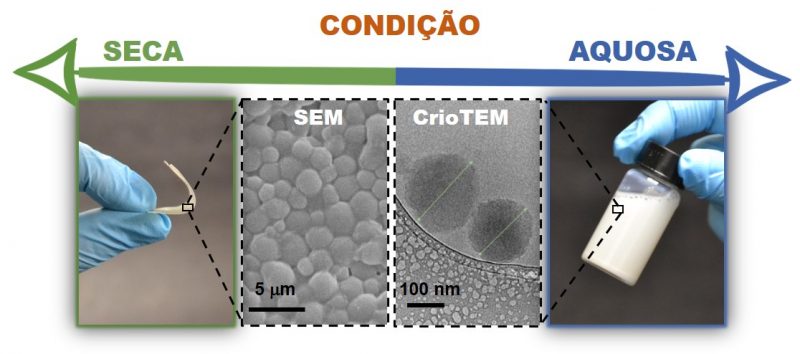
One of the secrets of the new film is its compartmentalized structure. Indeed, under the light of an electron microscope, it is possible to observe that the film contains partitions: spherical polymeric particles of about 500 nanometers, which carry a substance – in this case, neem oil, known for its insecticidal and repellent properties.

The particles help preserve the oil from the degradation that light would cause. At the same time, they allow its release in controlled doses, avoiding waste. When the film dissolves, the tiny particles become dispersed in the water, but they retain their functionality.

This scientific contiribution of the Brazilian team shows the possibility of developing products that the consumer can dismantle using only water, use in another context and rebuild without losing their main properties. Furthermore, the possibility of transforming a liquid into a film (smaller in size and weight) can be used to facilitate the transport and storage of the product and reduce the costs involved.
Figura_Pesquisa

On the left, the photograph and microscopy image show the compartmentalized film (dry condition). On the right, the film deconstructed in water can be seen, forming a colloidal dispersion containing nanoparticles (aqueous condition).

The work was published earlier this year in the journal Advanced Sustainable Systems. Furthermore, with the help of Unicamp’s Innovation Agency (Inova), the authors filed a patent application on the nanocompartmentalized films in last December.

“The main contribution of this work is the preparation of nanocompartmentalized films with the possibility of upcycling (that is, reuse). Thus, the traditional “linear economy” (discard after use) is directed towards the “circular economy”, prioritizing the sustainability of the process”, says postdoc Filipe Vargas Ferreira, who participated in the work and signs the scientific article as corresponding author with Professor Liliane Lona.

UN and European Union documents suggest that, by 2030, polymeric films used in packaging are manufactured in such a way that they can be recycled or reused. In this context, say the authors of the paper, the upcycling proposal presented in the work constitutes an opportunity to add value to the product, since it increases the functionality of the material and it is in accordance with the new global requirements.

At the beginning, the idea of this work was to prepare a liquid containing nanoparticles (a colloidal dispersion) carrying natural compounds with potential use in pest control in agriculture. To synthesize the nanoparticles, the team chose a commercial polymer blend called ecovio®, which stands out for being compostable, that is, for turning into fertilizer when it is finally discarded. “In the scientific literature, a blend had never been used in an encapsulation process of this type, because it is very difficult to work with more than one polymer in these situations”, reports Professor Liliane. The challenge was overcome by master’s student Izabella after a year of working with her advisor.

Subsequently, new possibilities to reuse the dispersion opened up when the master’s student found that the liquid formed flexible films when left on the laboratory bench for a few days. “When we analyzed these films under a scanning microscope (SEM) we realized that, during drying, the nanoparticles had self-organized, forming compartments in them”, says Izabella, who defended her master’s thesis on this work last year. “Satisfaction was even greater when we verified that the diameter of the particles was maintained when the film returned to the colloidal dispersion form when we added water”, reports Professor Liliane.

The study was funded mainly by the Brazilian agencies FAPESP and CNPq.
Figura_Autores

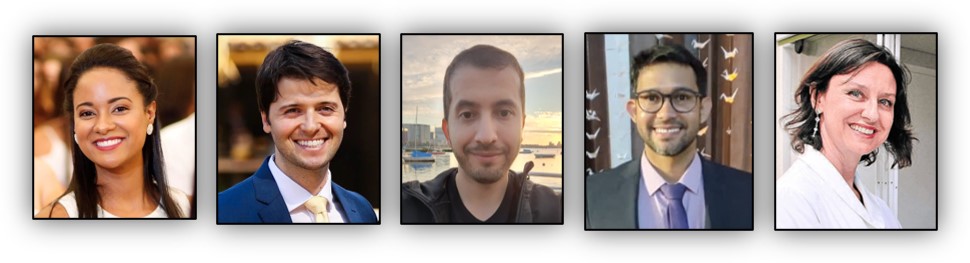
The authors of the scientific article. From left: Izabella W. I. A. Caetano, Filipe V. Ferreira, Danilo M. dos Santos, Ivanei F. Pinheiro and Liliane M. F. Lona

Paper reference: Water-Dependent Upcycling of Eco-Friendly Multifunctional Nanocompartmentalized Films. Izabella W. I. A. Caetano, Filipe V. Ferreira, Danilo M. dos Santos, Ivanei F. Pinheiro, and Liliane M. F. Lona. Adv. Sustainable Syst. 2023, 2200430. https://doi.org/10.1002/adsu.202200430

Corresponding authors contact: lona@unicamp.brf102309@dac.unicamp.br.

Women in science: Interview with the President of B-MRS, Mônica Alonso Cotta.

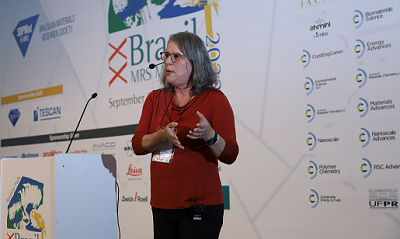
Prof. Mônica Cotta at the 2022 SBPMat annual event.
Prof. Mônica Cotta at the 2022 B-MRS meeting.

The passion for science spoke louder when, in 1981, Monica Alonso Cotta chose physics for her undergraduate degree at Unicamp without directly knowing women who worked in the area.

Later, in her master’s and doctoral studies, also at Unicamp, she opted for applied physics topics because she wanted her work to have the greatest possible impact on people’s quality of life. This choice, which earned her criticism from physicists who considered applied science to be inferior to fundamental, put the young scientist on the path of interdisciplinary research.

The path was consolidated in the post-doctorate, held at the Department of Materials Science at AT&T Bell Laboratories, where Monica worked alongside physicists, chemists and engineers in the challenge of developing wireless technology.

Today, at almost 60 years of age, Monica Cotta is part of a small group of women who have reached the top of their careers and hold management positions in academia. Since 2020, she has been President of the Brazilian Materials Research Society (B-MRS), a multi and interdisciplinary entity in essence. Since 2021, she has been the Director of the Gleb Wataghin Institute of Physics (Unicamp), her alma mater, which is one of the main research, teaching and extension centers in Physics in Brazil. In both institutions, Monica holds a historic place: that of the first woman to occupy the highest position. In addition, she is a professor at Unicamp, executive editor of  ACS Applied Nano Materials and productivity fellow at the National Council for Scientific and Technological Development, where she coordinates the Advisory Committee in Physics and Astronomy.

Those who work with Monica Cotta know that, in her daily work, the quest to improve people’s lives through science and the concern for ensuring gender equity in the scientific environment are always present.

In the month in which the International Day of Women and Girls in Science is celebrated, we invited Professor Monica to talk a little about being a woman and a scientist. Check it out!

B-MRS Newsletter: What was it like for you to be a girl and later a woman in science? Share with us some memories about the particularities and difficulties of being a woman and a scientist.

Monica Cotta: I usually tell students that I am already very old, and, happily, much of what I lived is no longer so present today. I remember being a ‘nerd’ girl, even though that term didn’t exist back then. I liked science fiction and the technology I could reach (I thought the supermarket cash register was great, because personal computers only appeared when I entered university), I idolized Jacques Costeau (I wanted to do oceanography, but it was very difficult in Brazil)… For all that, I remember not fitting into any female stereotypes of that time, and that had a big emotional impact on me. But my parents always supported me in my studies. I’m from Campinas, and to get as close to technology as possible in my situation, I attended a technical college in data processing and then enrolled at Unicamp in physics and computing. I ended up opting for physics, because science has always been my passion. But I liked applied physics, because I always wanted to do science that could become a tool for social well-being… This made my journey very ‘bumpy’, with a master’s degree in biomedical physics and a PhD in materials science. If this made me a ‘non-physicist’ for many of my colleagues, it also gave me a lot of experience with interdisciplinary work and how to ‘talk’ with different areas. Deep down, what was a ‘disadvantage’ became a great asset, because throughout my career I had the chance to interact and learn with scientists from many different areas. This was fundamental when, in the last decade, I decided to go back to the origins and work at the interface with biology, using knowledge in materials. But overall, I still feel like I live two lives, as part of my family to this day doesn’t have much of an idea of what I really do. I was never able to convey my passion for science to my parents and sister. The scientist husband turned out to be the best option, as he understood when I wanted to stay in the lab on Friday nights, or weekends. My two sons understand that they have a ‘workaholic’ mother because she loves what she does… And my daughter is following a similar path, as she is doing a PhD in neurosciences.

B-MRS Newsletter: In your perception, what has changed for girls and women researchers since the time you were a student and what still needs to change?

Monica Cotta: Fortunately, a lot has changed, in general… starting with the type of environment we live in, provided by technology. Today, young people can learn science with (good) YouTube channels or online courses. And the role of women has been expanded in recent decades, at least for part of our society. Today, a girl wanting to do physics can even generate strangeness, but not the incredulity and discomfort that I faced in my days.

But we know that part of our society still doesn’t think so. Unfortunately, there is still a lot of sexism and misogyny, confirmed by the tragic statistics of sexual violence and femicides. And women still face daily barriers in the fight for equity, including in their professional lives. Therefore, we need to continue fighting for education and equal social conditions, for everyone.

B-MRS Newsletter: According to your experience, which measures can be effective to combat gender inequality in universities, research groups, scientific events?

Monica Cotta: First, we need to talk about inequalities and raise awareness about microaggressions, unconscious bias, etc. so that we are alert and prepared to combat these situations on a daily basis, and prevent them from gradually destroying girls’ self-esteem. Another measure is to always be concerned with maintaining the representation of women in all spaces, whether as plenary speakers in scientific events or in management positions. In addition, equity criteria need to be incorporated into funding notices and productivity assessments, as we know how motherhood impacts women’s careers, who are also generally ‘caregivers’ in case of illness or elderly people in the family. On the other hand, these struggles must belong to the whole community, and not just to women. Men can and should be our allies.

B-MRS Newsletter: Why is it important to have girls and women in science?

Monica Cotta: Talent does not choose gender, and in general it makes no sense for science to go on without the talents of half of humanity!! However, good science needs new ideas, and ideas also come from our personal experiences, not just from knowledge acquired at school or university. I am always reminded of an example given by Beverly Hartline, an American professor who promotes gender issues in science and physics in particular. She uses the example of bathrooms in shopping malls. In general, they are similar in layout, but the wearing time is quite different for men and women. Consequently, there is always a huge queue in the women’s restrooms, which is not the case in the men’s restrooms. So whoever designed these bathrooms – probably a man – didn’t think about this detail… Today we have the family bathroom, which helps a lot mothers with sons and fathers with daughters who are walking around there. I remember hearing complaints from women because I would walk my 4-5 year old son into the girls’ bathroom because he was always tall and they thought he was ‘too old’ to go in with me. That was something uncomfortable and simple to solve, but that took decades to be considered…. That is why the diversity of views, arising from each one’s experiences – and gender is just one of the components in our ‘personal luggage’ – are essential for quality and disruptive science, which also helps to find solutions for the most complex problems of our society.

B-MRS Newsletter: What has the scientific career brought you of good, difficult, new, unexpected in your life story so far?

Monica Cotta: It brought many good things, such as contact with students, which for me is fundamental. Nothing gives more pleasure than seeing the personal growth and professional maturity that scientific research can provide, even outside academia. I always say that the scientific method is useful for everything, even for analyzing situations in people’s lives. But I´ll highlight what struck me the most. Unfortunately, in my family, we had several complicated health problems, and one way to control my anxiety in these situations was to study everything I could about the subject, which even helped me to find solutions in those moments. And for this, interdisciplinary training was again my salvation! A doctor once asked for my sources to pass on to his students, as he said my questions were too difficult to answer.

B-MRS Newsletter: Leave a few words for the researchers in our community, especially the younger ones, who are experiencing difficulties related to gender inequality.

Monica Cotta: We have to be realistic and remember that difficulties will always exist, and gender among them. But together we are stronger. Always look for allies among your colleagues, identify who has the same values and willingness to face these barriers. The same goes for institutions – like here at Unicamp, where we have the Executive Board of Human Rights and within it, the gender and sexuality commission (of which I am a part because I believe in that!). Use all the supports you can, as well as support your colleagues, because everything is always more difficult when we are alone.

The scientist in some good moments of her day-to-day life: meeting of IFGW women professors (2018), participation in UNICAMP Open Doors in 2018, fraternization of the research group in 2018, lecture at a weeklong IFGW scientific dissemination event before UNICAMP closed because of the pandemic, and a family trip in 2010.
The scientist in some good moments of her day-to-day life: meeting of IFGW women professors (2018), participation in Unicamp Open Doors in 2018, happy hour with the research group in 2018, lecture at a science popularization event just before Unicamp closed because of the pandemic, and a family trip in 2010.

B-MRS Newsletter. Year 10, issue 1


capa-ingles

Year 10, issue 1. February 3rd, 2023.

Featured paper

A team of researchers from six Brazilian institutions increased by around 30 times the photocatalytic activity of a semiconductor that is used in the generation of green hydrogen. The work was reported at ACS Applied Energy Materials. Know more.

artigo destaque

If you are the author of high-quality scientific work, carried out wholly or mostly in Brazil and published in a journal with a high impact factor, and you want to publicize it in our community, contact us to have your paper considered in the monthly selection of the “Featured paper”: comunicacao@sbpmat.org.br.

XXI B-MRS Meeting
Maceió (AL), October 1st to 5th, 2023

maceio

Symposia. The event comprises 24 thematic symposia covering design, synthesis, characterization, processing and applications of various materials, from traditional alloys to bio-based polymers. More than 100 researchers from Brazil, Argentina, Australia, Austria, Belgium, Canada, Chile, Colombia, France, Germany, Italy, Portugal, Switzerland, UK and USA are organizing our symposia. See the list of symposia and their description.

Submissions. Abstract submission within the symposia is open until April 17th. Know more.

Student awards. Contributions submitted by students and approved for presentation will be able to apply for student awards until July 17. Know more.

Registrations. Registration is open, with special fees for students and researchers from institutions from Latin American countries. See the values.

Venue. The venue for the event will be the Ruth Cardoso Cultural and Exhibition Center, in the city of Maceió, the capital of Alagoas state. Know more.

Chairmen. The general coordinators of the event are professors of the Brazilian Federal University of Alagoas (UFAL) and research productivity fellows: Carlos Jacinto da Silva, from the Institute of Physics, and Mario Roberto Meneghetti, from the Institute of Chemistry and Biotechnology.

Manifestos

– B-MRS repudiated the attacks on democracy and the rule of law that took place in Brasília on January 8, with the invasion by terrorists of the headquarters of the three powers of the Republic.

Opportunities

– Applications for the Erasmus Mundus Masters in Materials Science and Engineering AMASE are open. AMASE is a joint program of universities in Germany, France, Spain, Italy, Austria and Sweden. There are scholarships for the best students. Know more.

Upcoming events

– II Encuentro de Investigadores en Ciencia de Materiales. Montevideo (Uruguay). April 20 and 21, 2023. Website.

49ª International Conference on Metallurgical Coatings and Thin Films (ICMCTF). San Diego (USA). May 21 to 26, 2023. Website.

41st International Conference on Vacuum Ultraviolet and X-ray Physics (VUVX 2023). Campinas (SP, Brazil). July 3 to 7, 2023. Website.

IV Brazilian Nanocellulose Summit. São Carlos (SP, Brazil). August 9th to 11th, 2023. Website.

XXI B-MRS Meeting. Maceió (AL, Brazil). October 1 to 5, 2023. Website.

4th International Brazilian Conference on Tribology (TriboBR). Victoria (ES, Brazil). November 26th to 30th, 2023. Website.

Follow us on social networks

rodape-ingels

Unsubscribe if you no longer wish to receive the monthly issue of the B-MRS Newsletter.